
Valeriana officinalis L. · Family: Caprifoliaceae · Root & Rhizome Extract
A Valeriana officinalis root extract standardised to valerenic acids NLT 0.8% by HPLC — an assay that doubles as a species check, because Indian valerian cannot meet it. The species is declared by binomial on every batch. Deodorised grades available for formats where valerian's notorious odour is a problem. CoA-backed supply from India.
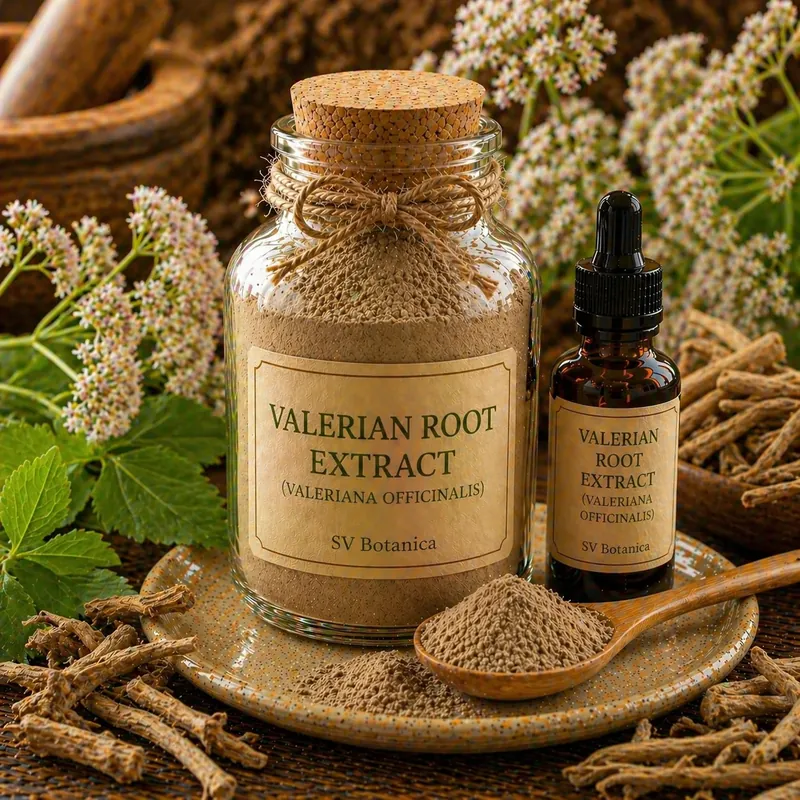
Standardised Grade
Valerenic Acids 0.8%One name, several species — and an assay that tells them apart
Valerian (Valeriana officinalis L.) is among the most established botanicals in the sleep and relaxation category, used from the root and rhizome and supported by pharmacopoeial monographs across several regions. It is also one of the few botanicals whose principal commercial risk is not adulteration in the usual sense but species substitution between plants that all legitimately carry the name valerian.
The genus contains several species in commercial use. Valeriana officinalis is the one the monographs describe and the one most buyers mean. Indian valerian — Valeriana jatamansi, also known as V. wallichii and traded as tagar — is a different Himalayan species with different chemistry. Mexican valerian (V. edulis) is a third. All are valerian; none is interchangeable with the others.
This matters more for an Indian supplier than most, and we would rather be direct about it: Indian valerian is what is locally abundant here, and it is cheaper. Any buyer sourcing valerian from India should ask which species they are being offered and should expect the binomial in writing. We supply V. officinalis against V. officinalis specifications and declare the species on every batch.
The technical resolution is unusually clean. Valerenic acids are characteristic of V. officinalis and are not present at meaningful levels in Indian valerian — so a 0.8% valerenic acid specification is not merely a potency measure, it is a species check. Material that is not V. officinalis structurally cannot meet it. That is the single most useful thing to know when buying valerian.
Valerenic acids, valepotriates and the volatile fraction
The standardisation basis — valerenic, acetoxyvalerenic and hydroxyvalerenic acids, assayed by HPLC. Characteristic of V. officinalis, which is what makes the assay a species check.
Iridoid esters present in fresh root. Chemically unstable — they degrade on drying and storage, so commercial dried material carries little. Not a sound standardisation basis; see the regulatory notes.
The fraction responsible for valerian's characteristic and notorious odour, including isovaleric acid. A formulation and warehousing consideration in its own right.
The wider terpene family to which the valerenic acids belong, contributing to the chromatographic fingerprint.
Secondary constituents of the root reported in the literature and present in full-spectrum native-ratio extracts.
Including GABA and glutamine, present in aqueous extracts — commonly cited, though their contribution after ingestion is debated.
Why the species declaration matters more than the percentage
Valerenic acids are characteristic of V. officinalis. A 0.8% specification therefore verifies identity as well as potency — Indian valerian cannot meet it. The cleanest control in the category.
Valeriana officinalis L. stated on every batch. Several distinct species trade as valerian, and only the binomial distinguishes them.
One of the best-documented botanicals in the category, with pharmacopoeial monographs across several regions supporting formulation and registration work.
Valerian's odour is genuinely difficult. A deodorised grade exists for formats where it cannot be masked — with an honest account of what deodorisation removes.
Aerial parts carry little of the actives and dilute the extract. We specify root and rhizome and control acid-insoluble ash, which rises with soil on an underground part.
Native-ratio extracts for traditional and tincture-heritage formats; valerenic-acid-standardised grades where a numeric specification is required.
These are functional and physico-chemical properties of the actives; SV Botanica does not make medical or therapeutic claims for this ingredient.
Standardise on valerenic acids — and get a species check with it
| Grade | Standardisation | Form | Best For | Solubility |
|---|---|---|---|---|
| Valerian Root Extract 0.8% Standard | Valerenic acids NLT 0.8% (HPLC) | Light to dark brown fine powder, ≥95% through 40 mesh | Sleep & relaxation capsules, tablets | Partially water-soluble |
| Valerian Root Extract 0.4% Economy | Valerenic acids NLT 0.4% (HPLC) | Light to dark brown fine powder | Multi-botanical blends, lower inclusion | Partially water-soluble |
| Valerian Root Extract Deodorised Deodorised | Valerenic acids to specification; volatiles reduced | Light brown fine powder | Gummies, beverages, odour-sensitive formats | Grade-dependent |
| Valerian Root Extract Ratio Full-spectrum | Native 4:1 / 5:1 ratio; valerenic acids reported | Brown fine powder | Traditional & tincture-heritage formats | Grade-dependent |
| Valerian Root Extract Water-Soluble Soluble | Valerenic acids to specification; cold-water soluble | Brown fine powder | Sachets, night-time beverages | Water-soluble |
Please specify Valeriana officinalis by binomial rather than "valerian". Several distinct species trade under the name, including Indian valerian (V. jatamansi, syn. V. wallichii, traded as tagar), which is a different plant with different chemistry and is abundant in India. A valerenic acid specification resolves this automatically, since valerenic acids are characteristic of V. officinalis — material that is not V. officinalis cannot meet a 0.8% figure. Note also that we do not offer a valepotriate-standardised grade: valepotriates are chemically unstable and largely absent from properly dried commercial material, so such a specification would be unreliable. The odour is real — discuss the deodorised grade before committing to an odour-sensitive format.
Valerian Root Extract is bought in five forms. The standardised extract is the stocked item; granulated and dispersible grades are produced on request and raw botanical forms are sourced against a confirmed order.
| Form | What it is | Specification basis | Availability |
|---|---|---|---|
| Standardised extract powder | Valeriana officinalis root and rhizome extract, dried and milled | NLT 0.8% valerenic acids (HPLC) | Stocked |
| Granulated (direct-compression) | Extract granulated for tablet lines | Same marker, declared on the granule | On request |
| Water-dispersible / soluble | Extract in a dispersible matrix for beverages, gummies and sachets | Marker declared on the matrix basis; carrier named | On request |
| Root powder (non-extracted) | Cleaned, dried Valeriana officinalis root and rhizome, milled to mesh | Botanical identity by TLC; heavy metals and microbial panel | On enquiry, subject to lot; phytosanitary certificate usually required |
| Cut & sifted root | Dried root pieces, sifted to size | Identity, moisture, foreign matter | On enquiry; for tea, decoction and in-house extraction |
A marker percentage without its assay method is not a specification; ask for the method and the plant part on every quotation. Read Valerian Root Extract: A Complete Buyer's Guide, Valerenic Acids, Valepotriates and How Valerian Is Standardised and Valerian Species Substitution: Indian, Mexican, Jatamansi and CITES before comparing offers.
Full product specification for Valerian Root Extract, valerenic acids 0.8%. Values are specification limits, not batch results; a batch-specific CoA is issued per shipment.
| Parameter | Specification / Limit | Method |
|---|---|---|
| Botanical Source | Valeriana officinalis L. — declared per batch | — |
| Plant Family | Caprifoliaceae (formerly Valerianaceae) | — |
| Part Used | Root and rhizome | — |
| Country of Origin | India | — |
| Appearance | Fine powder | Organoleptic |
| Colour | Light to dark brown* | Organoleptic |
| Odour | Characteristic, strong — see note | Organoleptic |
| Taste | Characteristic, bitter | Organoleptic |
| Identification | Corresponds to reference extract — positive | By TLC / HPLC |
| Valerenic Acids (% w/w, dry basis) | NLT 0.8 | By HPLC |
| — Valerenic Acid | Reported per batch | By HPLC |
| — Acetoxyvalerenic Acid | Reported per batch | By HPLC |
| Valepotriates | Not specified — see note | — |
| Loss on Drying (at 105°C, % w/w) | NMT 5.0 | IP-2014 |
| pH (1% w/v solution) | 4 – 6 | IP-2014 |
| Bulk Density (g/ml) | NLT 0.35 | IP-2014 |
| Particle Size (#40 mesh, % w/w) | NLT 95 | Sieve |
| Total Ash (% w/w) | NMT 10 | IP-2014 |
| Acid Insoluble Ash (% w/w) | NMT 2 (underground part — see note) | IP-2014 |
| Residual Solvent (Ethanol, ppm) | NMT 5,000 | By GC |
| Lead (ppm) | NMT 1.0 | ICP-MS |
| Arsenic (ppm) | NMT 1.0 | ICP-MS |
| Cadmium (ppm) | NMT 0.3 | ICP-MS |
| Mercury (ppm) | NMT 0.1 | ICP-MS |
| Pesticide Residues | Complies (EU MRL, on request) | GC-MS / LC-MS/MS |
| Ethylene Oxide (ETO) | Not treated — declaration provided | LC-MS/MS (on request) |
| Total Plate Count (cfu/g) | NMT 1,000 | USP <2021> |
| Yeast & Moulds / Fungi (cfu/g) | NMT 100 | USP <2021> |
| Escherichia coli | Absent | USP <2022> |
| Salmonella sp. | Absent | USP <2022> |
| Staphylococcus aureus | Absent | USP <2022> |
| Cultivation | Cultivated / wild-collected (declared per batch) | Declaration |
| Kosher / Halal | Certified (on request) | Certification |
| Shelf Life | 36 months from date of manufacture, in original packed condition | — |
| Storage | Cool, dry place away from light and moisture, in tightly sealed containers | — |
*Three lines on this specification warrant explanation. The botanical source line is the most important on the certificate. Several distinct species trade as valerian — Indian valerian (V. jatamansi, syn. V. wallichii) in particular is abundant in India and is a different plant. We declare the binomial, and the valerenic acid assay independently confirms it, since valerenic acids are characteristic of V. officinalis. Valepotriates are deliberately not specified: they are chemically unstable, degrade during drying and storage, and are largely absent from sound commercial material — a valepotriate specification would be unreliable and, on stability grounds, misleading. The odour is characteristic and strong. This is normal for valerian, not a defect, but it is a genuine warehousing and formulation consideration and it transfers to nearby materials — see the applications guide, and ask about the deodorised grade. Acid-insoluble ash is controlled with care because valerian is an underground part and soil adheres. A current Certificate of Analysis and MSDS are issued with every batch.
From root to standardised extract — species-verified, HPLC-assayed, documented
Raw Material & Species Control: The extract is prepared from the root and rhizome of Valeriana officinalis L. Species control is the defining quality question on this ingredient. Several Valeriana species trade under the name valerian, and Indian valerian (V. jatamansi, syn. V. wallichii, traded as tagar) is abundant in India and materially cheaper. We declare the binomial on every batch and identify by TLC and HPLC against authentic V. officinalis reference material. Buyers should also be aware that Nardostachys jatamansi — a distinct Himalayan plant sharing the epithet, listed under CITES Appendix II — is a separate species again and must not be conflated with either.
Manufacturing & Testing: Valerian Root Extract is manufactured at certified facilities in India. Each batch runs through a full QC battery — valerenic acids by HPLC with the individual acids reported, identity by TLC and HPLC, loss on drying, pH, bulk density, ash and acid-insoluble ash, mesh, residual solvent by GC, heavy metals by ICP-MS, pesticide residue screening, and a complete USP microbiological panel — before release.
Documentation & Compliance: Every shipment carries a batch-specific Certificate of Analysis stating the species by binomial, valerenic acids, collection status and the full contaminant profile, with an MSDS. Halal, Kosher and Organic certification are available — see our guides on EU pesticide MRL compliance and EU import requirements for botanical extracts.
What backs every batch of Valerian extract
Key information for global product registration and labelling
We would rather state this plainly than let a buyer discover it. Several distinct species trade legitimately as "valerian": Valeriana officinalis, which the pharmacopoeial monographs describe; Indian valerian (V. jatamansi, syn. V. wallichii, traded as tagar), a Himalayan species with different chemistry; and Mexican valerian (V. edulis). Indian valerian is abundant and cheaper in India specifically, which is precisely where much of the world's botanical extract capacity sits — so a buyer sourcing valerian from India carries a species risk they may not carry elsewhere. Ask for the binomial in writing. A valerenic acid specification also resolves it independently, since valerenic acids are characteristic of V. officinalis. Separately, Nardostachys jatamansi — a different Himalayan plant sharing the epithet — is listed under CITES Appendix II, and material of that species requires CITES documentation; it is not valerian and should never be supplied as such.
Valepotriates are iridoid esters present in fresh valerian root, and they are sometimes proposed as a standardisation marker. We do not offer a valepotriate-standardised grade, for two reasons. First, they are chemically unstable: they degrade during drying, processing and storage, so a figure measured at manufacture does not describe the material a buyer receives months later — the specification would not hold. Second, valepotriate content differs markedly between Valeriana species, so a valepotriate figure is a poor identity control compared with the valerenic acid assay. Where a buyer's own specification calls for valepotriate data we will discuss it, but we would want that stability limitation recorded in writing rather than left implicit.
Valerian is among the most established botanicals in the sleep and relaxation category, supported by pharmacopoeial monographs in several regions. Two practical notes for formulators. Valerian is commonly combined with other sedative botanicals and with melatonin, and the combined effect of such formulations is the brand's responsibility to assess. And valerian's traditional use includes populations for whom caution is normally advised — pregnancy, breastfeeding, children, and alongside sedative medication — so finished-product labelling should reflect the advice applicable in your market. Buyers remain responsible for compliance in their market. This product is not intended to diagnose, treat, cure or prevent any disease.
Deep-dive articles on valerian root extract for formulators, buyers, and brand owners
Four species share the name. One assay tells them apart.
TechnicalWhy one marker works as a species check and the other will not hold a specification.
QualityIndian valerian, Mexican valerian, jatamansi and CITES — the identity problems in one place.
ApplicationsCapsules, gummies and beverages — and managing an odour that genuinely resists masking.
ProcurementA scored checklist built around one question: which species is this?
MarketHow the sleep category grew, and why sourcing geography carries species risk.
Frequently co-formulated with Valerian Root Extract in sleep & calm blends
Technical and commercial questions answered by our ingredients team
Valeriana officinalis declared by binomial, standardised to valerenic acids 0.8% by HPLC — an assay that verifies the species as well as the strength. Deodorised grades available. Samples for qualified buyers.
Supplied as a bulk ingredient for further manufacture. Buyers are responsible for compliance with the regulations of their destination market. This product is not intended to diagnose, treat, cure or prevent any disease.
We use cookies for analytics and to measure our advertising. Essential cookies are always on. Privacy policy