
Withania somnifera (L.) Dunal · Root Only · Standardized to 5% Withanolides (Gravimetric)
India's most revered adaptogen, used for over 3,000 years in Ayurveda. SV Botanica supplies a root-only Ashwagandha Extract standardized to 5% withanolides by gravimetric assay — heavy-metal tested and made at GMP-certified facilities, with an HPLC withanolide test report available per batch.
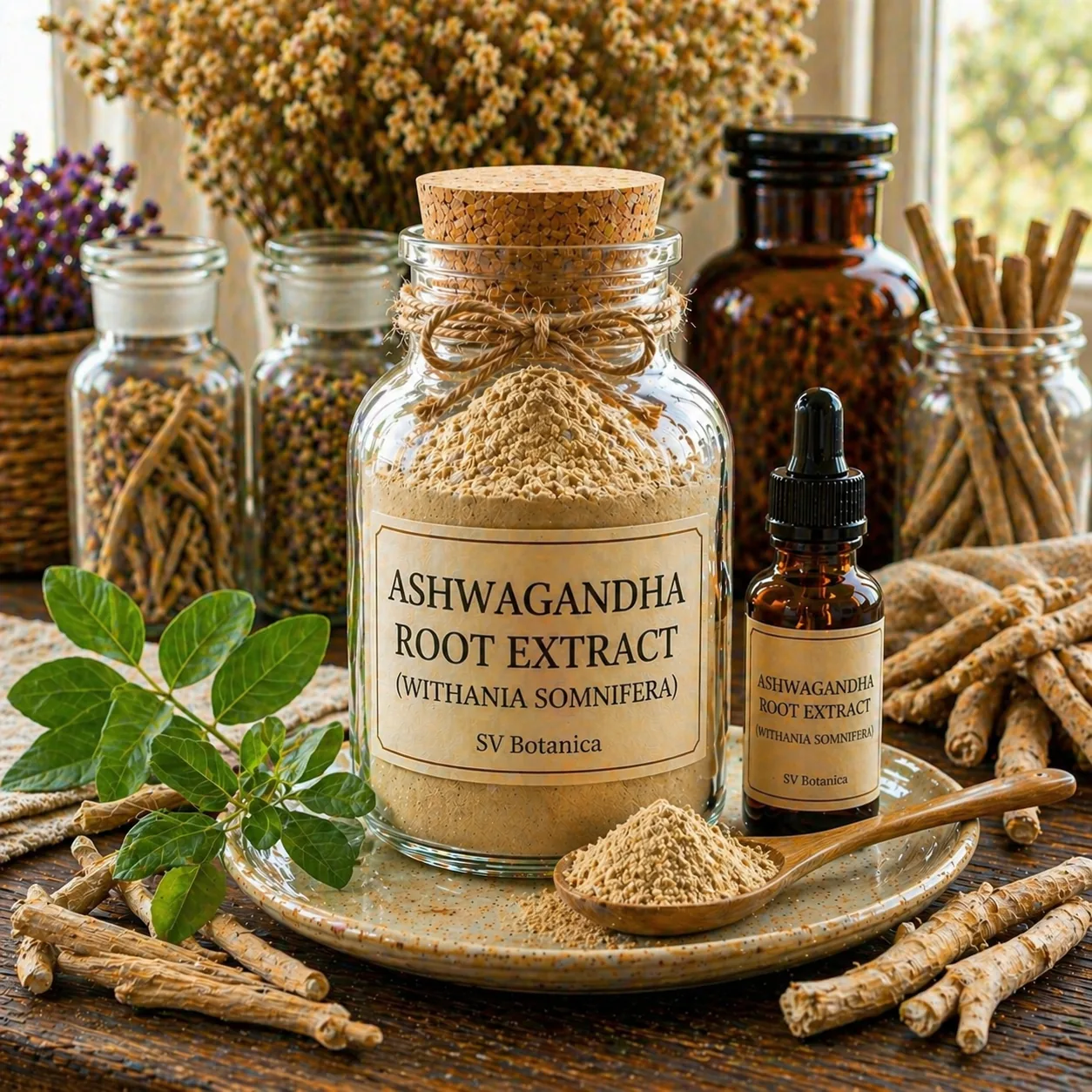
Bulk Ingredient
Withania somnifera · Root · 5% WithanolidesThe root of the world's most studied adaptogen, concentrated to a defined withanolide grade
Withania somnifera — ashwagandha — is the cornerstone adaptogen of Ayurveda, used for over three millennia to support resilience to stress, restful sleep and vitality. Its activity is attributed to a family of steroidal lactones called withanolides, concentrated in the root.
SV Botanica supplies Ashwagandha Extract as a root-only dry extract standardized to 5% withanolides, assayed gravimetrically (5.35% w/w on the reference batch) and identified by TLC. It is processed in GMP-certified facilities in India and screened by ICP-MS for heavy metals with a full microbial panel before release. An HPLC withanolide test report is available per batch to confirm the compound-specific profile, so the gravimetric figure is never the only data point you rely on.
Using root only — rather than cheaper leaf or whole-plant material — keeps the extract aligned with classical Ayurveda and naturally low in withaferin A, the withanolide that attracts the most regulatory scrutiny. Lower- and higher-potency grades (2.5%, 10%) and HPLC-assayed batches are produced on request, alongside organic and water-soluble material.
We supply supplement brands, nutraceutical manufacturers and Ayurvedic formulators across Europe, the USA, the Middle East and Southeast Asia. Every batch is backed by a Certificate of Analysis and full export documentation — start a conversation with our team via the quote request form, or read the full ashwagandha extract buyer's guide.
Key compounds driving ashwagandha's adaptogenic profile
The signature steroidal lactones of ashwagandha and the standardisation marker — measured as a group by gravimetric assay and individually by HPLC.
One of the principal root withanolides, frequently used as an HPLC reference marker for a defined, compound-specific profile.
Glycosylated withanolides (e.g. withanoside IV and VI) abundant in root that contribute to the total withanolide fraction.
A bioactive but heavily-scrutinised withanolide — naturally low in root and elevated in leaf, making it the analytical tell for plant part.
Acylsteryl-glucoside withanolides associated with the adaptogenic and restorative activity of the root.
Minor alkaloids and the native root polysaccharide matrix round out the full-spectrum profile of the gravimetric grade.
Evidence from clinical research on ashwagandha root extract and withanolides
Standardised ashwagandha root extract has reduced perceived stress and serum cortisol versus placebo in randomised trials — the core adaptogenic positioning.
Ref: Chandrasekhar K et al., 2012; Indian J Psychol MedRoot extract has improved sleep onset, quality and refreshed-on-waking scores in controlled studies of adults with poor sleep.
Ref: Langade D et al., 2019; CureusWithanolide-standardised root extract has supported memory, attention and executive function in adults with mild cognitive complaints.
Ref: Choudhary D et al., 2017; J Diet SupplResistance-training studies have shown gains in muscle strength, size and recovery with standardised ashwagandha versus placebo.
Ref: Wankhede S et al., 2015; J Int Soc Sports NutrRoot extract has improved stress and general wellbeing scores in randomised, placebo-controlled human research.
Ref: Salve J et al., 2019; CureusTrials in men have linked standardised root extract with healthy testosterone and vitality markers, anchoring men's-health formulas.
Ref: Lopresti AL et al., 2019; Am J Mens HealthAshwagandha pairs naturally with other Ayurvedic adaptogens and tonics — see our Shatavari Extract and Shilajit Extract for complementary vitality formulations, or Brahmi (Bacopa) for cognitive blends. For the science behind the actives, read withanolides & ashwagandha's actives.
Select the right withanolide grade and assay method for your formulation
| Grade | Specification | Assay | Best For | Certifications |
|---|---|---|---|---|
| Withanolides 5% Standard | NLT 5.0% withanolides (5.35% on batch) | Gravimetric | General wellness, stress & sleep formulas | GMP, Kosher |
| Withanolides 2.5% Entry | NLT 2.5% withanolides (2.59% on the published COA) | HPLC (batch COA published) | Cost-sensitive blends & multi-herb formulas | GMP, Kosher |
| Withanolides 10% Premium | NLT 10% withanolides | HPLC (on request) | High-potency & clinical-marker supplements | GMP, Halal |
| HPLC Test Report Any Grade | Compound-specific withanolide profile; withaferin A on request | HPLC | Defined-profile labels, monographs, QA spec | Available per batch |
| Organic / Water-Soluble | Native or standardised; organic on request | Gravimetric / HPLC | Beverages & certified-organic products | GMP, Organic (on request) |
The documented stock grade is 5% withanolides by gravimetric assay (the grade backed by our current Certificate of Analysis). An HPLC withanolide test report is available per batch on the same root material, and 2.5%, 10%, organic and water-soluble grades are produced on request. A gravimetric % and an HPLC % are not the same number — see gravimetric vs HPLC before comparing quotes.
Buyers ask for ashwagandha in four forms. The standardised extract is the stocked item; the others are sourced against a confirmed order.
| Form | What it is | Specification basis | Availability |
|---|---|---|---|
| Standardised root extract powder | Withania somnifera root, hydroalcoholic extraction, dried and milled | 2.5%, 5% or 10% withanolides (gravimetric or HPLC, stated on the COA) | Stocked; the grade behind the published COA |
| Water-soluble granules | Spray-dried or granulated root extract on a food-grade carrier | Withanolide content stated per lot | On request; beverages, sachets, effervescents |
| Root powder (non-extracted) | Cleaned, dried Withania somnifera root, milled to mesh | Botanical identity by TLC; heavy metals and microbial panel | On enquiry, subject to lot; phytosanitary certificate usually required |
| Cut & sifted root | Dried root pieces, sifted to size | Identity, moisture, foreign matter | On enquiry; for tea, decoction and in-house extraction |
Whichever form you specify, name the assay method next to the percentage: a 5% gravimetric figure and a 5% HPLC figure describe different material — see withanolides by gravimetric vs HPLC. Root-only is the pharmacopoeial position; for the root-and-leaf debate see root vs leaf extract, and for what the withanolides do, the withanolides explained.
Typical specification — 5% withanolides root grade (mapped from a current batch CoA)
| Parameter | Specification | Method |
|---|---|---|
| Botanical Name | Withania somnifera (L.) Dunal | — |
| Part Used | Root | — |
| CAS Number | 90147-43-6 (Ashwagandha root extract) | — |
| INCI Name | Withania Somnifera Root Extract | — |
| HS Code | 1302.19 (vegetable saps and extracts); 8-digit line confirmed per destination on the pro forma | — |
| Withanolides | NLT 5.0% (5.35% on batch) | Gravimetric |
| Identification | Positive vs. reference | TLC |
| Appearance | Light to dark brown fine powder | Organoleptic |
| Loss on Drying / Moisture | NMT 10.0% | IP-2014 |
| pH (1% solution) | 3 – 7 | IP-2014 |
| Bulk Density | NLT 0.25 g/mL | IP-2014 |
| Solubility in Water | NLT 60% | IP-2014 |
| Ash Content | NMT 15.0% | IP-2014 |
| Particle Size | NLT 95% through #40 mesh | Sieve |
| Heavy Metals (Pb/As/Cd/Hg) | ≤1 · ≤1 · ≤0.3 · ≤0.1 ppm | ICP-MS |
| Total Plate Count | NMT 1,000 CFU/g | USP <2021> |
| Yeast & Mould | NMT 100 CFU/g | USP <2021> |
| E. coli / Salmonella / S. aureus | Absent | USP <2022> |
| Shelf Life | 36 months (sealed, cool, dry) | — |
| Packaging | 25 kg HDPE drum with inner PE liner; 1 & 5 kg pouches for samples | — |
Figures shown are typical specifications for the 5% gravimetric root grade and reflect our current Certificate of Analysis; a batch-specific CoA is issued with every shipment. An HPLC withanolide test report (and a withaferin A figure) is available per batch on request. MSDS, allergen and Non-GMO declarations accompany each batch. Specifications for 2.5%, 10%, organic and water-soluble grades available on request.
Real lot documents, published as issued — what you receive with a quotation and with every shipment
With every shipment: batch COA, specification sheet, SDS, allergen statement, non-GMO, non-irradiation and ETO declarations, packing list and certificate of origin, plus a phytosanitary certificate where the destination requires one. Independent pre-shipment testing at Eurofins, SGS or Intertek is arranged on request and priced into the quotation. Other grades' COAs are shared at quotation.
The 5% standard grade is standardised gravimetrically (5.35% on the current batch) with an HPLC withanolide profile issued per lot on request. The 2.5% export grade is assayed by HPLC and its batch COA is published above. A 10% HPLC grade is quoted on request. Withaferin A and the glycoside/aglycone split are reported on the HPLC report when a specification calls for them.
The commercial facts a procurement team needs before the first call
From cultivated root to a defined withanolide grade — traceable, tested, certified
Raw Material Sourcing: Roots are sourced from cultivated Withania somnifera in India's traditional ashwagandha-growing belt, authenticated at source and processed as root only. Excluding leaf and whole-plant material keeps withaferin A naturally low and the profile aligned with classical Ayurveda.
Manufacturing & Testing: Root is cleaned, dried, extracted and standardised to 5% withanolides in GMP-certified facilities. Each batch runs a full QC battery — TLC identity, gravimetric withanolide assay, sieve, pH, ash and bulk-density checks, heavy metals by ICP-MS, and a complete microbiological panel — before release. An HPLC withanolide test report, including a withaferin A figure, is available per batch when a defined, compound-specific profile is required.
Documentation: Every shipment comes with a Certificate of Analysis, MSDS, Allergen Declaration, BSE/TSE-free statement, Non-GMO affidavit and Country of Origin Certificate. Kosher is certified and Halal available; organic certification on request. To qualify our facility or request specifications, reach our team via the certifications page or the quote form.
Full compliance for global B2B supply
Key information for global product registration and labelling
Ashwagandha is under active regulatory review in parts of the EU, with several member states scrutinising withaferin A and recommending caution. Root-only, low-withaferin-A material with an HPLC profile and full heavy-metal documentation is the safest position; labelling must comply with Regulation (EU) 1169/2011 and any national restrictions.
Marketed as a dietary ingredient under DSHEA (21 CFR Part 111). No pre-market approval is required, but importer facility registration with the FDA is needed. Heavy-metal limits (e.g. California Prop 65) make ICP-MS-tested material essential, and structure-function claims require substantiation and FDA notification.
A classical Ayurvedic rasayana, well-established under AYUSH and FSSAI-relevant for supplement use under the FSS (Health Supplements) Regulations 2022. Widely accepted across the Middle East (Halal grades), Southeast Asia and other markets, subject to local heavy-metal and labelling limits. See our regulatory & compliance guide.
The question formulators ask most — stated from the brand owners' published specifications
| Extract | Plant part | Standardisation | Positioning | What it means for sourcing |
|---|---|---|---|---|
| SV Botanica standardised root extract | Root only | 5% withanolides (gravimetric, HPLC profile per lot on request); 2.5% by HPLC; 10% by HPLC on request | Unbranded ingredient for your own label | No licence or brand agreement, competitive per-kg pricing, specification set by you, batch COA and third-party testing available |
| KSM-66® | Root only | 5% withanolides by HPLC (owner's specification) | Branded, clinically studied | Sourced from the brand owner or its distributors under licence terms; the mark can be used on pack |
| Sensoril® | Root and leaf | 10% withanolide glycosides by HPLC (owner's specification) | Branded, low-dose positioning | Sourced from the brand owner; note the leaf fraction where a root-only specification is required |
| Shoden® | Root and leaf | 35% withanolide glycosides by HPLC (owner's specification) | Branded, high-concentration, low milligram dose | Sourced from the brand owner; priced per active dose rather than per kilogram |
KSM-66, Sensoril and Shoden are trademarks of their respective owners. SV Botanica does not supply these branded ingredients; figures are quoted from the owners' published specifications for comparison only. A generic standardised extract is the right choice when you control the specification and the label; a branded extract is the right choice when the brand's clinical claims are part of your product story.
Frequently co-formulated with Ashwagandha Extract
Deep-dive articles for formulators, buyers, and brand owners
Grades, gravimetric vs HPLC, full CoA spec table and what to verify before ordering.
ScienceWhat the withanolides do, why the standardisation number matters, and the human evidence.
QualityWhy a gravimetric and an HPLC assay give different numbers — and how to read the CoA.
SourcingWhy root is the traditional, low-withaferin-A material and how to tell them apart.
RegulatoryHeavy-metal limits, withaferin A scrutiny, EU & US labelling and export documentation.
SourcingHow to evaluate Indian suppliers, audit a CoA and de-risk your bulk ashwagandha supply.
QualityEvery line of the certificate, and the six checks that decide if it is worth the paper.
AuthenticityLeaf substitution, carrier dilution, assay inflation and spiking, with the test for each.
ComparisonChoose the grade from the daily dose and the format, not from the percentage.
FormulationSolubility, taste, stability and grade by format.
ComparisonKSM-66, Sensoril and Shoden against a generic 5% root extract, on the published facts.
MarketDemand, India's supply belts, European headwinds and what moves the price.
Technical and commercial questions answered by our ingredients team
Tell us the grade, quantity and destination — a specification sheet and pricing follow, usually within one working day
Made at GMP-certified facilities, root-only, heavy-metal tested and fully documented supply. 5% gravimetric stock grade with an HPLC test report per batch; 2.5%, 10%, organic and water-soluble grades on request. Minimum order 25 kg. Samples available for qualified buyers.
Supplied as a bulk ingredient for further manufacture. Buyers are responsible for compliance with the regulations of their destination market. This product is not intended to diagnose, treat, cure or prevent any disease.
We use cookies for analytics and to measure our advertising. Essential cookies are always on. Privacy policy