
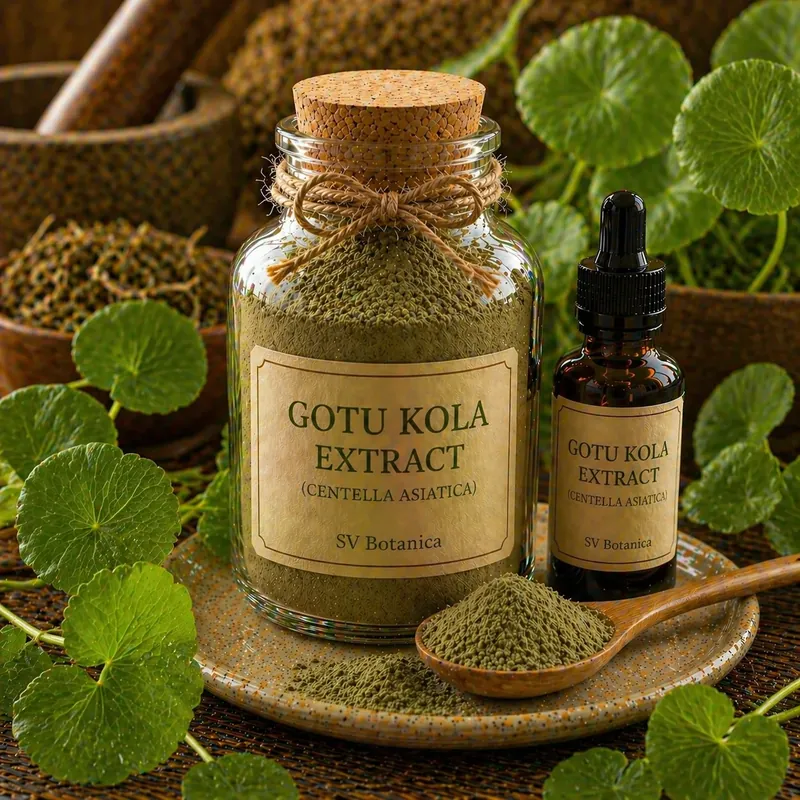
Centella asiatica (L.) Urban · Family: Apiaceae · Whole-Herb Extract
A Centella asiatica extract standardised to total triterpenes — with the individual asiaticoside, madecassoside, asiatic acid and madecassic acid split reported on every batch, because a total conceals which triterpene you actually bought, and cosmetic and nutraceutical buyers want different ones. TECA-ratio grades available. CoA-backed supply from India.
Standardised Grade
Triterpene Split ReportedFour triterpenes, one total — and two industries wanting different ones
Gotu kola (Centella asiatica (L.) Urban) — mandukaparni in Sanskrit, cica in modern cosmetic shorthand — is a creeping herb of the Apiaceae family found across wetlands and damp ground throughout South and Southeast Asia. It has long Ayurvedic use as a cognitive and skin-repair herb, and over the last decade it has become one of the most sought-after actives in cosmetic formulation.
Its actives are a family of pentacyclic triterpenes, and this is where specification care begins. Four matter commercially: the glycosides asiaticoside and madecassoside, and their corresponding aglycones asiatic acid and madecassic acid. A "total triterpenes 10%" figure sums them — and in doing so conceals which ones you have.
That matters because different industries want different members. Cosmetic formulators building on the cica positioning generally want madecassoside and asiaticoside; the pharmaceutical-heritage standard known as TECA or TTFCA specifies a defined ratio of asiaticoside to the two acids rather than a bare total. A total-only specification can be met by material weighted entirely toward the cheapest fraction.
One further thing deserves stating plainly. Centella is a wetland plant — it grows in damp, often marshy ground and standing water, and plants growing that way are efficient accumulators of what is in the water. Heavy metals are therefore a genuine, material risk on this ingredient rather than a routine box-tick, and we test every batch by ICP-MS accordingly.
The triterpene family — glycosides, aglycones and why the split matters
The principal triterpene glycoside and the most commonly specified single marker. Assayed by HPLC and reported individually.
The other major glycoside, and the one most sought by cosmetic formulators working in the cica space. Reported individually.
The aglycone of asiaticoside — a defined component of the pharmaceutical-heritage TECA ratio.
The aglycone of madecassoside, and the fourth member of the TECA specification.
The sum of the above. A useful concentration measure — and, on its own, silent about composition.
Secondary constituents of the herb contributing to the full-spectrum profile and chromatographic fingerprint.
Why formulators specify the triterpene split rather than a bare total
Asiaticoside, madecassoside, asiatic acid and madecassic acid reported separately on every batch. A total alone can be met by material weighted entirely toward one fraction.
Centella is among the most sought-after cosmetic actives of the last decade. Madecassoside in particular drives that demand, which is why we report it rather than folding it into a sum.
The pharmaceutical-heritage specification defines a ratio of asiaticoside to asiatic and madecassic acid rather than a bare total. Available where a buyer specification calls for it.
Long documented Ayurvedic use as mandukaparni, giving nootropic and daily-wellness formulations a genuine heritage rather than a constructed one.
Centella is a wetland plant and an efficient accumulator. Heavy metals are a real risk here, not a formality — tested per batch with numeric per-element limits.
A cold-water-soluble grade suits beverages, sachets and aqueous cosmetic systems; standard grades suit capsules, tablets and emulsions.
These are functional and physico-chemical properties of the actives; SV Botanica does not make medical or therapeutic claims for this ingredient.
Specify which triterpenes, not just how many — the total is not the specification
| Grade | Standardisation | Form | Best For | Solubility |
|---|---|---|---|---|
| Gotu Kola Extract 10% Standard | Total triterpenes NLT 10%; split reported | Brown to dark green fine powder, ≥95% through 40 mesh | Nutraceutical capsules, traditional formats | Partially water-soluble |
| Gotu Kola Extract Asiaticoside 40% High-assay | Asiaticoside NLT 40% (HPLC); split reported | Off-white to pale beige fine powder | Concentrated formats, cosmetic actives | Water-soluble |
| Gotu Kola Extract Madecassoside Cosmetic | Madecassoside standardised; split reported | Off-white to pale beige fine powder | Cica serums, creams & repair cosmetics | Water/glycol-soluble |
| Gotu Kola Extract TECA Ratio TECA / TTFCA | Defined asiaticoside : asiatic acid : madecassic acid ratio | Off-white fine powder | Where a pharmaceutical-heritage ratio specification applies | Water-soluble |
| Gotu Kola Extract Ratio Full-spectrum | Native 10:1 / 20:1 ratio; triterpenes reported | Dark green fine powder | Classical mandukaparni formats, herbal blends | Grade-dependent |
Please state which triterpenes your formulation needs, not only a total. A "total triterpenes 10%" specification can be satisfied by material weighted almost entirely toward one member of the family — and cosmetic buyers working in the cica space usually want madecassoside specifically, while a TECA specification defines a ratio rather than a sum. Every grade carries the individual asiaticoside, madecassoside, asiatic acid and madecassic acid split on the certificate. Given centella's wetland habit, all grades are tested for heavy metals by ICP-MS with numeric per-element limits.
Gotu Kola Extract is bought in five forms. The standardised extract is the stocked item; granulated and dispersible grades are produced on request and raw botanical forms are sourced against a confirmed order.
| Form | What it is | Specification basis | Availability |
|---|---|---|---|
| Standardised extract powder | Centella asiatica whole herb extract, dried and milled | NLT 10% total triterpenes, asiaticoside split reported | Stocked |
| Granulated (direct-compression) | Extract granulated for tablet lines | Same marker, declared on the granule | On request |
| Water-dispersible / soluble | Extract in a dispersible matrix for beverages, gummies and sachets | Marker declared on the matrix basis; carrier named | On request |
| Whole-herb powder (non-extracted) | Dried Centella asiatica whole herb, milled to mesh | Botanical identity by TLC; heavy metals and microbial panel | On enquiry, subject to lot; phytosanitary certificate usually required |
| Cut herb (tea-bag cut) | Dried herb, tea-bag cut or cut & sifted | Identity, moisture, foreign matter | On enquiry; for teas and in-house extraction |
A marker percentage without its assay method is not a specification; ask for the method and the plant part on every quotation. Read Brahmi vs Gotu Kola: The Two “Brahmis” and How to Tell Them Apart, Gotu Kola Extract: A Complete Buyer's Guide and Triterpenes, TECA and How Centella Is Standardised before comparing offers.
Full product specification for Gotu Kola Whole-Herb Extract, total triterpenes 10%. Values are specification limits, not batch results; a batch-specific CoA is issued per shipment.
| Parameter | Specification / Limit | Method |
|---|---|---|
| Botanical Source | Centella asiatica (L.) Urban | — |
| Plant Family | Apiaceae (Umbelliferae) | — |
| Part Used | Whole herb (aerial parts) | — |
| Country of Origin | India | — |
| Appearance | Fine powder | Organoleptic |
| Colour | Brown to dark green* | Organoleptic |
| Odour | Characteristic | Organoleptic |
| Taste | Characteristic, slightly bitter | Organoleptic |
| Identification | Corresponds to reference extract — positive | By TLC / HPLC |
| Total Triterpenes (% w/w, dry basis) | NLT 10.0 | By HPLC |
| — Asiaticoside (% w/w) | Reported per batch | By HPLC |
| — Madecassoside (% w/w) | Reported per batch | By HPLC |
| — Asiatic Acid (% w/w) | Reported per batch | By HPLC |
| — Madecassic Acid (% w/w) | Reported per batch | By HPLC |
| TECA Ratio (where specified) | Defined ratio to buyer specification | By HPLC |
| Loss on Drying (at 105°C, % w/w) | NMT 5.0 | IP-2014 |
| pH (1% w/v solution) | 4 – 7 | IP-2014 |
| Bulk Density (g/ml) | NLT 0.35 | IP-2014 |
| Particle Size (#40 mesh, % w/w) | NLT 95 | Sieve |
| Total Ash (% w/w) | NMT 12 | IP-2014 |
| Acid Insoluble Ash (% w/w) | NMT 2 | IP-2014 |
| Residual Solvent (Ethanol, ppm) | NMT 5,000 | By GC |
| Lead (ppm) | NMT 1.0 — see wetland note | ICP-MS |
| Arsenic (ppm) | NMT 1.0 — see wetland note | ICP-MS |
| Cadmium (ppm) | NMT 0.3 — see wetland note | ICP-MS |
| Mercury (ppm) | NMT 0.1 — see wetland note | ICP-MS |
| Pesticide Residues | Complies (EU MRL, on request) | GC-MS / LC-MS/MS |
| Ethylene Oxide (ETO) | Not treated — declaration provided | LC-MS/MS (on request) |
| Total Plate Count (cfu/g) | NMT 1,000 | USP <2021> |
| Yeast & Moulds / Fungi (cfu/g) | NMT 100 | USP <2021> |
| Escherichia coli | Absent | USP <2022> |
| Salmonella sp. | Absent | USP <2022> |
| Staphylococcus aureus | Absent | USP <2022> |
| Cultivation | Cultivated / wild-collected (declared per batch) | Declaration |
| Kosher / Halal | Certified (on request) | Certification |
| Shelf Life | 36 months from date of manufacture, in original packed condition | — |
| Storage | Cool, dry place away from light and moisture, in tightly sealed containers | — |
*The product is of herbal origin; slight colour variation may occur due to geographical and seasonal variation in the raw material. Two points on this specification deserve attention. First, the individual triterpene split is reported rather than only a total — a total can be met by material weighted almost entirely toward one member, and cosmetic and TECA buyers need to know which. Second, the heavy-metal block is a substantive control on this ingredient: Centella asiatica is a wetland plant growing in damp ground and standing water, and plants of that habit are efficient accumulators of what is in the water and soil. We test every batch by ICP-MS with numeric per-element limits and would encourage buyers to verify independently rather than treat these as routine. A current Certificate of Analysis and MSDS are issued with every batch.
From wetland herb to standardised extract — split-reported, metals-tested, documented
Raw Material & Authentication: The extract is prepared from Centella asiatica whole herb. Species identity matters more than usual here for two reasons: Hydrocotyle species are creeping wetland plants of similar appearance that are not centella, and the vernacular name brahmi is applied in India to both Centella asiatica and Bacopa monnieri — two unrelated plants with entirely different chemistry. We identify by TLC and HPLC against authentic reference material and declare the binomial. See our guide to the two brahmis.
Manufacturing & Testing: Gotu Kola Extract is manufactured at certified facilities in India. Each batch runs through a full QC battery — total triterpenes by HPLC with the individual asiaticoside, madecassoside, asiatic acid and madecassic acid split resolved and reported, loss on drying, pH, bulk density, ash and acid-insoluble ash, mesh, residual solvent by GC, heavy metals by ICP-MS, pesticide residue screening, and a complete USP microbiological panel — before release.
Heavy Metals & the Wetland Question: Because centella grows in damp ground and standing water, and plants of that habit accumulate what is in the water, heavy metals are a genuine risk on this ingredient rather than a routine parameter. We test every batch by ICP-MS with numeric per-element limits, declare collection status, and encourage independent verification — see our guides on EU pesticide MRL compliance and EU import requirements for botanical extracts.
What backs every batch of Gotu Kola extract
Key information for global product registration and labelling
This deserves explicit treatment rather than being buried in a contaminant table. Centella asiatica is a wetland plant, growing in damp ground and standing water, and plants of that habit are efficient accumulators of heavy metals present in the water and soil. Collection from uncharacterised wetland sites — including sites near industry, agriculture or urban run-off — carries real risk. This is not a theoretical concern on this ingredient. We test every batch by ICP-MS with numeric per-element limits, declare collection status, and would encourage buyers to verify independently and to prefer cultivated material where the growing environment is controlled.
Centella asiatica extract has a recognised INCI listing and is among the most widely used cosmetic actives of recent years under the cica banner. Cosmetic buyers should note that the triterpene composition matters to performance and positioning — madecassoside in particular drives much of the demand — so a total-triterpene specification may not deliver what the marketing implies. The finished-product safety assessment is the buyer's; we supply the specification, triterpene split and metals data to support it.
Used as a botanical active in cognitive, beauty-from-within and circulatory formats with documented Ayurvedic use as mandukaparni. A nomenclature caution applies: the name brahmi is used in India for both Centella asiatica and Bacopa monnieri, which are unrelated plants with entirely different chemistry and different markers. A specification or label naming "brahmi" without a binomial is genuinely ambiguous. Buyers remain responsible for compliance in their market. This product is not intended to diagnose, treat, cure or prevent any disease.
Deep-dive articles on gotu kola extract for formulators, buyers, and brand owners
Which triterpene do you actually need — and why a total won't tell you.
TechnicalFour compounds, one total, and the ratio specification that predates the cica boom.
QualityHydrocotyle substitution, the brahmi name problem, and heavy-metal risk from wetland collection.
ApplicationsCica serums, nootropics and beauty-from-within — and which triterpene each needs.
ProcurementA scored checklist weighted around triterpene reporting and heavy-metal control.
MarketHow the cica boom reshaped demand for a traditional Ayurvedic herb.
Frequently co-formulated with Gotu Kola Extract in skin, cognitive & circulatory blends
Technical and commercial questions answered by our ingredients team
Centella asiatica extract with the individual triterpene split reported and heavy metals tested by ICP-MS on every batch. TECA-ratio and cosmetic grades available. Samples for qualified buyers.
Supplied as a bulk ingredient for further manufacture. Buyers are responsible for compliance with the regulations of their destination market. This product is not intended to diagnose, treat, cure or prevent any disease.
We use cookies for analytics and to measure our advertising. Essential cookies are always on. Privacy policy