
Mentha × piperita L. · Family: Lamiaceae · Leaf Extract
A peppermint leaf extract standardised on rosmarinic acid NLT 5% by HPLC — a water-soluble polyphenol powder, and not peppermint essential oil, which is a volatile menthol-standardised product measured by GC. The two are routinely confused and are not interchangeable. Prepared from the leaf of Mentha × piperita for digestive, oral-care and functional-beverage formulators. CoA-backed supply from India.
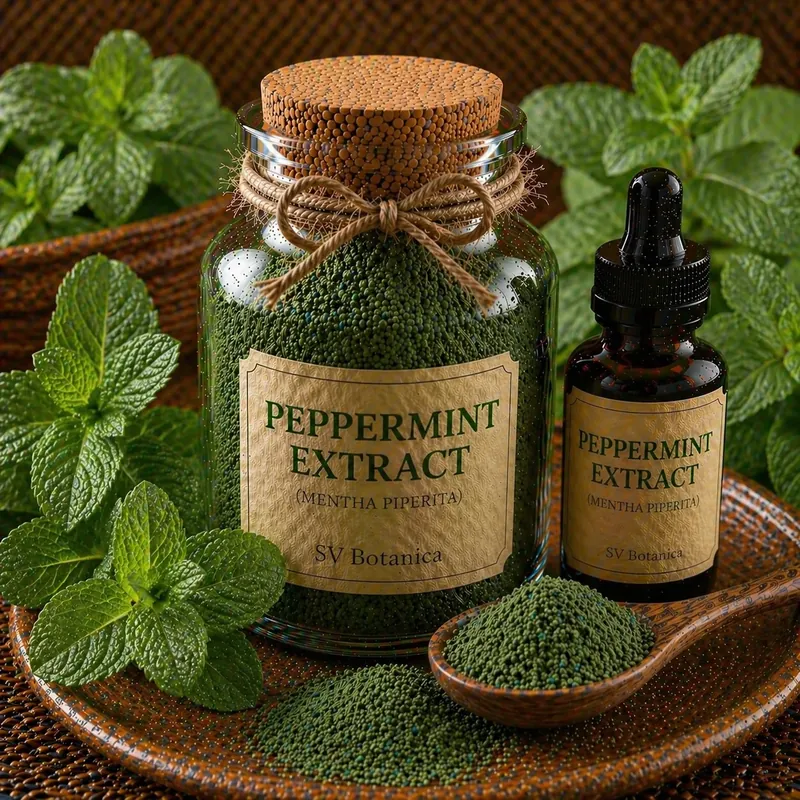
Leaf Extract
Rosmarinic Acid · Not Essential OilThe most confused specification in the mint category
Peppermint (Mentha × piperita L.) is a sterile hybrid of watermint and spearmint, propagated vegetatively, and one of the most widely cultivated aromatic crops in the world. That hybrid origin is worth noting: peppermint does not come true from seed, so every commercial planting descends from cuttings — which has real consequences for varietal consistency.
Peppermint is also the ingredient in this category most likely to be specified incorrectly, and the reason is a genuine confusion between two entirely different products. Peppermint essential oil is the volatile fraction — steam-distilled, standardised on menthol (typically 35–55%) by GC, oil-soluble, intensely aromatic, and the material behind enteric-coated capsules and flavour systems. Peppermint leaf extract is a water-soluble powder standardised on rosmarinic acid and polyphenols by HPLC, with comparatively little menthol.
The confusion shows up constantly in specifications asking for a leaf extract "standardised to menthol 40%". That figure belongs to the oil. A leaf extract powder does not carry menthol at anything approaching those levels — the volatiles are largely lost in extraction and drying — so such a specification cannot be met by any genuine leaf extract, and attempting to fill it invites either an oil-loaded material or an outright substitution.
We supply the leaf extract, standardised on rosmarinic acid NLT 5% by HPLC, with polyphenol-basis and native-ratio grades available. If your application needs menthol — flavour systems, cooling sensation, enteric-coated digestive capsules — you need the oil, and we will say so rather than sell you the wrong material.
The polyphenol fraction of the leaf — and the volatiles that belong to the oil
The principal phenolic acid of the Lamiaceae family and the standardisation basis for peppermint leaf extract. A defined compound assayed by HPLC.
Characteristic flavanone and flavone glycosides of peppermint leaf, contributing to the polyphenol fraction and the extract's fingerprint.
Flavone glycosides of the leaf, part of the wider polyphenol complex measured on a total-polyphenol basis.
The broader phenolic pool, used as an alternative standardisation basis where a polyphenol claim rather than a specific marker is wanted.
Volatile constituents belonging to the essential oil, largely lost in extraction and drying. Present only at low levels in a leaf extract powder.
Responsible for the leaf extract's light green colour, and a practical consideration in pale formulations.
Why formulators specify a rosmarinic-acid-standardised leaf extract
Rosmarinic acid is a single molecule with a reference standard — so the number means one thing, measured one way, and is comparable between laboratories.
Leaf extract and essential oil are different products with different markers, solubility and applications. We state which we are supplying, and will tell you when the oil is what you actually need.
Unlike the oil, the leaf extract is water-soluble — which makes it straightforward in beverages, sachets, effervescents and aqueous systems without emulsification.
Peppermint is among the most recognised botanicals for digestive comfort, with genuine culinary and traditional familiarity requiring no consumer education.
Rosmarinic acid and the wider flavonoid complex support antioxidant positioning on a defensible, quantified basis.
Mentha piperita leaf extract has a recognised INCI listing and suits oral-care, scalp and refreshing cosmetic formats where a water-soluble botanical is wanted.
These are functional and physico-chemical properties of the actives; SV Botanica does not make medical or therapeutic claims for this ingredient.
Leaf extract grades — and where the essential oil sits, for clarity
| Grade | Standardisation | Form | Best For | Solubility |
|---|---|---|---|---|
| Peppermint Leaf Extract 5% Standard | Rosmarinic acid NLT 5% (HPLC) | Light green to off-white fine powder, ≥95% through 40 mesh | Digestive supplements, oral care, beverages | Water-soluble |
| Peppermint Leaf Extract Polyphenol Polyphenol basis | Total polyphenols NLT 20% (UV) | Light green fine powder | Where a polyphenol claim rather than a specific marker is needed | Water-soluble |
| Peppermint Leaf Extract WS Water-soluble | Cold-water-soluble spray-dried; markers to specification | Pale green free-flowing powder | Shots, sachets, effervescents & RTD beverages | Cold-water-soluble |
| Peppermint Leaf Extract Ratio Full-spectrum | Native 4:1 / 10:1 ratio; rosmarinic acid reported | Green fine powder | Traditional herbal formats and teas | Grade-dependent |
| Peppermint Essential Oil Different product | Menthol 35–55% by GC — volatile oil | Clear to pale yellow mobile liquid | Flavour systems, cooling actives, enteric-coated capsules | Oil-soluble |
The last row is a different product class, listed here only to prevent the confusion that dominates this ingredient. Peppermint essential oil is a steam-distilled volatile fraction standardised on menthol by GC and is oil-soluble; peppermint leaf extract is a water-soluble powder standardised on rosmarinic acid by HPLC with comparatively little menthol. A specification asking for a leaf extract "standardised to menthol 40%" is describing the oil, and no genuine leaf extract powder can meet it. Tell us the application and we will tell you which product it needs — including when that is the oil rather than the extract.
Peppermint Extract is bought in five forms. The standardised extract is the stocked item; granulated and dispersible grades are produced on request and raw botanical forms are sourced against a confirmed order.
| Form | What it is | Specification basis | Availability |
|---|---|---|---|
| Standardised extract powder | Mentha × piperita leaf extract, dried and milled | NLT 5% rosmarinic acid (HPLC) | Stocked |
| Granulated (direct-compression) | Extract granulated for tablet lines | Same marker, declared on the granule | On request |
| Water-dispersible / soluble | Extract in a dispersible matrix for beverages, gummies and sachets | Marker declared on the matrix basis; carrier named | On request |
| Leaf powder (non-extracted) | Dried Mentha × piperita leaf, milled to mesh | Botanical identity by TLC; heavy metals and microbial panel | On enquiry, subject to lot; phytosanitary certificate usually required |
| Cut leaf (tea-bag cut) | Dried leaf, tea-bag cut or cut & sifted | Identity, moisture, foreign matter | On enquiry; for teas and in-house extraction |
A marker percentage without its assay method is not a specification; ask for the method and the plant part on every quotation. Read Peppermint Extract or Peppermint Oil? A Complete Buyer's Guide, Rosmarinic Acid, Menthol and How Peppermint Is Standardised and Peppermint Extract Adulteration and How Authenticity Is Proven before comparing offers.
Full product specification for Peppermint Leaf Dry Extract 5% rosmarinic acid. Values are specification limits, not batch results; a batch-specific CoA is issued per shipment.
| Parameter | Specification / Limit | Method |
|---|---|---|
| Botanical Source | Mentha × piperita L. | — |
| Plant Family | Lamiaceae | — |
| Part Used | Leaf | — |
| Product Class | Dry leaf extract — not essential oil | Declaration |
| Country of Origin | India | — |
| Appearance | Fine powder | Organoleptic |
| Colour | Light green to off-white* | Organoleptic |
| Odour | Characteristic, mildly minty | Organoleptic |
| Taste | Characteristic | Organoleptic |
| Identification | Corresponds to reference extract — positive | By TLC / HPLC |
| Rosmarinic Acid (% w/w, dry basis) | NLT 5.0 | By HPLC |
| Total Polyphenols (% w/w) | Reported per batch | By UV |
| Menthol (% w/w) | Low — reported per batch (see note) | By GC |
| Loss on Drying (at 105°C, % w/w) | NMT 5.0 | IP-2014 |
| pH (1% w/v solution) | 4 – 7 | IP-2014 |
| Bulk Density (g/ml) | NLT 0.35 | IP-2014 |
| Particle Size (#40 mesh, % w/w) | NLT 95 | Sieve |
| Total Ash (% w/w) | NMT 12 | IP-2014 |
| Acid Insoluble Ash (% w/w) | NMT 2 | IP-2014 |
| Residual Solvent (Ethanol, ppm) | NMT 5,000 | By GC |
| Lead (ppm) | NMT 1.0 | ICP-MS |
| Arsenic (ppm) | NMT 1.0 | ICP-MS |
| Cadmium (ppm) | NMT 0.3 | ICP-MS |
| Mercury (ppm) | NMT 0.1 | ICP-MS |
| Pesticide Residues | Complies (EU MRL, on request) | GC-MS / LC-MS/MS |
| Ethylene Oxide (ETO) | Not treated — declaration provided | LC-MS/MS (on request) |
| Total Plate Count (cfu/g) | NMT 1,000 | USP <2021> |
| Yeast & Moulds / Fungi (cfu/g) | NMT 100 | USP <2021> |
| Escherichia coli | Absent | USP <2022> |
| Salmonella sp. | Absent | USP <2022> |
| Staphylococcus aureus | Absent | USP <2022> |
| Cultivation | Cultivated | Declaration |
| Kosher / Halal | Certified (on request) | Certification |
| Shelf Life | 36 months from date of manufacture, in original packed condition | — |
| Storage | Cool, dry place away from light and moisture, in tightly sealed containers | — |
*The product is of herbal origin; slight colour variation may occur due to geographical and seasonal variation in the raw material. The menthol line is reported precisely to prevent the confusion this ingredient generates. A dry leaf extract carries only low levels of menthol — the volatile fraction is largely lost during extraction and drying — so a specification asking for a leaf extract at menthol 35–55% is describing peppermint essential oil, a different product measured by GC and standardised on a different basis. We report the figure so buyers can see plainly what class of material they hold. Note also that total ash runs higher on peppermint leaf than on many botanicals; acid-insoluble ash carries the tighter, more informative limit. A current Certificate of Analysis and MSDS are issued with every batch.
From leaf to water-soluble extract — class-declared, HPLC-assayed, documented
Raw Material & Authentication: The extract is prepared from cultivated Mentha × piperita leaf. Because peppermint is a sterile hybrid propagated vegetatively, and because the Mentha genus contains many species and hybrids that are readily confused — spearmint, cornmint and field mint among them — species identity is confirmed by TLC and HPLC against authentic peppermint reference material rather than assumed from a common name.
Manufacturing & Testing: Peppermint Leaf Extract is manufactured at certified facilities in India. Each batch runs through a full QC battery — rosmarinic acid by HPLC, total polyphenols by UV, menthol by GC (reported to confirm product class), loss on drying, pH, bulk density, ash and acid-insoluble ash, mesh, residual solvent by GC, heavy metals by ICP-MS, pesticide residue screening, and a complete USP microbiological panel — before release.
Documentation: Every shipment is supplied against a batch-specific Certificate of Analysis stating the product class (leaf extract, not essential oil), the rosmarinic acid figure and the menthol level, with an MSDS. Halal, Kosher and Organic certification are available — see our guides on EU pesticide MRL compliance and EU import requirements for botanical extracts.
What backs every batch of Peppermint extract
Key information for global product registration and labelling
The most common regulatory and commercial problem with peppermint is not a contaminant but a category error. Peppermint essential oil and peppermint leaf extract are different products with different markers, solubility, applications and — in several markets — different regulatory treatment, since essential oils and dry botanical extracts are not always handled under the same framework. A specification that names one and receives the other creates a mismatch that surfaces at audit rather than at goods-in. We declare the product class on every certificate and report menthol so the class is verifiable from the document itself.
Peppermint has extensive culinary and traditional use worldwide, which supports a comfortable food-use position for the leaf. Mentha piperita leaf extract also has a recognised INCI listing for cosmetic use. Digestive positioning is subject to specific claim rules in most jurisdictions. Note separately that peppermint oil carries its own considerations — including guidance around use in young children and interactions with reflux in some contexts — which are properties of the concentrated volatile oil rather than of a leaf extract, and a further reason the two should not be conflated in a safety assessment. Buyers remain responsible for compliance in their market. This product is not intended to diagnose, treat, cure or prevent any disease.
Supplied from India by SV Botanica — FSSAI Central Licence holder and an APEDA-registered exporter. India is among the world's largest producers of mint and mint derivatives, giving direct access to the raw material base. The material is Kosher certified and shipped against a batch-specific Certificate of Analysis with export documentation available on request.
Deep-dive articles on peppermint extract for formulators, buyers, and brand owners
The most confused specification in the mint category, and how to write the right one.
TechnicalWhy the leaf extract is standardised on a phenolic acid and the oil on menthol by GC.
QualityMentha species substitution, oil-loaded powders and spent leaf — and how to catch each.
ApplicationsDigestive, beverage, oral-care and cosmetic formats — and which product class each needs.
ProcurementA scored checklist that starts by confirming the supplier knows which product you asked for.
MarketHow the mint oil trade dwarfs the extract market, and what that means for buyers.
Frequently co-formulated with Peppermint Extract in digestive, oral-care & refreshing blends
Technical and commercial questions answered by our ingredients team
Water-soluble peppermint leaf extract standardised on rosmarinic acid NLT 5% by HPLC, with the product class declared and menthol reported. Samples available for qualified buyers.
Supplied as a bulk ingredient for further manufacture. Buyers are responsible for compliance with the regulations of their destination market. This product is not intended to diagnose, treat, cure or prevent any disease.
We use cookies for analytics and to measure our advertising. Essential cookies are always on. Privacy policy