
Allium sativum L. · Family: Amaryllidaceae · Bulb Extract
A garlic bulb extract standardised on alliin and allicin yield — the chemically correct basis, because allicin does not exist in intact garlic. It is formed enzymatically the moment the clove is crushed. A specification asking for "allicin content" is asking for something that isn't there. Aged (S-allyl cysteine) and odourless grades available. CoA-backed supply from India.
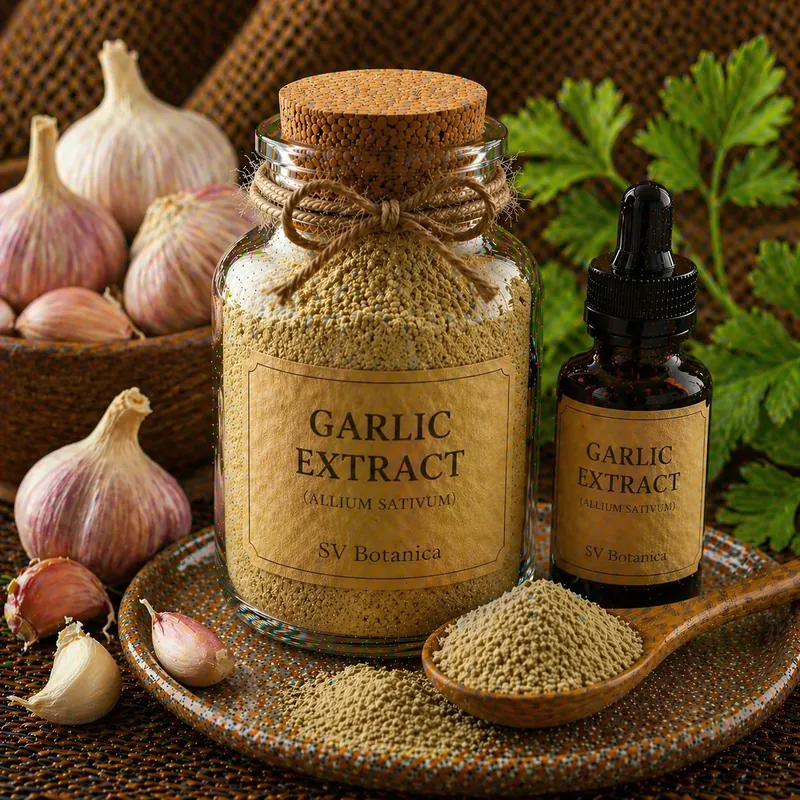
Standardised Grade
Alliin · Allicin YieldThe active everyone specifies is one the plant does not contain
Garlic (Allium sativum L.) is among the most studied botanicals in the world and among the most consistently mis-specified. The reason is a single piece of chemistry that most buyers have never been told.
Allicin is not present in intact garlic. A whole clove contains alliin, a stable sulphur amino acid, and — held separately inside the cell — the enzyme alliinase. Crush, cut or chew the clove and the two meet: alliinase converts alliin to allicin in seconds. That reaction is what garlic's smell actually is. Allicin is also unstable, degrading within hours to a family of secondary sulphur compounds.
So a specification asking for "allicin content 2%" in a dry powder is asking for a compound that either was never there or has largely decomposed. The correct commercial bases are alliin content — the stable precursor, assayed by HPLC — and allicin yield (also called allicin potential or allicin-releasing capacity), which measures how much allicin the material generates under defined conditions. That second figure is the one that reflects real-world performance.
There is a further consequence that decides formulation: alliinase is acid-labile. Stomach acid inactivates it, so an uncoated garlic tablet may deliver far less allicin than its yield figure suggests. This is why serious allicin-yield products are enteric-coated — the coating is not a marketing feature, it is what makes the specification meaningful. Separately, aged garlic extract is a different product entirely: a long-maturation process that converts the sulphur compounds to stable, odourless derivatives standardised on S-allyl cysteine (SAC), with no allicin chemistry involved at all.
A precursor, an enzyme, an unstable product — and a stable alternative
The stable sulphur amino acid actually present in intact garlic, and the primary standardisation basis. Assayed by HPLC.
The enzyme that converts alliin to allicin on cell disruption. Acid-labile — which is why enteric coating matters for allicin-yield products.
Formed only on disruption, and unstable thereafter. Specified as a yield under defined conditions rather than as a content.
The stable, odourless, water-soluble marker of aged garlic extract — a different product with a different specification basis.
Sulphur-containing precursors of the bulb that contribute to the wider profile and to aged-garlic chemistry.
Secondary sulphur compounds formed as allicin degrades — evidence that the allicin chemistry has already run.
Why formulators specify alliin and allicin yield rather than allicin content
Alliin is what the material contains; allicin yield is what it can produce. Together they describe garlic honestly, where an "allicin content" figure describes something the plant does not hold.
Garlic is among the most consumer-recognised botanicals for cardiovascular and daily-wellness positioning, requiring no category education.
Alliinase is acid-labile, so an allicin-yield claim only survives to the gut behind an enteric coat. We supply grades intended for that route and will say when a format undermines the spec.
A genuinely different product — stable, odourless, water-soluble, standardised on S-allyl cysteine, with none of the allicin instability.
Garlic's odour is the allicin chemistry itself. Deodorised and aged grades let formulators build acceptable formats where raw garlic would be unusable.
Garlic's universal food use gives it an unusually comfortable regulatory position and immediate consumer trust as a supplement ingredient.
These are functional and physico-chemical properties of the actives; SV Botanica does not make medical or therapeutic claims for this ingredient.
Three chemistries, not three strengths — pick the one your format can actually deliver
| Grade | Standardisation | Form | Best For | Solubility |
|---|---|---|---|---|
| Garlic Extract Alliin 1% Standard | Alliin NLT 1% (HPLC); allicin yield reported | Off-white to cream fine powder, ≥95% through 40 mesh | Capsules, tablets, general supplement blends | Water-soluble |
| Garlic Extract Allicin Yield High-yield | Allicin yield NLT 5,000 ppm under defined conditions | Off-white to cream fine powder | Enteric-coated tablets & capsules — see note | Water-soluble |
| Aged Garlic Extract (SAC) Aged | S-allyl cysteine standardised; odourless, stable | Pale cream fine powder | Odour-sensitive formats, daily-wellness, beverages | Water-soluble |
| Garlic Extract Odourless Deodorised | Alliin to specification, odour reduced | Off-white fine powder | Gummies, chewables, food fortification | Water-soluble |
| Garlic Powder (Culinary) Whole-food | Milled bulb — not an extract | Cream to pale yellow powder | Seasoning and culinary applications | Dispersible |
These are three different chemistries, not three strengths. An allicin-yield grade only performs as specified if the alliinase survives to the gut — it is acid-labile, so the grade belongs in an enteric-coated format; in an uncoated tablet the yield figure substantially overstates delivery. Aged garlic extract is a separate product standardised on S-allyl cysteine with no allicin chemistry at all, and its numbers are not comparable to an allicin-yield figure. Please tell us the format and we will confirm which chemistry it can actually deliver. Milled culinary garlic powder is a whole-food material and is quoted separately.
Garlic Extract is bought in five forms. The standardised extract is the stocked item; granulated and dispersible grades are produced on request and raw botanical forms are sourced against a confirmed order.
| Form | What it is | Specification basis | Availability |
|---|---|---|---|
| Standardised extract powder | Allium sativum bulb extract, dried and milled | NLT 1% alliin (HPLC), allicin yield reported | Stocked |
| Granulated (direct-compression) | Extract granulated for tablet lines | Same marker, declared on the granule | On request |
| Water-dispersible / soluble | Extract in a dispersible matrix for beverages, gummies and sachets | Marker declared on the matrix basis; carrier named | On request |
| Garlic powder (dehydrated) | Dehydrated garlic bulb, milled | Moisture, allicin yield; microbial panel | On enquiry, subject to lot |
| Dehydrated garlic flakes / granules | Sliced and dried bulb | Identity, moisture, foreign matter | On enquiry; spice-trade item |
A marker percentage without its assay method is not a specification; ask for the method and the plant part on every quotation. Read Garlic Extract: A Complete Buyer's Guide, Alliin, Alliinase and How Garlic Extract Is Standardised and Garlic Extract Adulteration and How Authenticity Is Proven before comparing offers.
Full product specification for Garlic Bulb Extract, alliin 1%. Values are specification limits, not batch results; a batch-specific CoA is issued per shipment.
| Parameter | Specification / Limit | Method |
|---|---|---|
| Botanical Source | Allium sativum L. | — |
| Plant Family | Amaryllidaceae (Alliaceae) | — |
| Part Used | Bulb | — |
| Country of Origin | India | — |
| Appearance | Fine powder | Organoleptic |
| Colour | Off-white to cream* | Organoleptic |
| Odour | Characteristic, pungent (reduced in deodorised/aged grades) | Organoleptic |
| Taste | Characteristic | Organoleptic |
| Identification | Corresponds to reference extract — positive | By TLC / HPLC |
| Alliin (% w/w, dry basis) | NLT 1.0 | By HPLC |
| Allicin Yield (ppm) | NLT 5,000 — under defined conditions | By HPLC |
| Allicin (as-is content) | Not specified — see note | — |
| S-Allyl Cysteine (aged grade, % w/w) | To specification | By HPLC |
| Alliinase Activity | Reported for allicin-yield grades | Enzymatic |
| Loss on Drying (at 105°C, % w/w) | NMT 5.0 | IP-2014 |
| pH (1% w/v solution) | 5 – 7 | IP-2014 |
| Bulk Density (g/ml) | NLT 0.40 | IP-2014 |
| Particle Size (#40 mesh, % w/w) | NLT 95 | Sieve |
| Total Ash (% w/w) | NMT 5 | IP-2014 |
| Acid Insoluble Ash (% w/w) | NMT 1 | IP-2014 |
| Residual Solvent (Ethanol, ppm) | NMT 5,000 | By GC |
| Lead (ppm) | NMT 1.0 | ICP-MS |
| Arsenic (ppm) | NMT 1.0 | ICP-MS |
| Cadmium (ppm) | NMT 0.3 | ICP-MS |
| Mercury (ppm) | NMT 0.1 | ICP-MS |
| Pesticide Residues | Complies (EU MRL, on request) | GC-MS / LC-MS/MS |
| Ethylene Oxide (ETO) | Not treated — declaration provided | LC-MS/MS (on request) |
| Total Plate Count (cfu/g) | NMT 1,000 | USP <2021> |
| Yeast & Moulds / Fungi (cfu/g) | NMT 100 | USP <2021> |
| Escherichia coli | Absent | USP <2022> |
| Salmonella sp. | Absent | USP <2022> |
| Staphylococcus aureus | Absent | USP <2022> |
| Cultivation | Cultivated | Declaration |
| Kosher / Halal | Certified (on request) | Certification |
| Shelf Life | 36 months from date of manufacture, in original packed condition | — |
| Storage | Cool, dry place away from light and moisture, in tightly sealed containers | — |
*The product is of herbal origin; slight colour variation may occur due to geographical and seasonal variation in the raw material. Note the deliberately unspecified line: allicin as-is content. Allicin is not present in intact garlic — it is formed from alliin by the enzyme alliinase when the clove is disrupted, and it degrades within hours to secondary sulphur compounds. Specifying an as-is allicin content in a dry powder therefore describes a compound that either was never present or has already decomposed. The meaningful figures are alliin (the stable precursor actually present) and allicin yield (what the material generates under defined conditions). Because alliinase is acid-labile, an allicin-yield specification is only realised in an enteric-coated format. A current Certificate of Analysis and MSDS are issued with every batch.
From bulb to standardised extract — precursor-assayed, yield-tested, documented
Raw Material & Processing: The extract is prepared from cultivated Allium sativum bulb. Processing route matters unusually here: gentle, low-temperature handling preserves alliinase activity and therefore allicin yield, while the aged-garlic route deliberately runs a long maturation that converts the sulphur compounds to stable S-allyl cysteine. The two routes produce genuinely different products from the same bulb, and the route is declared.
Manufacturing & Testing: Garlic Extract is manufactured at certified facilities in India. Each batch runs through a full QC battery — alliin by HPLC, allicin yield determined under defined conditions, alliinase activity reported for yield grades, S-allyl cysteine for aged grades, loss on drying, pH, bulk density, ash and acid-insoluble ash, mesh, residual solvent by GC, heavy metals by ICP-MS, pesticide residue screening, and a complete USP microbiological panel — before release.
Documentation: Every shipment is supplied against a batch-specific Certificate of Analysis stating the grade chemistry, the alliin figure and the allicin yield (or SAC for aged grades), with an MSDS. Halal, Kosher and Organic certification are available — see our guides on EU pesticide MRL compliance and EU import requirements for botanical extracts.
What backs every batch of Garlic extract
Key information for global product registration and labelling
The most common compliance problem with garlic is not a contaminant but a claim built on a chemically impossible specification. An on-pack statement of "allicin content" in a dry powder is not substantiable, because allicin is not present in intact garlic and degrades rapidly once formed. Claims should rest on alliin content or on allicin yield under stated conditions, and the conditions should be stated. Buyers should also note that an allicin-yield claim on an uncoated oral format is difficult to defend, since alliinase is acid-labile — the enteric coat is part of what makes the claim true.
Garlic has universal culinary use, which gives it an unusually comfortable food-use position. Finished-product formulators should nonetheless be aware that garlic is commonly flagged in consumer and healthcare guidance for potential interaction with anticoagulant and antiplatelet medication, often with advice around surgery — the same consideration that applies to ginkgo. Advisory labelling is standard practice in many markets. Requirements differ by jurisdiction and belong in your regulatory review.
Supplied from India by SV Botanica — FSSAI Central Licence holder and an APEDA-registered exporter. India is among the world's largest garlic producers, giving direct access to the raw material base. The material is Kosher certified and shipped against a batch-specific Certificate of Analysis with export documentation available on request.
Deep-dive articles on garlic extract for formulators, buyers, and brand owners
Why "allicin 2%" is a specification for a compound that isn't there.
TechnicalThe enzyme reaction behind garlic's chemistry, and why yield beats content.
QualityCulinary powder sold as extract, dead alliinase, and synthetic allicin claims.
ApplicationsCardiovascular, immunity and odour-sensitive formats — and why enteric coating is not optional.
ProcurementA scored checklist that starts by testing whether the supplier knows the chemistry.
MarketA culinary commodity feeding a supplement niche, and the odour problem that shapes demand.
Frequently co-formulated with Garlic Extract in cardiovascular & immunity blends
Technical and commercial questions answered by our ingredients team
Garlic bulb extract standardised on alliin and allicin yield, with aged (SAC) and odourless grades. The chemistry stated honestly on every certificate. Samples for qualified buyers.
Supplied as a bulk ingredient for further manufacture. Buyers are responsible for compliance with the regulations of their destination market. This product is not intended to diagnose, treat, cure or prevent any disease.
We use cookies for analytics and to measure our advertising. Essential cookies are always on. Privacy policy