
Camellia sinensis (L.) Kuntze · Family: Theaceae · Leaf Extract
The benchmark antioxidant polyphenol — standardised for catechins and EGCG by HPLC, with total polyphenols from 50% to 98%. Trusted by antioxidant, weight-management, sports-nutrition and functional-beverage formulators worldwide. Decaffeinated and certified-organic grades. GMP, ISO, Halal and Kosher certified supply from India.
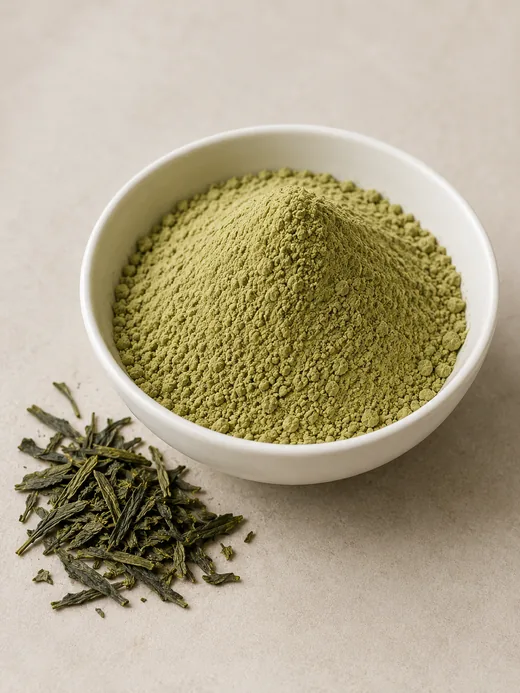
Actual Product
Camellia sinensis · Catechins / EGCG · Actual BatchThe most extensively researched antioxidant polyphenol ingredient
Green Tea Extract is produced from the young leaves of Camellia sinensis — the same plant behind all true teas. What distinguishes green tea is the processing: leaves are steamed or pan-fired soon after harvest to deactivate the polyphenol-oxidase enzymes. This stops fermentation and locks in the native catechin profile that black and oolong teas largely convert to theaflavins.
The primary bioactives are catechins — a family of flavan-3-ol polyphenols dominated by epigallocatechin gallate (EGCG), alongside EGC, ECG and EC. Green tea leaf also naturally contains caffeine, the calming amino acid L-theanine, and flavonols such as quercetin and kaempferol. Total polyphenols are quantified by UV-Vis, while individual catechins and EGCG are measured by HPLC — these markers form the basis of every standardised grade.
SV Botanica sources green tea leaf from India's established tea-growing regions — Assam, the Nilgiris and Darjeeling, plus the high-grown gardens of Kangra — and extracts via a validated water/hydro-alcoholic system at controlled temperatures to protect the heat- and oxygen-sensitive catechins. The result is a clean, pale green to greenish-brown powder that disperses readily in formulations.
We supply antioxidant, weight-management and sports-nutrition brands, functional-beverage companies and contract formulators across Europe, the USA, Japan and Southeast Asia. Formulators weighing the two leading metabolic polyphenols can start with our green coffee vs green tea comparison.
Key phytochemicals driving green tea's antioxidant profile
The headline antioxidant fraction, quantified by UV-Vis at 50%–98% across standardised grades. A family of flavan-3-ol catechins.
The most abundant and most-studied green tea catechin, and the reference compound for HPLC assay and biological activity.
The wider catechin family contributing to total polyphenol load and the characteristic antioxidant fingerprint of the leaf.
Naturally present in tea leaf; retained at a defined level in standard grades and reduced in decaffeinated grades.
A unique tea amino acid studied for its calming, focus-supporting effect — often paired with caffeine in cognitive formulas.
Quercetin, kaempferol and condensed tannins that add to the extract's total polyphenol and free-radical-scavenging capacity.
Evidence from clinical trials, systematic reviews, and mechanistic research
A controlled study reported that green tea extract increased 24-hour energy expenditure and fat oxidation beyond what its caffeine content alone would explain, pointing to the catechins as the active fraction.
Ref: Dulloo AG et al., 1999; Am J Clin NutrA meta-analysis of randomised trials found that catechin–caffeine mixtures produced a modest but significant effect on body weight and weight maintenance, supporting green tea's role in metabolic formulations.
Ref: Hursel R et al., 2009; Int J ObesA meta-analysis of controlled trials reported that green tea catechins significantly lowered total and LDL cholesterol, consistent with the polyphenols' role in cardiovascular support.
Ref: Zheng XX et al., 2011; Am J Clin NutrGreen tea catechins are potent dietary antioxidants, scavenging free radicals and supporting cellular defence. Green tea is one of the richest practical sources of these flavan-3-ol polyphenols.
Ref: Higdon JV & Frei B, 2003; Crit Rev Food Sci NutrA meta-analysis of randomised trials reported small but significant reductions in systolic and diastolic blood pressure with green tea intake, attributed in part to improved endothelial function.
Ref: Khalesi S et al., 2014; J HypertensThe combination of L-theanine and caffeine native to green tea has been shown to improve attention and alertness in controlled studies, underpinning its use in nootropic and energy blends.
Ref: Owen GN et al., 2008; Nutr NeurosciResponsible-marketing note: finished-product claims must be substantiated and compliant with each destination market's regulations. EFSA's 2018 assessment flagged a hepatic-safety signal for EGCG intakes at or above 800 mg/day from supplements, so formulators should calculate and declare the finished-product EGCG dose and keep it within applicable guidance.
Select the right standardisation, caffeine profile, and form for your formulation
| Grade | Standardisation | Form | Best For | Certifications |
|---|---|---|---|---|
| Polyphenols 50% Popular | ≥50% polyphenols (UV) | Fine powder, ≥95% through #40 mesh | Antioxidant capsules, functional foods, value nutraceutical blends | GMP, ISO, FSSAI |
| Polyphenols 90% / Catechins 80% Premium | ≥90% polyphenols (UV), ≥80% catechins (HPLC) | Fine powder, 100% through #40 mesh | High-potency antioxidant & metabolic supplements | GMP, ISO, Halal, Kosher |
| EGCG 50% High EGCG | ≥98% polyphenols (UV), 45–50% EGCG (HPLC) | Fine powder, 100% through #40 mesh | Clinical-dose EGCG formulations, premium positioning | GMP, ISO, Halal, Kosher |
| Decaffeinated Decaf | Standardised polyphenols/catechins, ≤0.5% caffeine | Fine powder, ≥95% through #40 mesh | Caffeine-sensitive & clean-label products, evening formulas | GMP, ISO, Halal, Kosher |
| Certified Organic Organic | Standardised polyphenols/catechins, organic-certified leaf | Fine powder | Organic & clean-label brands needing certified raw material | GMP, ISO, Organic |
| Water-Soluble Grade | ≥50% polyphenols equiv., instantised | Granular / spray-dried | RTD teas, beverages, metabolic shots, effervescent tablets | GMP, ISO, FSSAI, Food-grade |
Representative batch assays on file: 50% grade — 52.4% polyphenols (CoA SVB-COA-GT50-0526-01); 90/80 grade — 91.6% polyphenols, 81.3% catechins (CoA SVB-COA-GT90-0426-01); EGCG 50 grade — 98.1% polyphenols, 49.2% EGCG (CoA SVB-COA-GTE50-0326-01). Custom polyphenol/catechin/EGCG standardisations, caffeine targets, and mesh sizes available for orders ≥100 kg.
Green tea extract is bought in five forms. The standardised powders are the stocked items; instant and cut-leaf forms are sourced against a confirmed order.
| Form | What it is | Specification basis | Availability |
|---|---|---|---|
| Standardised extract powder | Camellia sinensis leaf, water or hydroalcoholic extraction, dried and milled | Polyphenols by UV (50, 90, 98%); catechins and EGCG by HPLC | Stocked |
| Decaffeinated extract | Standardised extract with caffeine reduced to ≤0.5% | Polyphenols and EGCG as above; caffeine by HPLC | On request |
| Organic extract | Standardised extract from certified-organic leaf | Polyphenols and EGCG as above; transaction certificate per lot | On request |
| Instant / water-soluble green tea | Spray-dried soluble tea solids for beverages | Polyphenol content declared; solubility and colour | On request |
| Cut leaf (tea-bag cut) | Dried green tea leaf, tea-bag cut, not extracted | Moisture, foreign matter, identity; pesticide screen | On enquiry, subject to lot; phytosanitary certificate usually required |
A polyphenol percentage by UV and an EGCG percentage by HPLC are different measurements on the same powder; a specification needs both, with the method named. See green tea standardisation: UV vs HPLC, the catechin and EGCG assay explained and the EGCG dosage guide.
Full analytical profile — Polyphenols 90% / Catechins 80% grade (representative batch SVB/GT90/2604-01)
| Parameter | Specification | Typical Result |
|---|---|---|
| Botanical Source | Camellia sinensis (L.) Kuntze | Conforms |
| Plant Family | Theaceae | — |
| Part Used | Leaf | — |
| Identification (HPLC) | Positive vs. reference | Positive |
| Marker Compound | Catechins / EGCG (polyphenols) | — |
| Assay Method | UV-Vis (polyphenols) / HPLC (catechins, EGCG) | — |
| Total Polyphenols | NLT 90.0% (UV) | 91.6% |
| Total Catechins | NLT 80.0% (HPLC) | 81.3% |
| EGCG | NLT 45.0% (HPLC) | 47.8% |
| Caffeine | Declared per grade (NMT 10.0%, standard) | 6.2% |
| Appearance | Pale green to greenish-brown fine powder | Conforms |
| Odour & Taste | Characteristic; astringent, mildly bitter | Conforms |
| Particle Size | NLT 95% through #40 mesh | 98.10% |
| Loss on Drying (105°C) | NMT 5.0% w/w | 3.42% |
| Ash Content | NMT 5.0% w/w | 1.86% |
| Bulk Density | NLT 0.30 g/mL | 0.46 g/mL |
| pH (1% aqueous solution) | 5.0–7.0 | 5.74 |
| Solubility in Water | NLT 90% w/w | 94.80% |
| Heavy Metals (ICP-MS) | Pb ≤1.0 · As ≤1.0 · Cd ≤0.3 · Hg ≤0.1 ppm | Complies |
| Residual Solvents | Comply with USP <467> limits | Complies |
| Pesticide Residues | Compliant with EU MRL (EC 396/2005) | Complies |
| Total Plate Count | NMT 1,000 CFU/g | 140 |
| Yeast & Mould | NMT 100 CFU/g | 18 |
| E. coli / Salmonella / S. aureus | Absent | Absent |
| Shelf Life | 24–36 months (sealed, ≤25°C, <60% RH, dark) | — |
| Packaging | 25 kg HDPE drum with inner PE liner; 500 kg FIBC on request | — |
Total polyphenols are quantified by UV-Vis and individual catechins/EGCG by HPLC — the industry-standard methods for green tea extract. A defined catechin isomer breakdown (EGCG, EGC, ECG, EC) is available on request for pharma-grade specifications. A current Certificate of Analysis, MSDS, and allergen/Non-GMO declarations are issued with every batch. Specifications for 50%, EGCG, decaffeinated and organic grades available on request.
From tea leaf to finished extract — traceable, tested, certified
Raw Material Sourcing: Green tea leaf is sourced under Good Agricultural and Collection Practices (GACP) from India's established tea regions — Assam, the Nilgiris, Darjeeling and the high-grown gardens of Kangra. Leaves are processed (steamed or pan-fired) soon after plucking to halt oxidation and preserve catechins. Botanical and grade authentication is performed by HPLC fingerprinting against reference standards before processing.
Manufacturing: Extraction is carried out in GMP-certified facilities (WHO-GMP and ISO 22000 audited) using validated water/hydro-alcoholic parameters at controlled temperatures to protect the heat- and oxygen-sensitive catechins. Each batch runs through a full QC battery — UV polyphenol assay, HPLC catechin/EGCG assay, caffeine determination, heavy-metals ICP-MS, pesticide-residue GC-MS/LC-MS, residual solvents, and a full microbiological panel — before release.
Documentation: Every shipment comes with Certificate of Analysis (CoA), MSDS, Allergen Declaration, BSE/TSE-free statement, Non-GMO affidavit, Country of Origin Certificate, and Phytosanitary Certificate. Organic, Halal and Kosher certificates are available for the appropriate grades. Procurement teams weighing green tea against the other leading metabolic polyphenol can reference our green coffee vs green tea comparison.
Full compliance for global B2B supply
Key information for global product registration and labelling
Green tea extract is used in EU food supplements; as tea (Camellia sinensis) has a long history of food use, conventional water/hydro-alcoholic extracts are generally not treated as Novel Food. Importantly, Regulation (EU) 2022/2340 sets conditions on catechins from green tea: products must stay below 800 mg EGCG/day and carry specified warnings. Confirm the extract specification and EGCG dose against current rules; labelling must comply with Regulation (EU) 1169/2011.
Classified as a dietary ingredient under DSHEA (21 CFR Part 111). No pre-market approval required for dietary supplements. Facility registration under the FDA is required for importers. Structure-function claims are permissible with 30-day FDA notification and substantiation; antioxidant and weight-management claims must be carefully and credibly substantiated.
FSSAI-compliant for food-supplement use under the FSS (Health Supplements, Nutraceuticals) Regulations 2022. Accepted in Japan (often as a Foods with Function Claims ingredient subject to dossier), the Middle East (Halal grades), Southeast Asia, Australia (TGA), and Canada (NNHPD). Caffeine and EGCG content should be declared per destination-market rules.
Deep-dive articles for formulators, buyers, and brand owners
Specify polyphenols, catechins and EGCG, set caffeine and grade, read the CoA, and meet EU and US documentation.
SourcingIndian tea origins, post-harvest de-enzyming, contaminant control and a supplier-qualification checklist.
ResearchWhat the evidence shows on antioxidant capacity, thermogenesis, lipids, blood pressure and cognition — with a safety guardrail.
TechnicalWhy the polyphenol, catechin and EGCG numbers differ, and how to read the standardisation on a CoA.
MarketDemand drivers, formulation pairings and responsible-claims guidance for brands in the metabolic category.
ComparisonCatechins/EGCG vs chlorogenic acids — choosing the right polyphenol for metabolic and energy formulations.
Frequently co-formulated with Green Tea Extract
Technical and commercial questions answered by our ingredients team
Made at GMP-certified facilities, HPLC-standardised, fully documented supply. 50–98% polyphenols, catechin and EGCG grades, plus decaffeinated and certified-organic options. Minimum order 25 kg. Samples available for qualified buyers.
Supplied as a bulk ingredient for further manufacture. Buyers are responsible for compliance with the regulations of their destination market. This product is not intended to diagnose, treat, cure or prevent any disease.
We use cookies for analytics and to measure our advertising. Essential cookies are always on. Privacy policy