
Allium cepa L. · Outer Dry Peel · Naturally Rich in Quercetin & Flavonols
The dry outer skin of the onion — discarded in the kitchen, but one of nature's richest sources of quercetin and flavonols. SV Botanica supplies a 10:1 native Onion Peel Extract, heavy-metal tested and made at GMP-certified facilities, with quercetin-standardised grades available on request.
Bulk Ingredient
Allium cepa · 10:1 Native · Peel / Skin ExtractThe papery outer skin concentrated into one of nature's richest quercetin sources
Allium cepa — the common onion — stores its highest concentration of flavonols not in the edible bulb but in the dry outer skin (peel). Those papery brown layers are exceptionally dense in quercetin, its glycosides and related flavonols, making onion peel one of the richest natural quercetin sources available to formulators.
SV Botanica supplies Onion Peel Extract as a 10:1 native concentrate of the outer dry peel, processed at our GMP-certified facility in India and screened by ICP-OES for heavy metals with a full microbial panel before release. The native grade preserves the full flavonol matrix; where a defined marker is required, quercetin-standardised grades (typically 5%–40% by HPLC) are produced on request.
Quercetin's standout property is its antioxidant and flavonol activity — long studied for cardiovascular, anti-inflammatory and metabolic support. That positions onion peel extract at the centre of antioxidant supplements, natural quercetin blends, and clean-label functional formulations. Water-soluble and organic-certified material are available on request.
We supply supplement brands, functional-food makers and Ayurvedic manufacturers across Europe, the USA, the Middle East and Southeast Asia. Every batch is backed by a Certificate of Analysis and full export documentation — start a conversation with our team via the quote request form. For a quercetin-standardised onion bulb material, see our Onion Extract.
Key compounds driving onion peel's flavonol profile
The flagship flavonol aglycone and the primary antioxidant of onion skin — the marker quantified by HPLC in standardised grades.
Quercetin-3,4′-diglucoside and 4′-glucoside — the bound storage forms abundant in peel that release quercetin on digestion.
Kaempferol and related flavonols add to the total flavonol load measured in native and standardised grades.
Red-pigment flavonoids present in red-onion skin — contributing colour and additional radical-scavenging capacity.
Thiosulfinates and related sulfur compounds characteristic of Allium species, retained in native peel extract.
Phenolic acids and the native peel matrix round out the antioxidant and clean-label profile.
Evidence from clinical and epidemiological research on quercetin and onion flavonols
Quercetin is among the most potent dietary flavonol antioxidants, scavenging free radicals and supporting cellular defence — the core rationale for onion-peel positioning.
Ref: Boots AW et al., 2008; Eur J PharmacolHigher dietary flavonol intake has been associated with reduced cardiovascular risk, and quercetin with healthy blood-pressure support in clinical work.
Ref: Edwards RL et al., 2007; J NutrQuercetin modulates pro-inflammatory signalling and histamine release in preclinical and human studies — relevant to allergy and inflammatory blends.
Ref: Mlcek J et al., 2016; MoleculesPopulation studies link flavonol-rich diets — onions a leading source — with favourable long-term health outcomes, anchoring everyday-antioxidant use.
Ref: Hertog MGL et al., 1993; LancetQuercetin has shown support for healthy glucose handling and metabolic markers in research models, relevant to metabolic-wellness formulas.
Ref: Kobori M et al., 2009; Mol Nutr Food ResAs an antioxidant flavonol, quercetin attenuates oxidative skin stress in research models — supporting beauty-from-within and topical antioxidant claims.
Ref: Vicentini FTMC et al., 2011; J Photochem Photobiol BOnion peel pairs naturally with other antioxidant and flavonoid botanicals — see our Green Tea Extract and Grape Seed Extract for complementary antioxidant formulations, or our standardised Onion (bulb) Extract for a defined quercetin marker.
Select the right form and marker for your formulation requirement
| Grade | Specification | Form | Best For | Certifications |
|---|---|---|---|---|
| 10:1 Native Standard | 10:1 native ratio; quercetin-rich (UV) | Fine powder, 80 mesh | Clean-label antioxidant & natural quercetin-source blends | GMP, FSSAI |
| Quercetin 5% Entry | ≥5% quercetin (HPLC) | Fine powder, 80 mesh | General flavonoid & antioxidant capsules | GMP, FSSAI |
| Quercetin 10% Popular | ≥10% quercetin (HPLC) | Fine powder, 80 mesh | Cardiovascular & immune-support formulas | GMP, Halal |
| Quercetin 20–40% Premium | ≥20% to ≥40% quercetin (HPLC) | Fine powder, 80 mesh | High-potency quercetin & clinical-marker supplements | GMP, Halal, FSSAI |
| Water-Soluble / Organic | Native or standardised; organic on request | Spray-dried / fine powder | Beverages & certified-organic products | GMP, Organic (on request) |
The documented standard grade is a 10:1 native extract (the grade backed by our current Certificate of Analysis). Quercetin-standardised grades (5%–40% by HPLC), water-soluble and organic-certified batches are produced on request; all grades are heavy-metal tested by ICP-OES. Custom quercetin percentages and native ratios available on enquiry.
Onion Peel Extract is bought in five forms. The standardised extract is the stocked item; granulated and dispersible grades are produced on request and raw botanical forms are sourced against a confirmed order.
| Form | What it is | Specification basis | Availability |
|---|---|---|---|
| Standardised extract powder | Allium cepa outer peel extract, dried and milled | 10:1 native peel extract, quercetin-rich (UV) | Stocked |
| Granulated (direct-compression) | Extract granulated for tablet lines | Same marker, declared on the granule | On request |
| Water-dispersible / soluble | Extract in a dispersible matrix for beverages, gummies and sachets | Marker declared on the matrix basis; carrier named | On request |
| Peel powder (non-extracted) | Dried Allium cepa outer peel, milled | Botanical identity by TLC; heavy metals and microbial panel | On enquiry, subject to lot; phytosanitary certificate usually required |
| Dried peel (cut) | Dried peel pieces | Identity, moisture, foreign matter | On enquiry, subject to lot |
A marker percentage without its assay method is not a specification; ask for the method and the plant part on every quotation. Read Onion Peel Extract Buyer's Guide: Quercetin, Grades & Sourcing, Quercetin & Onion Flavonols: Benefits & Constituents and Quercetin: HPLC vs UV Testing & the Assay Trap before comparing offers.
Typical specification — 10:1 native grade (Allium cepa outer-peel extract)
| Parameter | Specification | Typical Result |
|---|---|---|
| Botanical Name | Allium cepa L. | Conforms |
| Part Used | Outer dry peel / skin | — |
| Identification (TLC) | Positive vs. reference | Complies |
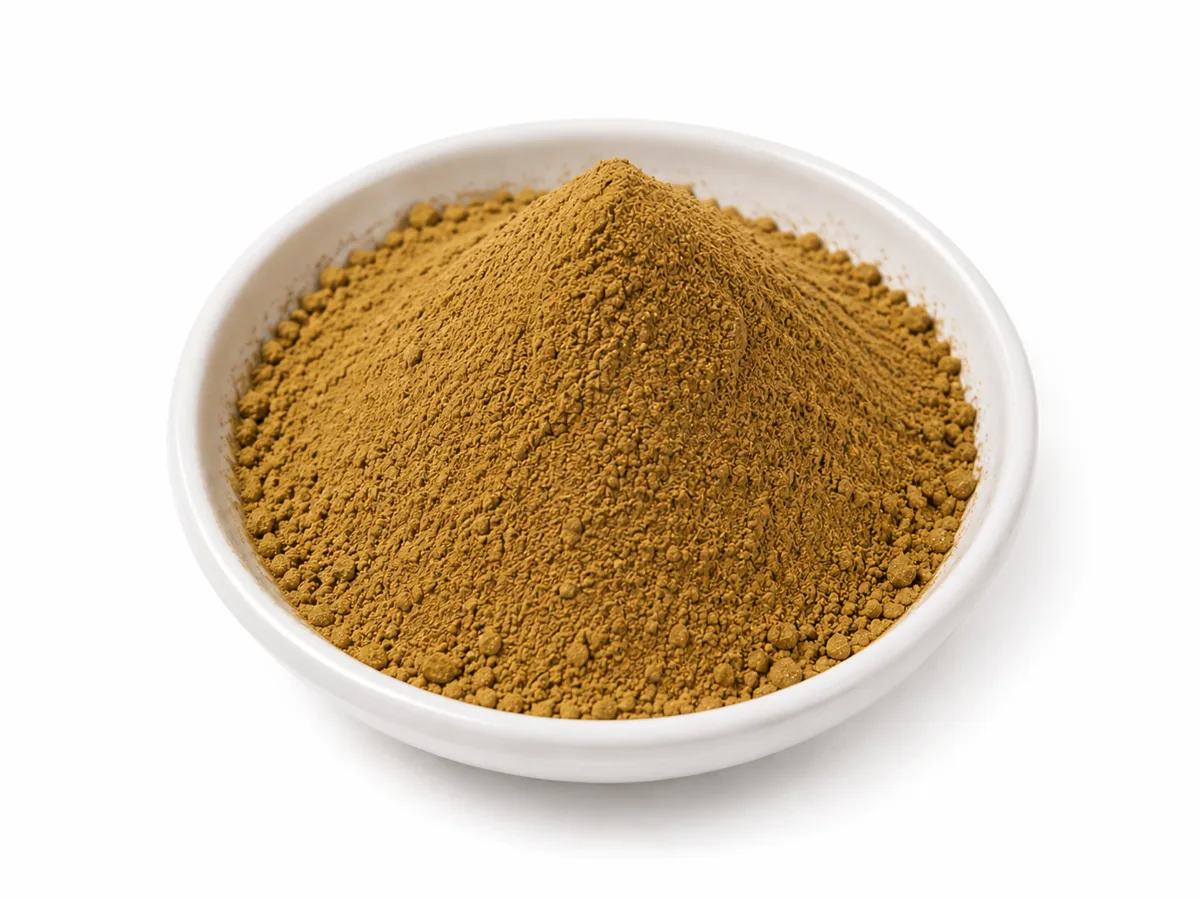
| Appearance | Yellow-tan to brown fine powder | Conforms |
| Extract Ratio (Assay, UV) | 10:1 native | 10:1 |
| Quercetin & Flavonols | Naturally present; standardised grades (5%–40% HPLC) on request | — |
| Solubility | NLT 98% | Complies |
| Particle Size | 100% through #80 mesh | Conforms |
| Loss on Drying / Moisture | NMT 5.0% w/w | 1.25% |
| Bulk Density | 0.40–0.60 g/mL | 0.56 g/mL |
| Heavy Metals (ICP-OES) | As ≤1 · Pb ≤3 · Cd ≤1 · Hg ≤0.1 ppm | B.L.Q (below limit) |
| Total Plate Count | <10,000 CFU/g | Complies |
| Yeast & Mould | <100 CFU/g | Complies |
| Coliforms | <10 CFU/g | Complies |
| E. coli / Salmonella / S. aureus | Absent | Absent |
| Shelf Life | 36 months (sealed, cool, dry) | — |
| Packaging | 25 kg HDPE drum with inner PE liner; 1 & 5 kg pouches for samples | — |
Figures shown are typical specifications for the 10:1 native grade and reflect our current supplier Certificate of Analysis; a batch-specific CoA is issued with every shipment. HPLC quercetin assay and custom standardisations are available on request. MSDS, allergen and Non-GMO declarations accompany each batch. Specifications for quercetin-standardised, water-soluble and organic grades available on request.
From selected outer peel to native extract — traceable, tested, certified
Raw Material Sourcing: Dry outer skins are sourced from onion-processing regions of India, authenticated at source and selected for clean, flavonol-rich peel. Using the outer skin — rather than the edible bulb — maximises quercetin and flavonol content and supports a consistent extract profile.
Manufacturing & Testing: Peel is cleaned, dried, extracted and concentrated to a 10:1 native ratio in GMP-certified, FSSAI-licensed facilities. Each batch runs through a full QC battery — TLC identity, UV/herb-ratio assay, sieve and bulk-density checks, heavy-metals by ICP-OES, and a complete microbiological panel — before release. Quercetin-standardised grades are assayed by HPLC against the target marker.
Documentation: Every shipment comes with a Certificate of Analysis, MSDS, Allergen Declaration, BSE/TSE-free statement, Non-GMO affidavit and Country of Origin Certificate. Halal and Kosher are available; organic certification on request. To qualify our facility or request specifications, reach our team via the certifications page or the quote form.
Full compliance for global B2B supply
Key information for global product registration and labelling
Onion (Allium cepa) has a long history of food use and is widely accepted as a food-supplement ingredient. Where used, labelling must comply with Regulation (EU) 1169/2011, and health claims must align with the EU Register; heavy-metal compliance is documented per batch.
Marketed as a dietary ingredient under DSHEA (21 CFR Part 111). No pre-market approval is required for dietary supplements, but importer facility registration with the FDA is needed. Heavy-metal limits (e.g. California Prop 65) make ICP-OES-tested material essential. Structure-function claims require substantiation and FDA notification.
A well-established food botanical, FSSAI-relevant for supplement use under the FSS (Health Supplements) Regulations 2022. Widely accepted in the Middle East (Halal grades), Southeast Asia and other markets that recognise onion-derived flavonols as functional ingredients, subject to local heavy-metal limits.
Frequently co-formulated with Onion Peel Extract
Deep-dive articles for formulators, buyers, and brand owners
Source, native vs standardised grades, CoA essentials and sourcing bulk material.
ScienceThe actives, the bioavailability question, and the human evidence behind the claims.
QualityWhy total flavonoids by UV and quercetin by HPLC give different numbers.
SourcingWhy the skin out-concentrates the bulb, and what the powder colour tells you.
RegulatoryFSSAI & GMP, contaminant limits, labelling and export documentation.
Technical and commercial questions answered by our ingredients team
Made at GMP-certified facilities, heavy-metal tested, fully documented supply. 10:1 native and quercetin-standardised grades, water-soluble and organic options. Minimum order 25 kg. Samples available for qualified buyers.
Supplied as a bulk ingredient for further manufacture. Buyers are responsible for compliance with the regulations of their destination market. This product is not intended to diagnose, treat, cure or prevent any disease.
We use cookies for analytics and to measure our advertising. Essential cookies are always on. Privacy policy