
Curcuma longa L. · Family: Zingiberaceae · Rhizome Extract
The benchmark anti-inflammatory botanical — standardised to 95% total curcuminoids by HPLC from Curcuma longa rhizome. Trusted by joint-health, antioxidant, sports-nutrition and functional-food formulators worldwide. Water-dispersible and certified-organic grades, lead-tested every batch. GMP, ISO, Halal and Kosher certified supply from India.
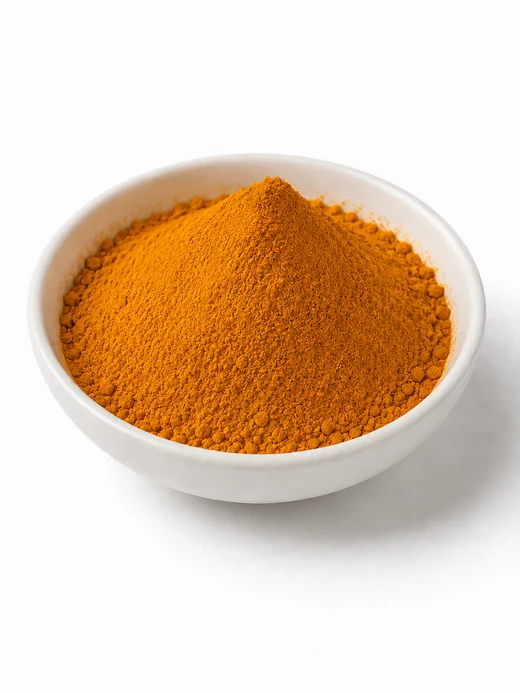
Actual Product
Curcuma longa · 95% Curcuminoids · Actual BatchThe most widely used standardised anti-inflammatory botanical
Turmeric Extract is produced from the dried rhizome of Curcuma longa — the bright golden root that has been central to Ayurvedic and culinary use for centuries. While culinary turmeric powder contains only about 2–5% curcuminoids, a standardised extract concentrates that active fraction; the most traded grade worldwide is 95% total curcuminoids by HPLC.
The active markers are the curcuminoids — a group of three closely related polyphenols: curcumin (the most abundant), demethoxycurcumin (DMC) and bisdemethoxycurcumin (BDMC). A genuine plant-derived extract shows all three in their natural ratio on the HPLC trace; that fingerprint is what separates a true botanical extract from synthetic curcumin. The rhizome also contains aromatic turmerones in its volatile oil, which are concentrated in oleoresins rather than the 95% powder.
SV Botanica sources turmeric from India's established growing belts — Erode in Tamil Nadu, Sangli in Maharashtra, Andhra Pradesh, and the high-curcumin Lakadong variety of Meghalaya — and standardises via a validated solvent-extraction and purification process, with every batch assayed by HPLC. The result is a clean, bright orange-yellow powder for joint-health, antioxidant, sports-nutrition and functional-food formulations.
We supply supplement brands, contract formulators and food & beverage companies across Europe, the USA, the Middle East and Asia. Buyers new to the category can start with our turmeric & curcumin extract buyer's guide.
Key phytochemicals driving turmeric's activity profile
The headline active fraction, standardised to 95% by HPLC. A complex of three polyphenols that defines a genuine standardised extract.
The most abundant curcuminoid (typically ~70–80% of the complex) and the reference compound for HPLC assay and most published research.
The second curcuminoid; its presence and ratio are part of the natural fingerprint used to confirm a plant-derived extract.
The third curcuminoid. All three together produce the authentic HPLC pattern that a single synthetic-curcumin peak cannot replicate.
Aromatic ar-turmerone and related sesquiterpenes from the rhizome's essential oil — concentrated in oleoresins, minimal in the 95% powder.
Native rhizome carbohydrates that dominate raw turmeric powder and are largely removed during standardisation to the 95% grade.
Evidence from clinical trials, systematic reviews, and mechanistic research
Curcumin is the most-studied dietary modulator of inflammatory signalling, acting on pathways such as NF-κB. A widely cited review summarises its mechanisms and human evidence in inflammatory conditions.
Ref: Hewlings SJ & Kalman DS, 2017; FoodsA systematic review and meta-analysis of randomised trials found standardised curcuminoids reduced knee osteoarthritis pain and improved function, supporting turmeric's leading role in joint formulations.
Ref: Daily JW et al., 2016; J Med FoodCurcuminoids scavenge free radicals and support the body's own antioxidant enzymes, a mechanism reviewed extensively in the biochemical literature on curcumin's protective activity.
Ref: Menon VP & Sudheer AR, 2007; Adv Exp Med BiolA controlled human study reported that co-administering piperine (from black pepper) markedly increased the bioavailability of curcumin — the basis for the common curcumin + black pepper pairing.
Ref: Shoba G et al., 1998; Planta MedicaA meta-analysis of randomised trials reported that curcumin/curcuminoid supplementation was associated with favourable changes in circulating lipids in certain populations, consistent with metabolic-support positioning.
Ref: Qin S et al., 2017; Nutrition JournalEarly randomised, placebo-controlled trials have explored curcumin for mood support, adding to an active research area alongside its better-established anti-inflammatory and joint applications.
Ref: Lopresti AL et al., 2014; J Affect DisordResponsible-marketing note: finished-product claims must be substantiated and compliant with each destination market's regulations. EFSA set an Acceptable Daily Intake for curcumin (E100) of 3 mg/kg body weight per day in its 2010 re-evaluation, so formulators should calculate and declare the finished-product curcuminoid dose and keep it within applicable guidance.
Select the right standardisation, form, and solubility for your formulation
| Grade | Standardisation | Form | Best For | Certifications |
|---|---|---|---|---|
| Curcumin 95% Popular | ≥95% total curcuminoids (HPLC) | Fine powder, ≥95% through #80 mesh | Joint & anti-inflammatory capsules, premium supplements | GMP, ISO, Halal, Kosher |
| Curcumin 95% Granular Tableting | ≥95% curcuminoids (HPLC), granulated | Free-flowing granules | Direct-compression tablets & high-speed lines | GMP, ISO, Halal, Kosher |
| Water-Dispersible Curcumin Bioavailable | Standardised curcuminoids, dispersible matrix | Beadlet / granular / powder | Beverages, clear liquids, gummies, shots | GMP, ISO, Food-grade |
| Certified Organic Curcumin 95% Organic | ≥95% curcuminoids, organic-certified rhizome | Fine powder | Organic & clean-label brands needing certified raw material | GMP, ISO, Organic |
| Turmeric Extract 10:1 / 20:1 Ratio | Ratio extract, lower curcuminoid level | Fine powder | Full-spectrum / traditional Ayurvedic formulas | GMP, ISO, FSSAI |
| Turmeric Oleoresin / Curcumin Colour | Curcumin colour (E100), declared curcumin % | Liquid / powder | Food & beverage natural colour applications | FSSAI, Food-grade |
Representative batch assay on file: 95% grade — 95.8% total curcuminoids by HPLC, lead <1 ppm by ICP-MS (CoA SVB-COA-TC95-0526-01). Custom curcuminoid standardisations, mesh sizes, water-dispersible and organic grades available for orders ≥100 kg. Turmeric oleoresin and curcumin colour are listed under Spices & Oleoresins.
Curcumin is bought in five forms. The 95% powder is the stocked item; the other extract grades are produced on request and the raw-rhizome forms are sourced against a confirmed order.
| Form | What it is | Specification basis | Availability |
|---|---|---|---|
| Curcumin 95% powder | Purified curcuminoid fraction of Curcuma longa rhizome | ≥95% total curcuminoids by HPLC; lead, residual solvent and microbial panel | Stocked |
| Granulated (direct-compression) | Curcumin 95% granulated for tablet lines | ≥95% curcuminoids by HPLC on the granule | On request |
| Water-dispersible curcumin | Curcuminoids in a dispersible matrix for beverages and gummies | Curcuminoid content declared on the matrix basis; carrier named | On request |
| Turmeric rhizome slices (TBC / C&S) | Dried Curcuma longa rhizome, tea-bag cut or cut & sifted; organic lots where available | Curcumin content by HPLC; moisture, foreign matter; identity | On enquiry, subject to lot; phytosanitary certificate usually required |
| Turmeric powder (ground rhizome) | Whole dried rhizome milled to mesh, not extracted | Curcumin content, ASTA colour, lead; identity | On enquiry, subject to lot |
The rhizome forms are the raw spice and are quoted against the whole turmeric page; the colour-and-flavour concentrate is turmeric oleoresin. Before comparing two curcumin quotations read curcumin 95% by HPLC vs UV and synthetic-curcumin adulteration.
Full analytical profile — Curcumin 95% grade (representative batch SVB/TC95/2605-01)
| Parameter | Specification | Typical Result |
|---|---|---|
| Botanical Source | Curcuma longa L. | Conforms |
| Plant Family | Zingiberaceae | — |
| Part Used | Rhizome | — |
| Identification (HPLC) | Positive vs. reference | Positive |
| Marker Compound | Curcuminoids (curcumin, DMC, BDMC) | — |
| Assay Method | HPLC | — |
| Total Curcuminoids | NLT 95.0% (HPLC) | 95.8% |
| Curcumin (of curcuminoids) | Typically 70–80% | 76.4% |
| Appearance | Orange-yellow fine powder | Conforms |
| Odour & Taste | Characteristic; slightly bitter | Conforms |
| Particle Size | NLT 95% through #80 mesh | 98.40% |
| Loss on Drying (105°C) | NMT 5.0% w/w | 2.18% |
| Ash Content | NMT 2.0% w/w | 0.74% |
| Bulk Density | NLT 0.30 g/mL | 0.41 g/mL |
| Solubility | Practically insoluble in water (dispersible grade available) | Conforms |
| Lead (Pb, ICP-MS) | NMT 3.0 ppm — tested every batch | <1.0 ppm |
| Heavy Metals (ICP-MS) | As ≤1.0 · Cd ≤0.3 · Hg ≤0.1 ppm | Complies |
| Synthetic Dye / Adulterant Screen | Lead chromate, metanil yellow, Sudan dyes — Absent | Absent |
| Residual Solvents | Comply with USP <467> limits | Complies |
| Pesticide Residues | Compliant with EU MRL (EC 396/2005) | Complies |
| Total Plate Count | NMT 1,000 CFU/g | 120 |
| Yeast & Mould | NMT 100 CFU/g | 15 |
| E. coli / Salmonella / S. aureus | Absent | Absent |
| Shelf Life | 24–36 months (sealed, ≤25°C, <60% RH, dark) | — |
| Packaging | 1 / 5 / 25 kg HDPE drum with double PE inner liner | — |
Curcuminoids are quantified by HPLC — the reference method that resolves curcumin, DMC and BDMC and exposes synthetic substitution. Because turmeric is a historic lead-adulteration risk, every batch is tested for lead by ICP-MS and screened for illegal dyes. A current Certificate of Analysis, MSDS, and allergen/Non-GMO declarations are issued with every batch. Specifications for granular, water-dispersible, organic and ratio grades available on request.
From rhizome to finished extract — traceable, tested, certified
Raw Material Sourcing: Turmeric rhizome is sourced under Good Agricultural and Collection Practices (GACP) from India's principal growing belts — Erode (Tamil Nadu), Sangli (Maharashtra), Andhra Pradesh, and the high-curcumin Lakadong variety of Meghalaya. Incoming material is authenticated by botanical identity and by HPLC curcuminoid fingerprint against reference standards before processing.
Manufacturing: Extraction and purification are carried out in GMP-certified facilities (WHO-GMP and ISO audited) using validated parameters to reach 95% total curcuminoids. Each batch runs a full QC battery — HPLC curcuminoid assay, an adulterant and synthetic-curcumin screen, lead and heavy-metals by ICP-MS, pesticide-residue GC-MS/LC-MS, residual solvents, and a full microbiological panel — before release. Lead testing on every batch is non-negotiable given turmeric's documented adulteration history.
Documentation: Every shipment comes with Certificate of Analysis (CoA), MSDS, Allergen Declaration, BSE/TSE-free statement, Non-GMO affidavit, Country of Origin Certificate, and Phytosanitary Certificate. Organic, Halal and Kosher certificates are available for the appropriate grades. Buyers can review our full process in the turmeric sourcing & quality guide and our adulteration & synthetic-curcumin guide.
Full compliance for global B2B supply
Key information for global product registration and labelling
Curcumin is approved as the food colour E100, and turmeric has a long history of food use. EFSA set an Acceptable Daily Intake of 3 mg/kg body weight/day for curcumin in its 2010 re-evaluation. Highly concentrated curcumin extracts intended for supplements should be checked against current novel-food positions, and labelling must comply with Regulation (EU) 1169/2011. Confirm curcuminoid dose and heavy-metal limits before launch.
Turmeric and curcumin are classified as dietary ingredients under DSHEA (21 CFR Part 111), and turmeric/curcumin have GRAS status for defined food uses. No pre-market approval is required for dietary supplements; importer facility registration with the FDA is required. Structure-function claims are permissible with 30-day FDA notification and substantiation; joint and anti-inflammatory claims must be credibly supported.
FSSAI-compliant for food-supplement use under the FSS (Health Supplements, Nutraceuticals) Regulations 2022. Accepted in Japan, the Middle East (Halal grades), Southeast Asia, Australia (TGA) and Canada (NNHPD). Because turmeric is a known lead-adulteration risk, heavy-metal (especially lead) limits should be confirmed per destination market and supported by ICP-MS data on each CoA. See our curcumin regulatory compliance guide.
Deep-dive articles for formulators, buyers, and brand owners
Specify total curcuminoids by HPLC, set grade and solubility, read the CoA, and meet EU and US documentation.
SourcingIndian turmeric origins, high-curcumin varieties, contaminant control and a supplier-qualification checklist.
ResearchWhat the evidence shows on inflammation, joints, antioxidant capacity and metabolism — with a safety guardrail.
TechnicalWhy HPLC and UV curcuminoid numbers differ, and how to read the standardisation on a CoA.
QualityLead chromate, metanil yellow, Sudan dyes and synthetic curcumin — what to test and how to spot them.
RegulatoryE100, EFSA ADI, novel-food positions and heavy-metal limits across the EU, US and Asian markets.
MarketPiperine, phytosome and dispersible technologies, demand drivers and responsible-claims guidance.
Frequently co-formulated with Turmeric Extract
Technical and commercial questions answered by our ingredients team
Made at GMP-certified facilities, HPLC-standardised, lead-tested and fully documented supply. 95% curcuminoids, plus granular, water-dispersible and certified-organic grades. Minimum order 25 kg. Samples available for qualified buyers.
Supplied as a bulk ingredient for further manufacture. Buyers are responsible for compliance with the regulations of their destination market. This product is not intended to diagnose, treat, cure or prevent any disease.
We use cookies for analytics and to measure our advertising. Essential cookies are always on. Privacy policy