
Vitis vinifera L. · Family: Vitaceae · Seed Extract
A polyphenol-rich grape seed extract standardised to proanthocyanidins NLT 95% — with the assay method declared on every certificate, because OPC figures measured by different methods are not comparable. Prepared from the seed of Vitis vinifera for antioxidant, vascular-support, cosmetic and functional-food formulators. CoA-backed, HPLC-authenticated supply from India.
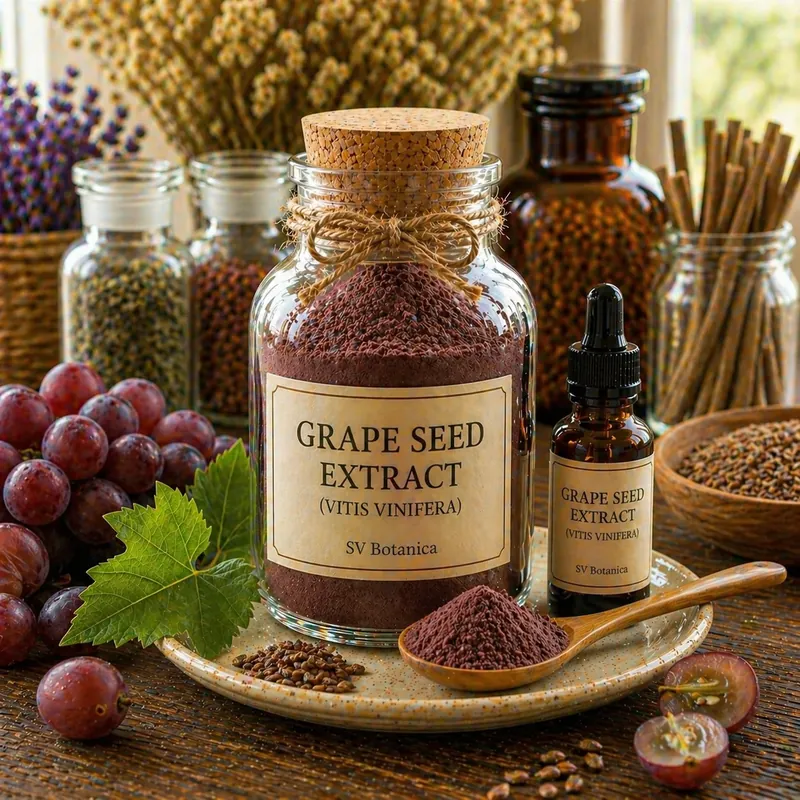
Standardised Grade
Vitis vinifera · 95% ProanthocyanidinsThe most method-sensitive assay in the botanical trade — and how we handle it
Grape seed (Vitis vinifera L.) extract is one of the most widely used antioxidant actives in the world, made from a by-product of the wine and juice industries. The seed is unusually rich in proanthocyanidins — condensed tannins built from catechin and epicatechin units — and concentrated extracts deliver that polyphenol load at a controlled specification rather than as a variable agricultural material.
Buying grape seed extract well requires understanding one thing above all others: the number on the certificate depends heavily on how it was measured. Proanthocyanidins are not a single compound but a polymeric series, and at least four assay methods are in common commercial use — DMAC, the Porter (butanol-HCl) method, vanillin, and various total-polyphenol methods such as Folin-Ciocalteu. They measure related but different things, and they return materially different numbers on the same sample.
That is why "95% OPC" from two suppliers can describe two quite different materials, and why some quotations that look competitive are simply using a method that reads high. SV Botanica declares the assay method on every certificate and reports the monomer profile — catechin, epicatechin and gallic acid — by HPLC, which gives buyers a compound-specific anchor that is portable between suppliers in a way an OPC percentage is not.
The second thing to know is that grape seed extract has a well-documented adulteration history, chiefly with peanut skin and pine bark — both cheap, both proanthocyanidin-rich, and the first carrying a genuine allergen consequence. Our authenticity package is built specifically around detecting those.
The polyphenol series that defines grape seed
Condensed tannins of two to roughly ten flavan-3-ol units — the oligomeric fraction that gives the extract its name and most of its commercial identity.
The monomeric flavan-3-ol building blocks. Reported by HPLC as a compound-specific anchor that no OPC percentage alone can provide.
Defined dimeric procyanidins used as chromatographic reference points and part of the extract's characteristic fingerprint.
Grape seed proanthocyanidins carry a characteristic degree of galloylation — a genuine point of difference from pine bark and peanut skin.
Longer chains beyond the oligomeric range. Present in all grape seed extracts; the oligomer-to-polymer balance is a real quality variable.
The wider phenolic pool, sometimes used as an alternative standardisation basis — and a frequent source of specification confusion.
Why formulators specify a method-declared proanthocyanidin extract
Grape seed is among the most concentrated botanical sources of proanthocyanidins available, giving formulators a very high antioxidant load per gram and efficient use of fill volume.
DMAC, Porter, vanillin and Folin methods return materially different figures on the same sample. We state which one produced the number, so your specification means something and quotations become comparable.
Catechin, epicatechin and gallic acid reported per batch give a compound-specific anchor. Unlike an OPC percentage, these numbers are portable between suppliers and laboratories.
Grape seed OPCs are among the best-recognised botanical actives for vascular and circulatory-support positioning, with strong consumer familiarity in both supplement and cosmetic categories.
The extract is an established cosmetic ingredient for antioxidant and anti-ageing formulations, with good water solubility and a recognised INCI listing.
Water-soluble at typical use levels, suiting beverages, sachets and effervescents as well as capsules and tablets — with astringency the variable to design around.
These are functional and physico-chemical properties of the actives; SV Botanica does not make medical or therapeutic claims for this ingredient.
Specify the number and the method — one without the other is not a specification
| Grade | Standardisation | Form | Best For | Solubility |
|---|---|---|---|---|
| Grape Seed Extract 95% Standard | Proanthocyanidins NLT 95% — method declared | Light tan to reddish-brown fine powder, ≥95% through 40 mesh | Antioxidant & vascular supplements, capsules & tablets | Water-soluble |
| Grape Seed Extract 80% Alternative assay | Proanthocyanidins NLT 80% — method declared | Light tan to reddish-brown fine powder | Cost-tuned blends, multi-ingredient formulas | Water-soluble |
| Grape Seed Extract Polyphenol Basis Polyphenol | Total polyphenols NLT 90% (Folin) | Reddish-brown fine powder | Where a polyphenol claim rather than an OPC claim is required | Water-soluble |
| Grape Seed Extract Low-Monomer Oligomer-rich | OPC-enriched, monomer content limited | Light tan fine powder | Formats where oligomer fraction is specified | Water-soluble |
| Grape Seed Extract Cosmetic Cosmetic | Proanthocyanidins to specification, low colour | Pale tan fine powder | Serums, creams & cosmetic antioxidant actives | Water/glycol-soluble |
The 95% proanthocyanidin grade is our CoA-backed flagship, supplied with the assay method named on the certificate and the catechin, epicatechin and gallic acid monomer profile reported by HPLC. Please state the required method in your specification — a 95% figure by one method is not equivalent to 95% by another, and comparing quotations without matching the method is the most common error in grape seed procurement. Alternative assay bases, oligomer-enriched and low-colour cosmetic grades, custom mesh and packaging can be quoted against buyer specification and order volume.
Grape Seed Extract is bought in five forms. The standardised extract is the stocked item; granulated and dispersible grades are produced on request and raw botanical forms are sourced against a confirmed order.
| Form | What it is | Specification basis | Availability |
|---|---|---|---|
| Standardised extract powder | Vitis vinifera seed extract, dried and milled | NLT 95% proanthocyanidins, method declared | Stocked |
| Granulated (direct-compression) | Extract granulated for tablet lines | Same marker, declared on the granule | On request |
| Water-dispersible / soluble | Extract in a dispersible matrix for beverages, gummies and sachets | Marker declared on the matrix basis; carrier named | On request |
| Seed powder (non-extracted) | Cleaned Vitis vinifera seed, milled to mesh | Botanical identity by TLC; heavy metals and microbial panel | On enquiry, subject to lot; phytosanitary certificate usually required |
| Whole seed | Cleaned, graded whole seed | Purity, moisture, foreign matter; pesticide screen | On enquiry, subject to lot; spice-trade item |
A marker percentage without its assay method is not a specification; ask for the method and the plant part on every quotation. Read Grape Seed Extract: A Complete Buyer's Guide, Proanthocyanidins, OPCs and How Grape Seed Extract Is Standardised and Grape Seed Extract Adulteration: Peanut Skin, Pine Bark and How to Detect Them before comparing offers.
Full product specification for Grape Seed Extract 95% proanthocyanidins. Values are specification limits, not batch results; a batch-specific CoA is issued per shipment.
| Parameter | Specification / Limit | Method |
|---|---|---|
| Botanical Source | Vitis vinifera L. | — |
| Plant Family | Vitaceae | — |
| Part Used | Seed | — |
| Country of Origin | India | — |
| Appearance | Fine powder | Organoleptic |
| Colour | Light tan to reddish-brown* | Organoleptic |
| Odour | Characteristic | Organoleptic |
| Taste | Characteristic, astringent | Organoleptic |
| Identification | Corresponds to reference extract — positive | By TLC / HPLC |
| Assay Method | Declared per batch (DMAC / Porter / vanillin) | Declaration |
| Proanthocyanidins (% w/w, dry basis) | NLT 95.0 | Method as declared |
| Total Polyphenols (% w/w) | Reported per batch | Folin-Ciocalteu |
| Catechin (% w/w) | Reported per batch | By HPLC |
| Epicatechin (% w/w) | Reported per batch | By HPLC |
| Gallic Acid (% w/w) | Reported per batch | By HPLC |
| Peanut / Pine Bark Marker Screen | Not detected | HPLC fingerprint |
| Loss on Drying (at 105°C, % w/w) | NMT 5.0 | IP-2014 |
| pH (1% w/v solution) | 4 – 6 | IP-2014 |
| Bulk Density (g/ml) | NLT 0.35 | IP-2014 |
| Particle Size (#40 mesh, % w/w) | NLT 95 | Sieve |
| Total Ash (% w/w) | NMT 5 | IP-2014 |
| Acid Insoluble Ash (% w/w) | NMT 1 | IP-2014 |
| Residual Solvent (Ethanol, ppm) | NMT 5,000 | By GC |
| Lead (ppm) | NMT 1.0 | ICP-MS |
| Arsenic (ppm) | NMT 1.0 | ICP-MS |
| Cadmium (ppm) | NMT 0.3 | ICP-MS |
| Mercury (ppm) | NMT 0.1 | ICP-MS |
| Pesticide Residues | Complies (EU MRL, on request) | GC-MS / LC-MS/MS |
| Ethylene Oxide (ETO) | Not treated — declaration provided | LC-MS/MS (on request) |
| Ochratoxin A (ppb) | NMT 2 | HPLC-FLD |
| Allergen Status | Peanut-free — declaration provided | Declaration |
| Total Plate Count (cfu/g) | NMT 1,000 | USP <2021> |
| Yeast & Moulds / Fungi (cfu/g) | NMT 100 | USP <2021> |
| Escherichia coli | Absent | USP <2022> |
| Salmonella sp. | Absent | USP <2022> |
| Staphylococcus aureus | Absent | USP <2022> |
| Cultivation | Cultivated | Declaration |
| Kosher / Halal | Certified (on request) | Certification |
| Shelf Life | 36 months from date of manufacture, in original packed condition | — |
| Storage | Cool, dry place away from light and moisture, in tightly sealed containers | — |
*The product is of herbal origin; slight colour variation may occur due to geographical and seasonal variation in the raw material. Proanthocyanidin content is method-dependent and the method is named on every certificate — a figure without its method cannot be compared between suppliers. The catechin, epicatechin and gallic acid monomer profile is reported by HPLC as a compound-specific anchor. Because grape seed extract has a documented adulteration history with peanut skin and pine bark, an HPLC fingerprint screen for those markers and a peanut-free declaration are supplied as standard. Ochratoxin A is tested given the material's origin in the grape processing chain. A current Certificate of Analysis and MSDS are issued with every batch.
From seed to standardised extract — authenticated, tested, documented
Raw Material & Authentication: The extract is prepared from Vitis vinifera seed, a by-product of the grape processing chain. Because grape seed extract is one of the most documented adulteration targets in the botanical trade — peanut skin and pine bark being the classic substitutes — identity is confirmed by TLC and by an HPLC fingerprint screened specifically against those markers, on every batch.
Manufacturing & Testing: Grape Seed Extract is manufactured at certified facilities in India. Each batch runs through a full QC battery — proanthocyanidins by a named and declared method, total polyphenols by Folin, catechin, epicatechin and gallic acid by HPLC, loss on drying, pH, bulk density, ash and acid-insoluble ash, mesh, residual solvent by GC, heavy metals by ICP-MS, ochratoxin A, pesticide residue screening, and a complete USP microbiological panel — before release.
Documentation & Allergen Position: Every shipment is supplied against a batch-specific Certificate of Analysis with an MSDS and a peanut-free declaration. That declaration is not a formality on this ingredient: peanut skin adulteration of grape seed extract is documented, and it would introduce an undeclared major allergen into a finished product. Halal, Kosher and Organic certification are available — see our guides on EU pesticide MRL compliance and EU import requirements for botanical extracts.
What backs every batch of Grape Seed extract
Key information for global product registration and labelling
Used as a botanical active in supplement, functional-food and beverage formats, the extract is supplied to a defined proanthocyanidin specification with the assay method declared. Grape seed extract has a long-established position in supplement markets worldwide and derives from a food-chain by-product, which supports its regulatory position. Buyers remain responsible for determining suitability and for compliance with the relevant food-supplement regulations in their market. This product is not intended to diagnose, treat, cure or prevent any disease.
Peanut skin is a documented adulterant of grape seed extract, and undeclared peanut material in a finished product is a serious allergen failure rather than a quality shortfall. We supply a peanut-free declaration as standard and screen the HPLC fingerprint against peanut and pine bark markers on every batch. Buyers with peanut-allergen programmes should treat grape seed extract as a material requiring positive authenticity evidence, not merely a supplier assurance.
Vitis vinifera seed extract is an established cosmetic ingredient with a recognised INCI listing, used in antioxidant and anti-ageing formulations. Supplied from India by SV Botanica — FSSAI Central Licence holder and an APEDA-registered exporter — Kosher certified, against a batch-specific Certificate of Analysis with export documentation on request.
Deep-dive articles on grape seed extract for formulators, buyers, and brand owners
Why '95% OPC' means nothing without a method, and how to write a specification that fixes it.
TechnicalDMAC, Porter, vanillin and Folin compared — four methods, four different answers.
QualityPeanut skin and pine bark — the botanical trade's best-documented substitution, and how to detect it.
ApplicationsAntioxidant, vascular, beauty and beverage formats — plus astringency and protein binding.
ProcurementA scored checklist for qualifying a grape seed extract supplier before you place a bulk order.
MarketWhere grape seed demand is growing, and how by-product economics shape supply.
Frequently co-formulated with Grape Seed Extract in antioxidant, vascular & beauty blends
Technical and commercial questions answered by our ingredients team
Proanthocyanidin-standardised with the method declared, monomer profile reported, peanut and pine bark screened. Vitis vinifera seed extract, NLT 95%. Samples available for qualified buyers.
Supplied as a bulk ingredient for further manufacture. Buyers are responsible for compliance with the regulations of their destination market. This product is not intended to diagnose, treat, cure or prevent any disease.
We use cookies for analytics and to measure our advertising. Essential cookies are always on. Privacy policy