
Ginkgo biloba L. · Family: Ginkgoaceae · Leaf Extract
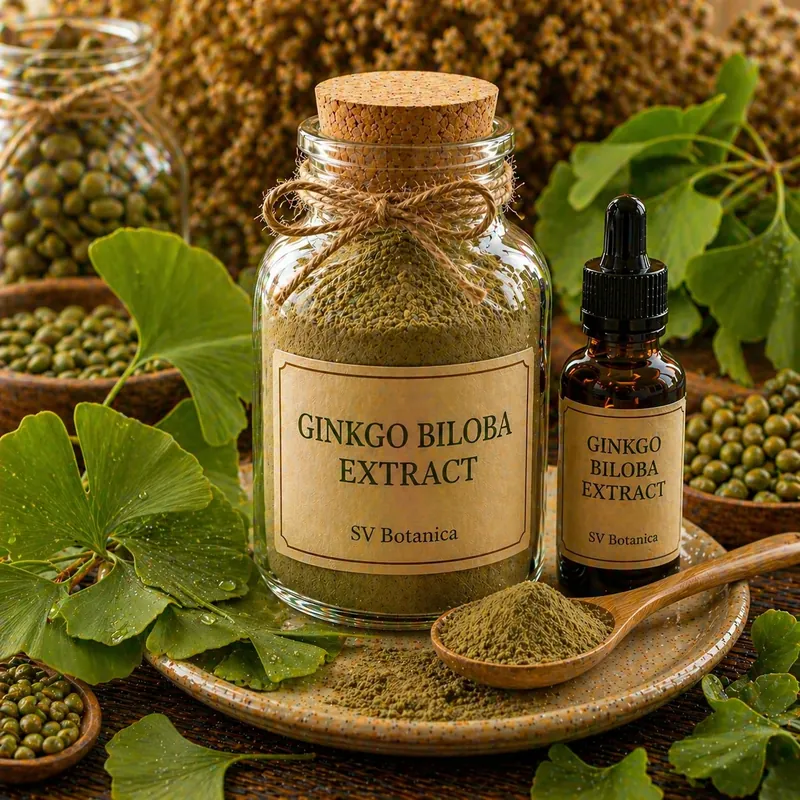
A ginkgo leaf extract built to the classic 24/6 specification — flavone glycosides NLT 24%, terpene lactones NLT 6% by HPLC — with ginkgolic acid limited to NMT 5 ppm and the flavonol aglycone ratio verified on every batch. Ginkgo is the most adulterated botanical in the trade; that ratio is how we prove ours isn't. CoA-backed supply from India.
24/6 Standardised
Ginkgolic Acid NMT 5 ppmThe industry's most copied specification — and its most adulterated ingredient
Ginkgo biloba L. is a living fossil: the sole surviving member of an order of trees that predates flowering plants, unchanged for something close to two hundred million years. Its fan-shaped leaf yields one of the most studied and most widely sold botanical extracts in the world, used across cognitive-support, memory and circulatory formulations.
Ginkgo is unusual in that the industry converged long ago on a single dual specification: flavone glycosides NLT 24% and terpene lactones NLT 6%, universally shorthanded as "24/6". Nearly every commercial ginkgo extract quotes it. That convergence is genuinely useful — buyers compare like with like — but it created a precise, well-known target, and a precise target is exactly what invites adulteration.
And ginkgo is, by a wide margin, the most adulterated botanical in commercial trade. The reason is arithmetic: the flavone glycoside assay works by hydrolysing glycosides to their flavonol aglycones and measuring those. Cheap flavonol sources — rutin, quercetin, and extracts of Sophora japonica or buckwheat — hydrolyse to the same aglycones. A weak ginkgo extract spiked with rutin will read 24% flavone glycosides while containing far less real ginkgo.
The defence is well established and we apply it on every batch: the quercetin:kaempferol:isorhamnetin aglycone ratio. Authentic ginkgo leaf produces these three in a characteristic proportion. Rutin and Sophora contribute quercetin almost exclusively, which distorts the ratio in a way no assay percentage reveals. Alongside it we hold ginkgolic acid to NMT 5 ppm — a genuine safety limit, since these alkylphenols are allergenic and cytotoxic and are removed by proper processing, not by good fortune.
Two active families, one safety limit, and one authenticity control
The flavonol glycoside fraction standardised to NLT 24%. Assayed by hydrolysis to quercetin, kaempferol and isorhamnetin, then summed.
Unique diterpene trilactones found nowhere else in the plant kingdom — part of the terpene lactone fraction and a genuine identity marker.
A sesquiterpene trilactone, also ginkgo-exclusive, making up the remainder of the 6% terpene lactone specification alongside the ginkgolides.
The authenticity control. Authentic ginkgo yields these aglycones in a characteristic proportion; flavonol spiking distorts it.
A limit parameter, not an active. Allergenic and cytotoxic alkylphenols held to NMT 5 ppm by proper processing.
A minor phenolic fraction of the leaf, contributing to the full-spectrum profile and to the extract's characteristic fingerprint.
Why formulators specify a ratio-verified, ginkgolic-acid-controlled ginkgo extract
Flavone glycosides NLT 24% and terpene lactones NLT 6% by HPLC — the industry-standard dual basis that lets buyers compare materials directly and formulate to a known active load.
The single control that separates authentic ginkgo from rutin-spiked material. We report the quercetin:kaempferol:isorhamnetin proportion on every batch, because the 24% figure alone cannot detect spiking.
A real safety limit, not a formality. These alkylphenols are allergenic and cytotoxic, and holding them below 5 ppm requires deliberate processing — it is a direct readout of manufacturing quality.
Ginkgo is among the most consumer-recognised botanicals for memory and cognitive-support formats, needing no category education and carrying decades of formulation heritage.
The terpene lactone fraction underpins ginkgo's long-established position in circulatory and microcirculation-support formulations, including eye- and ear-health blends.
Ginkgolides and bilobalide occur in no other plant. Their presence at specification is positive evidence of genuine ginkgo — which is why the terpene lactone half of 24/6 is harder to fake than the flavone half.
These are functional and physico-chemical properties of the actives; SV Botanica does not make medical or therapeutic claims for this ingredient.
The 24/6 standard, plus water-soluble and full-spectrum options
| Grade | Standardisation | Form | Best For | Solubility |
|---|---|---|---|---|
| Ginkgo Extract 24/6 Standard | Flavone glycosides NLT 24%, terpene lactones NLT 6% (HPLC); ginkgolic acid NMT 5 ppm | Brown to yellowish-brown fine powder, ≥95% through 40 mesh | Cognitive, memory & circulatory supplements; capsules & tablets | Partially water-soluble |
| Ginkgo Extract 24/6 Low-GA Ultra-low | As above, ginkgolic acid NMT 1 ppm | Brown to yellowish-brown fine powder | Markets or customers requiring a tighter alkylphenol limit | Partially water-soluble |
| Ginkgo Extract WS Water-soluble | Cold-water-soluble spray-dried; 24/6 to specification | Yellowish-brown free-flowing powder | Beverages, sachets, effervescents & drink mixes | Cold-water-soluble |
| Ginkgo Extract Ratio Full-spectrum | Native 50:1 ratio; markers reported | Brown fine powder | Traditional formats and herbal blends | Grade-dependent |
The 24/6 grade with ginkgolic acid NMT 5 ppm is our CoA-backed flagship. Every batch carries the quercetin:kaempferol:isorhamnetin aglycone ratio as a standard reported parameter, not an on-request extra — on this ingredient it is the control that matters most, and a supplier who cannot produce it cannot demonstrate authenticity. Alternative ginkgolic acid ceilings, cold-water-soluble and native-ratio grades, custom mesh and packaging can be quoted against buyer specification and order volume.
Ginkgo Biloba Extract is bought in five forms. The standardised extract is the stocked item; granulated and dispersible grades are produced on request and raw botanical forms are sourced against a confirmed order.
| Form | What it is | Specification basis | Availability |
|---|---|---|---|
| Standardised extract powder | Ginkgo biloba leaf extract, dried and milled | 24% flavone glycosides and 6% terpene lactones (HPLC), ginkgolic acids controlled | Stocked |
| Granulated (direct-compression) | Extract granulated for tablet lines | Same marker, declared on the granule | On request |
| Water-dispersible / soluble | Extract in a dispersible matrix for beverages, gummies and sachets | Marker declared on the matrix basis; carrier named | On request |
| Leaf powder (non-extracted) | Dried Ginkgo biloba leaf, milled to mesh | Botanical identity by TLC; heavy metals and microbial panel | On enquiry, subject to lot; phytosanitary certificate usually required |
| Cut leaf (tea-bag cut) | Dried leaf, tea-bag cut or cut & sifted | Identity, moisture, foreign matter | On enquiry; for teas and in-house extraction |
A marker percentage without its assay method is not a specification; ask for the method and the plant part on every quotation. Read Ginkgo Biloba Extract: A Complete Buyer's Guide, The 24/6 Specification: How Ginkgo Extract Is Standardised and Ginkgo: The Most Adulterated Botanical, and How Authenticity Is Proven before comparing offers.
Full product specification for Ginkgo Biloba Leaf Extract 24/6. Values are specification limits, not batch results; a batch-specific CoA is issued per shipment.
| Parameter | Specification / Limit | Method |
|---|---|---|
| Botanical Source | Ginkgo biloba L. | — |
| Plant Family | Ginkgoaceae | — |
| Part Used | Leaf | — |
| Country of Origin | India | — |
| Appearance | Fine powder | Organoleptic |
| Colour | Brown to yellowish-brown* | Organoleptic |
| Odour | Characteristic | Organoleptic |
| Taste | Characteristic, slightly bitter | Organoleptic |
| Identification | Corresponds to reference extract — positive | By TLC / HPLC |
| Total Flavone Glycosides (% w/w, dry basis) | NLT 24.0 | By HPLC |
| Total Terpene Lactones (% w/w, dry basis) | NLT 6.0 | By HPLC |
| — Ginkgolides A, B, C (% w/w) | Reported per batch | By HPLC |
| — Bilobalide (% w/w) | Reported per batch | By HPLC |
| Ginkgolic Acids (ppm) | NMT 5 | By HPLC |
| Quercetin : Kaempferol : Isorhamnetin | Within authentic range — reported per batch | By HPLC |
| Rutin | Not detected | By HPLC |
| Loss on Drying (at 105°C, % w/w) | NMT 5.0 | IP-2014 |
| pH (1% w/v solution) | 4 – 7 | IP-2014 |
| Bulk Density (g/ml) | NLT 0.35 | IP-2014 |
| Particle Size (#40 mesh, % w/w) | NLT 95 | Sieve |
| Total Ash (% w/w) | NMT 5 | IP-2014 |
| Acid Insoluble Ash (% w/w) | NMT 1 | IP-2014 |
| Residual Solvent (Acetone / Ethanol, ppm) | NMT 5,000 | By GC |
| Lead (ppm) | NMT 1.0 | ICP-MS |
| Arsenic (ppm) | NMT 1.0 | ICP-MS |
| Cadmium (ppm) | NMT 0.3 | ICP-MS |
| Mercury (ppm) | NMT 0.1 | ICP-MS |
| Pesticide Residues | Complies (EU MRL, on request) | GC-MS / LC-MS/MS |
| Ethylene Oxide (ETO) | Not treated — declaration provided | LC-MS/MS (on request) |
| Total Plate Count (cfu/g) | NMT 1,000 | USP <2021> |
| Yeast & Moulds / Fungi (cfu/g) | NMT 100 | USP <2021> |
| Escherichia coli | Absent | USP <2022> |
| Salmonella sp. | Absent | USP <2022> |
| Staphylococcus aureus | Absent | USP <2022> |
| Cultivation | Cultivated | Declaration |
| Kosher / Halal | Certified (on request) | Certification |
| Shelf Life | 36 months from date of manufacture, in original packed condition | — |
| Storage | Cool, dry place away from light and moisture, in tightly sealed containers | — |
*The product is of herbal origin; slight colour variation may occur due to geographical and seasonal variation in the raw material. Two parameters on this specification exist specifically because ginkgo is the most adulterated botanical in commercial trade. The quercetin:kaempferol:isorhamnetin aglycone ratio is reported on every batch because the 24% flavone glycoside figure alone cannot detect spiking with rutin, quercetin or Sophora japonica flavonols — all of which hydrolyse to the same aglycones measured by the assay. Rutin is separately screened and must be not detected. Ginkgolic acids are held to NMT 5 ppm as a safety limit; these alkylphenols are allergenic and cytotoxic and their removal is a deliberate processing step. A current Certificate of Analysis and MSDS are issued with every batch.
From leaf to 24/6 extract — ratio-verified, alkylphenol-controlled, documented
Raw Material & Authentication: The extract is prepared from cultivated Ginkgo biloba leaf. Because ginkgo is the most adulterated botanical in commercial trade, authenticity control here is not a formality — every batch is checked for the quercetin:kaempferol:isorhamnetin aglycone ratio against the authentic range, screened for rutin, and confirmed for the presence of ginkgolides and bilobalide, which occur in no other plant and therefore constitute positive evidence of genuine ginkgo.
Manufacturing & Testing: Ginkgo Leaf Extract is manufactured at certified facilities in India. Each batch runs through a full QC battery — flavone glycosides and terpene lactones by HPLC with the individual ginkgolides and bilobalide resolved, ginkgolic acids by HPLC against the 5 ppm ceiling, aglycone ratio, rutin screen, loss on drying, pH, bulk density, ash, mesh, residual solvent by GC, heavy metals by ICP-MS, pesticide residue screening, and a complete USP microbiological panel — before release.
Documentation: Every shipment is supplied against a batch-specific Certificate of Analysis carrying both halves of the 24/6 specification, the ginkgolic acid figure and the aglycone ratio, with an MSDS. Halal, Kosher and Organic certification are available — see our guides on EU pesticide MRL compliance and EU import requirements for botanical extracts.
What backs every batch of Ginkgo extract
Key information for global product registration and labelling
Ginkgolic acids are alkylphenols structurally related to the urushiols of poison ivy, and they are allergenic and cytotoxic. Pharmacopoeial and industry practice converges on a limit of not more than 5 ppm in a finished ginkgo extract, and some buyers specify tighter. This is not a nominal parameter: removing ginkgolic acids requires a deliberate processing step, so the figure on a certificate is a direct readout of manufacturing quality rather than of raw-material luck. We hold NMT 5 ppm as standard and can supply to a NMT 1 ppm specification on request.
Supplied as a botanical active to the 24/6 specification with full analytical documentation. Ginkgo is among the most extensively studied botanicals, but claim frameworks differ substantially by market and several jurisdictions constrain what may be said about cognitive and circulatory ingredients. Buyers remain responsible for determining suitability and for compliance with the food-supplement regulations applying in their market. Note also that ginkgo is commonly flagged for interaction with anticoagulant medication in consumer guidance — a labelling consideration for finished-product formulators. This product is not intended to diagnose, treat, cure or prevent any disease.
Supplied from India by SV Botanica — FSSAI Central Licence holder and an APEDA-registered exporter — with authenticity controls appropriate to an ingredient of this adulteration profile. The material is Kosher certified and shipped against a batch-specific Certificate of Analysis with export documentation available on request.
Deep-dive articles on ginkgo biloba extract for formulators, buyers, and brand owners
Why 24/6 alone is not a sufficient specification, and the three lines you must add to it.
TechnicalHow the flavone glycoside assay works, why that mechanism enables spiking, and what the ratio proves.
QualityThe most adulterated botanical in the trade — rutin, Sophora japonica, and how detection actually works.
ApplicationsCognitive, circulatory, eye-health and beverage formats — and the interaction labelling question.
ProcurementA scored checklist weighted almost entirely around authenticity capability.
MarketWhere ginkgo demand sits, and why a commoditised specification produced a quality crisis.
Frequently co-formulated with Ginkgo Biloba Extract in cognitive & circulatory blends
Technical and commercial questions answered by our ingredients team
24/6 by HPLC, ginkgolic acid NMT 5 ppm, flavonol aglycone ratio verified and rutin screened on every batch. Samples available for qualified buyers.
Supplied as a bulk ingredient for further manufacture. Buyers are responsible for compliance with the regulations of their destination market. This product is not intended to diagnose, treat, cure or prevent any disease.
We use cookies for analytics and to measure our advertising. Essential cookies are always on. Privacy policy