
Rubia cordifolia L. · Family: Rubiaceae · Root & Rhizome Extract
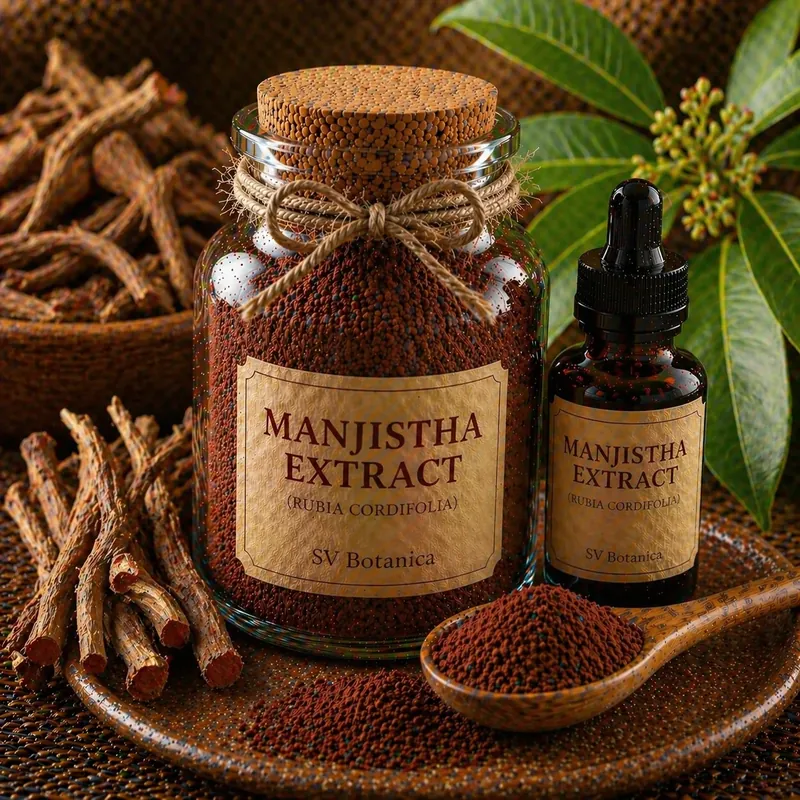
Ayurveda's manjistha — Indian madder, the classical varnya or complexion botanical — supplied with species verified by HPLC against Rubia tinctorum and the anthraquinone profile reported per batch. A closely related madder was withdrawn from the European market on genotoxicity grounds, which is why we treat species control here as a safety matter and say so on the product page. CoA-backed supply from India.
Species Verified
R. cordifolia · R. tinctorum ExcludedWhy the genus matters more here than the plant
Manjistha (Rubia cordifolia) — Indian madder — is a climbing perennial of the Rubiaceae family whose red root and rhizome have been used in Ayurveda for well over a thousand years, classically as a varnya or complexion botanical and as a raktashodhana or blood-purifying herb. Today its principal commercial use is in cosmetic and skin-care formulation, where its long traditional association with complexion translates directly into a modern positioning.
The important thing to understand about manjistha is not the plant but the genus. Rubia species are the madders — historically the world's most important source of red dye — and they share a chemistry built on anthraquinones: purpurin, munjistin, alizarin and related compounds. That chemistry is what makes them red, and it is also what has attracted regulatory attention.
Specifically: Rubia tinctorum, the European dyer's madder, was the subject of regulatory action in Europe on genotoxicity grounds associated with the anthraquinone lucidin. That history belongs to a different species from the one we supply — but it belongs to the same genus, the plants are related and visually comparable as dried red roots, and R. tinctorum is a cheap, widely available dye material. Which makes species substitution here a matter with a safety dimension rather than merely a commercial one.
We therefore verify species by HPLC fingerprint against authentic R. cordifolia reference material with R. tinctorum explicitly excluded, and we report the anthraquinone profile per batch rather than leaving the constituent class that carries the regulatory history undocumented. We also state the position plainly rather than quietly: buyers formulating for oral use should put the anthraquinone question into their own safety and regulatory review, and should not treat a supplier's silence on it as an all-clear.
The anthraquinone chemistry of Indian madder root
A principal anthraquinone of R. cordifolia root, contributing to the red colour and forming part of the fingerprint used for species verification.
Named for manjistha itself, and one of the more characteristic constituents of this species — particularly useful in distinguishing it from other madders.
The classic madder chromophores, shared across the genus, which is precisely why the pattern rather than the presence of anthraquinones is what identifies the species.
A further characteristic anthraquinone glycoside of the species, reported as part of the profile.
An anthraquinone reported in Rubia species; part of the constituent class that carries the genus's regulatory history and therefore worth documenting rather than ignoring.
Rubia species contain characteristic cyclic peptides — a constituent class distinct from the anthraquinones and of research interest, though not used for commercial standardisation.
Why formulators specify a species-verified manjistha
The control that matters most on this botanical. European dyer's madder is a related, cheaper, visually similar red root with a regulatory history — and it is excluded by fingerprint, not by assertion.
The constituent class that carries the genus's regulatory background is documented per batch rather than left unmentioned, so your regulatory review has something to work with.
Varnya in the Ayurvedic classical literature — a documented traditional association with complexion that underpins its modern cosmetic use.
The classical part. Aerial stem and leaf differ in composition and anthraquinone content, and are excluded by declaration.
The safety considerations differ substantially between ingested and topical use, and we set that out rather than supplying one specification for both without comment.
Root harvest ends the plant, so we prefer cultivated material where available and declare collection status per batch.
These are functional and physico-chemical properties of the actives; SV Botanica does not make medical or therapeutic claims for this ingredient.
Native ratio, profile-reported and cosmetic grades
| Grade | Standardisation | Form | Best For | Solubility |
|---|---|---|---|---|
| Manjistha Extract 10:1 Standard | Native 10:1 ratio; species verified, profile reported | Red-brown to deep red fine powder, ≥95% through 40 mesh | Cosmetic formulation, traditional formats | Partially water-soluble |
| Manjistha Extract 20:1 Concentrated | Native 20:1 ratio; species verified, profile reported | Deep red fine powder | Low-inclusion cosmetic actives | Partially water-soluble |
| Manjistha Extract WS Water-soluble | Cold-water-soluble spray-dried; species verified | Red-brown free-flowing powder | Aqueous cosmetic systems, serums, toners | Cold-water-soluble |
| Manjistha Extract Oil-Soluble Lipid-dispersible | Oil-dispersible grade; species verified | Deep red dispersion or powder | Oils, balms and anhydrous cosmetic systems | Oil-dispersible |
| Manjistha Root Powder Raw milled | Milled root and rhizome — not an extract | Red-brown coarse to fine powder | Classical churna, ubtan and masks | Dispersible |
Every grade carries species verification by HPLC fingerprint against authentic Rubia cordifolia reference material, with Rubia tinctorum explicitly excluded, and an anthraquinone profile reported for the batch. We treat both as standard rather than optional, for reasons set out in our anthraquinone guide. Milled root powder is a distinct product from an extract and is quoted separately — it remains widely used in classical ubtan and mask formats. Buyers should tell us whether the intended application is topical or oral, because the regulatory and safety considerations differ substantially between them and the documentation your review will need differs accordingly. Water-soluble and oil-dispersible grades can be quoted against buyer specification and order volume.
Manjistha Extract is bought in five forms. The standardised extract is the stocked item; granulated and dispersible grades are produced on request and raw botanical forms are sourced against a confirmed order.
| Form | What it is | Specification basis | Availability |
|---|---|---|---|
| Standardised extract powder | Rubia cordifolia root and rhizome extract, dried and milled | 10:1 native extract, species verified | Stocked |
| Granulated (direct-compression) | Extract granulated for tablet lines | Same marker, declared on the granule | On request |
| Water-dispersible / soluble | Extract in a dispersible matrix for beverages, gummies and sachets | Marker declared on the matrix basis; carrier named | On request |
| Root powder (non-extracted) | Cleaned, dried Rubia cordifolia root and rhizome, milled to mesh | Botanical identity by TLC; heavy metals and microbial panel | On enquiry, subject to lot; phytosanitary certificate usually required |
| Cut & sifted root | Dried root pieces, sifted to size | Identity, moisture, foreign matter | On enquiry; for tea, decoction and in-house extraction |
A marker percentage without its assay method is not a specification; ask for the method and the plant part on every quotation. Read Manjistha Extract: A Complete Buyer's Guide, Anthraquinones and the Madder Root History: What It Means for Manjistha and Species Verification in Rubia: Telling the Madders Apart before comparing offers.
Full product specification for Manjistha Root Dry Extract 10:1. Values are specification limits, not batch results; a batch-specific CoA is issued per shipment.
| Parameter | Specification / Limit | Method |
|---|---|---|
| Botanical Source | Rubia cordifolia L. | — |
| Plant Family | Rubiaceae | — |
| Part Used | Root and rhizome | — |
| Country of Origin | India | — |
| Appearance | Fine powder | Organoleptic |
| Colour | Red-brown to deep red* | Organoleptic |
| Odour | Characteristic | Organoleptic |
| Taste | Characteristic, astringent-bitter | Organoleptic |
| Identification | Corresponds to R. cordifolia reference — positive | By TLC |
| Species Verification | Fingerprint matches R. cordifolia; R. tinctorum not detected | By HPLC |
| Anthraquinone Profile | Purpurin / munjistin pattern reported per batch | By HPLC |
| Extraction Ratio | 10:1 native (grade-dependent) | Declaration |
| Aerial Part / Stem Material | Absent — root and rhizome declaration provided | Declaration |
| Intended Application | Topical or oral — stated at order for documentation | Declaration |
| Loss on Drying (at 105°C, % w/w) | NMT 5.0 | IP-2014 |
| pH (1% w/v solution) | 4 – 7 | IP-2014 |
| Bulk Density (g/ml) | NLT 0.35 | IP-2014 |
| Particle Size (#40 mesh, % w/w) | NLT 95 | Sieve |
| Total Ash (% w/w) | NMT 12 | IP-2014 |
| Acid Insoluble Ash (% w/w) | NMT 2 | IP-2014 |
| Residual Solvent (Ethanol, ppm) | NMT 5,000 | By GC |
| Lead (ppm) | NMT 1.0 | ICP-MS |
| Arsenic (ppm) | NMT 1.0 | ICP-MS |
| Cadmium (ppm) | NMT 0.3 | ICP-MS |
| Mercury (ppm) | NMT 0.1 | ICP-MS |
| Pesticide Residues | Complies (EU MRL, on request) | GC-MS / LC-MS/MS |
| Ethylene Oxide (ETO) | Not treated — declaration provided | LC-MS/MS (on request) |
| Aflatoxins B1 / Total (ppb) | NMT 2 / NMT 4 | HPLC-FLD |
| Synthetic Dyes | Absent — declaration provided | By HPLC (on request) |
| Total Plate Count (cfu/g) | NMT 1,000 | USP <2021> |
| Yeast & Moulds / Fungi (cfu/g) | NMT 100 | USP <2021> |
| Escherichia coli | Absent | USP <2022> |
| Salmonella sp. | Absent | USP <2022> |
| Staphylococcus aureus | Absent | USP <2022> |
| Collection Status | Cultivated / wild-collected (declared per batch) | Declaration |
| Kosher / Halal | Certified (on request) | Certification |
| Shelf Life | 36 months from date of manufacture, in original packed condition | — |
| Storage | Cool, dry place away from light and moisture, in tightly sealed containers | — |
*The product is of herbal origin; slight colour variation may occur due to geographical and seasonal variation in the raw material. The species verification line is the most important on this specification and we treat it as a safety control. Rubia is the madder genus, and Rubia tinctorum — European dyer's madder — was the subject of regulatory action in Europe on genotoxicity grounds associated with the anthraquinone lucidin. That history attaches to a different species from the one supplied here, but the two are related, both are dried red roots of the same genus, and R. tinctorum is inexpensive and widely traded as a dye material. We therefore fingerprint every batch by HPLC against authentic R. cordifolia reference and exclude R. tinctorum, rather than relying on a declaration. We also report the anthraquinone profile per batch so that the constituent class carrying this history is documented rather than unmentioned. Buyers formulating for oral use should place the anthraquinone question within their own safety and regulatory review — the considerations differ substantially between topical and ingested applications, and we would rather set that out than let silence be read as reassurance. A current Certificate of Analysis and MSDS are issued with every batch.
From red root to verified extract — species-fingerprinted, profiled, documented
Raw Material & Authentication: The extract is prepared from Rubia cordifolia root and rhizome, with species established analytically rather than assumed. Because Rubia is the madder genus and several of its members are traded as red dye roots — R. tinctorum most significantly, given its European regulatory history — we fingerprint incoming material and finished extract by HPLC against authentic R. cordifolia reference. Munjistin, named for this species, is a particularly useful element of that comparison. Aerial parts and stem are excluded by declaration.
Manufacturing & Testing: Manjistha Root Extract is manufactured at certified facilities in India. Each batch runs identity by TLC, species verification and anthraquinone profile by HPLC, loss on drying, pH, bulk density, total and acid-insoluble ash, mesh, residual solvent by GC, heavy metals by ICP-MS, aflatoxins by HPLC-FLD, pesticide residue screening and a complete USP microbiological panel before release. Synthetic dye screening is available on request, and on a deeply coloured root extract we regard it as a sensible control rather than an unusual demand.
Documentation: Every shipment is supplied against a batch-specific Certificate of Analysis stating the species by binomial, the fingerprint verification result with R. tinctorum excluded, the anthraquinone profile, the root-and-rhizome declaration and collection status, together with an MSDS. Tell us whether your application is topical or oral and we will supply the documentation set your regulatory review will need — see also our guides on EU pesticide MRL compliance and EU import requirements for botanical extracts.
What backs every batch of Manjistha extract
Key information for global product registration and labelling
This is the defining consideration for manjistha and we would rather state it directly than leave a buyer to find it. Rubia tinctorum — European dyer's madder, a different species in the same genus — was the subject of regulatory action in Europe on genotoxicity grounds associated with the anthraquinone lucidin. Manjistha is Rubia cordifolia, a distinct species with its own long history of use, and that action does not apply to it directly. But three facts sit together and should be handled rather than ignored: the genus shares an anthraquinone chemistry; R. tinctorum is a cheap, widely available red dye root that is not easy to distinguish from R. cordifolia once dried and milled; and the constituent class in question is the one that gives both plants their commercial character. Our conclusion is practical: species must be verified analytically, and the anthraquinone profile must be documented. We do both on every batch.
The great majority of commercial manjistha goes into cosmetic and skin-care applications, where the exposure route, the applicable regulatory framework and the safety assessment all differ from those for an ingested product. We supply for both, but we ask buyers to tell us which, because the documentation your review will need differs. For oral applications specifically, the anthraquinone question belongs squarely inside your own safety and regulatory review, and it should be addressed with your species verification and profile data in hand rather than assumed away. In the EU, buyers should additionally confirm the novel food position for a concentrated extract. We are not in a position to make those determinations for you — but we would be doing you a disservice if we supplied the material without making sure the question had been asked.
Supplied from India by SV Botanica — FSSAI Central Licence holder and an APEDA-registered exporter — from the species' native range. Manjistha is harvested for its root, which ends the plant, so collection status is declared per batch and cultivated material is preferred where available. Shipped against a batch-specific Certificate of Analysis carrying the species verification and anthraquinone profile, with export documentation available on request. This product is not intended to diagnose, treat, cure or prevent any disease.
Deep-dive articles on manjistha extract for formulators, buyers, and brand owners
Why species verification comes before every other line on a manjistha specification.
RegulatoryWhat happened to dyer's madder in Europe, and what it means for Indian madder.
TechnicalHow HPLC fingerprinting separates R. cordifolia from R. tinctorum — and why colour cannot.
ApplicationsSolubility, colour carry-over, formats, and why topical and oral are different questions.
QualityWhat a manjistha certificate must carry, starting with the species result.
SourcingA root harvest ends the plant — wild collection, cultivation and traceability.
Other cosmetic and traditional actives from our range
Technical and commercial questions answered by our ingredients team
Rubia cordifolia root extract with species verified by HPLC against R. tinctorum and the anthraquinone profile reported on every batch. Tell us whether your application is topical or oral. Samples for qualified buyers.
Supplied as a bulk ingredient for further manufacture. Buyers are responsible for compliance with the regulations of their destination market. This product is not intended to diagnose, treat, cure or prevent any disease.
We use cookies for analytics and to measure our advertising. Essential cookies are always on. Privacy policy