
Hibiscus sabdariffa L. · Family: Malvaceae · Calyx (Roselle) Extract
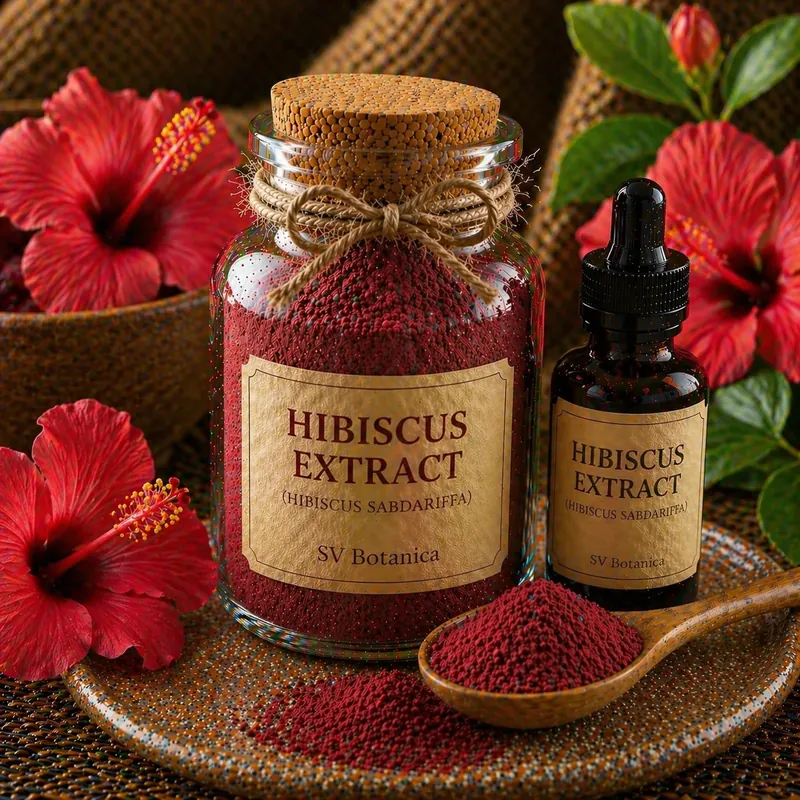
A tart, deep-red roselle calyx extract standardised to total anthocyanins NLT 10% by UV-Vis, with the delphinidin- and cyanidin-sambubioside profile confirmed by HPLC. Prepared from the calyx of Hibiscus sabdariffa for beverage, cardio-wellness, antioxidant, beauty-from-within and hair-care formulators — a functional active and a clean-label natural red in one material. CoA-backed supply from India.
Standardised Grade
Hibiscus sabdariffa · 10% AnthocyaninsA standardised anthocyanin active from the roselle calyx — one material, two commercial jobs
Hibiscus (Hibiscus sabdariffa L.), traded as roselle, is the botanical behind karkade in Egypt, agua de jamaica in Mexico and the deep-crimson herbal teas sold in essentially every market on earth. The part used is not the showy petal but the fleshy calyx — the sepal cup that swells around the seed pod after flowering — and the species matters as much as the part: the ornamental garden hibiscus, Hibiscus rosa-sinensis, is a different plant with a different chemistry, and it is not the trade material. A concentrated calyx extract delivers roselle's anthocyanins and organic acids at a controlled, assayable dose.
The defining constituents are the anthocyanins — principally delphinidin-3-sambubioside with cyanidin-3-sambubioside alongside — a sambubioside pairing distinctive enough to serve as a chemical fingerprint of genuine roselle. SV Botanica standardises this extract to total anthocyanins of not less than 10% by the UV-Vis pH-differential method, with the sambubioside profile confirmed by HPLC, so every batch is defined by verified pigment load rather than by colour intensity or extract ratio. A 25% anthocyanin grade, a polyphenol-standardised grade, native-ratio full-spectrum grades and certified organic material are also available.
The extract is finished as a free-flowing, deep burgundy to dark red powder that dissolves fully in water — the calyx's own organic acids, dominated by hibiscus acid and hydroxycitric acid, carry its characteristic tartness and hold an acidic pH in solution. That acidity is not incidental: anthocyanin colour is pH-dependent, brilliantly red below pH 3 and shifting toward purple as pH rises, which makes hibiscus a genuine dual-role ingredient — a functional botanical active and a clean-label red colour in the same declaration.
We supply beverage and tea manufacturers, supplement brands, functional-food formulators and cosmetic houses, with a batch-specific Certificate of Analysis on every shipment.
The pigments and acids that define the roselle calyx
The principal anthocyanin of the roselle calyx — typically the large majority of the pigment fraction — and the reference compound for identity testing. Also known as hibiscin.
The second major anthocyanin, co-occurring with the delphinidin pigment in a characteristic proportion that authenticates genuine H. sabdariffa material.
The organic-acid fraction that gives roselle its sharp tartness and acidic solution pH. Hibiscus acid — a lactone of hydroxycitric acid — is characteristic of the species.
Phenolic acids that anchor the non-pigment polyphenol fraction and contribute to the extract's Folin–Ciocalteu polyphenol figure.
Hibiscus-characteristic flavonols that round out the calyx's polyphenol profile alongside quercetin glycosides.
Pectic polysaccharides native to the fleshy calyx; they influence solution viscosity and mouthfeel in beverage applications and are managed during extraction.
Why formulators specify an anthocyanin-standardised extract — the functional role of the markers
A declared anthocyanin percentage by the UV-Vis pH-differential method, backed by an HPLC sambubioside profile, lets formulators build on a verified pigment load rather than on colour intensity — which can be faked — or on a vague extract ratio, which guarantees nothing.
Hibiscus is one of the most recognised botanicals in the clinically studied cardiovascular-wellness category, giving brands a familiar, tea-heritage hero ingredient for heart-health-positioned formulations without any consumer-education burden.
Below pH 3 the anthocyanins sit in their brilliant-red flavylium form, so an acidic beverage coloured with hibiscus needs no separate red. The same addition delivers the botanical story and the shade — one clean-label declaration doing two jobs.
Hibiscus carries a long hair-care tradition and a recognised INCI listing, and its anthocyanin-polyphenol profile suits beauty-from-within and scalp-care positioning across both nutraceutical and cosmetic formats.
Beyond the pigments, the calyx contributes protocatechuic and chlorogenic acids and hibiscus-characteristic flavonols — a broad polyphenol base that supports antioxidant positioning and is reported per batch by Folin–Ciocalteu.
Fully water-soluble, ≥95% through a 60-mesh sieve, with the calyx's own organic acids holding solution pH in the range where the colour is at its best — the extract behaves predictably in teas, shots, RTDs and premixes without carriers or clouding.
These are functional and physico-chemical properties of the actives; SV Botanica does not make medical or therapeutic claims for this ingredient.
The core specification for the flagship 10% anthocyanin grade, plus high-potency, polyphenol, ratio and organic options
| Grade | Standardisation | Form | Best For | Solubility |
|---|---|---|---|---|
| Hibiscus Extract 10% Standard | Total anthocyanins NLT 10% (UV-Vis) | Deep burgundy to dark red fine powder, ≥95% through 60 mesh | Cardio-wellness & antioxidant supplements, beverage premixes, capsules & tablets | Water-soluble |
| Hibiscus Extract 25% High-potency | Total anthocyanins NLT 25% (UV-Vis) | Dark red to violet-red fine powder | Low-dose formats, colour-critical beverages & confectionery, softgels | Water-soluble |
| Hibiscus Polyphenol Grade Polyphenol | Total polyphenols NLT 20% (Folin–Ciocalteu) | Red-brown fine powder | Antioxidant & beauty-from-within blends, capsules & sachets | Water-soluble |
| Hibiscus Extract Ratio Full-spectrum | Native 5:1 / 10:1 ratio (organic acids declared) | Deep red fine powder | Herbal teas, traditional formats, hair-care & cosmetic bases | Water-soluble |
| Hibiscus Extract Organic Certified organic | Anthocyanin or ratio basis, certified organic | Deep burgundy fine powder | Organic-certified beverages, teas & supplement lines | Water-soluble |
The 10% total anthocyanins grade is our CoA-backed flagship, assayed by the UV-Vis pH-differential method with identity confirmed by TLC and the delphinidin- and cyanidin-sambubioside profile reported by HPLC. Alternative standardisations, native-ratio (full-spectrum) extracts, certified organic material, custom mesh and packaging can be quoted against buyer specification and order volume. Every batch is released against a batch-specific Certificate of Analysis.
Hibiscus Extract is bought in five forms. The standardised extract is the stocked item; granulated and dispersible grades are produced on request and raw botanical forms are sourced against a confirmed order.
| Form | What it is | Specification basis | Availability |
|---|---|---|---|
| Standardised extract powder | Hibiscus sabdariffa calyx extract, dried and milled | NLT 10% anthocyanins (UV-Vis) | Stocked |
| Granulated (direct-compression) | Extract granulated for tablet lines | Same marker, declared on the granule | On request |
| Water-dispersible / soluble | Extract in a dispersible matrix for beverages, gummies and sachets | Marker declared on the matrix basis; carrier named | On request |
| Calyx powder (non-extracted) | Dried Hibiscus sabdariffa calyx, milled | Botanical identity by TLC; heavy metals and microbial panel | On enquiry, subject to lot; phytosanitary certificate usually required |
| Dried calyx (cut) | Dried calyces, cut or whole | Identity, moisture, foreign matter | On enquiry; for teas and beverages |
A marker percentage without its assay method is not a specification; ask for the method and the plant part on every quotation. Read Hibiscus Extract: A Complete Buyer's Guide, Hibiscus Anthocyanins and How Roselle Extract Is Standardised and Hibiscus Extract Adulteration and How Authenticity Is Proven before comparing offers.
Full product specification for Hibiscus Dry Extract 10%. Values are specification limits, not batch results; a batch-specific CoA is issued per shipment.
| Parameter | Specification / Limit | Method |
|---|---|---|
| Botanical Source | Hibiscus sabdariffa L. | — |
| Plant Family | Malvaceae | — |
| Part Used | Flower calyx (roselle), with epicalyx | — |
| Country of Origin | India | — |
| Appearance | Fine powder | Organoleptic |
| Colour | Deep burgundy to dark red* | Organoleptic |
| Odour | Characteristic, tart-fruity | Organoleptic |
| Taste | Characteristic, sour, astringent | Organoleptic |
| Identification | Corresponds to delphinidin-3-sambubioside — positive | By TLC |
| Loss on Drying (at 105°C, % w/w) | NMT 5.0 | IP-2014 |
| pH (1% w/v solution) | 2.5 – 3.8 | IP-2014 |
| Bulk Density (g/ml) | NLT 0.40 | IP-2014 |
| Particle Size (#60 mesh, % w/w) | NLT 95 | Sieve |
| Total Ash (% w/w) | NMT 8 | IP-2014 |
| Acid Insoluble Ash (% w/w) | NMT 2 | IP-2014 |
| Total Anthocyanins (% w/w, as cyanidin-3-glucoside equivalents) | NLT 10.0 | UV-Vis (pH differential) |
| Anthocyanin Profile (delphinidin- / cyanidin-3-sambubioside) | Reported per batch | By HPLC |
| Total Polyphenols (% w/w, GAE) | Reported per batch | UV (Folin–Ciocalteu) |
| Synthetic Colours (Amaranth, Allura Red, Carmoisine) | Absent | By HPLC / TLC |
| Residual Solvent (Ethanol, ppm) | NMT 5,000 | By GC |
| Lead (ppm) | NMT 1.0 | ICP-MS |
| Arsenic (ppm) | NMT 1.0 | ICP-MS |
| Cadmium (ppm) | NMT 0.3 | ICP-MS |
| Mercury (ppm) | NMT 0.1 | ICP-MS |
| Pesticide Residues | Complies (EU MRL, on request) | GC-MS / LC-MS/MS |
| Ethylene Oxide (ETO) | Not treated — declaration provided | LC-MS/MS (on request) |
| Aflatoxins B1 / Total (ppb) | NMT 2 / NMT 4 | HPLC-FLD |
| Total Plate Count (cfu/g) | NMT 1,000 | USP <2021> |
| Yeast & Moulds / Fungi (cfu/g) | NMT 100 | USP <2021> |
| Escherichia coli | Absent | USP <2022> |
| Salmonella sp. | Absent | USP <2022> |
| Staphylococcus aureus | Absent | USP <2022> |
| Cultivation | Cultivated | Declaration |
| Kosher / Halal | Certified (on request) | Certification |
| Shelf Life | 24 months from date of manufacture, in original packed condition | — |
| Storage | Cool, dry place, protected from light and moisture, in tightly sealed containers | — |
*The product is of herbal origin; slight colour variation may occur due to geographical and seasonal variation in the raw material. Total anthocyanins are assayed by the UV-Vis pH-differential method expressed as cyanidin-3-glucoside equivalents, identity is confirmed by TLC, and the sambubioside profile is reported by HPLC on request. Anthocyanins are heat- and light-sensitive; the stated shelf life assumes storage below 25°C away from light. A current Certificate of Analysis and MSDS are issued with every batch. EU pesticide MRL and ethylene oxide reports are available on request.
From calyx to standardised extract — authenticated, tested, documented
Raw Material & Authentication: The extract is prepared from cultivated Hibiscus sabdariffa calyx. Because deep-red botanicals invite a specific fraud — synthetic dye spiking and substitution with cheaper anthocyanin sources or ornamental Hibiscus rosa-sinensis material — identity is confirmed by TLC against delphinidin-3-sambubioside, the sambubioside profile is verified by HPLC, and a synthetic-colour screen is run before any lot is accepted.
Manufacturing & Testing: Hibiscus Dry Extract is manufactured at certified facilities in India. Each batch runs through a full QC battery — total anthocyanins by UV-Vis pH differential, HPLC pigment profile, loss on drying, pH, bulk density, ash and acid-insoluble ash, mesh, residual solvent by GC, heavy metals by ICP-MS, aflatoxins, pesticide residue screening, and a complete USP microbiological panel — before release.
Documentation: Every shipment is supplied against a batch-specific Certificate of Analysis with an MSDS. Halal, Kosher and Organic certification are available. Country of Origin and export documentation are provided on request. Because dried botanical materials are a recognised ethylene-oxide risk category, we supply a non-ETO declaration and can add LC-MS/MS testing — see our guides on EU pesticide MRL compliance and EU import requirements for botanical extracts.
What backs every batch of Hibiscus extract
Key information for global product registration and labelling
Used as a botanical active in supplement, functional-food and beverage formats, the extract is supplied to a defined anthocyanin specification with full analytical documentation. Hibiscus calyx has extensive, well-documented food use — as karkade, agua de jamaica and herbal tea — across essentially every market, which anchors the regulatory position of conventional extracts; unusually concentrated or novel preparations for the EU should be checked against the Novel Food position before formulation. Buyers remain responsible for compliance with the food-supplement regulations of their market. This product is not intended to diagnose, treat, cure or prevent any disease.
Hibiscus sabdariffa flower extract is an established cosmetic ingredient with a recognised INCI listing, used in hair-care, scalp, antioxidant and organic-acid skin-care formats. As an active input it should be used within the buyer's finished-product safety assessment; SV Botanica supplies the material specification and CoA to support that dossier.
Supplied from India by SV Botanica — FSSAI Central Licence holder and an APEDA-registered exporter. Roselle is cultivated across Indian growing regions, and India's extraction and standardisation infrastructure serves regulated markets worldwide. The material is shipped against a batch-specific Certificate of Analysis with export documentation available on request.
Deep-dive articles on hibiscus extract for formulators, buyers, and brand owners
How to specify roselle calyx extract by anthocyanin content, what a CoA must show, and why the species matters.
TechnicalWhat the sambubioside markers are, how the pH-differential assay works, and why colour is not an assay.
QualitySynthetic dye spiking, species substitution and spent calyx — and the fingerprint testing that catches them.
ApplicationsBeverage, cardio-wellness, beauty and gummy formats — and which hibiscus grade fits each.
ProcurementA scored checklist for qualifying a hibiscus extract supplier before you place a bulk order.
MarketHow the beverage boom and the retreat from synthetic dyes are pulling hibiscus demand.
Frequently co-formulated with Hibiscus Extract in antioxidant, beverage & beauty blends
Technical and commercial questions answered by our ingredients team
Anthocyanin-standardised, lab-tested, fully documented supply of Hibiscus sabdariffa calyx extract. Total anthocyanins NLT 10% by UV-Vis, sambubioside profile by HPLC. Samples available for qualified buyers.
Supplied as a bulk ingredient for further manufacture. Buyers are responsible for compliance with the regulations of their destination market. This product is not intended to diagnose, treat, cure or prevent any disease.
We use cookies for analytics and to measure our advertising. Essential cookies are always on. Privacy policy