
Azadirachta indica A.Juss. · Family: Meliaceae · Leaf Extract
A neem leaf extract standardised on bitter principles, with the plant part declared and azadirachtin reported — because leaf, bark and seed are three different materials, and an agricultural azadirachtin concentrate is not a cosmetic or supplement ingredient. Prepared from the leaf of Azadirachta indica for skin-purifying, oral-care and traditional formulators. CoA-backed supply from India.
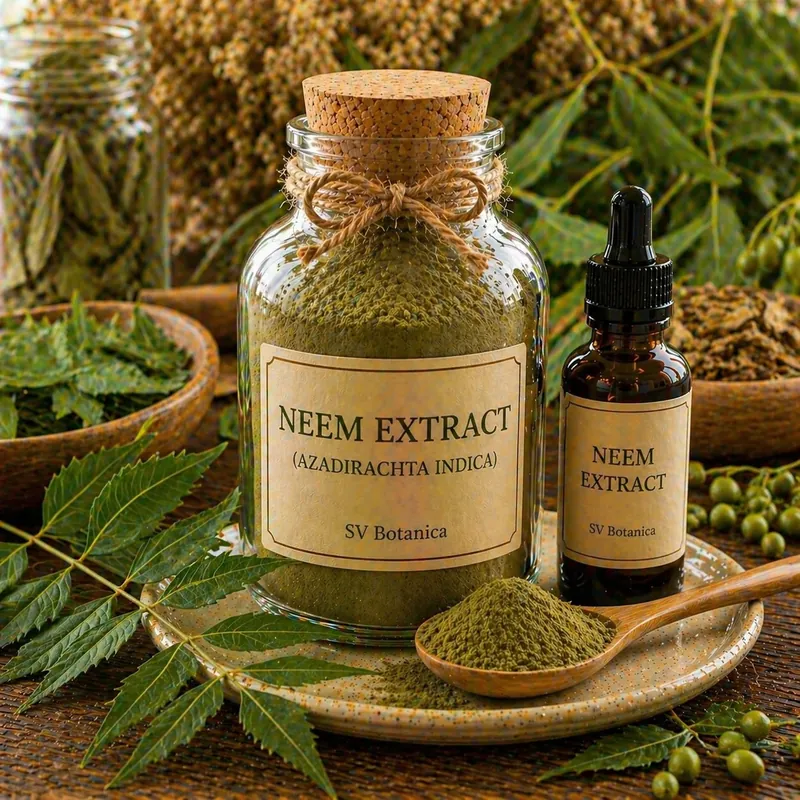
Leaf Extract
Part Declared · Azadirachtin ReportedOne tree, four commercial materials — and only some belong in a supplement
Neem (Azadirachta indica A.Juss.) — nimba in Sanskrit, the "village pharmacy" of the Indian subcontinent — is among the most widely used botanicals in Ayurveda and among the most widely misunderstood in international trade. The reason is that a single tree yields four commercially distinct materials with genuinely different compositions, uses and safety profiles.
Neem leaf is the material with the longest food-adjacent and traditional internal-use history, and it is what a nutraceutical or cosmetic specification normally means. Neem bark is a separate traditional material with its own profile. Neem oil, pressed from the seed kernel, is a fixed oil used topically and agriculturally. And azadirachtin concentrate — made from seed — is an agricultural biopesticide input, standardised on the insecticidal limonoid azadirachtin.
That fourth material is the source of most confusion in this ingredient, and it deserves stating plainly: a high-azadirachtin neem concentrate is a crop-protection product, not a cosmetic or supplement ingredient. Buyers who specify "neem extract, azadirachtin 10%" because it sounds like a potent standardisation are describing an agri-input. We standardise the nutraceutical and cosmetic leaf grades on bitter principles, and we report azadirachtin rather than maximising it.
Every batch therefore carries an explicit plant-part declaration. Leaf, bark and seed-derived materials are not interchangeable, they command different prices, and substituting between them is the most common quality failure on this ingredient. Water-soluble and low-colour cosmetic grades are available.
The limonoid family, and which member matters for which use
A principal limonoid of neem leaf and a useful identity marker for leaf-derived material, assayed by HPLC.
A major bitter constituent of the leaf, contributing substantially to the bitter-principles fraction used as the standardisation basis.
The agricultural marker, not a nutraceutical one. Concentrated in seed, low in leaf. We report it so buyers can confirm they have not received an agri-grade concentrate.
The wider triterpenoid limonoid complex characteristic of the Meliaceae family, defining neem's chemical identity.
The polyphenol fraction of the leaf, contributing antioxidant character to cosmetic and nutraceutical grades.
Oleic, stearic and linoleic acids dominate neem seed oil — a wholly different composition from a leaf extract.
Why formulators specify a part-declared, bitter-principle neem extract
Leaf, bark and seed-derived neem are different materials with different compositions and price points. Naming the part on the certificate is the primary quality control on this ingredient.
A high-azadirachtin concentrate is an agricultural biopesticide input. We report the figure so buyers can confirm they have received a leaf extract rather than a crop-protection material.
Neem is one of the most recognised botanicals in skin-purifying, anti-blemish and clarifying formulations, with an established INCI listing and genuine consumer familiarity.
The appropriate basis for a leaf extract intended for cosmetic or nutraceutical use, reflecting the nimbidin and limonoid fraction rather than the insecticidal marker.
A cold-water-soluble grade suits rinse-off and aqueous systems; a low-colour cosmetic grade limits the green-brown tint in pale formulations.
Neem twig and leaf have centuries of documented oral-care use, giving toothpaste and mouthwash formulators an ingredient with real heritage rather than constructed positioning.
These are functional and physico-chemical properties of the actives; SV Botanica does not make medical or therapeutic claims for this ingredient.
Specify the plant part first — it matters more than the assay percentage
| Grade | Standardisation | Form | Best For | Solubility |
|---|---|---|---|---|
| Neem Leaf Extract Standard | Bitter principles NLT 5%; azadirachtin reported | Greenish-brown to brown fine powder, ≥95% through 40 mesh | Cosmetic actives, oral care, traditional nutraceutical formats | Partially water-soluble |
| Neem Leaf Extract WS Water-soluble | Cold-water-soluble spray-dried; bitter principles to specification | Brown free-flowing powder | Rinse-off cosmetics, mouthwash, aqueous systems | Cold-water-soluble |
| Neem Leaf Extract Cosmetic Low-colour | Bitter principles to specification, colour reduced | Pale greenish-beige fine powder | Creams, serums & pale cosmetic bases | Water-dispersible |
| Neem Bark Extract Bark | Bitter principles to specification; bark declared | Brown fine powder | Traditional formulations calling specifically for bark | Partially water-soluble |
| Neem Leaf Extract Ratio Full-spectrum | Native 10:1 / 20:1 ratio (full-spectrum) | Dark greenish-brown fine powder | Classical Ayurvedic nimba formats | Grade-dependent |
We do not supply high-azadirachtin agricultural concentrate as a cosmetic or nutraceutical ingredient. Azadirachtin-standardised neem is a crop-protection input made from seed, and it is not appropriate for topical or internal formulations — if that is what you need, it should be bought as an agri-input from an agri-input supplier, against agricultural registration. Our leaf and bark grades are standardised on bitter principles with azadirachtin reported for confirmation. Every batch declares the plant part. Alternative assay strengths, water-soluble, low-colour and native-ratio grades can be quoted against buyer specification and order volume.
Neem Extract is bought in five forms. The standardised extract is the stocked item; granulated and dispersible grades are produced on request and raw botanical forms are sourced against a confirmed order.
| Form | What it is | Specification basis | Availability |
|---|---|---|---|
| Standardised extract powder | Azadirachta indica leaf extract, dried and milled | NLT 5% bitter principles, azadirachtin reported | Stocked |
| Granulated (direct-compression) | Extract granulated for tablet lines | Same marker, declared on the granule | On request |
| Water-dispersible / soluble | Extract in a dispersible matrix for beverages, gummies and sachets | Marker declared on the matrix basis; carrier named | On request |
| Leaf powder (non-extracted) | Dried Azadirachta indica leaf, milled to mesh | Botanical identity by TLC; heavy metals and microbial panel | On enquiry, subject to lot; phytosanitary certificate usually required |
| Cut leaf (tea-bag cut) | Dried leaf, tea-bag cut or cut & sifted | Identity, moisture, foreign matter | On enquiry; for teas and in-house extraction |
A marker percentage without its assay method is not a specification; ask for the method and the plant part on every quotation. Read Neem Extract: A Complete Buyer's Guide, Azadirachtin or Bitter Principles? How Neem Extract Is Standardised and Neem Extract Adulteration and How Authenticity Is Proven before comparing offers.
Full product specification for Neem Leaf Dry Extract. Values are specification limits, not batch results; a batch-specific CoA is issued per shipment.
| Parameter | Specification / Limit | Method |
|---|---|---|
| Botanical Source | Azadirachta indica A.Juss. | — |
| Plant Family | Meliaceae | — |
| Part Used | Leaf — declared per batch | Declaration |
| Country of Origin | India | — |
| Appearance | Fine powder | Organoleptic |
| Colour | Greenish-brown to brown* | Organoleptic |
| Odour | Characteristic | Organoleptic |
| Taste | Characteristic, intensely bitter | Organoleptic |
| Identification | Corresponds to reference leaf extract — positive | By TLC / HPLC |
| Bitter Principles (% w/w, dry basis) | NLT 5.0 — method declared | By UV / gravimetric |
| Nimbin (% w/w) | Reported per batch | By HPLC |
| Azadirachtin (ppm) | Reported per batch — leaf grade, not concentrated | By HPLC |
| Seed / Kernel Material | Absent — leaf-only declaration provided | Declaration |
| Loss on Drying (at 105°C, % w/w) | NMT 5.0 | IP-2014 |
| pH (1% w/v solution) | 4 – 7 | IP-2014 |
| Bulk Density (g/ml) | NLT 0.35 | IP-2014 |
| Particle Size (#40 mesh, % w/w) | NLT 95 | Sieve |
| Total Ash (% w/w) | NMT 12 | IP-2014 |
| Acid Insoluble Ash (% w/w) | NMT 2 | IP-2014 |
| Residual Solvent (Ethanol, ppm) | NMT 5,000 | By GC |
| Lead (ppm) | NMT 1.0 | ICP-MS |
| Arsenic (ppm) | NMT 1.0 | ICP-MS |
| Cadmium (ppm) | NMT 0.3 | ICP-MS |
| Mercury (ppm) | NMT 0.1 | ICP-MS |
| Pesticide Residues | Complies (EU MRL, on request) | GC-MS / LC-MS/MS |
| Ethylene Oxide (ETO) | Not treated — declaration provided | LC-MS/MS (on request) |
| Aflatoxins B1 / Total (ppb) | NMT 2 / NMT 4 | HPLC-FLD |
| Total Plate Count (cfu/g) | NMT 1,000 | USP <2021> |
| Yeast & Moulds / Fungi (cfu/g) | NMT 100 | USP <2021> |
| Escherichia coli | Absent | USP <2022> |
| Salmonella sp. | Absent | USP <2022> |
| Staphylococcus aureus | Absent | USP <2022> |
| Cultivation | Cultivated / wild-collected (declared per batch) | Declaration |
| Kosher / Halal | Certified (on request) | Certification |
| Shelf Life | 36 months from date of manufacture, in original packed condition | — |
| Storage | Cool, dry place away from light and moisture, in tightly sealed containers | — |
*The product is of herbal origin; slight colour variation may occur due to geographical and seasonal variation in the raw material. The plant-part line is the most important control on this specification. Neem leaf, bark, seed and seed-derived azadirachtin concentrate are four different commercial materials with different compositions, uses and safety profiles, and substituting between them is the most common failure on this ingredient. We declare the part on every batch and report azadirachtin so buyers can confirm they have not received an agricultural concentrate. Note that total ash runs higher on neem leaf than on many botanicals — this is characteristic of the material rather than a bulking signal, which is why acid-insoluble ash carries the tighter limit. A current Certificate of Analysis and MSDS are issued with every batch.
From leaf to standardised extract — part-verified, tested, documented
Raw Material & Authentication: The extract is prepared from Azadirachta indica leaf, with the plant part established at intake rather than assumed. Because leaf, bark and seed-derived neem differ substantially in composition and price, part verification is the primary raw-material control here — and it is inseparable from the safety position, since the seed-derived materials carry a different profile entirely.
Manufacturing & Testing: Neem Leaf Extract is manufactured at certified facilities in India. Each batch runs through a full QC battery — bitter principles by a named method, nimbin and azadirachtin by HPLC, loss on drying, pH, bulk density, ash and acid-insoluble ash, mesh, residual solvent by GC, heavy metals by ICP-MS, aflatoxins, pesticide residue screening, and a complete USP microbiological panel — before release.
Documentation: Every shipment is supplied against a batch-specific Certificate of Analysis stating the plant part and the azadirachtin figure, with an MSDS. Halal, Kosher and Organic certification are available. Country of Origin, collection status and export documentation are provided on request — see our guides on EU pesticide MRL compliance and EU import requirements for botanical extracts.
What backs every batch of Neem extract
Key information for global product registration and labelling
Azadirachta indica leaf extract is an established cosmetic ingredient with a recognised INCI listing, widely used in skin-purifying, clarifying and scalp formulations. As an active input it should sit within the buyer's finished-product safety assessment; SV Botanica supplies the material specification, plant-part declaration and CoA to support that dossier. Note that a cosmetic safety assessment should be based on the leaf extract specifically, not on data relating to neem oil or seed-derived materials, which have a different composition.
Neem leaf has the longest traditional internal-use history of the neem materials, but internal use of neem generally is subject to important cautions that a responsible formulator should not gloss over. Neem seed oil in particular has been associated with toxicity reports, especially in young children, and internal neem preparations are traditionally avoided in pregnancy — neem has documented traditional antifertility use. These cautions attach differently to different plant parts, which is a further reason the part declaration matters. Buyers are responsible for determining suitability, for appropriate advisory labelling and for compliance with the food-supplement regulations in their market. This product is not intended to diagnose, treat, cure or prevent any disease.
We supply neem leaf and bark extract for cosmetic and nutraceutical use. We do not supply high-azadirachtin agricultural concentrate under these specifications. Azadirachtin-standardised neem is a crop-protection product requiring agricultural registration in most markets, and it should be sourced accordingly rather than purchased as a botanical extract. If your enquiry concerns biopesticide use, we will say so rather than quote.
Deep-dive articles on neem extract for formulators, buyers, and brand owners
Four materials from one tree — how to specify the one you actually need.
TechnicalWhy the most potent-sounding neem standardisation is the wrong one for your formulation.
QualityPart substitution is the whole game on neem — and how the marker profile exposes it.
ApplicationsSkin, scalp and oral-care formats — plus bitterness, colour and the internal-use cautions.
ProcurementA scored checklist for qualifying a neem supplier, weighted around part verification.
MarketWhere neem demand is growing, and how the agri-input market shapes extract pricing.
Frequently co-formulated with Neem Extract in skin, scalp & purifying blends
Technical and commercial questions answered by our ingredients team
Neem leaf extract standardised on bitter principles, with the plant part declared and azadirachtin reported on every batch. Cosmetic and water-soluble grades available. Samples for qualified buyers.
Supplied as a bulk ingredient for further manufacture. Buyers are responsible for compliance with the regulations of their destination market. This product is not intended to diagnose, treat, cure or prevent any disease.
We use cookies for analytics and to measure our advertising. Essential cookies are always on. Privacy policy