
Rosa damascena Mill. · Family: Rosaceae · Petal Extract
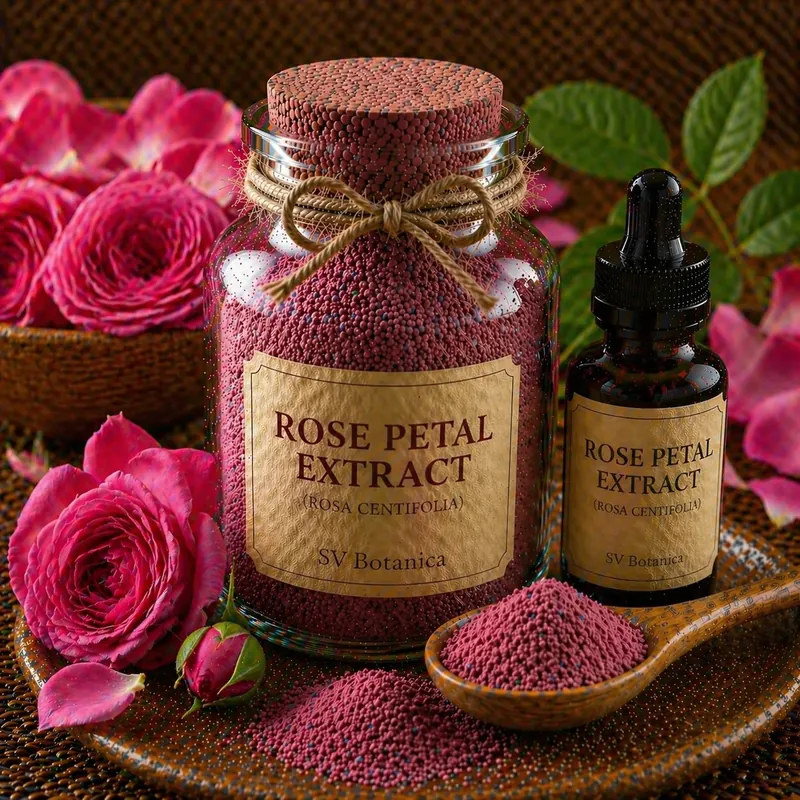
At least five commercially distinct products are sold as "rose", at prices differing by orders of magnitude — petal extract, rose water, rose absolute, rose otto and rose hip. This is petal extract, and we say so plainly. Prepared from cultivated food and extract-grade Rosa damascena, never from ornamental or cut-flower roses, which are among the most intensively sprayed crops in horticulture. CoA-backed supply from India.
Food-Grade Petals
Not Cut-Flower RosesFive products, one word, and a sourcing question underneath
Rose (Rosa damascena) — the Damask rose — is among the oldest cultivated aromatic plants, and India has a continuous tradition of working with it: Kannauj in Uttar Pradesh has distilled rose for centuries, and gulkand, rose water and rose petal preparations remain everyday products across the subcontinent.
The first difficulty in buying "rose" is that the word covers at least five commercially distinct products: dried petals, petal extract (this product), rose water (the hydrosol), rose absolute (solvent-extracted aromatic), rose otto (steam-distilled essential oil) — and, from a different part of a different plant entirely, rose hip. Prices between them differ by orders of magnitude, and quotations get compared across them more often than anyone admits.
The second difficulty is quieter and more consequential. Roses grown as ornamentals and for the cut-flower trade are not suitable raw material for a food or cosmetic ingredient. Cut-flower production is among the most intensively managed horticulture there is — the crop is grown for appearance and vase life under heavy pest-management programmes, with no requirement to meet residue limits for anything that will be eaten or applied to skin. Petals from florist stock, garden waste or ornamental plantings are cheap and available, and they should not enter this supply chain.
We supply petal extract from cultivated Rosa damascena grown for food and extract use, with the species declared, the grade purpose stated, and the anthocyanin and flavonoid profile reported. We also tell buyers which of the five rose products they are actually asking for, which is more useful at enquiry stage than any specification we could send afterwards.
What is in Damask rose petal
Cyanin-type pigments responsible for petal colour, and the constituents most sensitive to processing and storage — the reason colour is a handling consideration rather than a fixed property.
The principal flavonoid fraction of rose petal, forming the basis of the HPLC profile used for characterisation.
The phenolic and tannin fraction contributing astringency, and part of the traditional cosmetic rationale.
Citronellol, geraniol, nerol and phenylethyl alcohol give rose its scent. Present in petal, but note that these are what rose otto and absolute are made of — a petal extract is not an aromatic product and should not be bought as one.
Petal mucilage and polysaccharide fraction, relevant to the traditional soothing positioning in cosmetic use.
Rose hip — the fruit — is a different part with a different composition, notably vitamin C. It is a different product and is quoted separately.
Why formulators specify a food-grade Damask rose petal extract
Petals from roses grown for the purpose, not from ornamental or cut-flower stock — a crop managed for appearance under spray programmes designed with no ingredient use in mind.
Rosa damascena Mill. named on the certificate. R. centifolia and other species are different materials with different profiles and prices.
Rose has genuine, continuous documented use in skin and cosmetic preparation across Ayurvedic, Unani and European traditions.
Quercetin and kaempferol glycosides with the anthocyanin fraction reported, giving a characterisation where no single industry marker exists.
Kannauj and the northern rose belt have worked with R. damascena for centuries, giving a genuinely established cultivation and processing base.
Rose is used heavily in aqueous cosmetic systems and in beverages, so a cold-water-soluble grade is a practical requirement rather than an optional extra.
These are functional and physico-chemical properties of the actives; SV Botanica does not make medical or therapeutic claims for this ingredient.
Petal extract grades — and what we quote separately
| Grade | Standardisation | Form | Best For | Solubility |
|---|---|---|---|---|
| Rose Petal Extract 4:1 / 10:1 Standard | Native ratio; flavonoid profile reported | Pink-brown to reddish brown fine powder, ≥95% through 40 mesh | Cosmetic formulation, supplements, traditional formats | Partially water-soluble |
| Rose Petal Extract WS Water-soluble | Cold-water-soluble spray-dried; profile reported | Pink-brown free-flowing powder | Serums, toners, beverages, aqueous systems | Cold-water-soluble |
| Rose Petal Powder Raw milled | Milled dried petal — not an extract | Pink to red-brown powder | Masks, ubtan, teas, traditional formats | Dispersible |
| Dried Rose Petals (Whole) Whole petal | Graded whole dried petals | Pink to deep red dried petals | Teas, infusions, potpourri-grade culinary use | — |
| Rose Water / Otto / Absolute Quoted separately | Different products — not petal extract | Liquid / aromatic | Fragrance, aromatherapy, cosmetic aromatics | — |
The last row is there deliberately. Rose water, rose otto and rose absolute are genuinely different products from petal extract — different processes, different composition, different applications and prices differing by orders of magnitude. Rose otto and absolute in particular are aromatic materials belonging to the fragrance trade, and they are among the most frequently adulterated natural materials in commerce. We quote them separately and we would rather establish at enquiry which product a buyer actually needs than send a petal extract to someone expecting an aromatic. Every petal grade is prepared from cultivated Rosa damascena grown for food and extract use, with species and grade purpose declared. Whole dried petals are also available and are listed in our spices and botanicals range.
Rose Petal Extract is bought in five forms. The standardised extract is the stocked item; granulated and dispersible grades are produced on request and raw botanical forms are sourced against a confirmed order.
| Form | What it is | Specification basis | Availability |
|---|---|---|---|
| Standardised extract powder | Rosa damascena petal extract, dried and milled | 4:1 or 10:1 native extract, flavonoid profile reported | Stocked |
| Granulated (direct-compression) | Extract granulated for tablet lines | Same marker, declared on the granule | On request |
| Water-dispersible / soluble | Extract in a dispersible matrix for beverages, gummies and sachets | Marker declared on the matrix basis; carrier named | On request |
| Petal powder (non-extracted) | Dried Rosa damascena petals, milled | Botanical identity by TLC; heavy metals and microbial panel | On enquiry, subject to lot; phytosanitary certificate usually required |
| Dried petals (whole) | Dried petals, graded | Identity, moisture, foreign matter | On enquiry; for teas, cosmetics and in-house extraction |
A marker percentage without its assay method is not a specification; ask for the method and the plant part on every quotation. Read Rose Petal Extract: A Complete Buyer's Guide, Rose Products Explained: Petal Extract, Water, Absolute, Otto and Hip and Rose Petal Authenticity: The Right Species, and the Right Roses before comparing offers.
Full product specification for Rose Petal Dry Extract 4:1. Values are specification limits, not batch results; a batch-specific CoA is issued per shipment.
| Parameter | Specification / Limit | Method |
|---|---|---|
| Botanical Source | Rosa damascena Mill. | — |
| Plant Family | Rosaceae | — |
| Part Used | Petal | — |
| Country of Origin | India | — |
| Cultivation Purpose | Grown for food / extract use — not ornamental or cut-flower | Declaration |
| Appearance | Fine powder | Organoleptic |
| Colour | Pink-brown to reddish brown* | Organoleptic |
| Odour | Characteristic, floral | Organoleptic |
| Taste | Characteristic, floral-astringent | Organoleptic |
| Identification | Corresponds to R. damascena petal reference — positive | By TLC |
| Flavonoid Profile | Quercetin / kaempferol glycoside pattern — reported per batch | By HPLC |
| Anthocyanins | Reported per batch | By UV / HPLC |
| Total Polyphenols | Reported per batch | By UV |
| Extraction Ratio | 4:1 native (grade-dependent) | Declaration |
| Other Floral Material | Absent — declaration provided | Declaration |
| Synthetic Colours | Absent — declaration provided | By HPLC (on request) |
| Loss on Drying (at 105°C, % w/w) | NMT 5.0 | IP-2014 |
| pH (1% w/v solution) | 3.5 – 5.5 | IP-2014 |
| Bulk Density (g/ml) | NLT 0.35 | IP-2014 |
| Particle Size (#40 mesh, % w/w) | NLT 95 | Sieve |
| Total Ash (% w/w) | NMT 10 | IP-2014 |
| Acid Insoluble Ash (% w/w) | NMT 2 | IP-2014 |
| Residual Solvent (Ethanol, ppm) | NMT 5,000 | By GC |
| Lead (ppm) | NMT 1.0 | ICP-MS |
| Arsenic (ppm) | NMT 1.0 | ICP-MS |
| Cadmium (ppm) | NMT 0.3 | ICP-MS |
| Mercury (ppm) | NMT 0.1 | ICP-MS |
| Pesticide Residues | Complies (EU MRL) — screened; ornamental stock excluded | GC-MS / LC-MS/MS |
| Ethylene Oxide (ETO) | Not treated — declaration provided | LC-MS/MS (on request) |
| Aflatoxins B1 / Total (ppb) | NMT 2 / NMT 4 | HPLC-FLD |
| Total Plate Count (cfu/g) | NMT 10,000 | USP <2021> |
| Yeast & Moulds / Fungi (cfu/g) | NMT 100 | USP <2021> |
| Escherichia coli | Absent | USP <2022> |
| Salmonella sp. | Absent | USP <2022> |
| Staphylococcus aureus | Absent | USP <2022> |
| Cultivation | Cultivated (declared per batch) | Declaration |
| Kosher / Halal | Certified (on request) | Certification |
| Shelf Life | 24 months from date of manufacture, in original packed condition | — |
| Storage | Cool, dry place away from light, heat and moisture, in tightly sealed containers | — |
*The product is of floral origin; colour varies substantially with harvest, drying and storage, since anthocyanin pigments are inherently unstable — a duller batch is not necessarily a weaker one. The cultivation-purpose line is the one we would most encourage buyers to insist on. Roses grown as ornamentals and for the cut-flower trade are produced for appearance and vase life under intensive pest-management programmes, with no obligation to meet residue limits applicable to food or cosmetic ingredients. Petals from florist stock, ornamental plantings and floral waste are cheap and plentiful, and they are not appropriate raw material — which is why we declare cultivation purpose alongside EU MRL screening rather than treating residue compliance as a routine tick. Note also that no single accepted marker compound exists for rose petal extract, so we report a flavonoid and anthocyanin profile rather than presenting one number as an industry standard. And because rose is deeply pigmented, synthetic dye screening is available and sensible. A current Certificate of Analysis and MSDS are issued with every batch.
From cultivated petal to profiled extract — grade-controlled, profiled, documented
Raw Material & Grade Control: The extract is prepared from cultivated Rosa damascena petals grown for food and extract use. Species identification is not the principal difficulty on this ingredient — the principal difficulty is cultivation purpose. Ornamental and cut-flower roses are grown under intensive pest-management programmes aimed at appearance and vase life, with no obligation to meet ingredient residue limits, and petals from florist stock or floral waste are cheap and available. We source from rose cultivation intended for extraction and food use, declare that purpose, and screen to EU MRL rather than assuming compliance.
Processing & Testing: Rose petals are delicate and are processed promptly after harvest — petals are picked in the early morning in the traditional rose belt for good reason, and delay costs both colour and aromatic character. Extraction is at certified facilities in India. Each batch runs identity by TLC, flavonoid and anthocyanin profile by HPLC, total polyphenols, loss on drying, pH, bulk density, ash, mesh, residual solvent by GC, heavy metals by ICP-MS, aflatoxins by HPLC-FLD, pesticide residue screening and a complete USP microbiological panel before release. Synthetic dye screening is available and, on a deeply pigmented floral material, sensible.
Documentation: Every shipment is supplied against a batch-specific Certificate of Analysis stating the species as Rosa damascena Mill., the cultivation purpose, the flavonoid and anthocyanin profile, the extraction ratio and cultivation status, together with an MSDS. Halal, Kosher and Organic certification are available — see our guides on EU pesticide MRL compliance and EU import requirements for botanical extracts.
What backs every batch of Rose Petal extract
Key information for global product registration and labelling
The control we would most want a rose buyer to take away, because it is invisible on a conventional certificate. Ornamental and cut-flower rose production is among the most intensively managed horticulture there is. The crop is grown for appearance, uniformity and vase life, under pest and disease programmes designed around a product nobody eats or applies to skin — and therefore with no obligation to respect residue limits applicable to food or cosmetic ingredients. Petals from florist stock, ornamental plantings, floral waste and event flowers are inexpensive and abundant, and they represent a genuine and under-discussed risk in this supply chain. We source from rose cultivation grown for extraction and food use, declare cultivation purpose on the certificate, and screen to EU MRL. Buyers should ask for that declaration explicitly — a supplier who has never been asked the question may not know the answer.
Two identity points that belong in a specification. First, species: Rosa damascena Mill. is the Damask rose of the classical tradition; R. centifolia and other species are different materials with different profiles and price positions, and "rose" alone does not distinguish them. Second, product form: petal extract, rose water, rose absolute, rose otto and rose hip are five distinct products, and rose otto and absolute in particular are aromatic materials with a long and well-documented history of adulteration in the fragrance trade. Establishing which product and which species is intended is a specification matter, not a preference — and it prevents the commonest error on this ingredient, which is comparing quotations across products.
Supplied from India by SV Botanica — FSSAI Central Licence holder and an APEDA-registered exporter — from cultivated R. damascena in the northern Indian rose belt, with cultivation status and purpose declared per batch. Shipped against a batch-specific Certificate of Analysis carrying the species and grade declarations, with export documentation available on request. This product is not intended to diagnose, treat, cure or prevent any disease.
Deep-dive articles on rose petal extract for formulators, buyers, and brand owners
Five products called rose, and the sourcing question underneath all of them.
TechnicalPetal extract, rose water, absolute, otto and rose hip — what each is and what it costs.
QualityR. damascena versus other roses, and why ornamental petals should never enter the chain.
ApplicationsSolubility, colour instability, pH and where rose actually earns its place.
QualityWhat to require when no single marker compound exists for this ingredient.
SourcingKannauj, morning harvest, and why the window between picking and processing is hours.
Other floral and cosmetic actives from our range
Technical and commercial questions answered by our ingredients team
Rosa damascena petal extract from cultivated food and extract-grade roses, never ornamental or cut-flower stock, with species and cultivation purpose declared. Tell us which rose product you need. Samples for qualified buyers.
Supplied as a bulk ingredient for further manufacture. Buyers are responsible for compliance with the regulations of their destination market. This product is not intended to diagnose, treat, cure or prevent any disease.
We use cookies for analytics and to measure our advertising. Essential cookies are always on. Privacy policy