
Aloe barbadensis Miller · Family: Asphodelaceae · Inner-Leaf Gel Extract
An aloe vera gel extract standardised on polysaccharides, with aloin measured and declared on every batch — because aloin is the parameter that decides whether a material is fit for ingestible use, and a concentration ratio alone tells you nothing. Decolourised inner-leaf grades at aloin NMT 10 ppm. CoA-backed supply from India.
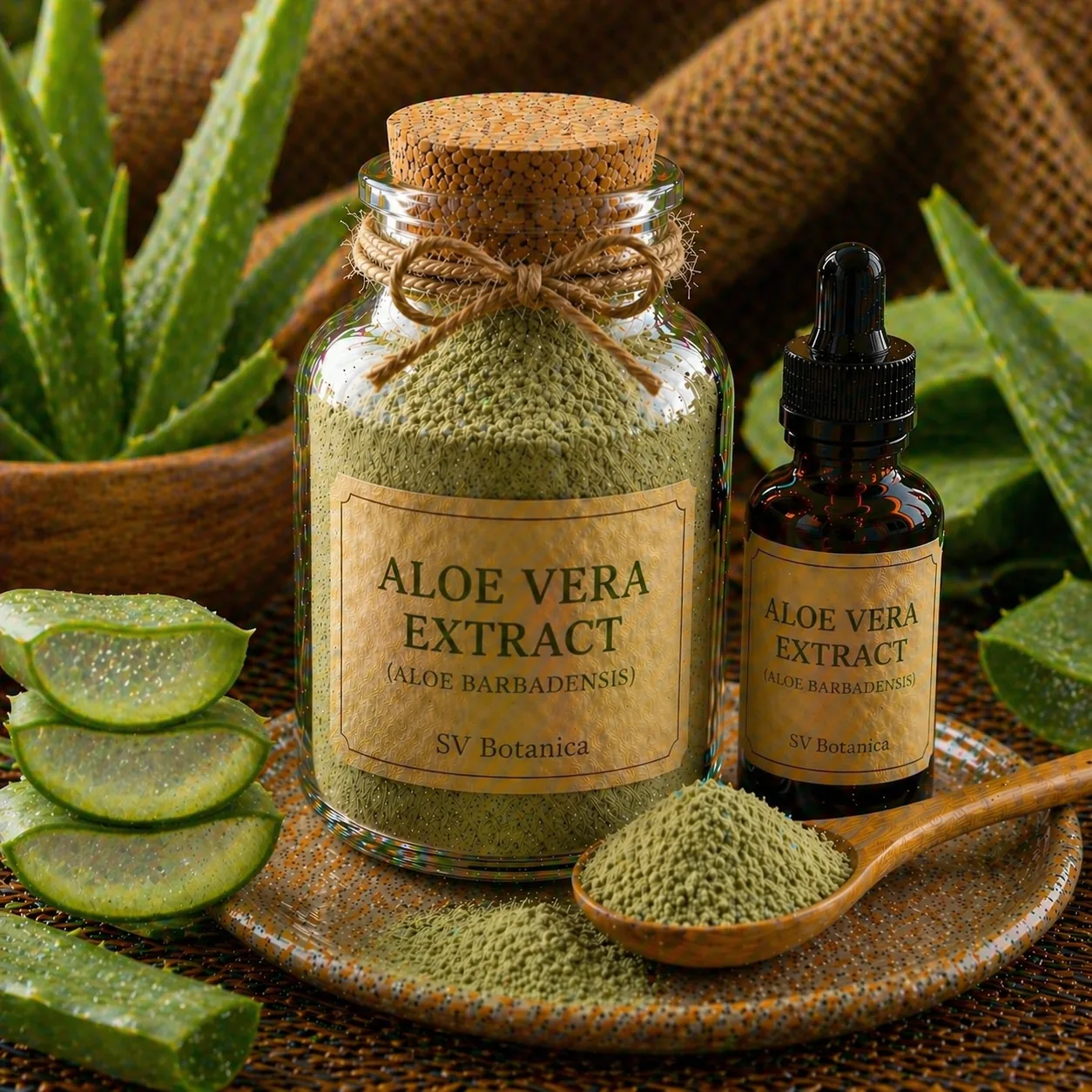
Decolourised Grade
Aloin NMT 10 ppm · Inner LeafA ratio that means nothing, and a limit parameter that means everything
Aloe vera (Aloe barbadensis Miller) is among the most widely used botanicals in the world, and among the most loosely specified. It is a succulent of the Asphodelaceae family whose leaf yields two quite different materials: the clear inner-leaf gel (the fillet), and the bitter yellow latex that sits just under the rind.
That anatomical split is the whole story. The latex carries aloin and related hydroxyanthracene derivatives — potent anthraquinone laxatives. The inner-leaf gel carries the polysaccharides, principally acemannan, that the ingredient is actually bought for. Fillet the leaf carefully and you get gel; process the whole leaf and you carry latex through, which is why whole-leaf material must be decolourised — a carbon-treatment step that strips aloin — before it is fit for ingestible use.
This matters regulatorily as well as commercially. The EU has prohibited hydroxyanthracene derivatives in food supplements, including preparations from Aloe species containing them, and the widely used industry standard for ingestible aloe sets aloin at not more than 10 ppm. A buyer formulating an ingestible product who has not asked for an aloin figure has not established the most consequential fact about their material.
The second trap is the concentration ratio. Aloe is sold as 100:1 and 200:1 gel powder, and those numbers sound like potency. They are not a specification — they describe how much liquid gel was evaporated, and since aloe gel is roughly 99% water, the ratio says nothing about polysaccharide content. Two 200:1 powders can differ several-fold in actives. We standardise on polysaccharides and report the ratio alongside, not instead.
The gel fraction, the latex fraction, and why they must be kept apart
The acetylated mannan complex of the inner-leaf gel — the fraction aloe is genuinely bought for, and our standardisation basis.
The commonly cited long-chain polysaccharide measure for aloe gel quality, reported where a buyer specification calls for it.
A limit parameter, not an active. Anthraquinone laxatives of the leaf latex, removed by decolourisation and measured on every batch.
The wider anthraquinone family carried in the latex, subject to prohibition in EU food supplements.
Minor constituents of the gel contributing to the material's characteristic profile.
A legitimate carrier in spray-dried gel powders — and the most common undeclared adulterant when it is not stated.
Why formulators specify a polysaccharide-standardised, aloin-tested aloe
The parameter that decides fitness for ingestible use. We measure aloin by HPLC and state the figure rather than writing "complies", so your intake and compliance arithmetic runs on a number.
Aloe's actives are its gel polysaccharides. Standardising on them — rather than on a concentration ratio — is the only basis that describes what you are actually buying.
Inner-leaf gel and decolourised whole leaf are different materials with different aloin risk and price. The part and process are stated on every certificate.
The gel powder dissolves readily, which makes aloe straightforward across beverages, gels, sachets and aqueous cosmetic systems without emulsification.
Aloe barbadensis leaf extract is one of the most recognised cosmetic ingredients in the world, with an established INCI listing and genuine consumer familiarity.
The decolourised gel supports digestive-comfort and daily-wellness positioning without the anthraquinone load that makes non-decolourised material unsuitable.
These are functional and physico-chemical properties of the actives; SV Botanica does not make medical or therapeutic claims for this ingredient.
Ratio is not a specification — read the polysaccharide and aloin columns
| Grade | Standardisation | Form | Best For | Solubility |
|---|---|---|---|---|
| Aloe Gel Powder 200:1 Standard | Polysaccharides NLT 10%; inner leaf; aloin declared | White to cream fine powder, ≥95% through 40 mesh | Beverages, supplements, cosmetic actives | Water-soluble |
| Aloe Gel Powder 100:1 Standard | Polysaccharides to specification; inner leaf; aloin declared | White to cream fine powder | Cost-tuned formulations, higher inclusion rates | Water-soluble |
| Aloe Whole Leaf Decolourised Decolourised | Aloin NMT 10 ppm; carbon-treated | Cream to pale beige fine powder | Ingestible applications where whole leaf is specified | Water-soluble |
| Aloe Extract Cosmetic Cosmetic | Polysaccharides to specification; low colour | White to off-white fine powder | Creams, serums, gels & aqueous cosmetic systems | Water-soluble |
| Aloe Whole Leaf Non-Decolourised Topical only | Aloin present — not for ingestible use | Yellow-brown fine powder | Topical and industrial applications only | Water-soluble |
Read the aloin column before the ratio column. A concentration ratio such as 100:1 or 200:1 describes how much liquid gel was evaporated — and since aloe gel is roughly 99% water, it says nothing about polysaccharide content; two 200:1 powders can differ several-fold in actives. For any ingestible application, specify a decolourised or inner-leaf grade with aloin NMT 10 ppm and require the measured figure on the certificate. Non-decolourised whole-leaf material carries anthraquinones and is supplied for topical and industrial use only; we will not quote it against an ingestible specification.
Aloe Vera Extract is bought in five forms. The standardised extract is the stocked item; granulated and dispersible grades are produced on request and raw botanical forms are sourced against a confirmed order.
| Form | What it is | Specification basis | Availability |
|---|---|---|---|
| Spray-dried powder | Aloe barbadensis inner-leaf gel extract, dried and milled | 200:1 inner-leaf gel powder, polysaccharides NLT 10%, aloin declared | Stocked |
| Granulated (direct-compression) | Extract granulated for tablet lines | Same marker, declared on the granule | On request |
| Water-dispersible / soluble | Extract in a dispersible matrix for beverages, gummies and sachets | Marker declared on the matrix basis; carrier named | On request |
| Aloe juice powder (100:1) | Lower-concentration spray-dried inner-leaf juice | Polysaccharides and aloin declared | On request |
| Decolorised / freeze-dried gel powder | Charcoal-decolorised or freeze-dried inner-leaf gel | Aloin below the declared limit; polysaccharides | On request, subject to minimum quantity |
A marker percentage without its assay method is not a specification; ask for the method and the plant part on every quotation. Read Aloe Vera Extract: A Complete Buyer's Guide, Aloin, Decolourisation and How Aloe Vera Is Standardised and Aloe Vera Adulteration and How Authenticity Is Proven before comparing offers.
Full product specification for Aloe Vera Gel Powder 200:1, decolourised inner leaf. Values are specification limits, not batch results; a batch-specific CoA is issued per shipment.
| Parameter | Specification / Limit | Method |
|---|---|---|
| Botanical Source | Aloe barbadensis Miller (syn. Aloe vera (L.) Burm.f.) | — |
| Plant Family | Asphodelaceae | — |
| Part Used | Inner-leaf gel (fillet) — declared per batch | Declaration |
| Processing | Decolourised — declared per batch | Declaration |
| Country of Origin | India | — |
| Appearance | Fine powder | Organoleptic |
| Colour | White to cream* | Organoleptic |
| Odour | Characteristic, faint | Organoleptic |
| Taste | Characteristic | Organoleptic |
| Identification | Corresponds to reference extract — positive | By TLC / HPLC |
| Polysaccharides (% w/w, dry basis) | NLT 10.0 | By UV / HPLC |
| Aloverose (% w/w) | Reported on request | By NMR / HPLC |
| Aloin A + B (ppm) | NMT 10 — measured and declared per batch | By HPLC |
| Concentration Ratio | 200:1 (reported, not a specification basis) | Declaration |
| Carrier / Maltodextrin (%) | Declared by name and percentage if present | Declaration |
| Loss on Drying (at 105°C, % w/w) | NMT 8.0 | IP-2014 |
| pH (1% w/v solution) | 3.5 – 5.5 | IP-2014 |
| Bulk Density (g/ml) | NLT 0.35 | IP-2014 |
| Particle Size (#40 mesh, % w/w) | NLT 95 | Sieve |
| Total Ash (% w/w) | NMT 20 (characteristically high — see note) | IP-2014 |
| Acid Insoluble Ash (% w/w) | NMT 2 | IP-2014 |
| Lead (ppm) | NMT 1.0 | ICP-MS |
| Arsenic (ppm) | NMT 1.0 | ICP-MS |
| Cadmium (ppm) | NMT 0.3 | ICP-MS |
| Mercury (ppm) | NMT 0.1 | ICP-MS |
| Pesticide Residues | Complies (EU MRL, on request) | GC-MS / LC-MS/MS |
| Ethylene Oxide (ETO) | Not treated — declaration provided | LC-MS/MS (on request) |
| Total Plate Count (cfu/g) | NMT 1,000 | USP <2021> |
| Yeast & Moulds / Fungi (cfu/g) | NMT 100 | USP <2021> |
| Escherichia coli | Absent | USP <2022> |
| Salmonella sp. | Absent | USP <2022> |
| Staphylococcus aureus | Absent | USP <2022> |
| Cultivation | Cultivated | Declaration |
| Kosher / Halal | Certified (on request) | Certification |
| Shelf Life | 36 months from date of manufacture, in original packed condition | — |
| Storage | Cool, dry place away from light and moisture, in tightly sealed containers | — |
*The aloin line is the most consequential on this specification. Aloin and related hydroxyanthracene derivatives sit in the leaf latex, not the gel, and are removed by filleting or by carbon decolourisation. We measure aloin by HPLC and state the figure rather than writing "complies", because an ingestible product's compliance position depends on the number. Note that total ash runs characteristically high on aloe — the gel is mineral-rich and spray-dried powders often carry a declared carrier — so acid-insoluble ash is the more informative figure; applying a generic botanical ash limit will reject good material. The concentration ratio is reported, not specified: it describes evaporation of a ~99% water gel and does not indicate polysaccharide content. A current Certificate of Analysis and MSDS are issued with every batch.
From leaf to gel powder — filleted, decolourised, aloin-tested, documented
Raw Material & Processing: The extract is prepared from cultivated Aloe barbadensis. Inner-leaf grades are filleted to separate the gel from the latex-bearing rind; whole-leaf grades are carbon-decolourised to strip aloin. Both routes are legitimate; what matters is that the route is declared and that the resulting aloin figure is measured rather than assumed.
Manufacturing & Testing: Aloe Gel Powder is manufactured at certified facilities in India. Each batch runs through a full QC battery — polysaccharides by UV/HPLC, aloin by HPLC, loss on drying, pH, bulk density, ash and acid-insoluble ash, mesh, heavy metals by ICP-MS, pesticide residue screening, and a complete USP microbiological panel — before release. Carriers, where used in a spray-dried powder, are declared by name and percentage.
Documentation: Every shipment is supplied against a batch-specific Certificate of Analysis stating the plant part, the processing route, the measured aloin figure and the polysaccharide assay, with an MSDS. Halal, Kosher and Organic certification are available — see our guides on EU pesticide MRL compliance and EU import requirements for botanical extracts.
What backs every batch of Aloe Vera extract
Key information for global product registration and labelling
This is the defining regulatory consideration for aloe and it should not be glossed over. Aloin and related hydroxyanthracene derivatives are anthraquinone laxatives carried in the leaf latex, and the EU has prohibited hydroxyanthracene derivatives in food supplements, including preparations from Aloe species containing them. The widely applied industry standard for ingestible aloe sets aloin at not more than 10 ppm. Practically: any ingestible aloe product requires a decolourised or properly filleted inner-leaf material with a measured aloin figure, and a certificate stating "complies" without a number does not support a compliance position. We measure and declare it on every batch.
Aloe barbadensis leaf extract is among the most established cosmetic ingredients worldwide, with a recognised INCI listing and long topical use. The regulatory position for topical use is considerably more straightforward than for ingestion, and non-decolourised material has legitimate topical applications. As always the finished-product safety assessment is the buyer's, and we supply the specification, processing declaration and aloin figure to support it.
Ratio claims such as 100:1 and 200:1 are widespread in aloe marketing and are frequently misread as potency statements. Because aloe gel is roughly 99% water, the ratio describes evaporation rather than active content, and two materials at the same ratio can differ several-fold in polysaccharides. Buyers making on-pack claims should base them on a measured polysaccharide figure rather than on the ratio, which is not a specification and will not substantiate a content claim.
Deep-dive articles on aloe vera extract for formulators, buyers, and brand owners
Inner leaf or whole leaf, decolourised or not — and why 200:1 is not a specification.
TechnicalThe latex/gel split, the 10 ppm limit, and why polysaccharides beat concentration ratios.
QualityMaltodextrin dilution is endemic in aloe — and the tests that expose it.
ApplicationsBeverage, gel, supplement and skincare formats — and the ingestible/topical divide.
ProcurementA scored checklist weighted around aloin control and carrier declaration.
MarketA commodity with a wide quality spread, and why the cheapest aloe is usually mostly maltodextrin.
Frequently co-formulated with Aloe Vera Extract in skin, digestive & wellness blends
Technical and commercial questions answered by our ingredients team
Inner-leaf and decolourised aloe gel powder standardised on polysaccharides, with aloin measured and declared on every batch. Samples available for qualified buyers.
Supplied as a bulk ingredient for further manufacture. Buyers are responsible for compliance with the regulations of their destination market. This product is not intended to diagnose, treat, cure or prevent any disease.
We use cookies for analytics and to measure our advertising. Essential cookies are always on. Privacy policy