
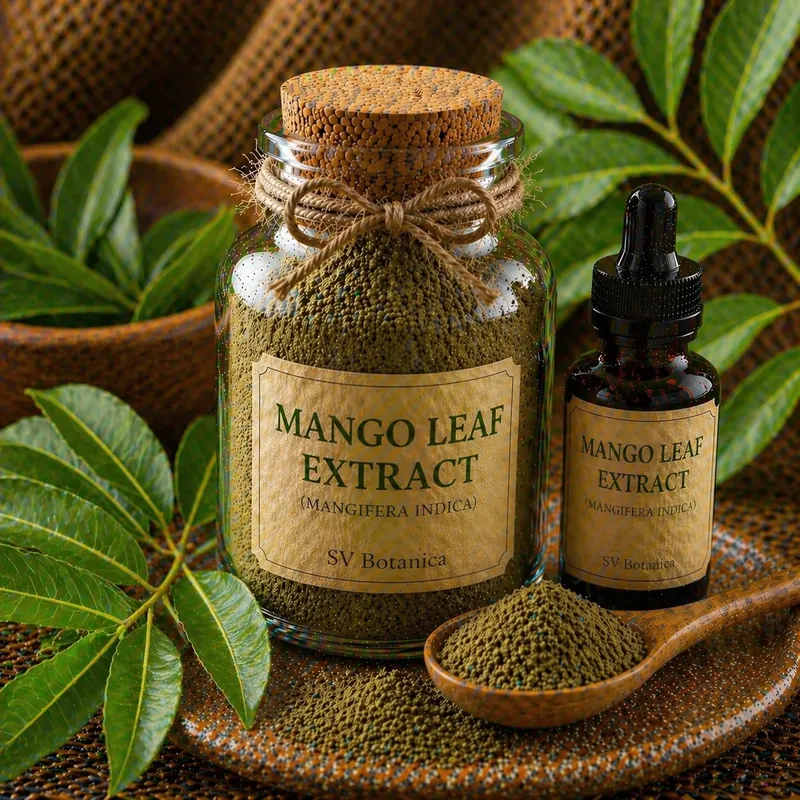
Mangifera indica L. · Family: Anacardiaceae · Leaf Extract
Mango leaf is bought for mangiferin — and mangiferin is made by several plants that are not mango trees. An assay figure alone therefore proves the compound is present, not that it came from where you think. We verify the botanical source alongside the assay, declare leaf maturity, and record the orchard spray history that a fruit-crop by-product inevitably carries. CoA-backed supply from India.
Source Verified
Not Assay AloneWhy a mangiferin percentage does not establish what you bought
Mango leaf (Mangifera indica) has moved in a decade from an agricultural residue to a specified nutraceutical ingredient, driven almost entirely by one compound: mangiferin, a xanthone C-glucoside associated with metabolic and antioxidant positioning. India is the world's largest mango producer, so the raw material is abundant here in a way it is almost nowhere else.
The commercial catch is specific and worth understanding before writing a specification. Mangiferin is not unique to mango. It occurs in several unrelated plants — Anemarrhena asphodeloides, Salacia and Swertia species, honeybush (Cyclopia) and others — and some of those are established commercial sources of mangiferin in their own right. A high-purity mangiferin can be produced from material that never came near a mango tree.
So a certificate reading mangiferin 20% tells you the compound is present at that level. It does not tell you the extract is mango leaf. On an ingredient sold on a single marker with cheaper alternative sources available, that gap is the whole quality question — which is why we verify the botanical source against M. indica leaf reference material rather than resting on the assay.
Two further controls follow from what mango leaf actually is. It is a by-product of intensive fruit cultivation, so the leaf carries whatever spray programme was designed to protect the fruit — we record agrochemical history and screen accordingly. And mangiferin content varies markedly with leaf maturity, young leaves differing substantially from mature ones, so we declare maturity rather than leaving a variable that large unstated.
What is in mango leaf
The xanthone C-glucoside on which the ingredient is standardised, and the reason the market exists. Present in mango leaf at commercially useful levels — and also, importantly, in several unrelated plants.
A structural isomer occurring alongside mangiferin in mango leaf. Useful in source verification, since the relationship between related xanthones differs between botanical sources.
Gallotannins and gallic acid derivatives characteristic of the leaf, contributing to the supporting profile.
Quercetin and kaempferol glycosides, part of the wider polyphenol fraction.
Further phenolic constituents reported in M. indica leaf, contributing to the chromatographic pattern.
Mango belongs to the same family as cashew and poison ivy, and sensitised individuals can react to mango plant material. Relevant for topical formats — see the regulatory section.
Why formulators specify source-verified mango leaf
Mangiferin occurs in several plants that are not mango. We confirm the material against M. indica leaf reference rather than accepting the assay as proof of origin.
Assayed at 10%, 20% or 60% depending on grade, with the supporting xanthone and phenolic profile reported alongside it.
Mangiferin varies substantially between young and mature leaf. Declaring maturity removes a variable that otherwise moves your input batch to batch.
Mango leaf is a by-product of a heavily managed fruit crop. Spray programmes are designed around fruit, not leaf — so residue control here is real work, not a formality.
Mangiferin's research interest sits in metabolic and antioxidant areas, the categories where this ingredient is principally formulated.
India is the world's largest mango producer, so leaf is genuinely abundant here rather than a scarce by-product competed for across markets.
These are functional and physico-chemical properties of the actives; SV Botanica does not make medical or therapeutic claims for this ingredient.
Mangiferin grades and native ratio
| Grade | Standardisation | Form | Best For | Solubility |
|---|---|---|---|---|
| Mango Leaf Extract 10% Standard | Mangiferin NLT 10% by HPLC; source verified | Green-brown to brown fine powder, ≥95% through 40 mesh | Supplement blends, capsules & tablets | Partially water-soluble |
| Mango Leaf Extract 20% High-assay | Mangiferin NLT 20% by HPLC; source verified | Brown fine powder | Metabolic and sports formulations | Partially water-soluble |
| Mango Leaf Extract 60% Concentrated | Mangiferin NLT 60% by HPLC; source verified | Yellow-brown fine powder | Low-dose and high-potency formats | Partially water-soluble |
| Mango Leaf Extract Ratio Full-spectrum | Native 10:1 / 20:1 ratio; mangiferin reported | Green-brown fine powder | Whole-leaf profile formulations, teas | Grade-dependent |
| Mango Leaf Powder Raw milled | Milled dried leaf — not an extract | Green coarse to fine powder | Teas and traditional formats | Dispersible |
Every grade carries botanical source verification against Mangifera indica leaf reference material as well as the mangiferin assay, because the assay on its own cannot establish origin — mangiferin is produced commercially from other botanical sources, and a high-assay grade is precisely where a cheaper source would be most tempting to blend. Note that the 60% grade is a substantially different product from the 10% and 20%: reaching that concentration requires purification steps that strip much of the leaf's supporting profile, so it is a mangiferin-led ingredient rather than a leaf-extract one. Buyers wanting the whole-leaf profile should specify a native-ratio grade instead. Leaf maturity is declared on every batch, and orchard agrochemical history is recorded for EU MRL screening.
Mango Leaf Extract is bought in five forms. The standardised extract is the stocked item; granulated and dispersible grades are produced on request and raw botanical forms are sourced against a confirmed order.
| Form | What it is | Specification basis | Availability |
|---|---|---|---|
| Standardised extract powder | Mangifera indica leaf extract, dried and milled | NLT 10% mangiferin (HPLC) | Stocked |
| Granulated (direct-compression) | Extract granulated for tablet lines | Same marker, declared on the granule | On request |
| Water-dispersible / soluble | Extract in a dispersible matrix for beverages, gummies and sachets | Marker declared on the matrix basis; carrier named | On request |
| Leaf powder (non-extracted) | Dried Mangifera indica leaf, milled to mesh | Botanical identity by TLC; heavy metals and microbial panel | On enquiry, subject to lot; phytosanitary certificate usually required |
| Cut leaf (tea-bag cut) | Dried leaf, tea-bag cut or cut & sifted | Identity, moisture, foreign matter | On enquiry; for teas and in-house extraction |
A marker percentage without its assay method is not a specification; ask for the method and the plant part on every quotation. Read Mango Leaf Extract: A Complete Buyer's Guide, Mangiferin and Source Verification: Proving Which Plant It Came From and Leaf Maturity and Mangiferin Variability in Mango Leaf before comparing offers.
Full product specification for Mango Leaf Dry Extract, Mangiferin 20%. Values are specification limits, not batch results; a batch-specific CoA is issued per shipment.
| Parameter | Specification / Limit | Method |
|---|---|---|
| Botanical Source | Mangifera indica L. | — |
| Plant Family | Anacardiaceae | — |
| Part Used | Leaf | — |
| Country of Origin | India | — |
| Appearance | Fine powder | Organoleptic |
| Colour | Green-brown to brown* | Organoleptic |
| Odour | Characteristic | Organoleptic |
| Taste | Characteristic, bitter-astringent | Organoleptic |
| Identification | Corresponds to M. indica leaf reference — positive | By TLC |
| Botanical Source Verification | Profile corresponds to M. indica leaf reference | By HPLC |
| Mangiferin (% w/w, dry basis) | NLT 20 | By HPLC |
| Isomangiferin / Supporting Profile | Corresponds to reference — reported on request | By HPLC |
| Leaf Maturity | Mature leaf — declared per batch | Declaration |
| Stem / Petiole Material | NMT 2% — declaration provided | Declaration |
| Extraction Ratio | Declared (native-ratio grades) | Declaration |
| Loss on Drying (at 105°C, % w/w) | NMT 5.0 | IP-2014 |
| pH (1% w/v solution) | 4 – 6 | IP-2014 |
| Bulk Density (g/ml) | NLT 0.35 | IP-2014 |
| Particle Size (#40 mesh, % w/w) | NLT 95 | Sieve |
| Total Ash (% w/w) | NMT 10 | IP-2014 |
| Acid Insoluble Ash (% w/w) | NMT 2 | IP-2014 |
| Residual Solvent (Ethanol, ppm) | NMT 5,000 | By GC |
| Lead (ppm) | NMT 1.0 | ICP-MS |
| Arsenic (ppm) | NMT 1.0 | ICP-MS |
| Cadmium (ppm) | NMT 0.3 | ICP-MS |
| Mercury (ppm) | NMT 0.1 | ICP-MS |
| Pesticide Residues | Complies (EU MRL) — screened, orchard history recorded | GC-MS / LC-MS/MS |
| Ethylene Oxide (ETO) | Not treated — declaration provided | LC-MS/MS (on request) |
| Aflatoxins B1 / Total (ppb) | NMT 2 / NMT 4 | HPLC-FLD |
| Total Plate Count (cfu/g) | NMT 10,000 | USP <2021> |
| Yeast & Moulds / Fungi (cfu/g) | NMT 100 | USP <2021> |
| Escherichia coli | Absent | USP <2022> |
| Salmonella sp. | Absent | USP <2022> |
| Staphylococcus aureus | Absent | USP <2022> |
| Cultivation | Cultivated orchard (declared per batch) | Declaration |
| Kosher / Halal | Certified (on request) | Certification |
| Shelf Life | 24 months from date of manufacture, in original packed condition | — |
| Storage | Cool, dry place away from light and moisture, in tightly sealed containers | — |
*The product is of herbal origin; colour varies with leaf maturity, season and grade. The line that does the most work on this specification is the botanical source verification, not the assay. Mangiferin is produced commercially from more than one botanical source — it occurs in Anemarrhena asphodeloides, Salacia and Swertia species, honeybush and others — so a mangiferin percentage establishes that the compound is present, not that it originated in mango leaf. We verify the material against M. indica leaf reference by HPLC, looking at the supporting xanthone and phenolic pattern rather than the single marker peak. Two further points are specific to this material: mangiferin content varies markedly with leaf maturity, so maturity is declared rather than left as an unstated variable; and mango leaf is a by-product of intensive fruit cultivation, where spray programmes are designed around residue limits for fruit rather than for a leaf ingredient, which makes EU MRL screening a substantive control here rather than a routine one. A current Certificate of Analysis and MSDS are issued with every batch.
From orchard by-product to verified extract — source-checked, maturity-declared, residue-screened
Raw Material & Source Control: The extract is prepared from Mangifera indica leaf collected from cultivated orchards, with the botanical source verified analytically. Species identification is not the difficulty here — a mango tree is unmistakable — but origin verification of the finished extract is, because mangiferin is available from other botanical sources and the assay cannot distinguish them. We verify the finished material against M. indica leaf reference by HPLC, examining the supporting xanthone and phenolic pattern rather than the marker peak alone. Leaf maturity is recorded at collection and declared.
Processing & Testing: Mango leaf is dried promptly and processed at certified facilities in India. Each batch runs identity by TLC, mangiferin and supporting profile by HPLC with source verification, loss on drying, pH, bulk density, total and acid-insoluble ash, mesh, residual solvent by GC, heavy metals by ICP-MS, aflatoxins by HPLC-FLD, a full USP microbiological panel and pesticide residue screening to EU MRL before release. That last control carries real weight on this ingredient rather than being a formality, for the reasons set out in our sourcing guide.
Documentation: Every shipment is supplied against a batch-specific Certificate of Analysis stating the species, the source verification result, the mangiferin assay, leaf maturity, the extraction basis and cultivation status, together with an MSDS. Halal, Kosher and Organic certification are available — see our guides on EU pesticide MRL compliance and EU import requirements for botanical extracts.
What backs every batch of Mango Leaf extract
Key information for global product registration and labelling
Worth raising because it is rarely stated and is genuinely relevant for some applications. Mango belongs to the Anacardiaceae — the family that also contains cashew and poison ivy — and mango plant material contains constituents related to those responsible for contact reactions in sensitised individuals. Reactions to mango sap and peel are documented, particularly in people sensitised to related plants. For oral supplement use at normal inclusion this is not generally treated as a significant concern; for topical and cosmetic applications it is a question a formulator's safety assessor should address rather than one to discover through consumer complaints. We are not making a safety determination for your product — we are making sure the question is visible before you formulate.
For EU-bound product, confirm the novel food position for a concentrated mango leaf extract at your specification. Mango fruit is an established food; a high-assay mangiferin-standardised leaf extract is a different proposition, and the position for a 60% grade may not be that of a 10% one. Metabolic and blood-sugar claims are tightly controlled in all major markets and generally unavailable for botanicals in the EU; positioning that describes the ingredient rather than asserting an outcome travels considerably further. These determinations belong in your regulatory review, and we will supply the specification and process detail it needs.
Supplied from India by SV Botanica — FSSAI Central Licence holder and an APEDA-registered exporter. Leaf is collected from cultivated orchards with agrochemical history recorded, cultivation status declared per batch, and material screened to EU MRL where the destination requires it. Shipped against a batch-specific Certificate of Analysis carrying the source verification and mangiferin assay. This product is not intended to diagnose, treat, cure or prevent any disease.
Deep-dive articles on mango leaf extract for formulators, buyers, and brand owners
Why the mangiferin percentage on your certificate proves less than it looks like it does.
TechnicalThe compound is made by several plants. Here is how to establish which one yours came from.
TechnicalYoung leaf versus mature leaf, season, and why the assay moves so much.
ApplicationsGrade selection, the 60% question, and the allergen note nobody mentions.
QualityWhat to require beyond the assay, and why residue screening is real work here.
SourcingLeaf from a sprayed fruit crop — spray history, roadside collection and traceability.
Other metabolic and antioxidant actives from our range
Technical and commercial questions answered by our ingredients team
Mangifera indica leaf extract standardised on mangiferin with the botanical source verified, leaf maturity declared and orchard spray history recorded. Samples for qualified buyers.
Supplied as a bulk ingredient for further manufacture. Buyers are responsible for compliance with the regulations of their destination market. This product is not intended to diagnose, treat, cure or prevent any disease.
We use cookies for analytics and to measure our advertising. Essential cookies are always on. Privacy policy