
Carica papaya L. · Family: Caricaceae · Leaf Blade Extract
Papaya leaf is bought for a reason that most regulated markets will not permit on a label, and we would rather say that at the top of the page than let a buyer discover it after formulating. What we supply is a leaf-blade-only extract with carpaine reported by HPLC, petiole and stem excluded, fully documented — and a straight account of where the claim line sits in your market. CoA-backed supply from India.
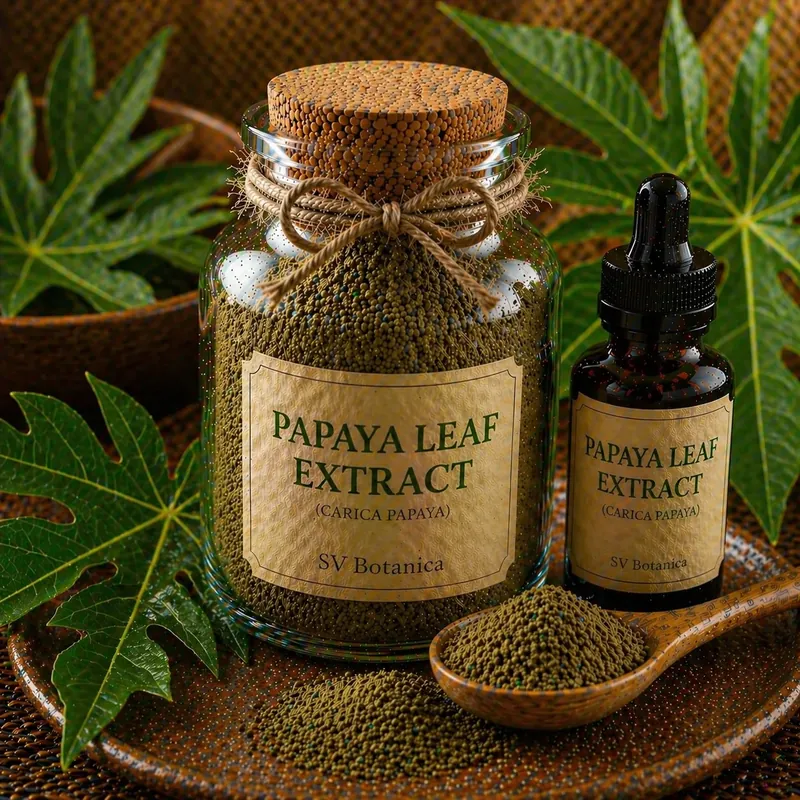
Leaf Blade Only
Petiole ExcludedAn ingredient defined as much by its regulatory position as by its chemistry
Papaya leaf (Carica papaya) is the leaf of the papaya tree, a fast-growing tropical species of the Caricaceae family cultivated throughout India, Southeast Asia, Africa and Latin America. Traditional preparations of the fresh leaf are long established across tropical Asia, and demand for standardised leaf extract has grown substantially over the last decade — particularly in India and Southeast Asia.
It is worth being direct about why. Papaya leaf is overwhelmingly associated with platelet support during dengue, an association strong enough that a papaya leaf extract preparation is available in India as an approved formulation for dengue-related thrombocytopenia. That is a genuine regulatory pathway in one market, under a medicinal framework, with the clinical and manufacturing obligations that implies.
It is also, for almost every other buyer, the exact claim they cannot make. A dietary supplement marketed for a disease indication is not a supplement — it is an unapproved drug, in the EU, the US and most regulated markets alike. We would rather state this on the product page than let a brand build a launch around it and discover the problem in a regulatory review. The ingredient is legitimate and supplyable; the marketing needs care that most ingredients do not.
On the material itself, two controls do the work. The first is carpaine, the characteristic alkaloid of the leaf, which we report by HPLC on every batch — most papaya leaf in the market is sold with no marker assay at all. The second is the part: a papaya leaf is a large palmate blade on a long, thick, hollow petiole, and the petiole is heavy, cheap and easy to include. We supply leaf blade only, with petiole and stem excluded by declaration.
What is in the leaf blade
The characteristic macrocyclic alkaloid of papaya leaf and the most useful analytical marker for the material. Reported by HPLC on every batch. Concentrated in the leaf blade rather than the petiole, which makes it a part-integrity indicator as well as an identity one.
Quercetin and kaempferol glycosides form the principal polyphenol fraction of the leaf, reported as a supporting profile.
The dominant glucosinolate of papaya leaf, which on enzymatic hydrolysis yields benzyl isothiocyanate — a constituent worth understanding for both processing and formulation, since it drives some of the leaf's characteristic pungency.
Frequently assumed to be the point of papaya leaf, and largely not: the commercially important proteases are concentrated in the latex of the unripe fruit, not the leaf. Any residual enzyme activity does not survive standard extraction and drying.
Responsible for the green colour, and a useful visual indicator of drying quality — poorly or slowly dried leaf browns noticeably.
The leaf carries a normal leafy mineral profile, reflected in total ash limits.
Why formulators specify a carpaine-profiled, blade-only papaya leaf
The characteristic alkaloid marker of the leaf, on every batch. Most papaya leaf trades with no marker assay whatsoever, which makes strength and part integrity impossible to verify.
The petiole is long, thick, hollow and heavy, and adds weight without adding markers. Blade-only is declared and supported by the carpaine figure.
A thin tropical leaf degrades quickly if dried slowly. Controlled drying preserves colour and marker content, and colour is a genuine quality tell on this material.
Traditional use is a fresh leaf juice, so juice-powder and cold-water-soluble grades correspond more closely to established practice than a capsule does.
We tell buyers where the claim boundary sits before they formulate rather than after. On this ingredient that is more valuable than another percentage point of assay.
Papaya is cultivated year-round across India, and we ship into the markets where this ingredient has its established demand.
These are functional and physico-chemical properties of the actives; SV Botanica does not make medical or therapeutic claims for this ingredient.
Leaf extract, juice powder and native ratio
| Grade | Standardisation | Form | Best For | Solubility |
|---|---|---|---|---|
| Papaya Leaf Extract 10:1 Standard | Native 10:1 ratio; carpaine reported by HPLC | Green to green-brown fine powder, ≥95% through 40 mesh | Capsules, tablets, supplement blends | Partially water-soluble |
| Papaya Leaf Extract 20:1 Concentrated | Native 20:1 ratio; carpaine reported | Green-brown fine powder | Low-dose formats, concentrated blends | Partially water-soluble |
| Papaya Leaf Juice Powder Traditional-equivalent | Spray-dried leaf juice; carpaine reported, carrier declared | Green free-flowing powder | Juice-format products, shots, sachets | Water-soluble |
| Papaya Leaf Extract WS Water-soluble | Cold-water-soluble spray-dried; carpaine reported | Green-brown free-flowing powder | Beverages, effervescents, drink mixes | Cold-water-soluble |
| Papaya Leaf Powder Raw milled | Milled dried leaf blade — not an extract | Green coarse to fine powder | Teas, traditional formats, capsule fills | Dispersible |
Papaya leaf juice powder and papaya leaf extract are different products, and on this ingredient the distinction has more than commercial significance: traditional use is a preparation of the fresh leaf juice, so a juice powder corresponds more closely to established practice than a solvent extract does. Buyers who care about that correspondence should specify juice powder rather than assuming an extract is simply a stronger version of it. Milled leaf powder is a third product again and is not an extract. Every grade carries carpaine reported by HPLC and a leaf-blade-only declaration with petiole and stem excluded. Where a spray-dried grade uses a carrier, the carrier and inclusion level are declared. Native-ratio, juice-powder and water-soluble grades can be quoted against buyer specification and order volume.
Papaya Leaf Extract is bought in five forms. The standardised extract is the stocked item; granulated and dispersible grades are produced on request and raw botanical forms are sourced against a confirmed order.
| Form | What it is | Specification basis | Availability |
|---|---|---|---|
| Standardised extract powder | Carica papaya leaf extract, dried and milled | 10:1 native leaf extract, carpaine reported (HPLC) | Stocked |
| Granulated (direct-compression) | Extract granulated for tablet lines | Same marker, declared on the granule | On request |
| Water-dispersible / soluble | Extract in a dispersible matrix for beverages, gummies and sachets | Marker declared on the matrix basis; carrier named | On request |
| Leaf powder (non-extracted) | Dried Carica papaya leaf, milled to mesh | Botanical identity by TLC; heavy metals and microbial panel | On enquiry, subject to lot; phytosanitary certificate usually required |
| Cut leaf (tea-bag cut) | Dried leaf, tea-bag cut or cut & sifted | Identity, moisture, foreign matter | On enquiry; for teas and in-house extraction |
A marker percentage without its assay method is not a specification; ask for the method and the plant part on every quotation. Read Papaya Leaf Extract: A Complete Buyer's Guide, Papaya Leaf Standardisation: Why a 10:1 Ratio Is Not a Specification and Papaya Leaf Adulteration: Petiole in the Blade and Ratio Claims Nobody Can Check before comparing offers.
Full product specification for Papaya Leaf Dry Extract 10:1. Values are specification limits, not batch results; a batch-specific CoA is issued per shipment.
| Parameter | Specification / Limit | Method |
|---|---|---|
| Botanical Source | Carica papaya L. | — |
| Plant Family | Caricaceae | — |
| Part Used | Leaf blade (lamina) | — |
| Country of Origin | India | — |
| Appearance | Fine powder | Organoleptic |
| Colour | Green to green-brown* | Organoleptic |
| Odour | Characteristic | Organoleptic |
| Taste | Characteristic, bitter | Organoleptic |
| Identification | Corresponds to C. papaya leaf reference — positive | By TLC |
| Carpaine | Reported per batch | By HPLC |
| Flavonoid Profile | Corresponds to reference — reported on request | By HPLC |
| Petiole / Stem Material | Absent — leaf-blade declaration provided | Declaration |
| Extraction Ratio | 10:1 native (grade-dependent) | Declaration |
| Carrier | Declared with inclusion level (where used) | Declaration |
| Loss on Drying (at 105°C, % w/w) | NMT 5.0 | IP-2014 |
| pH (1% w/v solution) | 5 – 7 | IP-2014 |
| Bulk Density (g/ml) | NLT 0.35 | IP-2014 |
| Particle Size (#40 mesh, % w/w) | NLT 95 | Sieve |
| Total Ash (% w/w) | NMT 12 | IP-2014 |
| Acid Insoluble Ash (% w/w) | NMT 2 | IP-2014 |
| Residual Solvent (Ethanol, ppm) | NMT 5,000 | By GC |
| Lead (ppm) | NMT 1.0 | ICP-MS |
| Arsenic (ppm) | NMT 1.0 | ICP-MS |
| Cadmium (ppm) | NMT 0.3 | ICP-MS |
| Mercury (ppm) | NMT 0.1 | ICP-MS |
| Pesticide Residues | Complies (EU MRL, on request) | GC-MS / LC-MS/MS |
| Ethylene Oxide (ETO) | Not treated — declaration provided | LC-MS/MS (on request) |
| Aflatoxins B1 / Total (ppb) | NMT 2 / NMT 4 | HPLC-FLD |
| Total Plate Count (cfu/g) | NMT 10,000 | USP <2021> |
| Yeast & Moulds / Fungi (cfu/g) | NMT 100 | USP <2021> |
| Escherichia coli | Absent | USP <2022> |
| Salmonella sp. | Absent | USP <2022> |
| Staphylococcus aureus | Absent | USP <2022> |
| Cultivation | Cultivated (declared per batch) | Declaration |
| Kosher / Halal | Certified (on request) | Certification |
| Shelf Life | 24 months from date of manufacture, in original packed condition | — |
| Storage | Cool, dry place away from light and moisture, in tightly sealed containers | — |
*The product is of herbal origin; colour varies with leaf maturity, drying conditions and season. Two lines on this specification are doing the work most papaya leaf certificates leave undone. The first is carpaine: a great deal of papaya leaf trades with no marker assay at all, which leaves a buyer unable to distinguish a well-made extract from a weak one or from material diluted with petiole. The second is the leaf-blade declaration. A papaya leaf sits on a long, thick, hollow petiole that is heavy, easy to harvest along with the blade, and low in markers — making petiole inclusion the ordinary dilution route on this material, and often a matter of careless harvesting rather than deliberate substitution. The carpaine figure and the acid-insoluble ash limit together make it visible. Note also that papain and the commercially important proteases are constituents of fruit latex rather than leaf, and do not survive extraction and drying regardless — a papaya leaf extract should not be specified or marketed on enzyme activity. A current Certificate of Analysis and MSDS are issued with every batch.
From fresh blade to profiled extract — part-controlled, marker-reported, documented
Raw Material & Part Control: The extract is prepared from Carica papaya leaf blade, harvested from cultivated papaya and processed promptly. Species identification is straightforward on this material — papaya is unmistakable and universally cultivated — so the raw-material control that matters is part integrity rather than species. Petiole and stem are separated and excluded, which is a manual step at the collection stage and the point at which most of the quality difference on this ingredient is decided.
Processing & Testing: Papaya leaf is thin, wet and perishable, so drying is prompt and temperature-controlled — slow drying browns the leaf and costs both colour and marker content. Extraction is at certified facilities in India, with juice-powder grades produced by spray-drying leaf juice. Each batch runs identity by TLC, carpaine by HPLC, flavonoid profile, loss on drying, pH, bulk density, ash and acid-insoluble ash, mesh, residual solvent by GC, heavy metals by ICP-MS, aflatoxins by HPLC-FLD, pesticide residue screening and a complete USP microbiological panel before release.
Documentation: Every shipment is supplied against a batch-specific Certificate of Analysis stating the species, the carpaine result, the leaf-blade declaration, the extraction ratio or juice-powder form, and carrier with inclusion level where used, together with an MSDS. Halal, Kosher and Organic certification are available — see our guides on EU pesticide MRL compliance and EU import requirements for botanical extracts.
What backs every batch of Papaya Leaf extract
Key information for global product registration and labelling
This is the single most important thing to understand about papaya leaf, and we would rather put it on the product page than in a footnote. The ingredient is strongly associated with platelet support during dengue, and in India a papaya leaf extract preparation is available as an approved formulation for dengue-related thrombocytopenia — a medicinal registration in one market, with the clinical and manufacturing obligations that carries. That is not a claim a dietary supplement can make. In the EU, the US and most regulated markets, marketing a supplement for the treatment or prevention of a disease makes it an unapproved drug, and the association is well enough known that regulators recognise the implication even when the wording is careful. Buyers should treat the dengue and platelet framing as unavailable outside a medicinal pathway, and should plan positioning on that basis before formulating rather than after. We will supply the ingredient with full documentation; we will not help construct claim language that we believe crosses that line.
Papaya leaf has genuine traditional use in tropical Asia, and traditional-use framing is the route that travels in markets whose frameworks recognise it. India and several Southeast Asian markets treat the ingredient far more comfortably than the EU does — unsurprisingly, since that is where both the tradition and the dengue burden are. In the EU, buyers should also confirm the novel food position for their specific preparation, since the status of a concentrated extract is not automatically that of a traditional leaf preparation. As always, the determination depends on your specification and intended use and belongs with your regulatory reviewer.
Supplied from India by SV Botanica — FSSAI Central Licence holder and an APEDA-registered exporter — from cultivated papaya, with cultivation status declared per batch. The material is shipped against a batch-specific Certificate of Analysis carrying the carpaine result and leaf-blade declaration, with export documentation available on request. This product is supplied as a botanical ingredient and is not intended to diagnose, treat, cure or prevent any disease.
Deep-dive articles on papaya leaf extract for formulators, buyers, and brand owners
Carpaine, petiole exclusion, juice powder versus extract, and the claim question first.
TechnicalWhy most papaya leaf trades with no marker at all, and what carpaine tells you.
QualityPetiole in the blade, leaf maturity, and powder sold as extract.
RegulatoryWhere the dengue association stops being marketing and starts being a drug claim.
QualityWhat to require on a papaya leaf certificate when most carry no assay.
SourcingA thin, perishable leaf — why drying decides most of the quality.
Other traditional leaf and wellness actives from our range
Technical and commercial questions answered by our ingredients team
Carica papaya leaf blade extract with carpaine reported by HPLC, petiole and stem excluded by declaration, and juice-powder grades available. Samples for qualified buyers.
Supplied as a bulk ingredient for further manufacture. Buyers are responsible for compliance with the regulations of their destination market. This product is not intended to diagnose, treat, cure or prevent any disease.
We use cookies for analytics and to measure our advertising. Essential cookies are always on. Privacy policy