
Trigonella foenum-graecum L. · Family: Fabaceae · Seed Extract
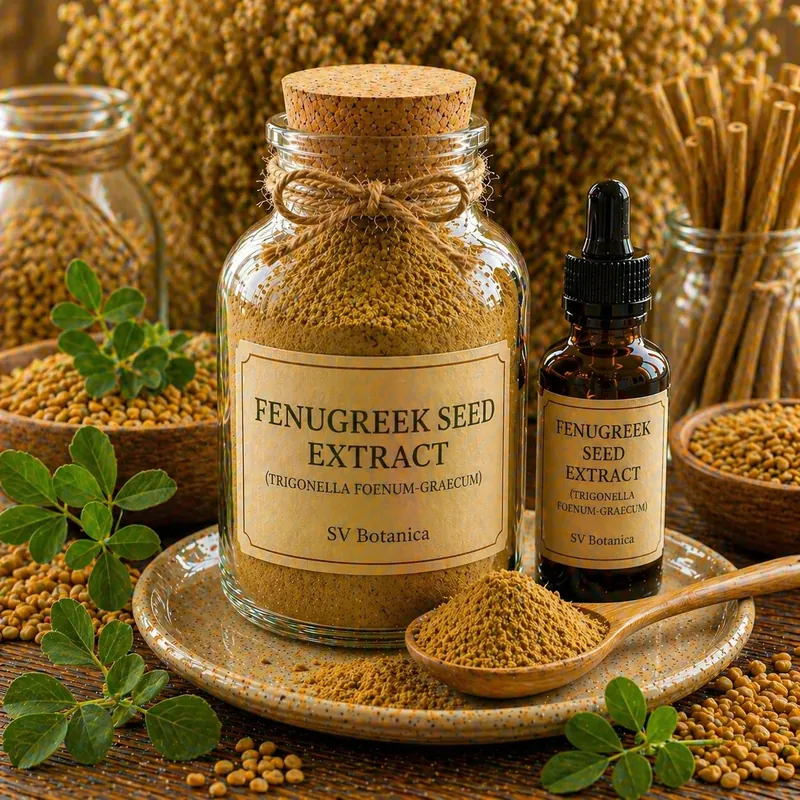
A saponin-rich fenugreek seed extract standardised to furostanol saponins NLT 50%. Prepared from the seed of Trigonella foenum-graecum for sports-nutrition, metabolic-wellness, women's-wellness and lactation-support formulators — with 4-hydroxyisoleucine, de-bittered and galactomannan fibre grades. CoA-backed, authenticated supply from India.
Standardised Grade
Trigonella foenum-graecum · 50% SaponinsA standardised saponin active from the world's most cultivated legume spice
Fenugreek (Trigonella foenum-graecum L.) — methi across the Indian subcontinent — is a legume of the Fabaceae family grown as both spice and forage for at least four thousand years. India is by a wide margin the world's largest producer, and the seed has a dual identity that shapes everything about how the extract is bought: it is simultaneously a culinary spice with an unmistakable aroma and a source of concentrated steroidal saponins.
The extract's functional identity rests on its furostanol saponins — principally protodioscin and related glycosides — which are the basis of the mainstream commercial grade, typically standardised to 50%. Alongside them sit three constituents that define the specialty grades: 4-hydroxyisoleucine, an unusual amino acid essentially unique to fenugreek; trigonelline, an alkaloid that gives the seed its name; and galactomannan, a soluble fibre that makes up a large fraction of the seed and is sold as a grade in its own right.
Two practical characteristics distinguish fenugreek from most seed extracts. First, the assay is not HPLC — furostanol saponins are conventionally measured by a UV spectrophotometric method, which is a genuine specification weakness buyers should understand rather than ignore. Second, fenugreek is intensely aromatic and bitter; the maple-like note comes from sotolone, and it survives concentration, which is why a de-bittered grade exists and why sensory testing belongs in your qualification protocol.
SV Botanica standardises the flagship grade to furostanol saponins of not less than 50%, with 20% and 60% grades, a 4-hydroxyisoleucine-standardised grade, de-bittered material and galactomannan fibre available. As a legume, fenugreek carries a genuine allergen consideration — we supply a full allergen declaration with every batch.
The saponins, alkaloids and fibre that define fenugreek seed
The steroidal saponin complex that forms the basis of the mainstream grade. Standardised here to NLT 50% and the reference point for most commercial specifications.
The principal furostanol glycoside of fenugreek and the compound most often named in the sports-nutrition literature; reported by HPLC on request.
An unusual branched-chain amino acid essentially unique to fenugreek seed, and the marker for the metabolic-positioning specialty grade.
The pyridine alkaloid that gives Trigonella its name, contributing to the seed's characteristic profile and assayed by HPLC where specified.
The soluble fibre that constitutes a large share of the seed. Sold as its own grade for satiety, texture and glycaemic-response applications.
The lactone responsible for fenugreek's distinctive maple aroma — the sensory signature that de-bittered grades are made to reduce.
Why formulators specify a saponin-standardised fenugreek extract — the functional role of the markers
The saponin complex is the basis of fenugreek's commercial identity. A declared percentage lets formulators build sports and metabolic products on a consistent active load rather than a nominal extract ratio — provided the method is stated, since saponin assay is method-sensitive.
Fenugreek is an established component of the sports-nutrition ingredient set, appearing in strength, performance and body-composition formats where a standardised saponin load matters for dose consistency.
The 4-hydroxyisoleucine grade and the galactomannan fibre grade both serve metabolic-wellness positioning, giving formulators two distinct routes into the category from one seed.
Fenugreek carries centuries of traditional use in lactation-support and women's-wellness preparations, giving brands a heritage ingredient with strong recognition in several key markets.
The fibre grade delivers a viscous soluble fibre useful for satiety, texture and mouthfeel in beverages and functional foods — a genuinely different product from the saponin grade, from the same seed.
Fenugreek's maple-bitter sotolone character survives concentration and will dominate an unmasked format. The de-bittered grade exists specifically to make palatable formats achievable.
These are functional and physico-chemical properties of the actives; SV Botanica does not make medical or therapeutic claims for this ingredient.
Saponin, amino-acid and fibre grades — three different reasons to buy the same seed
| Grade | Standardisation | Form | Best For | Solubility |
|---|---|---|---|---|
| Fenugreek Extract 50% Standard | Furostanol saponins NLT 50% (UV) | Light yellow to beige fine powder, ≥95% through 40 mesh | Sports nutrition, metabolic & women's-wellness supplements | Partially water-soluble |
| Fenugreek Extract 20% / 60% Alternative assay | Furostanol saponins NLT 20% or NLT 60% (UV) | Light yellow to beige fine powder | Dose-tuned supplement formats | Partially water-soluble |
| Fenugreek 4-Hydroxyisoleucine 20% Specialty | 4-Hydroxyisoleucine NLT 20% (HPLC) | Off-white to pale beige powder | Metabolic-wellness & glycaemic-support formats | Water-soluble |
| Fenugreek De-Bittered Sensory | Saponins to specification, sotolone reduced | Pale beige fine powder, reduced aroma | Beverages, gummies, chewables & food fortification | Partially water-soluble |
| Fenugreek Galactomannan Fibre Fibre | Galactomannan NLT 75% (soluble fibre) | Off-white free-flowing powder | Satiety, texture & glycaemic-response applications | Water-soluble, viscous |
The 50% furostanol saponin grade is our CoA-backed flagship. Because saponin content is conventionally determined by UV spectrophotometry rather than HPLC, we state the method on every certificate and will report protodioscin and trigonelline by HPLC on request — this matters when comparing quotations, as saponin figures are not directly comparable across methods. Alternative assay strengths, 4-hydroxyisoleucine, de-bittered and galactomannan fibre grades, custom mesh and packaging can be quoted against buyer specification and order volume.
Fenugreek Seed Extract is bought in five forms. The standardised extract is the stocked item; granulated and dispersible grades are produced on request and raw botanical forms are sourced against a confirmed order.
| Form | What it is | Specification basis | Availability |
|---|---|---|---|
| Standardised extract powder | Trigonella foenum-graecum seed extract, dried and milled | NLT 50% furostanol saponins (UV) | Stocked |
| Granulated (direct-compression) | Extract granulated for tablet lines | Same marker, declared on the granule | On request |
| Water-dispersible / soluble | Extract in a dispersible matrix for beverages, gummies and sachets | Marker declared on the matrix basis; carrier named | On request |
| Seed powder (non-extracted) | Cleaned Trigonella foenum-graecum seed, milled to mesh | Botanical identity by TLC; heavy metals and microbial panel | On enquiry, subject to lot; phytosanitary certificate usually required |
| Whole seed | Cleaned, graded whole seed | Purity, moisture, foreign matter; pesticide screen | On enquiry, subject to lot; spice-trade item |
A marker percentage without its assay method is not a specification; ask for the method and the plant part on every quotation. Read Fenugreek Seed Extract: A Complete Buyer's Guide, Furostanol Saponins and How Fenugreek Extract Is Standardised and Fenugreek Extract Adulteration and How Authenticity Is Proven before comparing offers.
Full product specification for Fenugreek Seed Dry Extract 50% saponins. Values are specification limits, not batch results; a batch-specific CoA is issued per shipment.
| Parameter | Specification / Limit | Method |
|---|---|---|
| Botanical Source | Trigonella foenum-graecum L. | — |
| Plant Family | Fabaceae (Leguminosae) | — |
| Part Used | Seed | — |
| Country of Origin | India | — |
| Appearance | Fine powder | Organoleptic |
| Colour | Light yellow to beige* | Organoleptic |
| Odour | Characteristic, maple-like | Organoleptic |
| Taste | Characteristic, bitter | Organoleptic |
| Identification | Corresponds to reference extract — positive | By TLC |
| Loss on Drying (at 105°C, % w/w) | NMT 5.0 | IP-2014 |
| pH (1% w/v solution) | 4 – 7 | IP-2014 |
| Bulk Density (g/ml) | NLT 0.35 | IP-2014 |
| Particle Size (#40 mesh, % w/w) | NLT 95 | Sieve |
| Total Ash (% w/w) | NMT 8 | IP-2014 |
| Acid Insoluble Ash (% w/w) | NMT 2 | IP-2014 |
| Furostanol Saponins (% w/w, dry basis) | NLT 50.0 | By UV Spectrophotometry |
| Protodioscin (% w/w) | Reported per batch on request | By HPLC |
| Trigonelline (% w/w) | Reported per batch on request | By HPLC |
| 4-Hydroxyisoleucine (% w/w) | NLT 20 in specialty grade | By HPLC |
| Protein (% w/w) | Reported per batch | Kjeldahl |
| Residual Solvent (Ethanol, ppm) | NMT 5,000 | By GC |
| Lead (ppm) | NMT 1.0 | ICP-MS |
| Arsenic (ppm) | NMT 1.0 | ICP-MS |
| Cadmium (ppm) | NMT 0.3 | ICP-MS |
| Mercury (ppm) | NMT 0.1 | ICP-MS |
| Pesticide Residues | Complies (EU MRL, on request) | GC-MS / LC-MS/MS |
| Ethylene Oxide (ETO) | Not treated — declaration provided | LC-MS/MS (on request) |
| Aflatoxins B1 / Total (ppb) | NMT 2 / NMT 4 | HPLC-FLD |
| Allergen Status | Legume (Fabaceae) — declaration provided | Declaration |
| Total Plate Count (cfu/g) | NMT 1,000 | USP <2021> |
| Yeast & Moulds / Fungi (cfu/g) | NMT 100 | USP <2021> |
| Escherichia coli | Absent | USP <2022> |
| Salmonella sp. | Absent | USP <2022> |
| Staphylococcus aureus | Absent | USP <2022> |
| Cultivation | Cultivated | Declaration |
| Kosher / Halal | Certified (on request) | Certification |
| Shelf Life | 36 months from date of manufacture, in original packed condition | — |
| Storage | Cool, dry place away from light and moisture, in tightly sealed containers | — |
*The product is of herbal origin; slight colour variation may occur due to geographical and seasonal variation in the raw material. Furostanol saponins are determined by UV spectrophotometry — the conventional industry method for this marker — and the method is stated on every certificate; protodioscin and trigonelline are available by HPLC on request. Fenugreek is a legume and buyers should note the allergen position: cross-reactivity with other Fabaceae species including peanut and chickpea has been reported, and an allergen declaration is supplied with every batch. A current Certificate of Analysis and MSDS are issued per shipment.
From seed to standardised extract — authenticated, tested, documented
Raw Material & Authentication: The extract is prepared from cultivated Trigonella foenum-graecum seed. India is the world's largest producer, which gives direct access to the raw-material base rather than a re-export chain. Identity is confirmed by TLC against reference extract, and saponin content is determined on every batch before acceptance.
Manufacturing & Testing: Fenugreek Seed Dry Extract is manufactured at certified facilities in India. Each batch runs through a full QC battery — furostanol saponins by UV spectrophotometry with the method stated, loss on drying, pH, bulk density, ash and acid-insoluble ash, mesh, residual solvent by GC, heavy metals by ICP-MS, aflatoxins, pesticide residue screening, and a complete USP microbiological panel — before release. Protodioscin, trigonelline and 4-hydroxyisoleucine are available by HPLC where a buyer specification calls for them.
Documentation & Allergen Position: Every shipment is supplied against a batch-specific Certificate of Analysis with an MSDS and a full allergen declaration. Fenugreek is a legume, and cross-reactivity with other Fabaceae species including peanut and chickpea has been reported — this is a real labelling consideration in several markets and we treat it as a standard documentation item rather than an on-request extra. See our guides on EU pesticide MRL compliance and EU import requirements for botanical extracts.
What backs every batch of Fenugreek extract
Key information for global product registration and labelling
Used as a botanical active in supplement, sports-nutrition and functional-food formats, the extract is supplied to a defined saponin specification with full analytical documentation. Fenugreek has extensive culinary history across South Asia, the Middle East and the Mediterranean, which supports its food-use position in most markets. Buyers remain responsible for determining suitability and for compliance with the relevant food-supplement regulations in their market. This product is not intended to diagnose, treat, cure or prevent any disease.
Fenugreek is a legume of the Fabaceae family and cross-reactivity with other legumes, notably peanut and chickpea, has been reported in the allergy literature. Requirements differ by market and fenugreek is not universally a named allergen, but a responsible finished-product allergen assessment should consider it — particularly for products marketed to consumers with legume allergy. We supply a full allergen declaration with every batch so the assessment can be made on facts.
Supplied from India by SV Botanica — FSSAI Central Licence holder and an APEDA-registered exporter. India is the world's largest fenugreek producer, giving direct access to the raw material base and to the seasonal contracting that makes supply predictable. The material is Kosher certified and shipped against a batch-specific Certificate of Analysis with export documentation available on request.
Deep-dive articles on fenugreek seed extract for formulators, buyers, and brand owners
How to specify saponin, amino-acid and fibre grades — and why quoted saponin figures are not comparable.
TechnicalWhy fenugreek is assayed by UV not HPLC, what that means for your specification, and the diosgenin myth.
QualityHow a method-sensitive assay invites saponin spiking, and the tests that expose it.
ApplicationsSports, metabolic, women's-wellness and fibre formats — plus the bitterness problem nobody plans for.
ProcurementA scored checklist for qualifying a fenugreek extract supplier before you place a bulk order.
MarketWhere fenugreek demand is growing, and why India's production dominance shapes your pricing.
Frequently co-formulated with Fenugreek Seed Extract in sports, metabolic & men's-wellness blends
Technical and commercial questions answered by our ingredients team
Saponin-standardised, lab-tested, fully documented supply of Trigonella foenum-graecum seed extract. Furostanol saponins NLT 50%, with 4-hydroxyisoleucine, de-bittered and galactomannan grades. Samples available for qualified buyers.
Supplied as a bulk ingredient for further manufacture. Buyers are responsible for compliance with the regulations of their destination market. This product is not intended to diagnose, treat, cure or prevent any disease.
We use cookies for analytics and to measure our advertising. Essential cookies are always on. Privacy policy