
Gymnema sylvestre (Retz.) R.Br. ex Sm. · Family: Apocynaceae · Leaf Extract
The Ayurvedic "sugar destroyer" — gurmar — standardised to gymnemic acids NLT 25% with the assay method named on every certificate, because gymnemic acid percentages measured by different methods are not comparable. Prepared from the leaf of Gymnema sylvestre for metabolic, glycaemic-support and sugar-reduction formulators, with a sweetness-suppression functional check. CoA-backed supply from India.
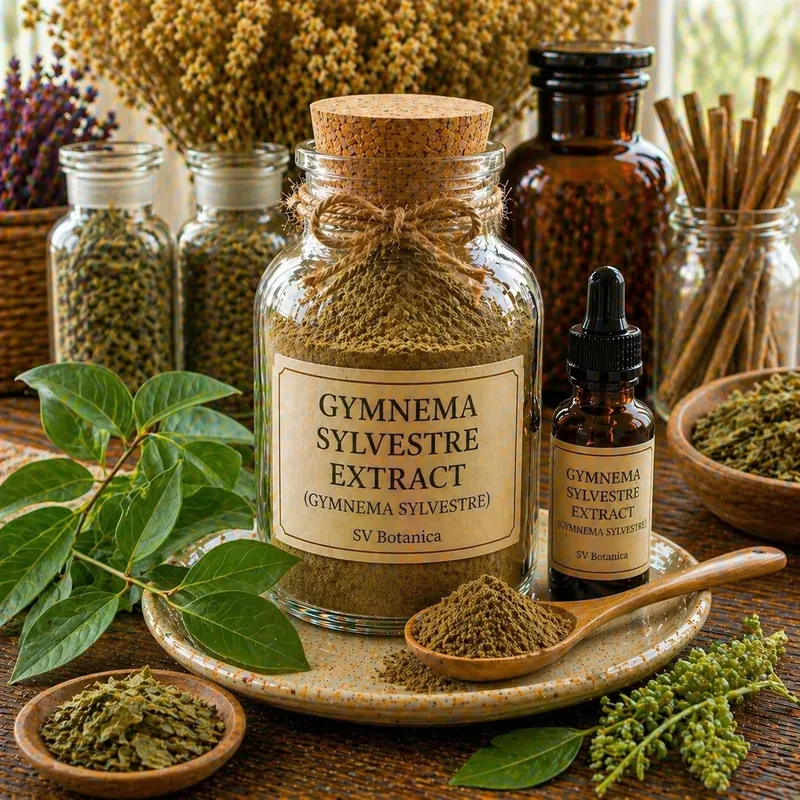
Standardised Grade
Gymnema sylvestre · 25% Gymnemic AcidsThe one botanical whose authenticity you can check on your own tongue
Gymnema sylvestre — gurmar in Hindi, literally "sugar destroyer" — is a woody climber of the Apocynaceae family native to central and southern India, and one of the oldest recorded botanicals in Ayurvedic practice for metabolic and glycaemic support. Its Sanskrit name meshashringi refers to the ram's-horn shape of its fruit.
The leaf is remarkable for a property that is genuinely rare in the botanical trade: chewing it temporarily abolishes the ability to taste sweetness. The effect is immediate, unmistakable and lasts on the order of half an hour — sugar placed on the tongue registers as gritty texture with no sweetness at all. It is attributed principally to the gymnemic acid fraction and to gurmarin, a peptide in the leaf.
That property matters commercially for two reasons. It is the basis of a real application — sugar-reduction and sweet-craving formats — and, more usefully to a buyer, it is a functional bioassay. A genuine, potent gymnema extract suppresses sweetness. An extract diluted or spiked with cheaper saponins does not, no matter what its certificate claims. We verify it on every batch.
That check matters because gymnema shares a specification weakness with several saponin botanicals: gymnemic acid assay is method-dependent. The compounds are a family, not a single molecule, and the conventional UV and gravimetric methods return materially different figures. This is why "gymnemic acids 75%" appears on the market at prices that make little sense — the number reflects a method as much as a material. We name the method on every certificate and are candid about what the number does and does not mean.
The saponin family, the peptide, and what actually suppresses sweetness
The principal triterpene saponins of the leaf and the standardisation basis. A family of related oleanane-type glycosides rather than a single compound.
Further saponins of the leaf that co-occur with the gymnemic acids and contribute to the total measured by class assay methods.
A polypeptide of the leaf associated with sweetness suppression. Peptide rather than saponin, and not captured by a saponin assay at all.
A hydrolysis product used in some analytical protocols as a reference basis — a further reason quoted percentages differ between suppliers.
The secondary phenolic fraction of the leaf, contributing to the full-spectrum profile and the extract's characteristic fingerprint.
Responsible for the extract's green to dark green colour, and a practical formulation consideration in pale or clear systems.
Why formulators specify a method-declared, function-verified gymnema extract
Gymnemic acid figures measured by different methods are not comparable. Naming the method converts a marketing percentage into a specification you can actually hold a supplier to — and makes quotations comparable.
A genuine bioassay, and a rarity in botanicals. Potent gymnema abolishes sweet taste for around half an hour; diluted or saponin-spiked material does not. Function verified, not just assayed.
Gymnema is among the most established Ayurvedic botanicals for metabolic-wellness formulation, with centuries of documented traditional use behind the positioning.
The taste-suppression property supports a genuinely differentiated application — lozenges, sprays and chews aimed at sweet craving, where the consumer experiences the effect directly.
A cold-water-soluble grade suits beverages, sachets and effervescents; the standard grade suits capsules, tablets and dry blends where solubility is not required in pack.
25%, 50% and 75% grades are available — but read the method line before comparing them, because a higher number on a different method is not a stronger material.
These are functional and physico-chemical properties of the actives; SV Botanica does not make medical or therapeutic claims for this ingredient.
Read the method column before comparing the percentages — on this ingredient they are not equivalent
| Grade | Standardisation | Form | Best For | Solubility |
|---|---|---|---|---|
| Gymnema Extract 25% Standard | Gymnemic acids NLT 25% — method declared | Green to dark green fine powder, ≥95% through 40 mesh | Metabolic & glycaemic supplements, capsules & tablets | Partially water-soluble |
| Gymnema Extract 50% High-assay | Gymnemic acids NLT 50% — method declared | Green to brownish-green fine powder | Low-dose formats, concentrated stacks | Partially water-soluble |
| Gymnema Extract 75% Very-high-assay | Gymnemic acids NLT 75% — method critical | Brownish-green fine powder | Where a high nominal assay is specified — confirm the method | Partially water-soluble |
| Gymnema Extract WS Water-soluble | Cold-water-soluble spray-dried; assay to specification | Green free-flowing powder | Beverages, sachets, effervescents & drink mixes | Cold-water-soluble |
| Gymnema Extract Ratio Full-spectrum | Native 10:1 / 20:1 ratio (full-spectrum) | Dark green fine powder | Traditional & Ayurvedic formats, herbal blends | Grade-dependent |
The 25% grade is our CoA-backed standard. A candid note on the higher grades: because gymnemic acids are a saponin class measured by UV or gravimetric methods rather than a single compound quantified by chromatography, the quoted percentage is strongly method-dependent — and a nominal 75% figure generally reflects a different analytical basis rather than three times the material of a 25% grade. We name the method on every certificate and will supply an HPLC profile and a sweetness-suppression check so you can compare materials on something more solid than the headline number. Every batch is released against a batch-specific Certificate of Analysis.
Gymnema Sylvestre Extract is bought in five forms. The standardised extract is the stocked item; granulated and dispersible grades are produced on request and raw botanical forms are sourced against a confirmed order.
| Form | What it is | Specification basis | Availability |
|---|---|---|---|
| Standardised extract powder | Gymnema sylvestre leaf extract, dried and milled | NLT 25% gymnemic acids, method declared | Stocked |
| Granulated (direct-compression) | Extract granulated for tablet lines | Same marker, declared on the granule | On request |
| Water-dispersible / soluble | Extract in a dispersible matrix for beverages, gummies and sachets | Marker declared on the matrix basis; carrier named | On request |
| Leaf powder (non-extracted) | Dried Gymnema sylvestre leaf, milled to mesh | Botanical identity by TLC; heavy metals and microbial panel | On enquiry, subject to lot; phytosanitary certificate usually required |
| Cut leaf (tea-bag cut) | Dried leaf, tea-bag cut or cut & sifted | Identity, moisture, foreign matter | On enquiry; for teas and in-house extraction |
A marker percentage without its assay method is not a specification; ask for the method and the plant part on every quotation. Read Gymnema Sylvestre Extract: A Complete Buyer's Guide, Gymnemic Acids and How Gymnema Extract Is Standardised and Gymnema Extract Adulteration and How Authenticity Is Proven before comparing offers.
Full product specification for Gymnema Sylvestre Leaf Extract 25%. Values are specification limits, not batch results; a batch-specific CoA is issued per shipment.
| Parameter | Specification / Limit | Method |
|---|---|---|
| Botanical Source | Gymnema sylvestre (Retz.) R.Br. ex Sm. | — |
| Plant Family | Apocynaceae (formerly Asclepiadaceae) | — |
| Part Used | Leaf | — |
| Country of Origin | India | — |
| Appearance | Fine powder | Organoleptic |
| Colour | Green to dark green* | Organoleptic |
| Odour | Characteristic | Organoleptic |
| Taste | Characteristic, bitter | Organoleptic |
| Identification | Corresponds to reference extract — positive | By TLC |
| Assay Method | Declared per batch (UV / gravimetric) | Declaration |
| Gymnemic Acids (% w/w, dry basis) | NLT 25.0 | Method as declared |
| Sweetness Suppression | Positive — verified per batch | Functional check |
| Saponin HPLC Profile | Available on request | By HPLC |
| Loss on Drying (at 105°C, % w/w) | NMT 5.0 | IP-2014 |
| pH (1% w/v solution) | 4 – 7 | IP-2014 |
| Bulk Density (g/ml) | NLT 0.35 | IP-2014 |
| Particle Size (#40 mesh, % w/w) | NLT 95 | Sieve |
| Total Ash (% w/w) | NMT 10 | IP-2014 |
| Acid Insoluble Ash (% w/w) | NMT 2 | IP-2014 |
| Residual Solvent (Ethanol, ppm) | NMT 5,000 | By GC |
| Lead (ppm) | NMT 1.0 | ICP-MS |
| Arsenic (ppm) | NMT 1.0 | ICP-MS |
| Cadmium (ppm) | NMT 0.3 | ICP-MS |
| Mercury (ppm) | NMT 0.1 | ICP-MS |
| Pesticide Residues | Complies (EU MRL, on request) | GC-MS / LC-MS/MS |
| Ethylene Oxide (ETO) | Not treated — declaration provided | LC-MS/MS (on request) |
| Total Plate Count (cfu/g) | NMT 1,000 | USP <2021> |
| Yeast & Moulds / Fungi (cfu/g) | NMT 100 | USP <2021> |
| Escherichia coli | Absent | USP <2022> |
| Salmonella sp. | Absent | USP <2022> |
| Staphylococcus aureus | Absent | USP <2022> |
| Cultivation | Cultivated / wild-collected (declared per batch) | Declaration |
| Kosher / Halal | Certified (on request) | Certification |
| Shelf Life | 36 months from date of manufacture, in original packed condition | — |
| Storage | Cool, dry place away from light and moisture, in tightly sealed containers | — |
*The product is of herbal origin; slight colour variation may occur due to geographical and seasonal variation in the raw material. Gymnemic acid content is method-dependent — the compounds are a saponin class measured by UV or gravimetric methods, not a single molecule quantified chromatographically, and different protocols return materially different figures on the same sample. We name the method on every certificate so the number can be interpreted and so quotations can be compared like with like. The sweetness-suppression check is reported as a functional confirmation: a potent, genuine gymnema extract abolishes sweet taste, and material that assays on paper but fails this check warrants investigation. A current Certificate of Analysis and MSDS are issued with every batch.
From leaf to standardised extract — method-declared, function-verified, documented
Raw Material & Authentication: The extract is prepared from Gymnema sylvestre leaf, collected from central and southern India where the species is native. Identity is confirmed by TLC against reference material, and — unusually among botanicals — verified functionally by the sweetness-suppression check, which no amount of saponin spiking reproduces.
Manufacturing & Testing: Gymnema Leaf Extract is manufactured at certified facilities in India. Each batch runs through a full QC battery — gymnemic acids by a named and declared method, sweetness-suppression confirmation, loss on drying, pH, bulk density, ash and acid-insoluble ash, mesh, residual solvent by GC, heavy metals by ICP-MS, pesticide residue screening, and a complete USP microbiological panel — before release. An HPLC saponin profile is available where a buyer specification calls for a chromatographic anchor.
Documentation: Every shipment is supplied against a batch-specific Certificate of Analysis stating the assay method and the sweetness-suppression result, with an MSDS. Halal, Kosher and Organic certification are available. Country of Origin, collection status and export documentation are provided on request — see our guides on EU pesticide MRL compliance and EU import requirements for botanical extracts.
What backs every batch of Gymnema extract
Key information for global product registration and labelling
Used as a botanical active in supplement and functional-food formats, supplied to a defined gymnemic acid specification with the method declared. Gymnema has extensive documented traditional use in Ayurveda, which supports its position in most markets, though it does not have the broad culinary history that some botanicals carry. Buyers remain responsible for determining suitability and for compliance with the food-supplement regulations applying in their market, and should note that metabolic and glycaemic positioning attracts particular scrutiny on claims. This product is not intended to diagnose, treat, cure or prevent any disease.
Gymnema sits in the glycaemic-support category, where claim frameworks are strict in most regulated markets and where any implication of treating a diagnosed condition is not permissible. Finished-product formulators should also be aware that consumer guidance commonly advises those managing blood sugar with medication to consult a healthcare professional before using glycaemic-positioned supplements — an advisory-labelling consideration for this category generally. We supply the ingredient specification and documentation to support your regulatory assessment.
Supplied from India by SV Botanica — FSSAI Central Licence holder and an APEDA-registered exporter — from the species' native range. Collection status (cultivated or wild-collected) is declared per batch. The material is Kosher certified and shipped against a batch-specific Certificate of Analysis with export documentation available on request.
Deep-dive articles on gymnema sylvestre extract for formulators, buyers, and brand owners
Why a 75% gymnemic acid claim may not mean what you think, and how to specify around it.
TechnicalA class assay, four protocols and one honest explanation of why the percentages disagree.
QualitySaponin spiking, spent leaf and species substitution — plus the bioassay that catches all three.
ApplicationsMetabolic, craving-control and beverage formats — and formulating with a taste-blocking active.
ProcurementA scored checklist for qualifying a gymnema supplier before you place a bulk order.
MarketWhere gymnema demand is growing, and how sugar-reduction reformulation expanded it.
Frequently co-formulated with Gymnema Sylvestre Extract in metabolic & glycaemic blends
Technical and commercial questions answered by our ingredients team
Gymnemic acids NLT 25% with the assay method declared and sweetness-suppression verified on every batch. Gurmar leaf extract from its native range. Samples available for qualified buyers.
Supplied as a bulk ingredient for further manufacture. Buyers are responsible for compliance with the regulations of their destination market. This product is not intended to diagnose, treat, cure or prevent any disease.
We use cookies for analytics and to measure our advertising. Essential cookies are always on. Privacy policy