
Momordica charantia L. · Family: Cucurbitaceae · Fruit Extract
A karela fruit extract standardised to charantin — with the assay basis declared, because charantin is a mixture of two glucosides rather than one compound, and with seed material excluded. Prepared from the fruit of Momordica charantia for metabolic, glycaemic-support and traditional formulators. CoA-backed supply from India.
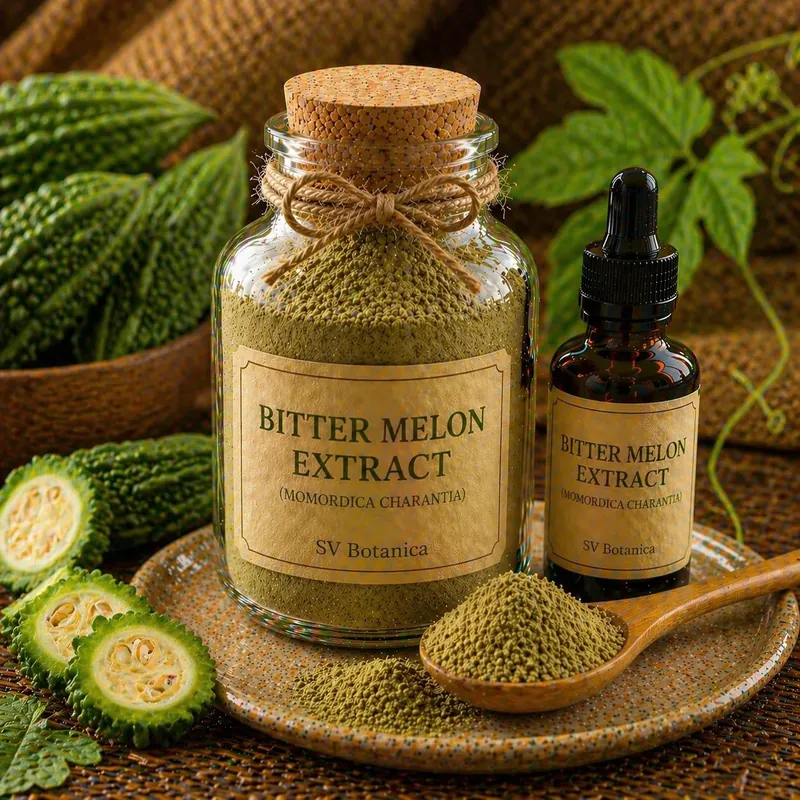
Standardised Grade
Charantin · Seed-FreeA marker that isn't one compound, and a seed you don't want
Bitter melon (Momordica charantia L.) — karela across the Indian subcontinent, bitter gourd or balsam pear elsewhere — is a Cucurbitaceae vine whose fruit is simultaneously a common vegetable and one of the most established traditional botanicals for metabolic and glycaemic support. It is eaten daily across South Asia, which gives it an unusually comfortable food-use position.
Two things need care when buying it. The first is the marker. Charantin is not a single compound — it is conventionally a mixture of two steroidal glucosides, sitosteryl glucoside and stigmasteryl glucoside, and different laboratories quantify it against different bases. A "charantin 5%" figure is therefore less unambiguous than it appears, which is why we state the assay basis rather than just the number.
The second is the seed. Bitter melon seed contains vicine, a pyrimidine glycoside relevant to people with G6PD deficiency — an inherited enzyme condition affecting a meaningful share of the population in parts of the Mediterranean, Africa, the Middle East and South and Southeast Asia. Seed is also where the more concerning toxicity reports in the literature concentrate. We therefore supply deseeded fruit extract with seed material excluded and declare it on every batch.
Alongside charantin, the fruit carries momordicosides — cucurbitane-type triterpene glycosides that constitute the more modern and more chromatographically tractable marker set — and polypeptide-p, an insulin-like peptide of traditional interest. Water-soluble and native-ratio grades are available.
The glucoside, glycoside and peptide fractions of karela fruit
Conventionally a mixture of sitosteryl glucoside and stigmasteryl glucoside — a pair, not a single compound, which is why the assay basis must be stated.
Cucurbitane-type triterpene glycosides characteristic of M. charantia. Individually quantifiable by HPLC and the more analytically robust marker set.
An insulin-like peptide of the fruit, of traditional and research interest. Being a peptide, it is not captured by a glucoside assay.
The cucurbitacin-related compounds responsible for the fruit's intense characteristic bitterness.
A seed constituent, not a fruit-flesh one. Relevant to G6PD deficiency — and the reason our specification excludes seed material.
Responsible for the extract's light green to olive-green colour, and a practical consideration in pale formulations.
Why formulators specify a seed-free, basis-declared bitter melon extract
Charantin is a glucoside pair rather than a single molecule, and laboratories quantify it against different bases. Stating the basis is what makes the number interpretable and quotations comparable.
Bitter melon seed carries vicine, relevant to G6PD deficiency, and is where the more concerning toxicity reports concentrate. Deseeded fruit is the appropriate material for a supplement, and we declare it.
Karela is among the most established traditional botanicals in metabolic-wellness formulation, with genuine daily culinary use across South Asia behind the positioning.
Cucurbitane-type glycosides are individually quantifiable by HPLC, giving a chromatographic anchor that a charantin figure alone cannot provide.
A cold-water-soluble grade suits juices, shots, sachets and effervescents — formats with real traction for karela in its home markets.
Eaten as a daily vegetable across South Asia and beyond, which gives bitter melon a comfortable food-use position relative to botanicals without culinary history.
These are functional and physico-chemical properties of the actives; SV Botanica does not make medical or therapeutic claims for this ingredient.
Specify the charantin basis and confirm seed exclusion — both belong on the order
| Grade | Standardisation | Form | Best For | Solubility |
|---|---|---|---|---|
| Bitter Melon Extract 5% Standard | Charantin NLT 5% — basis declared; seed-free | Light green to olive-green fine powder, ≥95% through 40 mesh | Metabolic & glycaemic supplements, capsules & tablets | Partially water-soluble |
| Bitter Melon Extract 10% High-assay | Charantin NLT 10% — basis declared; seed-free | Olive-green fine powder | Low-dose formats, crowded metabolic stacks | Partially water-soluble |
| Bitter Melon Extract WS Water-soluble | Cold-water-soluble spray-dried; seed-free | Pale green free-flowing powder | Juices, shots, sachets & effervescents | Cold-water-soluble |
| Bitter Melon Extract Ratio Full-spectrum | Native 10:1 ratio; charantin reported; seed-free | Green to olive fine powder | Traditional & Ayurvedic karela formats | Grade-dependent |
| Bitter Melon Fruit Powder Whole-food | Milled deseeded fruit — not an extract | Green coarse to fine powder | Whole-food and culinary-adjacent formats | Dispersible |
All grades are supplied seed-free from deseeded fruit, declared on every batch — bitter melon seed carries vicine, relevant to G6PD deficiency, and is where the more concerning toxicity reports in the literature concentrate. Please note that the milled fruit powder is a whole-food material, not an extract, with a far lower marker concentration; the two should never be quoted against the same specification. Because charantin is a glucoside pair rather than a single compound, we state the assay basis on every certificate and will supply a momordicoside profile by HPLC where a chromatographic anchor is wanted.
Bitter Melon Extract is bought in five forms. The standardised extract is the stocked item; granulated and dispersible grades are produced on request and raw botanical forms are sourced against a confirmed order.
| Form | What it is | Specification basis | Availability |
|---|---|---|---|
| Standardised extract powder | Momordica charantia fruit extract, dried and milled | NLT 5% charantin, seed-free fruit | Stocked |
| Granulated (direct-compression) | Extract granulated for tablet lines | Same marker, declared on the granule | On request |
| Water-dispersible / soluble | Extract in a dispersible matrix for beverages, gummies and sachets | Marker declared on the matrix basis; carrier named | On request |
| Fruit powder (non-extracted) | Dried Momordica charantia fruit, milled to mesh | Botanical identity by TLC; heavy metals and microbial panel | On enquiry, subject to lot; phytosanitary certificate usually required |
| Whole dried fruit | Dried fruit, graded and cleaned | Identity, moisture, foreign matter | On enquiry, subject to lot |
A marker percentage without its assay method is not a specification; ask for the method and the plant part on every quotation. Read Bitter Melon Extract: A Complete Buyer's Guide, Charantin: How Bitter Melon Extract Is Standardised and Bitter Melon Adulteration and How Authenticity Is Proven before comparing offers.
Full product specification for Bitter Melon Fruit Extract 5% charantin. Values are specification limits, not batch results; a batch-specific CoA is issued per shipment.
| Parameter | Specification / Limit | Method |
|---|---|---|
| Botanical Source | Momordica charantia L. | — |
| Plant Family | Cucurbitaceae | — |
| Part Used | Fruit — deseeded; seed material excluded | Declaration |
| Country of Origin | India | — |
| Appearance | Fine powder | Organoleptic |
| Colour | Light green to olive-green* | Organoleptic |
| Odour | Characteristic | Organoleptic |
| Taste | Characteristic, intensely bitter | Organoleptic |
| Identification | Corresponds to reference extract — positive | By TLC / HPLC |
| Charantin (% w/w, dry basis) | NLT 5.0 — assay basis declared | By HPLC |
| Momordicoside Profile | Corresponds to reference — reported on request | By HPLC |
| Seed Material | Absent — deseeded declaration provided | Declaration |
| Loss on Drying (at 105°C, % w/w) | NMT 5.0 | IP-2014 |
| pH (1% w/v solution) | 4 – 7 | IP-2014 |
| Bulk Density (g/ml) | NLT 0.35 | IP-2014 |
| Particle Size (#40 mesh, % w/w) | NLT 95 | Sieve |
| Total Ash (% w/w) | NMT 10 | IP-2014 |
| Acid Insoluble Ash (% w/w) | NMT 2 | IP-2014 |
| Residual Solvent (Ethanol, ppm) | NMT 5,000 | By GC |
| Lead (ppm) | NMT 1.0 | ICP-MS |
| Arsenic (ppm) | NMT 1.0 | ICP-MS |
| Cadmium (ppm) | NMT 0.3 | ICP-MS |
| Mercury (ppm) | NMT 0.1 | ICP-MS |
| Pesticide Residues | Complies (EU MRL, on request) | GC-MS / LC-MS/MS |
| Ethylene Oxide (ETO) | Not treated — declaration provided | LC-MS/MS (on request) |
| Aflatoxins B1 / Total (ppb) | NMT 2 / NMT 4 | HPLC-FLD |
| Total Plate Count (cfu/g) | NMT 1,000 | USP <2021> |
| Yeast & Moulds / Fungi (cfu/g) | NMT 100 | USP <2021> |
| Escherichia coli | Absent | USP <2022> |
| Salmonella sp. | Absent | USP <2022> |
| Staphylococcus aureus | Absent | USP <2022> |
| Cultivation | Cultivated | Declaration |
| Kosher / Halal | Certified (on request) | Certification |
| Shelf Life | 36 months from date of manufacture, in original packed condition | — |
| Storage | Cool, dry place away from light and moisture, in tightly sealed containers | — |
*The product is of herbal origin; slight colour variation may occur due to geographical and seasonal variation in the raw material. Two lines on this specification deserve particular attention. The charantin assay basis is declared because charantin is conventionally a mixture of sitosteryl and stigmasteryl glucosides rather than a single compound, and different laboratories quantify it against different reference bases — a figure without its basis is not comparable between suppliers. Seed material is excluded because bitter melon seed carries vicine, a pyrimidine glycoside relevant to people with G6PD deficiency, and because the more concerning toxicity reports in the literature concentrate on seed rather than fruit flesh. A current Certificate of Analysis and MSDS are issued with every batch.
From deseeded fruit to standardised extract — seed-excluded, basis-declared, documented
Raw Material & Authentication: The extract is prepared from cultivated Momordica charantia fruit, deseeded before extraction. Seed removal is a deliberate processing step rather than an incidental outcome: seed carries vicine and is where the more concerning toxicity reports concentrate, so excluding it is a safety-led decision that we declare on every batch. Identity is confirmed by TLC and HPLC against reference material.
Manufacturing & Testing: Bitter Melon Fruit Extract is manufactured at certified facilities in India. Each batch runs through a full QC battery — charantin by HPLC with the assay basis stated, momordicoside profile where specified, loss on drying, pH, bulk density, ash and acid-insoluble ash, mesh, residual solvent by GC, heavy metals by ICP-MS, aflatoxins, pesticide residue screening, and a complete USP microbiological panel — before release.
Documentation: Every shipment is supplied against a batch-specific Certificate of Analysis stating the deseeded declaration and the charantin assay basis, with an MSDS. Halal, Kosher and Organic certification are available — see our guides on EU pesticide MRL compliance and EU import requirements for botanical extracts.
What backs every batch of Bitter Melon extract
Key information for global product registration and labelling
Bitter melon seed contains vicine, a pyrimidine glycoside in the same family as the compounds implicated in favism, and therefore relevant to people with glucose-6-phosphate dehydrogenase (G6PD) deficiency — an inherited enzyme condition affecting a meaningful share of the population in parts of the Mediterranean, Africa, the Middle East and South and Southeast Asia. Seed is also where the more concerning toxicity reports in the literature concentrate. Our position is that a supplement-grade bitter melon extract should be made from deseeded fruit, and we declare seed exclusion on every batch so that a buyer's safety assessment can rest on a documented fact rather than an assumption.
Bitter melon sits in the glycaemic-support category, where claim frameworks are strict in most regulated markets and implying treatment of a diagnosed condition is not permissible. Consumer guidance commonly advises those managing blood sugar with medication to consult a healthcare professional before using glycaemic-positioned supplements, and advisory labelling to that effect is widespread category practice. Bitter melon is also traditionally avoided in pregnancy in several traditions. Requirements differ by jurisdiction and belong in your regulatory review. This product is not intended to diagnose, treat, cure or prevent any disease.
Bitter melon fruit is eaten as a daily vegetable across South Asia and beyond, which gives it a comfortable food-use position relative to botanicals without culinary history — though that history attaches to the fruit, not to concentrated seed-bearing preparations. Supplied from India by SV Botanica — FSSAI Central Licence holder and an APEDA-registered exporter — Kosher certified, against a batch-specific Certificate of Analysis with export documentation on request.
Deep-dive articles on bitter melon extract for formulators, buyers, and brand owners
Why charantin isn't one compound, and why seed exclusion belongs in your specification.
TechnicalA glucoside pair, several assay bases, and the momordicoside anchor that fixes the problem.
QualitySeed inclusion, whole-fruit powder sold as extract, and basis substitution.
ApplicationsMetabolic, juice and capsule formats — and formulating with an intensely bitter active.
ProcurementA scored checklist for qualifying a bitter melon supplier before you place a bulk order.
MarketWhere karela demand is growing, and how vegetable-crop economics shape extract supply.
Frequently co-formulated with Bitter Melon Extract in metabolic & glycaemic blends
Technical and commercial questions answered by our ingredients team
Karela fruit extract standardised to charantin with the assay basis declared and seed material excluded on every batch. Water-soluble grades available. Samples for qualified buyers.
Supplied as a bulk ingredient for further manufacture. Buyers are responsible for compliance with the regulations of their destination market. This product is not intended to diagnose, treat, cure or prevent any disease.
We use cookies for analytics and to measure our advertising. Essential cookies are always on. Privacy policy