
Hericium erinaceus (Bull.) Pers. · Family: Hericiaceae · Fruiting-Body Extract
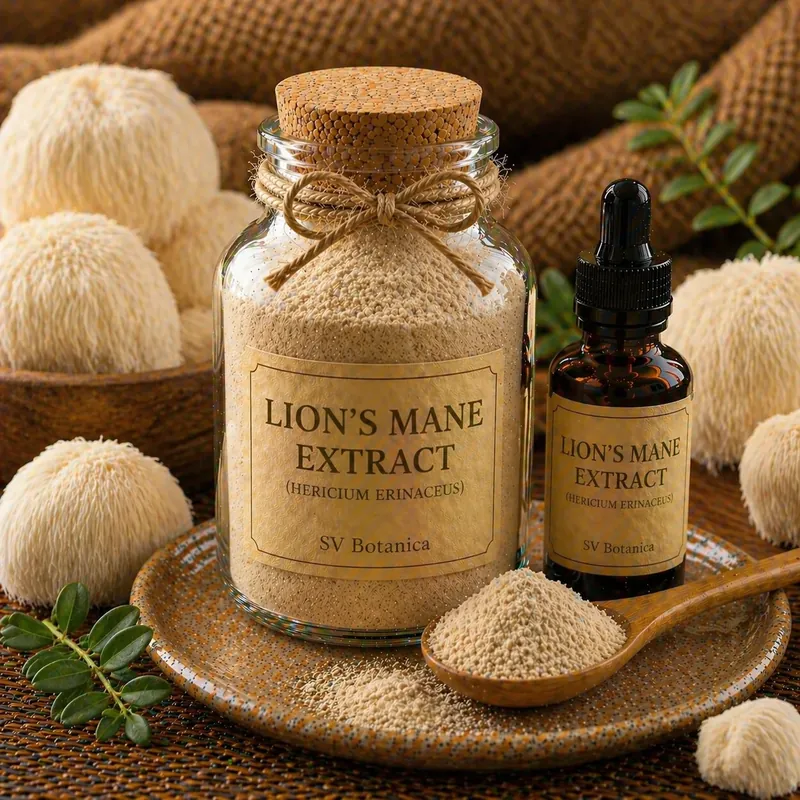
A fruiting-body-only extract of the lion's mane mushroom standardised to beta-glucans NLT 30% by enzymatic assay — no mycelium, no grain. Prepared from cultivated Hericium erinaceus for nootropic, cognitive-wellness, functional-beverage and mushroom-blend formulators. CoA-backed, identity-verified supply from India.
Standardised Grade
Hericium erinaceus · 30% Beta-GlucansA fruiting-body-only beta-glucan active from the most closely watched functional mushroom in the category
Lion's mane (Hericium erinaceus) is a tooth fungus of the family Hericiaceae, instantly recognisable by the cascading white spines of its fruiting body. It has a long culinary and traditional history in East Asia — hou tou gu, the "monkey head mushroom", in China and yamabushitake in Japan — and in the last decade it has become the cognitive flagship of the functional mushroom category. It is a mushroom, not a herb: the raw material is a cultivated fungal fruiting body grown on hardwood-based substrate, and everything about specifying it well follows from that difference.
The single question that defines quality in this category is fruiting body versus mycelium-on-grain. Much of what is sold as "lion's mane" is fermented grain colonised by mycelium, dried and milled whole — mostly starch, with a fraction of actual fungal material. SV Botanica supplies fruiting-body-only extract: no mycelium, no grain, and backs the claim analytically with a beta-glucan assay by enzymatic method and an alpha-glucan (starch) limit that grain-based material cannot meet.
The defining constituents are the fungal cell-wall beta-glucans — 1,3/1,6-linked polysaccharides standardised here to not less than 30% by enzymatic assay, with a 40% high-potency grade available. The enzymatic method matters: the trade is full of "polysaccharides 50%" figures generated by UV spectrophotometry that count starch, carriers and sugars alongside genuine beta-glucan. The fruiting body also carries the hericenones, the aromatic terpenoid fraction most cited in the research literature on this species, reported per batch on our dual-extract grade.
The extract is finished as a free-flowing, off-white to cream powder produced by hot-water extraction. We supply supplement brands, nootropic and mushroom-coffee formulators, functional-beverage manufacturers and contract packers, with a batch-specific Certificate of Analysis on every shipment.
What the fruiting body actually contains — and the marker that proves what it does not
The branched fungal cell-wall polysaccharides that define a genuine mushroom extract. Standardised here to NLT 30% by enzymatic assay, which measures true beta-glucan rather than total carbohydrate.
Aromatic compounds of the fruiting body and the terpenoid fraction most cited in the research literature on this species. Carried in our dual-extract grade and reported per batch.
Diterpenoids concentrated in the mycelium rather than the fruiting body. Their near-absence from a fruiting-body extract is expected — a supplier claiming high erinacines from fruiting body deserves questions.
The wider polysaccharide–protein complexes of the fungal cell wall that accompany the beta-glucan fraction in a full hot-water extract.
The characteristic fungal sterol, and a useful positive marker of genuine fungal tissue. Reported per batch on request.
What should not be there. Alpha-glucan is the signature of grain substrate and starchy carriers; we limit it to NMT 5% so the absence of grain is a tested number, not a slogan.
Why formulators specify a beta-glucan-standardised fruiting-body extract — the functional role of the markers
Lion's mane is the defining botanical of the nootropic and brain-health category, with hericenone and NGF-pathway research providing the rationale most cited in the literature. A declared beta-glucan load lets brands build in this clinically studied category on a consistent, verifiable active basis.
"Fruiting body only" is the premium claim in this category — and ours is backed by numbers: beta-glucans NLT 30% by enzymatic assay and alpha-glucans NMT 5%. Mycelium-on-grain material fails both, so the specification itself excludes grain filler.
Beta-glucans are assayed by the enzymatic (Megazyme-type) method, which hydrolyses and measures true beta-glucan. UV "polysaccharide" figures read starch and carriers as actives; an enzymatic figure is the number a label claim can safely stand on.
Fungal 1,3/1,6 beta-glucans are the best-studied class of immune-supporting polysaccharides, letting one material serve both cognitive and immune-wellness positioning in mushroom complexes and seasonal formats.
As a hot-water extract the powder disperses readily in warm liquids, and a water-soluble grade is available for mushroom coffee, cacao blends, RTD formats and drink mixes where clarity and mouthfeel decide the product.
A free-flowing 40–80 mesh powder with controlled moisture blends predictably in capsules, gummies and powder systems, and the declared beta-glucan basis holds the active load steady across batches and supplier audits.
These are functional and physico-chemical properties of the actives; SV Botanica does not make medical or therapeutic claims for this ingredient.
The core specification for the flagship 30% beta-glucan grade, plus high-potency, organic, water-soluble and dual-extract options
| Grade | Standardisation | Form | Best For | Solubility |
|---|---|---|---|---|
| Lion's Mane Extract 30% Standard | Beta-glucans NLT 30% (enzymatic assay) | Off-white to cream fine powder, 40–80 mesh | Nootropic & cognitive-wellness capsules, mushroom complexes, gummies | Readily dispersible (hot-water extract) |
| Lion's Mane Extract 40% High-potency | Beta-glucans NLT 40% (enzymatic assay) | Off-white to cream fine powder | Low-dose formats, crowded stacks, premium single-ingredient lines | Readily dispersible (hot-water extract) |
| Lion's Mane Extract Organic Certified organic | Beta-glucans declared per batch (enzymatic assay) | Off-white to cream fine powder | Organic-certified supplement & food lines | Readily dispersible |
| Lion's Mane Extract WS Water-soluble | Cold-water-dispersible instant grade | Cream free-flowing powder | Mushroom coffee & cacao, RTD beverages, drink mixes | Cold-water-dispersible |
| Lion's Mane Dual Extract Dual-extract | Hot-water + hydroethanolic; hericenones reported per batch | Cream to light tan fine powder | Premium nootropic formats, terpenoid-forward positioning | Partially water-soluble |
The 30% beta-glucan grade is our CoA-backed flagship, assayed by the enzymatic (Megazyme-type) method with alpha-glucans limited to NMT 5% and identity confirmed by HPTLC. All grades are prepared from fruiting body only — no mycelium, no grain. Alternative standardisations, certified-organic supply, custom mesh and packaging can be quoted against buyer specification and order volume. Every batch is released against a batch-specific Certificate of Analysis.
Lion's Mane Extract is bought in five forms. The standardised extract is the stocked item; granulated and dispersible grades are produced on request and raw botanical forms are sourced against a confirmed order.
| Form | What it is | Specification basis | Availability |
|---|---|---|---|
| Standardised extract powder | Hericium erinaceus fruiting body extract, dried and milled | NLT 30% beta-glucans (enzymatic), fruiting body | Stocked |
| Granulated (direct-compression) | Extract granulated for tablet lines | Same marker, declared on the granule | On request |
| Water-dispersible / soluble | Extract in a dispersible matrix for beverages, gummies and sachets | Marker declared on the matrix basis; carrier named | On request |
| Fruiting-body powder (non-extracted) | Dried Hericium erinaceus fruiting body, milled | Identity; beta-glucans reported; heavy metals | On enquiry, subject to lot; phytosanitary certificate usually required |
| Dried fruiting body (whole or sliced) | Dried fruiting bodies, graded | Identity, moisture, foreign matter | On enquiry, subject to lot |
A marker percentage without its assay method is not a specification; ask for the method and the plant part on every quotation. Read Lion's Mane Extract: A Complete Buyer's Guide, Beta-Glucans, Hericenones and How Lion's Mane Extract Is Standardised and Lion's Mane Adulteration and How Authenticity Is Proven before comparing offers.
Full product specification for Lion's Mane Extract 30%. Values are specification limits, not batch results; a batch-specific CoA is issued per shipment.
| Parameter | Specification / Limit | Method |
|---|---|---|
| Biological Source | Hericium erinaceus (Bull.) Pers. | — |
| Family | Hericiaceae (fungus) | — |
| Part Used | Fruiting body only (no mycelium, no grain) | — |
| Country of Origin | India | — |
| Appearance | Fine powder | Organoleptic |
| Colour | Off-white to cream* | Organoleptic |
| Odour | Characteristic, mild mushroom | Organoleptic |
| Taste | Characteristic, mildly savoury | Organoleptic |
| Identification | Corresponds to reference Hericium erinaceus — positive | By HPTLC |
| Loss on Drying (at 105°C, % w/w) | NMT 5.0 | IP-2014 |
| pH (1% w/v solution) | 5 – 7 | IP-2014 |
| Bulk Density (g/ml) | NLT 0.35 | IP-2014 |
| Particle Size (40–80 mesh, % w/w) | NLT 95 | Sieve |
| Total Ash (% w/w) | NMT 8 | IP-2014 |
| Acid Insoluble Ash (% w/w) | NMT 2 | IP-2014 |
| Beta-Glucans (% w/w, dry basis) | NLT 30.0 | Enzymatic (Megazyme) |
| Alpha-Glucans / Starch (% w/w) | NMT 5.0 | Enzymatic (Megazyme) |
| Total Polysaccharides (% w/w) | Reported per batch (reference only) | UV (phenol-sulfuric) |
| Ergosterol | Reported per batch (on request) | By HPLC |
| Residual Solvent (Ethanol, ppm) | NMT 5,000 | By GC |
| Lead (ppm) | NMT 1.0 | ICP-MS |
| Arsenic (ppm) | NMT 1.0 | ICP-MS |
| Cadmium (ppm) | NMT 0.3 | ICP-MS |
| Mercury (ppm) | NMT 0.1 | ICP-MS |
| Total Heavy Metals (ppm) | NMT 10 | ICP-MS |
| Pesticide Residues | Complies (EU MRL, on request) | GC-MS / LC-MS/MS |
| Ethylene Oxide (ETO) | Not treated — declaration provided | LC-MS/MS (on request) |
| Aflatoxins B1 / Total (ppb) | NMT 2 / NMT 4 | HPLC-FLD |
| Total Plate Count (cfu/g) | NMT 1,000 | USP <2021> |
| Yeast & Moulds / Fungi (cfu/g) | NMT 100 | USP <2021> |
| Escherichia coli | Absent | USP <2022> |
| Salmonella sp. | Absent | USP <2022> |
| Staphylococcus aureus | Absent | USP <2022> |
| Cultivation | Cultivated (controlled substrate) | Declaration |
| Kosher / Halal | Certified (on request) | Certification |
| Shelf Life | 24 months from date of manufacture, in original packed condition | — |
| Storage | Cool, dry place away from light and moisture, in tightly sealed containers | — |
*The product is of natural fungal origin; slight colour variation may occur due to substrate and harvest variation in the raw material. Beta-glucans and alpha-glucans are measured by the enzymatic (Megazyme-type) method on a dry basis; the UV polysaccharide figure is reported for reference only and is not a release criterion. Identity is confirmed by HPTLC, with ITS DNA sequencing of raw material available on request. A current Certificate of Analysis and MSDS are issued with every batch. EU pesticide MRL and ethylene oxide reports are available on request.
From fruiting body to standardised extract — authenticated, tested, documented
Raw Material & Authentication: The extract is prepared exclusively from the cultivated fruiting body of Hericium erinaceus grown on controlled hardwood-based substrate — no mycelium, no grain. Because mycelium-on-grain material is the defining adulteration risk in this category, every batch carries a fruiting-body-only declaration backed by numbers: beta-glucans by enzymatic assay, an alpha-glucan (starch) limit of NMT 5%, and HPTLC identity, with ITS DNA sequencing of incoming raw material available on request.
Manufacturing & Testing: Lion's Mane Extract is manufactured at certified facilities in India by hot-water extraction. Each batch runs through a full QC battery — beta-glucan and alpha-glucan by enzymatic assay, loss on drying, pH, bulk density, ash and acid-insoluble ash, mesh, residual solvent by GC, heavy metals by ICP-MS, aflatoxins, pesticide residue screening, and a complete USP microbiological panel — before release.
Documentation: Every shipment is supplied against a batch-specific Certificate of Analysis with an MSDS. Halal, Kosher and Organic certification are available. Country of Origin and export documentation are provided on request. For EU-bound shipments we supply a non-ETO declaration with LC-MS/MS testing available, and screen pesticides to EU MRLs — see our guides on EU pesticide MRL compliance and EU import requirements for botanical extracts.
What backs every batch of Lion's Mane extract
Key information for global product registration and labelling
Used as a functional mushroom active in supplement, functional-food and beverage formats, the extract is supplied to a defined beta-glucan specification with full analytical documentation. In the United States, lion's mane operates within the DSHEA dietary-supplement framework. In the European Union the position requires attention: the Novel Food status of Hericium erinaceus preparations is treated differently across member states, and concentrated extracts carry more scrutiny than whole-mushroom powders — buyers should confirm the position in their target market before launch. Buyers remain responsible for compliance with the relevant food-supplement regulations in their market. This product is not intended to diagnose, treat, cure or prevent any disease.
Lion's mane has a genuine culinary history in East Asia, where the fresh fruiting body is cooked as a delicacy, and the extract now anchors the mushroom-coffee and functional-beverage categories globally. As a hot-water extract of a cultivated food mushroom it integrates readily into beverage, gummy and powder systems; SV Botanica supplies the material specification, CoA and declarations to support the buyer's own product dossier.
Supplied from India by SV Botanica — FSSAI Central Licence holder and an APEDA-registered exporter. Indian controlled-environment cultivation of Hericium erinaceus gives access to traceable fruiting-body raw material outside the dominant China supply chain, a sourcing story an increasing number of US and EU brands specifically ask for. The material is shipped against a batch-specific Certificate of Analysis with export documentation available on request.
Deep-dive articles on lion's mane extract for formulators, buyers, and brand owners
How to specify lion's mane by beta-glucan content, fruiting body vs mycelium, and what a CoA must show.
TechnicalWhy enzymatic assay beats UV polysaccharides, and how the alpha-glucan figure exposes grain filler.
QualityMycelium-on-grain, starch dilution and inflated polysaccharide claims — and the testing that catches them.
ApplicationsNootropic capsules, mushroom coffee, gummies and blends — and which lion's mane grade fits each.
ProcurementA scored checklist for qualifying a lion's mane supplier before you place a bulk order.
MarketWhere the functional mushroom boom is heading, the EU Novel Food question, and what it means for buyers.
Frequently co-formulated with Lion's Mane Extract in nootropic, adaptogen & cognitive-wellness blends
Technical and commercial questions answered by our ingredients team
Fruiting-body-only, beta-glucan-standardised, fully documented supply of Hericium erinaceus extract. Beta-glucans NLT 30% by enzymatic assay. Samples available for qualified buyers.
Supplied as a bulk ingredient for further manufacture. Buyers are responsible for compliance with the regulations of their destination market. This product is not intended to diagnose, treat, cure or prevent any disease.
We use cookies for analytics and to measure our advertising. Essential cookies are always on. Privacy policy