
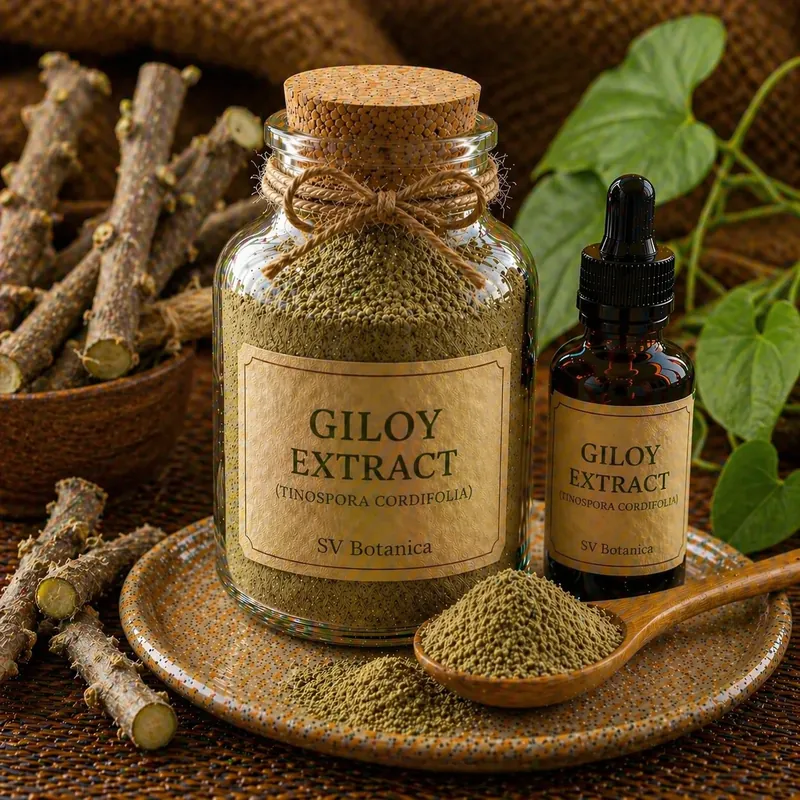
Tinospora cordifolia (Willd.) Hook.f. & Thomson · Family: Menispermaceae · Stem Extract
Ayurveda's amrita — "the nectar of immortality" — supplied with Tinospora cordifolia species verified by HPLC fingerprint on every batch, explicitly excluding the look-alike T. crispa. On this botanical, species verification is a safety control rather than a quality nicety. Standardised on bitter principles from the mature stem. CoA-backed supply from India.
Species Verified
T. cordifolia · T. crispa ExcludedThe one botanical where species verification is a safety control, not a formality
Giloy (Tinospora cordifolia) — guduchi or amrita in Sanskrit, "the nectar of immortality" — is among the most revered rasayana botanicals in Ayurveda, a climbing shrub of the Menispermaceae family whose mature stem has been used for immunity and convalescent support for well over two thousand years. Its reputation grew sharply in recent years as immunity-positioned supplements expanded worldwide.
That growth exposed a problem the trade had largely ignored. Giloy has a close botanical relative — Tinospora crispa — that is visually similar as a climbing stem, grows in overlapping regions of Asia, and is not the Ayurvedic guduchi. Reports of liver injury associated with giloy products prompted scrutiny in India, and species misidentification with T. crispa — for which hepatotoxicity concerns are documented — was among the explanations proposed by researchers and regulatory reviewers.
We take a clear position on this: species verification on giloy is a safety control, not a quality nicety. Every batch is fingerprinted by HPLC against authentic T. cordifolia reference material with T. crispa explicitly excluded, and the species is declared by binomial on the certificate. A supplier who cannot demonstrate species — as distinct from asserting it — is not adequately controlling the one risk this botanical actually carries.
The extract is prepared from the mature stem, which is the classical part, standardised on bitter principles with the method declared. Note that giloy satva — the traditional starch sediment — is a different product from a standardised extract and should never be quoted against the same specification.
The bitter and alkaloid fractions of guduchi stem
Characteristic clerodane furanoditerpene and glycoside constituents of T. cordifolia, central to the HPLC fingerprint used for species verification.
The bitter fraction that forms the standardisation basis, reflecting the stem's diterpene and glycoside complex.
An isoquinoline alkaloid present in Tinospora stem, contributing to the characteristic profile and useful as a supporting marker.
Bitter glycosides historically named for the plant, part of the traditional characterisation of guduchi.
The arabinogalactan-type polysaccharides of the stem, associated with the traditional immunity positioning and prominent in water-soluble grades.
The starch sediment traditionally separated as giloy satva — a distinct classical product, not a standardised extract.
Why formulators specify a species-verified guduchi stem extract
The control that matters most on this botanical. T. crispa is a visually similar relative that is not guduchi and carries documented hepatotoxicity concerns. We fingerprint against authentic T. cordifolia and exclude it on every batch.
Giloy is among the most recognised Ayurvedic botanicals for immunity and convalescent support, with genuinely documented classical use spanning millennia rather than constructed heritage.
The classical part is the mature stem. Leaf, root and immature growth differ in composition and are cheaper — the part declaration keeps the material honest.
Standardised on the stem's bitter fraction with the assay method named, so figures can be interpreted and quotations compared like with like.
A cold-water-soluble grade suits kadha-style beverages, shots, sachets and effervescents — formats with real traction in giloy's core markets.
Documented across the Ayurvedic classical literature as amrita, one of the most highly regarded rasayana botanicals — provenance that is factual rather than marketing.
These are functional and physico-chemical properties of the actives; SV Botanica does not make medical or therapeutic claims for this ingredient.
Stem extract, satva and native ratio — three different products
| Grade | Standardisation | Form | Best For | Solubility |
|---|---|---|---|---|
| Giloy Extract 2.5% Standard | Bitter principles NLT 2.5% (UV); species verified | Brown to dark brown fine powder, ≥95% through 40 mesh | Immunity supplements, Ayurvedic formats, capsules & tablets | Partially water-soluble |
| Giloy Extract 5% High-assay | Bitter principles NLT 5% (UV); species verified | Dark brown fine powder | Low-dose formats, concentrated blends | Partially water-soluble |
| Giloy Extract WS Water-soluble | Cold-water-soluble spray-dried; species verified | Brown free-flowing powder | Kadha beverages, shots, sachets & effervescents | Cold-water-soluble |
| Giloy Extract Ratio Full-spectrum | Native 10:1 / 20:1 ratio; species verified | Dark brown fine powder | Classical guduchi formulations, herbal blends | Grade-dependent |
| Giloy Satva Traditional | Starch sediment — not a standardised extract | Off-white to cream powder | Classical satva preparations only | Dispersible |
Giloy satva is a different product from a standardised extract — it is the traditional starch sediment separated from the stem, off-white rather than brown, with a very different composition and marker content. It is a legitimate classical preparation but should never be quoted against an extract specification. Every extract grade carries species verification by HPLC fingerprint against authentic T. cordifolia, with T. crispa excluded, and states the bitter-principles assay method. Alternative assay strengths, water-soluble and native-ratio grades can be quoted against buyer specification and order volume.
Giloy Extract is bought in five forms. The standardised extract is the stocked item; granulated and dispersible grades are produced on request and raw botanical forms are sourced against a confirmed order.
| Form | What it is | Specification basis | Availability |
|---|---|---|---|
| Standardised extract powder | Tinospora cordifolia stem extract, dried and milled | NLT 2.5% bitter principles (UV), species verified | Stocked |
| Granulated (direct-compression) | Extract granulated for tablet lines | Same marker, declared on the granule | On request |
| Water-dispersible / soluble | Extract in a dispersible matrix for beverages, gummies and sachets | Marker declared on the matrix basis; carrier named | On request |
| Stem powder (non-extracted) | Dried Tinospora cordifolia stem, milled to mesh | Botanical identity by TLC; heavy metals and microbial panel | On enquiry, subject to lot; phytosanitary certificate usually required |
| Cut stem | Dried stem pieces, sifted to size | Identity, moisture, foreign matter | On enquiry; for decoction and in-house extraction |
A marker percentage without its assay method is not a specification; ask for the method and the plant part on every quotation. Read Giloy Extract: A Complete Buyer's Guide, T. cordifolia or T. crispa? How Giloy Is Verified and Standardised and Giloy Adulteration: The Look-Alike Species and How It Is Caught before comparing offers.
Full product specification for Giloy Stem Dry Extract 2.5%. Values are specification limits, not batch results; a batch-specific CoA is issued per shipment.
| Parameter | Specification / Limit | Method |
|---|---|---|
| Botanical Source | Tinospora cordifolia (Willd.) Hook.f. & Thomson | — |
| Plant Family | Menispermaceae | — |
| Part Used | Mature stem | — |
| Country of Origin | India | — |
| Appearance | Fine powder | Organoleptic |
| Colour | Brown to dark brown* | Organoleptic |
| Odour | Characteristic | Organoleptic |
| Taste | Characteristic, bitter | Organoleptic |
| Identification | Corresponds to T. cordifolia reference — positive | By TLC |
| Species Verification | Fingerprint matches T. cordifolia; T. crispa not detected | By HPLC |
| Bitter Principles (% w/w, dry basis) | NLT 2.5 — method declared | By UV |
| Marker Profile (tinosporide / tinocordiside) | Corresponds to reference — reported on request | By HPLC |
| Berberine (% w/w) | Reported per batch | By HPLC |
| Leaf / Root Material | Absent — mature-stem declaration provided | Declaration |
| Loss on Drying (at 105°C, % w/w) | NMT 5.0 | IP-2014 |
| pH (1% w/v solution) | 4 – 7 | IP-2014 |
| Bulk Density (g/ml) | NLT 0.35 | IP-2014 |
| Particle Size (#40 mesh, % w/w) | NLT 95 | Sieve |
| Total Ash (% w/w) | NMT 10 | IP-2014 |
| Acid Insoluble Ash (% w/w) | NMT 2 | IP-2014 |
| Residual Solvent (Ethanol, ppm) | NMT 5,000 | By GC |
| Lead (ppm) | NMT 1.0 | ICP-MS |
| Arsenic (ppm) | NMT 1.0 | ICP-MS |
| Cadmium (ppm) | NMT 0.3 | ICP-MS |
| Mercury (ppm) | NMT 0.1 | ICP-MS |
| Pesticide Residues | Complies (EU MRL, on request) | GC-MS / LC-MS/MS |
| Ethylene Oxide (ETO) | Not treated — declaration provided | LC-MS/MS (on request) |
| Aflatoxins B1 / Total (ppb) | NMT 2 / NMT 4 | HPLC-FLD |
| Total Plate Count (cfu/g) | NMT 1,000 | USP <2021> |
| Yeast & Moulds / Fungi (cfu/g) | NMT 100 | USP <2021> |
| Escherichia coli | Absent | USP <2022> |
| Salmonella sp. | Absent | USP <2022> |
| Staphylococcus aureus | Absent | USP <2022> |
| Cultivation | Cultivated / wild-collected (declared per batch) | Declaration |
| Kosher / Halal | Certified (on request) | Certification |
| Shelf Life | 36 months from date of manufacture, in original packed condition | — |
| Storage | Cool, dry place away from light and moisture, in tightly sealed containers | — |
*The product is of herbal origin; slight colour variation may occur due to geographical and seasonal variation in the raw material. The species verification line is the most important on this specification, and we treat it as a safety control. Tinospora crispa is a visually similar relative growing in overlapping regions that is not the Ayurvedic guduchi, and for which hepatotoxicity concerns are documented; species misidentification was among the explanations proposed by researchers when liver-injury reports associated with giloy products prompted scrutiny in India. We therefore fingerprint every batch by HPLC against authentic T. cordifolia reference material rather than relying on a supplier declaration. Giloy satva — the traditional starch sediment — is a distinct product and is quoted separately. A current Certificate of Analysis and MSDS are issued with every batch.
From mature stem to verified extract — species-fingerprinted, tested, documented
Raw Material & Authentication: The extract is prepared from mature Tinospora cordifolia stem, with species established analytically rather than assumed. Because T. crispa is a visually similar relative in overlapping regions, and because misidentification carries genuine safety implications rather than merely commercial ones, we fingerprint incoming material and finished extract by HPLC against authentic T. cordifolia reference — and we treat a failure to match as a rejection rather than a discussion.
Manufacturing & Testing: Giloy Stem Extract is manufactured at certified facilities in India. Each batch runs through a full QC battery — species verification by HPLC fingerprint, bitter principles by a named method, berberine and marker profile by HPLC, loss on drying, pH, bulk density, ash and acid-insoluble ash, mesh, residual solvent by GC, heavy metals by ICP-MS, aflatoxins, pesticide residue screening, and a complete USP microbiological panel — before release.
Documentation: Every shipment is supplied against a batch-specific Certificate of Analysis stating the species by binomial, the fingerprint verification result and the mature-stem declaration, with an MSDS. Halal, Kosher and Organic certification are available — see our guides on EU pesticide MRL compliance and EU import requirements for botanical extracts.
What backs every batch of Giloy extract
Key information for global product registration and labelling
This is the defining regulatory consideration for giloy and we would rather state it directly than leave it implicit. Following reports of liver injury associated with giloy-containing products, the ingredient attracted regulatory and scientific scrutiny in India, and species misidentification with Tinospora crispa — a visually similar relative for which hepatotoxicity concerns are documented — was among the explanations proposed by researchers and reviewers. Whatever weight one gives to any individual case, the practical conclusion is firm: a giloy specification that does not verify species analytically is not controlling the principal risk. We fingerprint every batch by HPLC against authentic T. cordifolia reference material and exclude T. crispa.
Supplied as a botanical active with full analytical documentation. Giloy has extensive documented use in Ayurvedic classical literature, which supports traditional-use framing in markets that recognise it. Immunity positioning is subject to strict claim rules in most regulated markets. Given the hepatic considerations above, finished-product formulators should also consider appropriate advisory labelling — particularly for consumers with existing liver conditions or taking hepatically-metabolised medication — with the specific requirement determined by your regulatory review. This product is not intended to diagnose, treat, cure or prevent any disease.
Supplied from India by SV Botanica — FSSAI Central Licence holder and an APEDA-registered exporter — from the species' native range. Collection status (cultivated or wild-collected) is declared per batch. The material is Kosher certified and shipped against a batch-specific Certificate of Analysis carrying the species verification, with export documentation available on request.
Deep-dive articles on giloy extract for formulators, buyers, and brand owners
Why species verification is the first line of a giloy specification, not the last.
TechnicalT. cordifolia versus T. crispa — how HPLC fingerprinting tells them apart, and why assay cannot.
QualityThe look-alike species, stem versus leaf, and satva sold as extract.
ApplicationsImmunity, kadha and beverage formats — plus the hepatic labelling question.
ProcurementA scored checklist where one capability outweighs everything else.
MarketHow an immunity boom, then a safety scare, reshaped the giloy market.
Frequently co-formulated with Giloy Extract in immunity & traditional wellness blends
Technical and commercial questions answered by our ingredients team
Tinospora cordifolia stem extract with species verified by HPLC fingerprint and T. crispa excluded on every batch. Bitter principles standardised, method stated. Samples for qualified buyers.
Supplied as a bulk ingredient for further manufacture. Buyers are responsible for compliance with the regulations of their destination market. This product is not intended to diagnose, treat, cure or prevent any disease.
We use cookies for analytics and to measure our advertising. Essential cookies are always on. Privacy policy