
Phyllanthus emblica L. (syn. Emblica officinalis) · Family: Phyllanthaceae · Fruit Extract
A water-soluble Amla (Indian gooseberry) fruit extract standardised to total tannins NLT 40% by titration. Prepared from the fruit of Phyllanthus emblica for nutraceutical, nutricosmetic, hair-care, functional-food and beverage formulators. CoA-backed, tannin-authenticated supply from India.
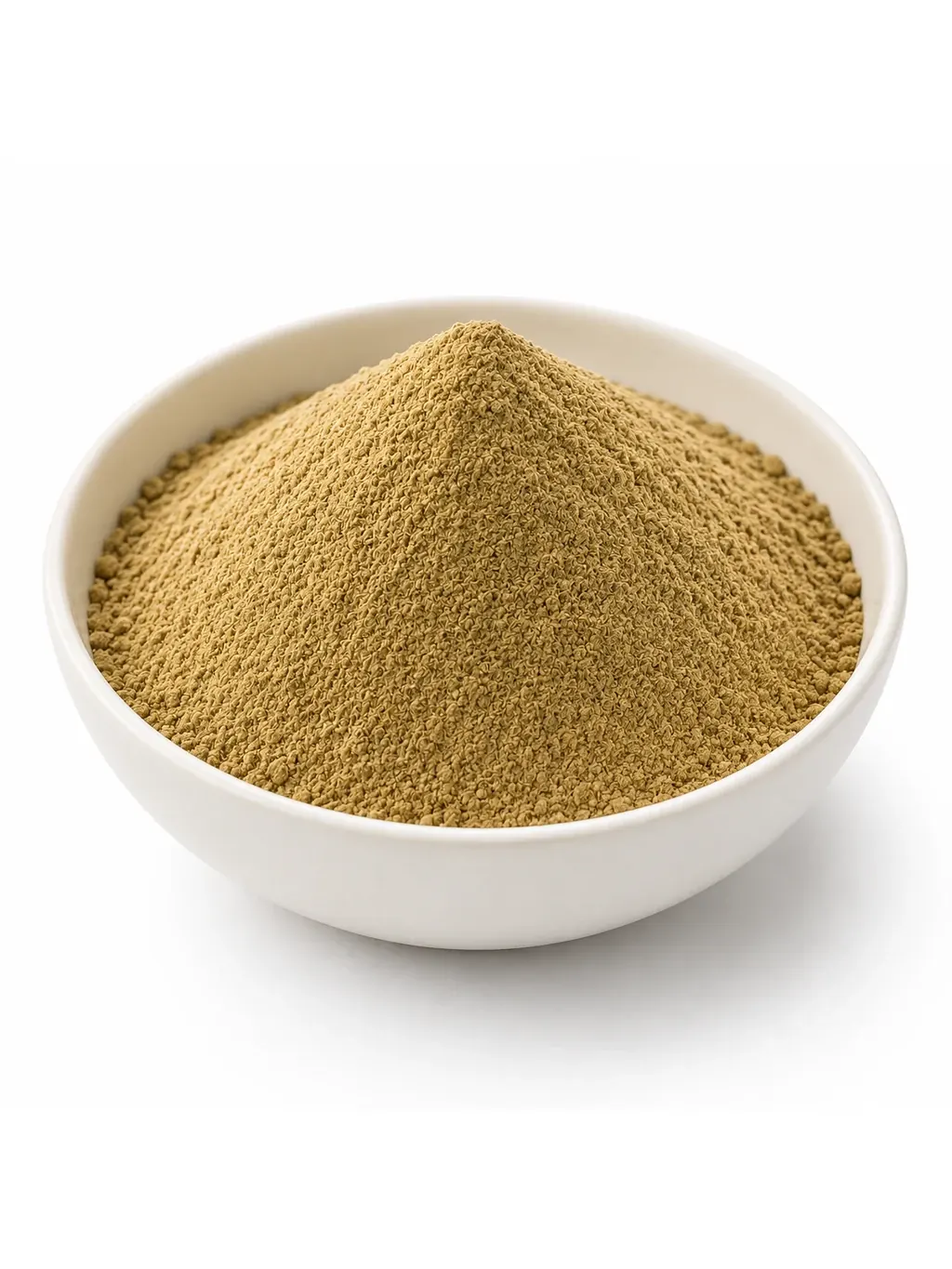
Actual Product
Phyllanthus emblica · 40% Tannins · Actual BatchA standardised antioxidant active from Ayurveda's premier rasayana fruit
Amla (Phyllanthus emblica L.), the Indian gooseberry, is one of the most revered fruits in Ayurveda and a cornerstone of the classical Triphala and Chyawanprash formulations. The fruit is exceptionally rich in hydrolysable tannins, polyphenols and naturally occurring vitamin C, and concentrated, standardised extracts let formulators deliver those actives at a controlled, verifiable specification.
The characteristic constituents of Amla are its low-molecular-weight hydrolysable tannins — notably emblicanin A and emblicanin B, together with punigluconin, pedunculagin, gallic acid and ellagic acid. SV Botanica standardises this extract to total tannins of not less than 40% by titration, so every batch is defined by its most meaningful markers rather than by colour alone.
The extract is finished as a free-flowing, water-soluble powder, dark brown in colour, with solubility in water of not less than 85% w/w. That solubility makes it well suited to aqueous functional beverages, juices and wellness shots as well as capsules, tablets and cosmetic bases. Slight colour variation between batches is normal for a herbal material and reflects natural variation in the raw fruit.
We supply supplement brands, nutricosmetic and hair-care houses, functional-food and beverage manufacturers against buyer specifications, with a batch-specific Certificate of Analysis on every shipment.
The tannins and polyphenols that define Amla fruit
The hydrolysable polyphenol fraction that defines Amla. Standardised here to NLT 40% by titration — the primary assay basis of every batch.
The characteristic low-molecular-weight hydrolysable tannins of Amla fruit and a key point of botanical identity.
A principal phenolic acid marker of Amla, widely used to characterise the fruit's polyphenol profile.
A polyphenol that contributes to Amla's antioxidant profile alongside the emblicanins and gallic acid.
Amla fruit is among the richest natural plant sources of vitamin C, which occurs naturally in the botanical matrix.
Punigluconin, pedunculagin and the broader phenolic complex underpin the fruit's recognised antioxidant activity.
Why formulators specify a standardised Amla extract — the functional role of the markers
Amla's tannins and polyphenols are widely studied for antioxidant activity. A defined tannin percentage lets formulators build antioxidant and “healthy-ageing” products on a consistent, verifiable active load.
Standardisation to total tannins by titration, with tannin identity confirmed by TLC, gives a defensible identity and assay for a fruit extract prone to dilution and substitution.
Solubility in water of NLT 85% w/w allows clean incorporation into aqueous beverages, juices, effervescents, capsules and cosmetic bases without specialised solubilisers.
Amla is a globally recognised hair-care and skin active, giving brands a familiar, label-friendly hero ingredient for nutricosmetic and personal-care lines.
As Ayurveda's premier rasayana fruit and a natural source of vitamin C, Amla is a recognised hero active for immunity, digestive and daily-wellness formats.
A free-flowing powder passing ≥95% through a 40-mesh sieve with controlled bulk density disperses and blends predictably across batches.
These are functional and physico-chemical properties of the actives; SV Botanica does not make medical or therapeutic claims for this ingredient.
The core specification for the flagship 40% tannin grade
| Grade | Standardisation | Form | Best For | Solubility |
|---|---|---|---|---|
| Amla Extract 40% Standard | Total tannins NLT 40% (titration) | Dark-brown fine powder, ≥95% through 40 mesh | Supplements, nutricosmetics, hair care, functional foods & beverages | Water-soluble (NLT 85% w/w) |
The 40% tannin grade is our CoA-backed flagship, standardised to total tannins by titration with identity confirmed for tannin by TLC. Alternative standardisations and ratio (full-spectrum) extracts, custom mesh and packaging can be quoted against buyer specification and order volume. Every batch is released against a batch-specific Certificate of Analysis.
Amla Extract is bought in five forms. The standardised extract is the stocked item; granulated and dispersible grades are produced on request and raw botanical forms are sourced against a confirmed order.
| Form | What it is | Specification basis | Availability |
|---|---|---|---|
| Standardised extract powder | Phyllanthus emblica fruit extract, dried and milled | NLT 40% total tannins (titration) | Stocked |
| Granulated (direct-compression) | Extract granulated for tablet lines | Same marker, declared on the granule | On request |
| Water-dispersible / soluble | Extract in a dispersible matrix for beverages, gummies and sachets | Marker declared on the matrix basis; carrier named | On request |
| Fruit powder (non-extracted) | Dried Phyllanthus emblica fruit, milled to mesh | Botanical identity by TLC; heavy metals and microbial panel | On enquiry, subject to lot; phytosanitary certificate usually required |
| Whole dried fruit | Dried fruit, graded and cleaned | Identity, moisture, foreign matter | On enquiry, subject to lot |
A marker percentage without its assay method is not a specification; ask for the method and the plant part on every quotation. Read Amla Extract: A Complete Buyer's Guide for Formulators, Amla Tannins & How the Extract Is Standardised and Amla Extract Adulteration & Authenticity before comparing offers.
Full product specification for Amla Dry Extract 40%. Values are specification limits, not batch results; a batch-specific CoA is issued per shipment.
| Parameter | Specification / Limit | Method |
|---|---|---|
| Botanical Source | Phyllanthus emblica L. (syn. Emblica officinalis) | — |
| Plant Family | Phyllanthaceae | — |
| Part Used | Fruit | — |
| Country of Origin | India | — |
| Appearance | Fine powder | Organoleptic |
| Colour | Dark brown* | Organoleptic |
| Odour | Characteristic | Organoleptic |
| Taste | Sour | Organoleptic |
| Identification | Presence of tannin — positive | By TLC |
| Loss on Drying (at 105°C, % w/w) | NMT 10.0 | IP-2014 |
| pH (1% w/v solution) | 2 – 7 | IP-2014 |
| Bulk Density (g/ml) | NLT 0.25 | IP-2014 |
| Solubility in Water (% w/w) | NLT 85 | IP-2014 |
| Ash Content (% w/w) | NMT 10 | IP-2014 |
| Particle Size (#40 mesh, % w/w) | NLT 95 | Sieve |
| Total Tannins (% w/w, dry basis) | NLT 40.0 | By Titration |
| Lead (ppm) | NMT 1.0 | ICP-MS |
| Arsenic (ppm) | NMT 1.0 | ICP-MS |
| Cadmium (ppm) | NMT 0.3 | ICP-MS |
| Mercury (ppm) | NMT 0.1 | ICP-MS |
| Total Plate Count (cfu/g) | NMT 1,000 | USP <2021> |
| Yeast & Moulds / Fungi (cfu/g) | NMT 100 | USP <2021> |
| Escherichia coli | Absent | USP <2022> |
| Salmonella sp. | Absent | USP <2022> |
| Staphylococcus aureus | Absent | USP <2022> |
| Cultivation | Cultivated | Declaration |
| Kosher | Certified | Certification |
| Shelf Life | 36 months from date of manufacture, in original packed condition | — |
| Storage | Cool, dry place away from light and moisture, in tightly sealed containers | — |
*The product is of herbal origin; slight colour variation may occur due to geographical and seasonal variation in the raw material. Total tannins are standardised by titration and tannin identity is confirmed by TLC. A current Certificate of Analysis and MSDS are issued with every batch.
From fruit to standardised extract — authenticated, tested, documented
Raw Material & Authentication: The extract is prepared from cultivated Phyllanthus emblica fruit. Because fruit extracts can be diluted or substituted, tannin identity is confirmed by TLC and total tannin content is assayed by titration on every batch before it is accepted.
Manufacturing & Testing: Amla Dry Extract is manufactured at certified facilities in India. Each batch runs through a full QC battery — total tannin assay by titration, loss on drying, pH, bulk density, ash, water solubility and mesh, heavy metals by ICP-MS, and a complete USP microbiological panel — before release.
Documentation: Every shipment is supplied against a batch-specific Certificate of Analysis with an MSDS. The material is Kosher certified. Country of Origin and export documentation are provided on request. For buyers shipping into the EU, see our guides on EU pesticide MRL compliance and EU import requirements for botanical extracts.
What backs every batch of Amla extract
Key information for global product registration and labelling
Used as a botanical active in supplement, functional-food and beverage formats, the extract is supplied to a defined total-tannin specification with full analytical documentation. Buyers are responsible for determining suitability and for compliance with the relevant food-supplement regulations in their market. This product is not intended to diagnose, treat, cure or prevent any disease.
Phyllanthus emblica fruit extract is an established cosmetic ingredient with a recognised INCI listing, widely used in hair and skin care. As an active input it should be used within the buyer's finished-product safety assessment; SV Botanica supplies the material specification and CoA to support that dossier.
Supplied from India by SV Botanica — FSSAI Central Licence holder and an APEDA-registered exporter. The material is Kosher certified and shipped against a batch-specific Certificate of Analysis with export documentation available on request.
Deep-dive articles for formulators, buyers, and brand owners
How to specify grade, method, and documentation when sourcing amla extract.
TechnicalWhat total tannins NLT 40% means and how standardised amla extract is measured by titration.
QualityHow amla is substituted and how TLC identity and marker profiling prove a genuine Phyllanthus emblica extract.
NutricosmeticsWhere a water-soluble amla active fits in hair, scalp and skin formulations.
FormulationUsing a water-soluble amla active in capsules, beverages and immune formulations.
ProcurementA checklist for qualifying an amla extract supplier from India.
MarketDemand drivers and end-uses shaping the amla extract category.
Frequently co-formulated with Amla Extract in antioxidant, digestive & hair-care blends
Technical and commercial questions answered by our ingredients team
Tannin-standardised, lab-tested, fully documented supply of water-soluble Phyllanthus emblica fruit extract. Total tannins NLT 40%. Samples available for qualified buyers.
Supplied as a bulk ingredient for further manufacture. Buyers are responsible for compliance with the regulations of their destination market. This product is not intended to diagnose, treat, cure or prevent any disease.
We use cookies for analytics and to measure our advertising. Essential cookies are always on. Privacy policy