
Emblica officinalis · Terminalia bellirica · Terminalia chebula · Fruit Blend Extract
Ayurveda's most celebrated formulation — the 1:1:1 blend of amla, bibhitaki and haritaki fruit — supplied with the ratio verified by marker HPLC rather than merely declared. Because a single tannin assay cannot tell you what is actually in a three-fruit blend. Standardised to total tannins NLT 40%, water-soluble, for digestive, detox and antioxidant formulators. CoA-backed supply from India.
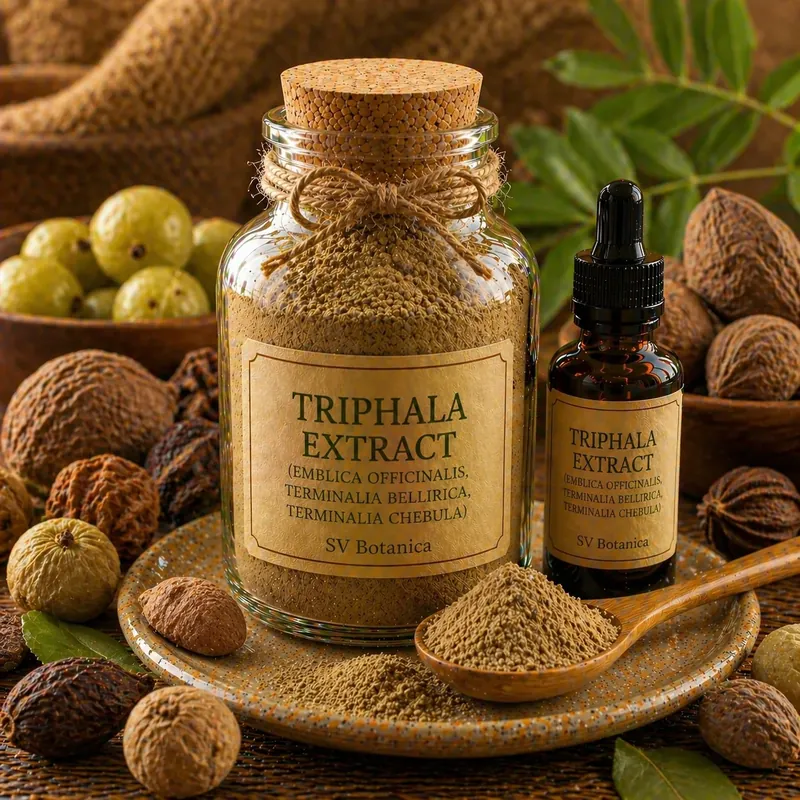
Classical 1:1:1
Ratio Verified by Marker HPLCA blend, not a botanical — and that changes how it must be specified
Triphala — Sanskrit for "three fruits" — is the most widely used formulation in Ayurveda, documented across the classical texts and in continuous use for well over two thousand years. It combines the dried fruit of amla (Emblica officinalis), bibhitaki (Terminalia bellirica) and haritaki (Terminalia chebula) in equal parts by weight.
The classical rationale is that the three fruits address the three doshas between them, producing a balanced preparation no single fruit achieves alone. Whatever weight one gives the traditional framework, the practical point stands: triphala is defined by its composition, not by a marker. A preparation containing the right total tannins in the wrong proportions is not triphala.
That creates a specification problem unlike anything else in this range. Every other extract here is one plant with one marker. Triphala is three plants whose ratio is the product — and a total tannin assay, the conventional standardisation basis, is structurally incapable of telling you what the ratio is. All three fruits are tannin-rich. A blend of 60% cheap amla and 40% haritaki can hit exactly the same tannin figure as a correct 1:1:1.
Our answer is to verify the ratio rather than assert it. Each fruit contributes characteristic marker compounds — chebulagic and chebulinic acid are distinctive to Terminalia chebula, with a different profile in T. bellirica, while amla contributes its own signature — and the relative proportions of those markers reconstruct the blend composition by HPLC. Every batch is released against that verification, alongside total tannins NLT 40%.
Three fruits, and the markers that identify each
The most abundant single phenolic across all three fruits and a principal contributor to the total tannin figure. Common to all three, so not diagnostic of ratio on its own.
Ratio markers. Characteristic ellagitannins of Terminalia chebula (haritaki), present at a different profile in T. bellirica — the basis of blend verification.
An ellagitannin hydrolysis product present across the blend, contributing to the antioxidant profile and to the marker fingerprint.
A characteristic ellagitannin of the Terminalia and Emblica genera, used as a supporting identity marker.
The distinctive hydrolysable tannin complex of Emblica officinalis, identifying the amla fraction of the blend.
Present in the amla fraction. Note that vitamin C is heat- and process-labile, so a triphala extract should not be assumed to carry raw-fruit levels.
Why formulators specify a ratio-verified triphala rather than a tannin figure alone
The control that matters most on a blend. Because all three fruits are tannin-rich, a total tannin assay cannot detect a wrong ratio. Marker HPLC reconstructs the actual composition — the only way to know you bought triphala.
Each fruit named by binomial on every certificate, deseeded fruit pericarp only. On a three-component blend, a single "triphala" line is not a specification.
Triphala is Ayurveda's most recognised digestive and regularity formulation, giving brands a heritage ingredient with genuine documented tradition rather than constructed positioning.
Standardised to total tannins NLT 40%, the blend delivers a substantial hydrolysable-tannin and polyphenol load across gallic, ellagic and chebulic acid families.
The blend is water-soluble, which makes it unusually straightforward across beverages, sachets, effervescents and teas as well as capsules and tablets.
Documented across the Ayurvedic classical texts and in continuous use for over two millennia — a provenance story that is factual rather than marketing.
These are functional and physico-chemical properties of the actives; SV Botanica does not make medical or therapeutic claims for this ingredient.
Classical ratio, custom ratios, and why the composition line matters more than the assay line
| Grade | Standardisation | Form | Best For | Solubility |
|---|---|---|---|---|
| Triphala Extract 1:1:1 Classical | Tannins NLT 40% (UV); ratio verified by marker HPLC | Brown to dark brown fine powder, ≥95% through 40 mesh | Digestive, detox & antioxidant supplements; classical formulations | Water-soluble |
| Triphala Extract 20% Lower assay | Tannins NLT 20% (UV); ratio verified | Brown fine powder | Cost-tuned blends, multi-ingredient formulas | Water-soluble |
| Triphala Extract Custom Ratio Custom | Buyer-specified fruit ratio, verified by marker HPLC | Brown to dark brown fine powder | Proprietary formulations departing from classical proportion | Water-soluble |
| Triphala Extract Organic Organic | Certified organic; tannins and ratio to specification | Brown to dark brown fine powder | Certified-organic finished products | Water-soluble |
| Triphala Churna Powder Traditional | Milled fruit powder, not an extract; 1:1:1 | Brown coarse to fine powder | Traditional churna formats and classical preparations | Dispersible |
Please note that the churna is a milled fruit powder, not an extract — it is a legitimate and traditional product but has a much lower marker concentration than a standardised extract, and the two should never be quoted against the same specification. For all extract grades we verify the fruit ratio by marker HPLC and state it on the certificate, because a total tannin figure alone cannot distinguish a correct 1:1:1 from a blend weighted toward whichever fruit was cheapest. Custom ratios are available where a proprietary formulation departs from classical proportion — we will verify whatever ratio you specify.
Triphala Extract is bought in four forms. The standardised extract is the stocked item; granulated and dispersible grades are produced on request and raw botanical forms are sourced against a confirmed order.
| Form | What it is | Specification basis | Availability |
|---|---|---|---|
| Standardised extract powder | The three botanicals extracted and blended 1:1:1 | NLT 40% tannins (UV), 1:1:1 amla, haritaki and bibhitaki verified by marker HPLC | Stocked |
| Granulated (direct-compression) | Extract granulated for tablet lines | Same marker, declared on the granule | On request |
| Water-dispersible / soluble | Extract in a dispersible matrix for beverages, gummies and sachets | Marker declared on the matrix basis; carrier named | On request |
| Classical churna (powdered blend, non-extracted) | The three botanicals milled and blended 1:1:1, not extracted | Ratio verified by marker HPLC; identity; heavy metals | On enquiry, subject to lot |
A marker percentage without its assay method is not a specification; ask for the method and the plant part on every quotation. Read Triphala Extract: A Complete Buyer's Guide, Verifying a Three-Fruit Blend: How Triphala Is Standardised and Triphala Adulteration: Ratio Manipulation and How It Is Caught before comparing offers.
Full product specification for Triphala Extract 1:1:1, tannins 40%. Values are specification limits, not batch results; a batch-specific CoA is issued per shipment.
| Parameter | Specification / Limit | Method |
|---|---|---|
| Composition | Amla : Bibhitaki : Haritaki — 1:1:1 by weight | Declaration + marker HPLC |
| Botanical Source 1 | Emblica officinalis Gaertn. (syn. Phyllanthus emblica) — amla | — |
| Botanical Source 2 | Terminalia bellirica (Gaertn.) Roxb. — bibhitaki | — |
| Botanical Source 3 | Terminalia chebula Retz. — haritaki | — |
| Part Used | Fruit — deseeded pericarp only | — |
| Country of Origin | India | — |
| Appearance | Fine powder | Organoleptic |
| Colour | Brown to dark brown* | Organoleptic |
| Odour | Characteristic | Organoleptic |
| Taste | Characteristic, astringent & sour | Organoleptic |
| Identification | Corresponds to reference blend — positive | By TLC / HPLC |
| Fruit Ratio Verification | Consistent with 1:1:1 — reported per batch | By marker HPLC |
| Total Tannins (% w/w, dry basis) | NLT 40.0 | By UV |
| Gallic Acid (% w/w) | Reported per batch | By HPLC |
| Ellagic Acid (% w/w) | Reported per batch | By HPLC |
| Chebulagic / Chebulinic Acid (% w/w) | Reported per batch — ratio marker | By HPLC |
| Seed / Stone Material | Absent — deseeded declaration provided | Declaration |
| Loss on Drying (at 105°C, % w/w) | NMT 5.0 | IP-2014 |
| pH (1% w/v solution) | 3 – 5 | IP-2014 |
| Bulk Density (g/ml) | NLT 0.35 | IP-2014 |
| Particle Size (#40 mesh, % w/w) | NLT 95 | Sieve |
| Total Ash (% w/w) | NMT 8 | IP-2014 |
| Acid Insoluble Ash (% w/w) | NMT 2 | IP-2014 |
| Residual Solvent (Ethanol, ppm) | NMT 5,000 | By GC |
| Lead (ppm) | NMT 1.0 | ICP-MS |
| Arsenic (ppm) | NMT 1.0 | ICP-MS |
| Cadmium (ppm) | NMT 0.3 | ICP-MS |
| Mercury (ppm) | NMT 0.1 | ICP-MS |
| Pesticide Residues | Complies (EU MRL, on request) | GC-MS / LC-MS/MS |
| Ethylene Oxide (ETO) | Not treated — declaration provided | LC-MS/MS (on request) |
| Aflatoxins B1 / Total (ppb) | NMT 2 / NMT 4 | HPLC-FLD |
| Total Plate Count (cfu/g) | NMT 1,000 | USP <2021> |
| Yeast & Moulds / Fungi (cfu/g) | NMT 100 | USP <2021> |
| Escherichia coli | Absent | USP <2022> |
| Salmonella sp. | Absent | USP <2022> |
| Staphylococcus aureus | Absent | USP <2022> |
| Cultivation | Cultivated / wild-collected (declared per batch) | Declaration |
| Kosher / Halal | Certified (on request) | Certification |
| Shelf Life | 36 months from date of manufacture, in original packed condition | — |
| Storage | Cool, dry place away from light and moisture, in tightly sealed containers | — |
*The product is of herbal origin; slight colour variation may occur due to geographical and seasonal variation in the raw material. The composition line is the most important on this specification. Triphala is defined by its 1:1:1 fruit ratio, and a total tannin assay cannot verify that ratio — all three fruits are tannin-rich, so a blend weighted toward the cheapest fruit can meet the same tannin figure as a correct one. We therefore verify the ratio by marker HPLC, using the chebulagic/chebulinic acid and ellagic acid profile characteristic of each species, and report it per batch. Fruit is supplied deseeded — stone and seed material contribute weight and ash without markers. A current Certificate of Analysis and MSDS are issued with every batch.
From three fruits to one verified blend — ratio-confirmed, deseeded, documented
Raw Material & Authentication: The blend is prepared from deseeded fruit of Emblica officinalis, Terminalia bellirica and Terminalia chebula, each species identified before blending. Because the finished product is a composition rather than a single botanical, our controls sit at two points: species identity on each incoming fruit, and ratio verification by marker HPLC on the finished blend — the only way to confirm what a buyer is actually receiving.
Manufacturing & Testing: Triphala Extract is manufactured at certified facilities in India. Each batch runs through a full QC battery — total tannins by UV, gallic, ellagic and chebulagic/chebulinic acid by HPLC for ratio verification, loss on drying, pH, bulk density, ash and acid-insoluble ash, mesh, residual solvent by GC, heavy metals by ICP-MS, aflatoxins, pesticide residue screening, and a complete USP microbiological panel — before release.
Documentation: Every shipment is supplied against a batch-specific Certificate of Analysis stating all three species by binomial, the deseeded declaration, the marker profile and the ratio verification result, with an MSDS. Halal, Kosher and Organic certification are available — see our guides on EU pesticide MRL compliance and EU import requirements for botanical extracts.
What backs every batch of Triphala extract
Key information for global product registration and labelling
Supplied as a botanical blend to a defined composition and tannin specification with full analytical documentation. Because triphala is a multi-species preparation, labelling requirements in most markets call for each species to be declared individually rather than under a collective trade name — a point that catches formulators who treat "triphala" as though it were a single ingredient. We supply all three binomials on every certificate to support that. Buyers remain responsible for determining suitability and for compliance with the food-supplement regulations applying in their market. This product is not intended to diagnose, treat, cure or prevent any disease.
Triphala has documented use across the Ayurvedic classical literature and continuous traditional use spanning millennia, which supports traditional-use framing in markets that recognise it. Note that digestive and regularity positioning is subject to specific claim rules in most jurisdictions, and that laxative-adjacent claims in particular are tightly controlled. Traditional-use framing and conservative claims are the appropriate approach; your regulatory review should establish the permissible wording for each market.
Supplied from India by SV Botanica — FSSAI Central Licence holder and an APEDA-registered exporter — with all three fruits sourced from their traditional growing regions. Collection status (cultivated or wild-collected) is declared per batch. The material is Kosher certified and shipped against a batch-specific Certificate of Analysis with export documentation available on request.
Deep-dive articles on triphala extract for formulators, buyers, and brand owners
Buying a blend, not a botanical — why the composition line matters more than the tannin figure.
TechnicalHow marker HPLC reconstructs a three-fruit blend, and why a tannin assay structurally cannot.
QualityRatio manipulation is the adulteration route unique to blends — and it hides behind a passing assay.
ApplicationsDigestive, detox, beverage and oral-care formats — plus astringency and the vitamin C question.
ProcurementA scored checklist for qualifying a triphala supplier, weighted around ratio verification.
MarketWhere triphala demand is growing, and how three separate fruit markets set one blend's price.
Frequently co-formulated with Triphala Extract in digestive, detox & antioxidant blends
Technical and commercial questions answered by our ingredients team
The classical 1:1:1 blend of amla, bibhitaki and haritaki — with the ratio verified by marker HPLC, not just declared. Tannins NLT 40%. Samples available for qualified buyers.
Supplied as a bulk ingredient for further manufacture. Buyers are responsible for compliance with the regulations of their destination market. This product is not intended to diagnose, treat, cure or prevent any disease.
We use cookies for analytics and to measure our advertising. Essential cookies are always on. Privacy policy