
Cinnamomum verum J.Presl / Cinnamomum cassia (L.) J.Presl · Family: Lauraceae · Bark Extract
A warming cinnamon bark extract supplied in Ceylon and Cassia grades — with the species named and coumarin content declared on every batch, because the two are not interchangeable and only one is safe at sustained dose. Standardised to polyphenols NLT 20% or cinnamaldehyde by HPLC, for metabolic-wellness, functional-food and beverage formulators. CoA-backed supply from India.
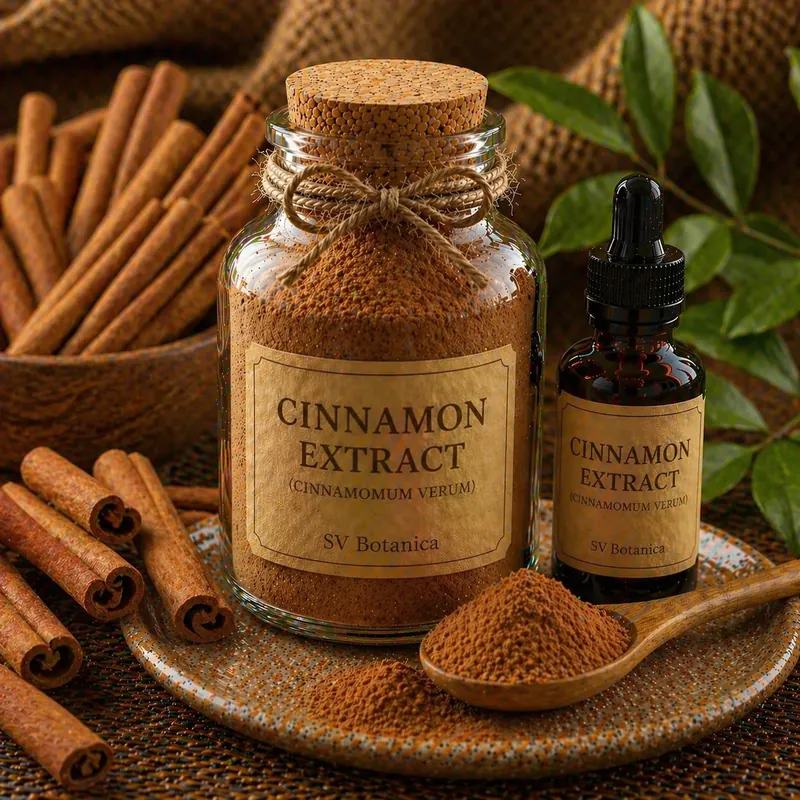
Ceylon & Cassia
Species & Coumarin DeclaredTwo different barks sold under one name — and only one is safe at supplement dose
Cinnamon is not one botanical. The name covers several Cinnamomum species whose dried inner bark is traded interchangeably as a spice, and the distinction that matters commercially is between Ceylon cinnamon (Cinnamomum verum) — sometimes called "true cinnamon" — and Cassia cinnamon (Cinnamomum cassia and related species). Both are genuine cinnamon. They are not equivalent inputs.
The difference that decides your specification is coumarin. Cassia bark contains coumarin at levels that are material at supplement doses; Ceylon bark contains only trace amounts. Coumarin is hepatotoxic in sustained high intake, and regulators — the EU most explicitly — have set a tolerable daily intake and limits in specific foods around it. A metabolic-support supplement is, by design, taken every day for months, which is precisely the intake pattern the coumarin limit exists to constrain.
This is why we treat cinnamon differently from other bark extracts: every batch names the species and states the measured coumarin content, rather than shipping "cinnamon extract" and leaving the buyer to assume. A Cassia grade is entirely appropriate for a flavour application or a low-dose food use, and it is cheaper; a Ceylon grade is what a daily-dose supplement generally needs. Choosing between them is a decision for your formulation, not a detail to be discovered at a customer audit.
The extract is standardised either to polyphenols NLT 20% by UV — the basis most metabolic positioning uses, reflecting the type-A proanthocyanidin fraction — or to cinnamaldehyde by HPLC where the aromatic principle is what matters. Water-soluble and native-ratio grades are available. We supply supplement brands, functional-food and beverage manufacturers and Ayurvedic formulators, with a batch-specific Certificate of Analysis on every shipment.
The aromatic, phenolic and limit-parameter constituents of cinnamon bark
The principal aromatic compound of cinnamon bark and the basis of the flavour-facing grade. Assayed by HPLC; typically higher in Cassia than in Ceylon.
A limit parameter, not an active. Substantial in Cassia, trace in Ceylon. Measured by HPLC and declared on every batch so intake arithmetic can be done.
The doubly-linked procyanidins characteristic of cinnamon and the fraction most associated with its metabolic positioning.
The wider phenolic pool, and the usual standardisation basis for metabolic-facing grades at NLT 20% by UV.
Secondary aromatic constituents contributing to the bark's characteristic profile; eugenol is more prominent in Ceylon.
The volatile fraction carrying the aroma, defining the oleoresin and flavour grades rather than the standardised powder.
Why formulators specify a species-declared, coumarin-tested cinnamon extract
Ceylon and Cassia are traded interchangeably as "cinnamon" and priced differently. Naming the species on the certificate is the difference between a specification and a hope — and it is the foundation of the coumarin position.
Coumarin is the reason cinnamon needs more care than other bark extracts. We measure it by HPLC and state the figure, so you can calculate contribution per daily serving rather than assume it away.
Cinnamon is one of the most consumer-recognised botanicals in metabolic-wellness formulation, giving brands a familiar hero ingredient that needs no category education.
Polyphenols NLT 20% by UV for metabolic positioning, or cinnamaldehyde by HPLC where the aromatic principle drives the application. They are different products — specify which.
A cold-water-soluble grade suits beverages, sachets and effervescents; the standard grade is partially water-soluble and suits capsules, tablets and dry blends.
Cinnamon's extensive culinary history gives it an unusually comfortable food-use position, making the same extract viable across supplement, bakery, beverage and flavour applications.
These are functional and physico-chemical properties of the actives; SV Botanica does not make medical or therapeutic claims for this ingredient.
Specify the species first, the standardisation basis second — both belong on the order
| Grade | Standardisation | Form | Best For | Solubility |
|---|---|---|---|---|
| Cinnamon Extract Ceylon 20% Low-coumarin | Polyphenols NLT 20% (UV); Cinnamomum verum; coumarin declared (trace) | Light brown fine powder, ≥95% through 40 mesh | Daily-dose metabolic supplements, long-duration formats | Partially water-soluble |
| Cinnamon Extract Cassia 20% Standard | Polyphenols NLT 20% (UV); Cinnamomum cassia; coumarin declared | Reddish-brown fine powder | Low-dose formats, food and flavour applications | Partially water-soluble |
| Cinnamon Extract Cinnamaldehyde Aromatic | Cinnamaldehyde NLT 5% (HPLC); species declared | Light to reddish-brown fine powder | Flavour-facing formats, bakery, beverages | Partially water-soluble |
| Cinnamon Extract WS Water-soluble | Cold-water-soluble spray-dried; polyphenols to specification | Light brown free-flowing powder | Beverages, sachets, effervescents & drink mixes | Cold-water-soluble |
| Cinnamon Extract Ratio Full-spectrum | Native 10:1 / 20:1 ratio; coumarin declared | Brown fine powder | Traditional & Ayurvedic formats, herbal blends | Grade-dependent |
Please state both the species (Ceylon or Cassia) and the standardisation basis (polyphenols or cinnamaldehyde) on your enquiry. Ceylon material carries a genuine cost premium and there is no way to produce a low-coumarin extract from Cassia bark — the coumarin is in the raw material. Every batch is released against a batch-specific Certificate of Analysis stating the species and the measured coumarin content. Alternative assay strengths, water-soluble and native-ratio grades, custom mesh and packaging can be quoted against buyer specification and order volume.
Cinnamon Extract is bought in five forms. The standardised extract is the stocked item; granulated and dispersible grades are produced on request and raw botanical forms are sourced against a confirmed order.
| Form | What it is | Specification basis | Availability |
|---|---|---|---|
| Standardised extract powder | Cinnamomum verum bark extract, dried and milled | NLT 20% polyphenols (UV), Ceylon bark, coumarin declared | Stocked |
| Granulated (direct-compression) | Extract granulated for tablet lines | Same marker, declared on the granule | On request |
| Water-dispersible / soluble | Extract in a dispersible matrix for beverages, gummies and sachets | Marker declared on the matrix basis; carrier named | On request |
| Bark powder (non-extracted) | Dried Cinnamomum verum bark, milled to mesh | Botanical identity by TLC; heavy metals and microbial panel | On enquiry, subject to lot; phytosanitary certificate usually required |
| Cut bark | Dried bark pieces, sifted to size | Identity, moisture, foreign matter | On enquiry; for decoction and in-house extraction |
A marker percentage without its assay method is not a specification; ask for the method and the plant part on every quotation. Read Cinnamon Extract: A Complete Buyer's Guide, Coumarin in Cinnamon: Ceylon, Cassia and the Daily-Dose Problem and Cinnamon Extract Adulteration and How Authenticity Is Proven before comparing offers.
Full product specification for Cinnamon Bark Extract 20% polyphenols. Values are specification limits, not batch results; a batch-specific CoA is issued per shipment.
| Parameter | Specification / Limit | Method |
|---|---|---|
| Botanical Source | Cinnamomum verum J.Presl (Ceylon) or C. cassia (L.) J.Presl — declared per batch | — |
| Plant Family | Lauraceae | — |
| Part Used | Bark | — |
| Country of Origin | India / Sri Lanka (declared per batch) | — |
| Appearance | Fine powder | Organoleptic |
| Colour | Light brown to reddish-brown* | Organoleptic |
| Odour | Characteristic, aromatic | Organoleptic |
| Taste | Characteristic, sweet-pungent | Organoleptic |
| Identification | Corresponds to reference extract — positive | By TLC / HPLC |
| Species Declaration | Ceylon or Cassia — stated per batch | Declaration |
| Total Polyphenols (% w/w, dry basis) | NLT 20.0 | By UV |
| Cinnamaldehyde (% w/w) | Reported per batch (NLT 5 in aromatic grade) | By HPLC |
| Coumarin (ppm) | Measured and declared per batch | By HPLC |
| Loss on Drying (at 105°C, % w/w) | NMT 5.0 | IP-2014 |
| pH (1% w/v solution) | 4 – 6 | IP-2014 |
| Bulk Density (g/ml) | NLT 0.35 | IP-2014 |
| Particle Size (#40 mesh, % w/w) | NLT 95 | Sieve |
| Total Ash (% w/w) | NMT 6 | IP-2014 |
| Acid Insoluble Ash (% w/w) | NMT 2 | IP-2014 |
| Residual Solvent (Ethanol, ppm) | NMT 5,000 | By GC |
| Lead (ppm) | NMT 1.0 | ICP-MS |
| Arsenic (ppm) | NMT 1.0 | ICP-MS |
| Cadmium (ppm) | NMT 0.3 | ICP-MS |
| Mercury (ppm) | NMT 0.1 | ICP-MS |
| Pesticide Residues | Complies (EU MRL, on request) | GC-MS / LC-MS/MS |
| Ethylene Oxide (ETO) | Not treated — declaration provided | LC-MS/MS (on request) |
| Aflatoxins B1 / Total (ppb) | NMT 2 / NMT 4 | HPLC-FLD |
| Total Plate Count (cfu/g) | NMT 1,000 | USP <2021> |
| Yeast & Moulds / Fungi (cfu/g) | NMT 100 | USP <2021> |
| Escherichia coli | Absent | USP <2022> |
| Salmonella sp. | Absent | USP <2022> |
| Staphylococcus aureus | Absent | USP <2022> |
| Cultivation | Cultivated | Declaration |
| Kosher / Halal | Certified (on request) | Certification |
| Shelf Life | 36 months from date of manufacture, in original packed condition | — |
| Storage | Cool, dry place away from light and moisture, in tightly sealed containers | — |
*The product is of herbal origin; slight colour variation may occur due to geographical and seasonal variation in the raw material. Coumarin is measured by HPLC and declared as a figure on every batch, not merely stated as "complies" — a Cassia-derived extract legitimately carries coumarin, and buyers formulating a daily-dose product need the number to perform their own intake arithmetic. Species is declared per batch; there is no process route to a low-coumarin extract from Cassia bark, so a low-coumarin requirement is a Ceylon requirement. A current Certificate of Analysis and MSDS are issued with every batch. EU pesticide MRL and ethylene oxide reports are available on request.
From bark to standardised extract — species-verified, coumarin-tested, documented
Raw Material & Authentication: The extract is prepared from Cinnamomum bark with the species established at intake, not assumed. Because Ceylon and Cassia bark are traded interchangeably and Ceylon carries a genuine cost premium, species verification is the primary authenticity control on this material — and it is inseparable from the coumarin position, since the coumarin is a property of the species rather than the process.
Manufacturing & Testing: Cinnamon Bark Extract is manufactured at certified facilities. Each batch runs through a full QC battery — polyphenols by UV, cinnamaldehyde and coumarin by HPLC, loss on drying, pH, bulk density, ash and acid-insoluble ash, mesh, residual solvent by GC, heavy metals by ICP-MS, aflatoxins, pesticide residue screening, and a complete USP microbiological panel — before release.
Documentation: Every shipment is supplied against a batch-specific Certificate of Analysis stating the species and the measured coumarin content, with an MSDS. Halal, Kosher and Organic certification are available. Because dried bark is a recognised ethylene-oxide risk category, we supply a non-ETO declaration and can add LC-MS/MS testing — see our guides on EU pesticide MRL compliance and EU import requirements for botanical extracts.
What backs every batch of Cinnamon extract
Key information for global product registration and labelling
This is the defining regulatory consideration for cinnamon. Coumarin is hepatotoxic at sustained high intake, and the EU in particular has established a tolerable daily intake and set maximum levels in specified foods. Cassia bark contains coumarin at levels that are material at supplement doses; Ceylon bark contains only traces. Because a metabolic-support supplement is taken daily over months — exactly the intake pattern the limit addresses — the species choice is a safety decision, not a cost decision. We declare the measured coumarin figure on every batch so buyers can calculate contribution per serving against the framework applying in their market.
Cinnamon has extensive culinary history worldwide, which gives it a comfortable food-use position and makes the same extract viable across supplement, bakery, beverage and flavour applications. Buyers remain responsible for determining suitability and for compliance with the food-supplement and flavouring regulations applying in their market. This product is not intended to diagnose, treat, cure or prevent any disease.
Supplied from India by SV Botanica — FSSAI Central Licence holder and an APEDA-registered exporter — with Ceylon material sourced against species-verified bark. The material is Kosher certified and shipped against a batch-specific Certificate of Analysis stating species and coumarin content, with export documentation available on request.
Deep-dive articles on cinnamon extract for formulators, buyers, and brand owners
Ceylon or Cassia, polyphenols or cinnamaldehyde — the two decisions that define your specification.
TechnicalWhy the species decides the safety position, what the intake limit means, and how to do the arithmetic.
QualityCassia sold as Ceylon is the trade's most profitable substitution — and how to detect it.
ApplicationsMetabolic, beverage, bakery and flavour formats — and which cinnamon grade each one needs.
ProcurementA scored checklist for qualifying a cinnamon extract supplier before you place a bulk order.
MarketWhere cinnamon demand is growing, and how the Ceylon premium and coumarin rules shape supply.
Frequently co-formulated with Cinnamon Extract in metabolic & glycaemic blends
Technical and commercial questions answered by our ingredients team
Ceylon and Cassia grades with species named and coumarin measured on every batch. Polyphenols NLT 20% or cinnamaldehyde by HPLC. Samples available for qualified buyers.
Supplied as a bulk ingredient for further manufacture. Buyers are responsible for compliance with the regulations of their destination market. This product is not intended to diagnose, treat, cure or prevent any disease.
We use cookies for analytics and to measure our advertising. Essential cookies are always on. Privacy policy