
Glycyrrhiza glabra L. · Family: Fabaceae · Root & Stolon Extract
A sweet, versatile licorice root extract standardised to glycyrrhizin NLT 20% by HPLC. Prepared from the root of Glycyrrhiza glabra for digestive, respiratory-wellness, confectionery and skin-brightening formulators — with deglycyrrhizinated (DGL) and glabridin-standardised grades for applications where glycyrrhizin must be removed. CoA-backed, HPLC-authenticated supply from India.
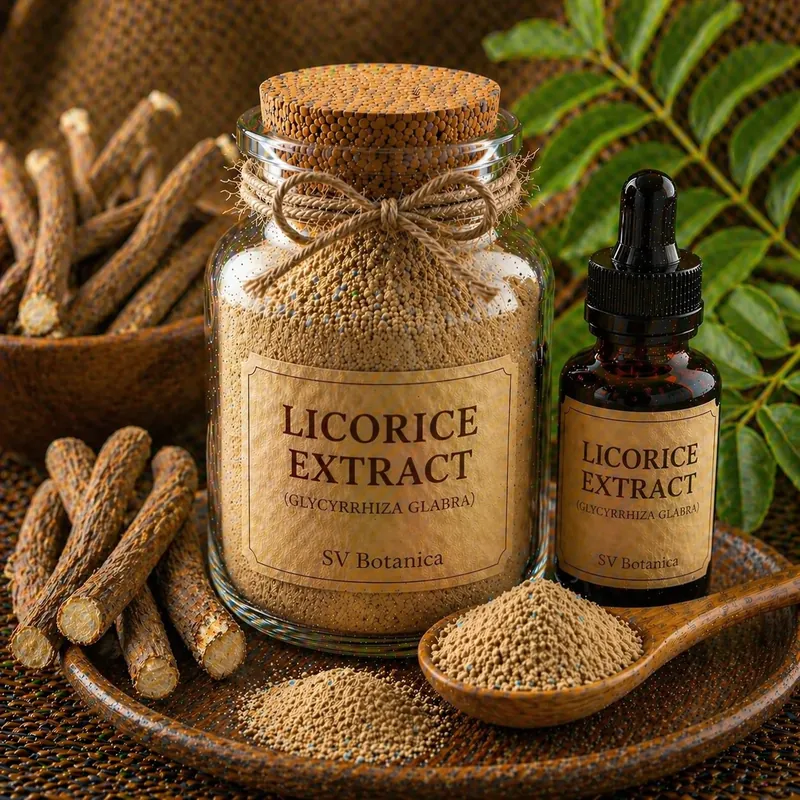
Standardised Grade
Glycyrrhiza glabra · 20% GlycyrrhizinOne root, three completely different commercial products
Licorice (Glycyrrhiza glabra L.) — mulethi in Ayurveda, yashtimadhu in the classical texts — is among the most widely used botanicals in the world, appearing in Ayurvedic, Chinese and European traditions and in more pharmacopoeial monographs than almost any other root. The name comes from the Greek glykys rhiza, "sweet root", and that sweetness is chemistry: glycyrrhizin is roughly fifty times sweeter than sucrose.
What makes licorice unusual to buy is that the same root yields three genuinely different commercial materials. The glycyrrhizin-standardised extract is the mainstream grade, assayed by HPLC and used in digestive, respiratory and confectionery applications. DGL — deglycyrrhizinated licorice — has the glycyrrhizin deliberately stripped to not more than 2%, for digestive products that need the flavonoid fraction without the blood-pressure caution glycyrrhizin carries. And the glabridin-standardised grade, typically 40%, is a hydrophobic cosmetic active for skin-brightening formulations, chemically and commercially unrelated to the other two.
Ordering the wrong one of those three is the single most common licorice sourcing error, and it is not a small mistake — a DGL grade and a 20% glycyrrhizin grade have opposite specifications for the same marker. SV Botanica standardises the flagship grade to glycyrrhizin of not less than 20% by HPLC, with 10% and 25% grades, DGL, glabridin 40% and native-ratio full-spectrum extracts available.
We supply supplement brands, confectionery and beverage manufacturers, cosmetic formulators and Ayurvedic houses, with a batch-specific Certificate of Analysis on every shipment.
The saponin and flavonoid fractions that define licorice root
The triterpene saponin — glycyrrhizic acid — that gives licorice its sweetness and its regulatory profile. Standardised here to NLT 20% by HPLC and deliberately removed in the DGL grade.
An isoflavan of the hydrophobic fraction, the marker for cosmetic skin-brightening grades. Present at low levels in the standard extract; concentrated to 40% for cosmetic use.
Principal flavanone glycoside and its aglycone, major contributors to the flavonoid fraction that DGL grades are made to preserve.
A chalcone characteristic of Glycyrrhiza and part of the antioxidant flavonoid complex of the root.
The aglycone formed when glycyrrhizin is hydrolysed; used as an active in its own right in topical formulations.
The water-soluble fraction that carries much of the root's body and mouthfeel in confectionery and beverage applications.
Why formulators specify a glycyrrhizin-standardised extract — and when they specify it removed
Glycyrrhizin is both the sweet principle and the compound regulators care about, which makes an accurate declared percentage more consequential here than for most botanicals. HPLC assay gives a defensible number for formulation and for labelling arithmetic.
Licorice is one of the oldest and most recognised botanicals for digestive comfort and mucosal soothing, and DGL in particular is a category standard in gastric-comfort supplements.
Deglycyrrhizinated licorice reduces glycyrrhizin to NMT 2%, letting brands formulate meaningful daily doses of the flavonoid fraction without the intake ceiling that glycyrrhizin imposes.
The glabridin-standardised 40% grade is an established cosmetic active for brightening and evening-tone formulations, supplied to a defined marker rather than as an unquantified "licorice extract".
Glycyrrhizin is around fifty times sweeter than sucrose and highly water-soluble, making the standard grade useful as both an active and a functional sweetening and masking agent in confectionery and beverages.
A free-flowing powder passing ≥95% through a 40-mesh sieve with controlled bulk density disperses and blends predictably across batches, with pH and solubility declared per grade.
These are functional and physico-chemical properties of the actives; SV Botanica does not make medical or therapeutic claims for this ingredient.
Three commercially distinct materials from one root — specify by marker, not by name
| Grade | Standardisation | Form | Best For | Solubility |
|---|---|---|---|---|
| Licorice Extract 20% Standard | Glycyrrhizin NLT 20% (HPLC) | Light to medium brown fine powder, ≥95% through 40 mesh | Digestive & respiratory supplements, confectionery, beverages | Water-soluble |
| Licorice Extract 10% / 25% Alternative assay | Glycyrrhizin NLT 10% or NLT 25% (HPLC) | Light to medium brown fine powder | Dose-tuned supplement and food formats | Water-soluble |
| Licorice DGL Deglycyrrhizinated | Glycyrrhizin NMT 2%; flavonoid fraction retained | Light brown to buff fine powder | Gastric-comfort supplements, chewables, higher daily doses | Water-dispersible |
| Licorice Extract Glabridin 40% Cosmetic | Glabridin NLT 40% (HPLC) | Off-white to pale yellow powder | Skin-brightening serums, creams & cosmetic actives | Oil/glycol-soluble |
| Licorice Extract Ratio Full-spectrum | Native 4:1 / 10:1 ratio (full-spectrum) | Brown fine powder | Traditional & Ayurvedic formats, herbal blends | Grade-dependent |
The 20% glycyrrhizin grade is our CoA-backed flagship, standardised by HPLC with identity confirmed by TLC. DGL, glabridin-standardised cosmetic grades, alternative assay strengths, native-ratio (full-spectrum) extracts, custom mesh and packaging can be quoted against buyer specification and order volume. Please state the grade family — standardised, DGL or glabridin — on your enquiry, as the three carry opposite specifications for the same marker. Every batch is released against a batch-specific Certificate of Analysis.
Licorice Extract is bought in five forms. The standardised extract is the stocked item; granulated and dispersible grades are produced on request and raw botanical forms are sourced against a confirmed order.
| Form | What it is | Specification basis | Availability |
|---|---|---|---|
| Standardised extract powder | Glycyrrhiza glabra root extract, dried and milled | NLT 20% glycyrrhizin (HPLC) | Stocked |
| Granulated (direct-compression) | Extract granulated for tablet lines | Same marker, declared on the granule | On request |
| Water-dispersible / soluble | Extract in a dispersible matrix for beverages, gummies and sachets | Marker declared on the matrix basis; carrier named | On request |
| Root powder (non-extracted) | Cleaned, dried Glycyrrhiza glabra root, milled to mesh | Botanical identity by TLC; heavy metals and microbial panel | On enquiry, subject to lot; phytosanitary certificate usually required |
| Cut & sifted root | Dried root pieces, sifted to size | Identity, moisture, foreign matter | On enquiry; for tea, decoction and in-house extraction |
A marker percentage without its assay method is not a specification; ask for the method and the plant part on every quotation. Read Licorice Extract: A Complete Buyer's Guide, Glycyrrhizin and How Licorice Extract Is Standardised and Licorice Extract Adulteration and How Authenticity Is Proven before comparing offers.
Full product specification for Licorice Dry Extract 20% glycyrrhizin. Values are specification limits, not batch results; a batch-specific CoA is issued per shipment.
| Parameter | Specification / Limit | Method |
|---|---|---|
| Botanical Source | Glycyrrhiza glabra L. | — |
| Plant Family | Fabaceae (Leguminosae) | — |
| Part Used | Root and stolon | — |
| Country of Origin | India | — |
| Appearance | Fine powder | Organoleptic |
| Colour | Light to medium brown* | Organoleptic |
| Odour | Characteristic | Organoleptic |
| Taste | Characteristic, sweet | Organoleptic |
| Identification | Corresponds to glycyrrhizin — positive | By TLC |
| Loss on Drying (at 105°C, % w/w) | NMT 5.0 | IP-2014 |
| pH (1% w/v solution) | 4 – 6 | IP-2014 |
| Bulk Density (g/ml) | NLT 0.35 | IP-2014 |
| Particle Size (#40 mesh, % w/w) | NLT 95 | Sieve |
| Total Ash (% w/w) | NMT 10 | IP-2014 |
| Acid Insoluble Ash (% w/w) | NMT 2 | IP-2014 |
| Glycyrrhizin (% w/w, dry basis) | NLT 20.0 | By HPLC |
| Glabridin (% w/w) | Reported per batch (40% in cosmetic grade) | By HPLC |
| Residual Solvent (Ethanol, ppm) | NMT 5,000 | By GC |
| Lead (ppm) | NMT 1.0 | ICP-MS |
| Arsenic (ppm) | NMT 1.0 | ICP-MS |
| Cadmium (ppm) | NMT 0.3 | ICP-MS |
| Mercury (ppm) | NMT 0.1 | ICP-MS |
| Pesticide Residues | Complies (EU MRL, on request) | GC-MS / LC-MS/MS |
| Ethylene Oxide (ETO) | Not treated — declaration provided | LC-MS/MS (on request) |
| Total Plate Count (cfu/g) | NMT 1,000 | USP <2021> |
| Yeast & Moulds / Fungi (cfu/g) | NMT 100 | USP <2021> |
| Escherichia coli | Absent | USP <2022> |
| Salmonella sp. | Absent | USP <2022> |
| Staphylococcus aureus | Absent | USP <2022> |
| Cultivation | Cultivated / wild-collected (declared per batch) | Declaration |
| Kosher / Halal | Certified (on request) | Certification |
| Shelf Life | 36 months from date of manufacture, in original packed condition | — |
| Storage | Cool, dry place away from light and moisture, in tightly sealed containers | — |
*The product is of herbal origin; slight colour variation may occur due to geographical and seasonal variation in the raw material. Glycyrrhizin is standardised by HPLC and identity is confirmed by TLC. The DGL grade carries an inverted glycyrrhizin specification (NMT 2%) and the cosmetic grade is standardised on glabridin — please confirm the grade family on your order. A current Certificate of Analysis and MSDS are issued with every batch. EU pesticide MRL and ethylene oxide reports are available on request.
From root to standardised extract — authenticated, tested, documented
Raw Material & Authentication: The extract is prepared from Glycyrrhiza glabra root and stolon. Because three Glycyrrhiza species — glabra, uralensis and inflata — are all pharmacopoeially recognised somewhere in the world but carry different flavonoid profiles, correct-species declaration matters more here than for most roots. Glycyrrhizin identity is confirmed by TLC and content assayed by HPLC on every batch before acceptance.
Manufacturing & Testing: Licorice Dry Extract is manufactured at certified facilities in India. Each batch runs through a full QC battery — glycyrrhizin by HPLC, loss on drying, pH, bulk density, ash and acid-insoluble ash, mesh, residual solvent by GC, heavy metals by ICP-MS, pesticide residue screening, and a complete USP microbiological panel — before release. DGL batches are additionally assayed to confirm glycyrrhizin has been reduced below the 2% ceiling.
Documentation: Every shipment is supplied against a batch-specific Certificate of Analysis with an MSDS. Halal, Kosher and Organic certification are available. Because glycyrrhizin carries an intake ceiling in most regulated markets, we state the assayed percentage rather than a range, so buyers can perform their own labelling arithmetic — see our guides on EU pesticide MRL compliance and EU import requirements for botanical extracts.
What backs every batch of Licorice extract
Key information for global product registration and labelling
Glycyrrhizin is one of the few botanical markers with a widely recognised intake ceiling — international scientific opinion has converged on around 100 mg per day as a level below which adverse effects are not expected in most adults. Sustained higher intake is associated with pseudoaldosteronism, potassium loss and raised blood pressure. We declare the assayed glycyrrhizin percentage on every batch so buyers can calculate contribution per serving, and offer DGL where a higher daily dose of the flavonoid fraction is wanted. Buyers are responsible for compliance with food-supplement regulations in their market.
Several markets, the EU among them, require a specific advisory statement on confectionery and beverages above defined glycyrrhizin thresholds, advising that people with hypertension avoid excessive consumption. Because the trigger is glycyrrhizin content in the finished product, an accurate assayed figure on the ingredient CoA — not a nominal grade name — is what makes that arithmetic defensible. DGL is the usual route where the threshold would otherwise be crossed.
Glycyrrhiza glabra root extract is an established cosmetic ingredient with a recognised INCI listing, with the glabridin-standardised grade used as a brightening active. Supplied from India by SV Botanica — FSSAI Central Licence holder and an APEDA-registered exporter — Kosher certified, against a batch-specific Certificate of Analysis with export documentation on request.
Deep-dive articles on licorice root extract for formulators, buyers, and brand owners
Standardised, DGL or glabridin — how to specify the right one of three very different materials.
TechnicalWhat the marker is, how HPLC assay works, and why the DGL specification is inverted.
QualitySpecies substitution, spent root and ammonium glycyrrhizinate spiking — and the tests that catch them.
ApplicationsDigestive, respiratory, confectionery and cosmetic formats — and the glycyrrhizin ceiling arithmetic.
ProcurementA scored checklist for qualifying a licorice extract supplier before you place a bulk order.
MarketWhere licorice demand is growing across the US, EU and Asia, and which segments drive it.
Frequently co-formulated with Licorice Extract in digestive, respiratory & skin-brightening blends
Technical and commercial questions answered by our ingredients team
Glycyrrhizin-standardised, lab-tested, fully documented supply of Glycyrrhiza glabra root extract. Glycyrrhizin NLT 20% by HPLC, with DGL and glabridin 40% grades. Samples available for qualified buyers.
Supplied as a bulk ingredient for further manufacture. Buyers are responsible for compliance with the regulations of their destination market. This product is not intended to diagnose, treat, cure or prevent any disease.
We use cookies for analytics and to measure our advertising. Essential cookies are always on. Privacy policy