
Lepidium meyenii Walp. · Family: Brassicaceae · Hypocotyl (Root) Extract · Origin: Peru
Andean maca of declared Peruvian origin, with colour phenotype and gelatinisation status stated on every batch and macamides reported — because glucosinolates occur across the whole cabbage family and cannot identify maca on their own. Prepared from the hypocotyl of Lepidium meyenii for vitality, hormonal-balance and sports formulators. CoA-backed supply.
Peruvian Origin
Phenotype & Gelatinisation DeclaredAn Andean crop, three colour phenotypes, and a marker that isn't specific to it
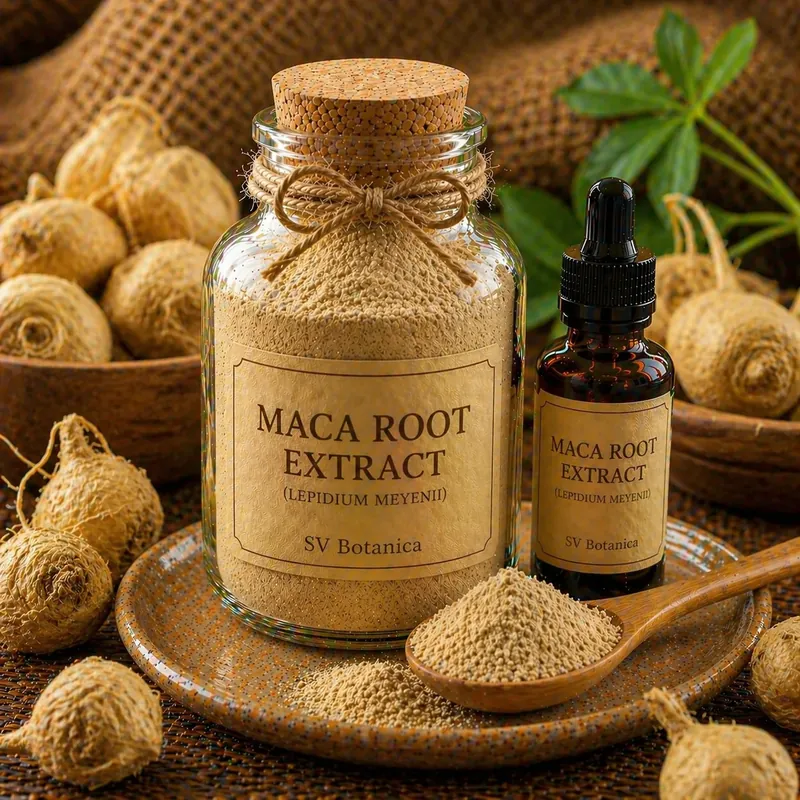
Maca (Lepidium meyenii Walp.) is a Brassicaceae — the cabbage and mustard family — cultivated on the high Andean plateau of Peru at altitudes above four thousand metres, where few other crops survive. The part used is technically the hypocotyl, a swollen stem-root structure, though it is universally traded as "maca root". It has been grown and eaten in the region for centuries and is a genuine food crop, not merely a medicinal botanical.
We should be straightforward about origin: maca is Andean, not Indian. SV Botanica supplies it as an exporter and merchant rather than as an origin producer, and every batch carries a declared Peruvian origin. Peru also maintains protections around maca germplasm and raw material, and a supply chain that respects those is the only kind worth having — origin declaration is part of demonstrating that, not decoration.
Two variables define what you actually receive, and both are routinely left unstated. The first is colour phenotype: maca grows as yellow, red and black hypocotyls, these are genuinely different materials with different availability and price, and "maca extract" without a phenotype normally resolves to yellow — the most abundant. The second is gelatinisation: maca gelatinizada has been heat- and pressure-treated to remove starch and improve digestibility, and it is a different product from raw maca at a different price.
The marker deserves care too. Maca is conventionally standardised on glucosinolates at around 0.6% — but glucosinolates occur throughout the Brassicaceae, from broccoli to mustard, so a glucosinolate figure cannot confirm the material is maca. What can are the macamides and macaenes, benzylated alkamides essentially unique to Lepidium meyenii. We report them.
The maca-specific markers, and the ones shared with the cabbage family
The maca-specific marker. Benzylated fatty acid amides essentially unique to Lepidium meyenii — the compounds that can actually confirm identity.
Unsaturated fatty acids characteristic of maca, occurring alongside the macamides and part of the authenticity fingerprint.
The conventional standardisation basis at NLT 0.6% — but shared across the entire Brassicaceae, so not species-specific.
The principal glucosinolate of maca, benzyl-type; more characteristic than total glucosinolates though still not unique.
The wider nutritional fraction of the hypocotyl, contributing to maca's positioning as a food crop rather than only an extract source.
Substantial in raw maca and largely removed in gelatinised grades — the difference between the two products.
Why formulators specify an origin-, phenotype- and processing-declared maca
Maca is Andean. We state origin on every batch and supply through a chain that respects Peru's protections around maca raw material — a documented fact rather than an assumption.
Glucosinolates occur across the whole cabbage family and cannot identify maca. Macamides are essentially unique to Lepidium meyenii — the only marker that confirms what you actually have.
Yellow, red and black maca are genuinely different materials with different availability and price. Unspecified "maca" normally means yellow; if you want red or black, the certificate should say so.
Gelatinised maca is heat- and pressure-treated to remove starch and improve digestibility — a different product at a different price from raw. Declared, not assumed.
Maca has strong consumer recognition in vitality, hormonal-balance and endurance positioning, with genuine Andean food-crop heritage behind it.
Maca's food-crop character and good solubility suit smoothie powders, beverages, bars and functional foods as readily as capsules.
These are functional and physico-chemical properties of the actives; SV Botanica does not make medical or therapeutic claims for this ingredient.
Three variables to state: phenotype, gelatinisation, and standardisation basis
| Grade | Standardisation | Form | Best For | Solubility |
|---|---|---|---|---|
| Maca Extract Yellow Standard | Glucosinolates NLT 0.6%; macamides reported; yellow phenotype | Cream to light beige fine powder, ≥95% through 40 mesh | General vitality & wellness formats, capsules & powders | Water-soluble |
| Maca Extract Red Phenotype | Glucosinolates to specification; red phenotype declared | Pale pink-beige fine powder | Women's-wellness positioning; phenotype-specific formulations | Water-soluble |
| Maca Extract Black Phenotype | Glucosinolates to specification; black phenotype declared | Grey-beige to light brown fine powder | Sports, endurance & men's-vitality positioning | Water-soluble |
| Maca Gelatinizada Gelatinised | Starch removed by heat/pressure; phenotype declared | Cream fine powder, improved dispersion | Digestibility-sensitive formats, beverages, daily-use powders | Readily water-soluble |
| Maca Extract Concentrated High-assay | Concentrated extract; macamides and glucosinolates reported | Light beige fine powder | Capsules & low-dose formats | Water-soluble |
Please state all three variables on your enquiry: colour phenotype (yellow, red or black), gelatinisation status (raw or gelatinised), and standardisation basis. An unspecified "maca extract" normally resolves to raw yellow — the most abundant and least expensive — which may or may not be what your formulation intends. Red and black phenotypes are genuinely scarcer and priced accordingly. Every batch declares Peruvian origin, phenotype and processing, and reports macamides as the maca-specific marker alongside the conventional glucosinolate figure.
Maca Root Extract is bought in five forms. The standardised extract is the stocked item; granulated and dispersible grades are produced on request and raw botanical forms are sourced against a confirmed order.
| Form | What it is | Specification basis | Availability |
|---|---|---|---|
| Standardised extract powder | Lepidium meyenii hypocotyl extract, dried and milled | Glucosinolates NLT 0.6%, macamides reported, phenotype stated | Stocked |
| Granulated (direct-compression) | Extract granulated for tablet lines | Same marker, declared on the granule | On request |
| Water-dispersible / soluble | Extract in a dispersible matrix for beverages, gummies and sachets | Marker declared on the matrix basis; carrier named | On request |
| Gelatinised maca powder | Cooked and dried hypocotyl, starch broken down | Glucosinolates; phenotype stated; microbial panel | On enquiry, subject to lot |
| Raw maca powder | Dried hypocotyl, milled | Botanical identity by TLC; heavy metals and microbial panel | On enquiry, subject to lot; phytosanitary certificate usually required |
A marker percentage without its assay method is not a specification; ask for the method and the plant part on every quotation. Read Maca Root Extract: A Complete Buyer's Guide, Macamides, Glucosinolates and How Maca Is Standardised and Maca Adulteration and How Authenticity Is Proven before comparing offers.
Full product specification for Maca Root Extract, yellow phenotype. Values are specification limits, not batch results; a batch-specific CoA is issued per shipment.
| Parameter | Specification / Limit | Method |
|---|---|---|
| Botanical Source | Lepidium meyenii Walp. | — |
| Plant Family | Brassicaceae (Cruciferae) | — |
| Part Used | Hypocotyl (commercially 'root') | — |
| Country of Origin | Peru — declared per batch | Declaration |
| Colour Phenotype | Yellow / red / black — declared per batch | Declaration |
| Processing | Raw or gelatinised — declared per batch | Declaration |
| Appearance | Fine powder | Organoleptic |
| Colour | Cream to light beige (phenotype-dependent)* | Organoleptic |
| Odour | Characteristic, malty | Organoleptic |
| Taste | Characteristic, malty-earthy | Organoleptic |
| Identification | Corresponds to reference extract — positive | By TLC / HPLC |
| Glucosinolates (% w/w, dry basis) | NLT 0.6 — method declared | By HPLC / UV |
| Macamides (% w/w) | Reported per batch — maca-specific marker | By HPLC |
| Macaenes | Reported on request | By HPLC |
| Glucotropaeolin | Reported on request | By HPLC |
| Starch (gelatinised grades) | Substantially reduced — reported | Gravimetric |
| Loss on Drying (at 105°C, % w/w) | NMT 5.0 | IP-2014 |
| pH (1% w/v solution) | 5 – 7 | IP-2014 |
| Bulk Density (g/ml) | NLT 0.40 | IP-2014 |
| Particle Size (#40 mesh, % w/w) | NLT 95 | Sieve |
| Total Ash (% w/w) | NMT 6 | IP-2014 |
| Acid Insoluble Ash (% w/w) | NMT 2 | IP-2014 |
| Lead (ppm) | NMT 1.0 | ICP-MS |
| Arsenic (ppm) | NMT 1.0 | ICP-MS |
| Cadmium (ppm) | NMT 0.3 | ICP-MS |
| Mercury (ppm) | NMT 0.1 | ICP-MS |
| Pesticide Residues | Complies (EU MRL, on request) | GC-MS / LC-MS/MS |
| Ethylene Oxide (ETO) | Not treated — declaration provided | LC-MS/MS (on request) |
| Total Plate Count (cfu/g) | NMT 10,000 | USP <2021> |
| Yeast & Moulds / Fungi (cfu/g) | NMT 100 | USP <2021> |
| Escherichia coli | Absent | USP <2022> |
| Salmonella sp. | Absent | USP <2022> |
| Staphylococcus aureus | Absent | USP <2022> |
| Cultivation | Cultivated — Andean highlands | Declaration |
| Kosher / Halal | Certified (on request) | Certification |
| Shelf Life | 36 months from date of manufacture, in original packed condition | — |
| Storage | Cool, dry place away from light and moisture, in tightly sealed containers | — |
*Colour varies with phenotype — yellow maca is cream to light beige, red is pale pink-beige, black is grey-beige to light brown — so colour should be read against the declared phenotype rather than against a single expectation. Three declarations on this specification carry the information that a glucosinolate figure cannot. Origin is declared because maca is an Andean crop and SV Botanica supplies it as exporter rather than origin producer. Phenotype and processing are declared because yellow, red and black maca, and raw versus gelatinised, are genuinely different materials at different prices. And macamides are reported because glucosinolates occur throughout the Brassicaceae — from broccoli to mustard — and therefore cannot confirm that a material is maca. A current Certificate of Analysis and MSDS are issued with every batch.
From Andean hypocotyl to declared extract — origin, phenotype and marker documented
Origin & Supply Chain: Maca is an Andean crop cultivated on the Peruvian high plateau, and we state that plainly rather than obscuring it — SV Botanica supplies maca as an exporter and merchant rather than as an origin producer. Every batch carries a declared Peruvian origin. Peru maintains protections around maca germplasm and raw material, and we regard a supply chain that respects those as the only kind worth operating; origin declaration is part of demonstrating it.
Authentication & Testing: Because glucosinolates occur throughout the Brassicaceae and cannot identify maca, authentication rests on macamides — benzylated alkamides essentially unique to Lepidium meyenii — reported by HPLC on every batch, with macaenes and glucotropaeolin available on request. Each batch also runs loss on drying, pH, bulk density, ash and acid-insoluble ash, mesh, heavy metals by ICP-MS, pesticide residue screening, and a complete microbiological panel before release.
Documentation: Every shipment is supplied against a batch-specific Certificate of Analysis stating origin, colour phenotype, processing status (raw or gelatinised) and the macamide figure, with an MSDS. Halal, Kosher and Organic certification are available — see our guides on EU pesticide MRL compliance and EU import requirements for botanical extracts.
What backs every batch of Maca extract
Key information for global product registration and labelling
Maca is an Andean crop and Peru maintains protections around maca germplasm and raw material, reflecting its status as a native crop of significant national importance. We state Peruvian origin on every batch and supply through a chain that respects those protections. Buyers should be aware that origin claims on maca attract genuine scrutiny — "Peruvian maca" is a meaningful provenance statement in this category, and one that a responsible supplier should be able to document rather than assert. SV Botanica supplies maca as exporter and merchant rather than as origin producer, and we would rather be explicit about that than imply otherwise.
Maca has a long history of use as a food crop in the Andes, which supports its food-use position in many markets, though buyers should confirm the specific position for their jurisdiction — a concentrated extract is not automatically covered by a traditional whole-food history. Positioning around vitality, hormonal balance and fertility is subject to claim rules that differ substantially by market and can be strict. Buyers remain responsible for determining suitability and for compliance with the food-supplement regulations applying in their market. This product is not intended to diagnose, treat, cure or prevent any disease.
Maca is a member of the Brassicaceae — the same family as broccoli, cabbage and mustard — and carries glucosinolates in common with them. Beyond the analytical consequence discussed on this page, formulators should note that glucosinolate-containing plants attract specific consideration in some contexts, including thyroid-related guidance in certain markets. This is a finished-product assessment matter rather than an ingredient defect, and we supply the specification and marker documentation to support it.
Deep-dive articles on maca root extract for formulators, buyers, and brand owners
Three variables nobody states — phenotype, gelatinisation and origin — and why each changes what you receive.
TechnicalWhy the conventional marker cannot identify maca, and the compounds that can.
QualityStarch bulking, phenotype substitution and origin claims — a well-documented adulteration target.
ApplicationsVitality, sports and food formats — plus raw versus gelatinised and the phenotype question.
ProcurementA scored checklist weighted around origin documentation and macamide capability.
MarketA single-origin Andean crop with global demand — and what that does to price and provenance.
Frequently co-formulated with Maca Root Extract in vitality, sports & wellness blends
Technical and commercial questions answered by our ingredients team
Peruvian-origin maca with colour phenotype and gelatinisation status declared, and macamides reported as the maca-specific marker. Samples available for qualified buyers.
Supplied as a bulk ingredient for further manufacture. Buyers are responsible for compliance with the regulations of their destination market. This product is not intended to diagnose, treat, cure or prevent any disease.
We use cookies for analytics and to measure our advertising. Essential cookies are always on. Privacy policy