
Tribulus terrestris L. · Family: Zygophyllaceae · Fruit Extract
Ayurveda's premier herb for men's vitality and physical performance — standardised for steroidal saponins at 40%, 60% and 90%, with a protodioscin-standardised HPLC grade for buyers who need a defined active. Trusted by supplement, sports-nutrition, and Ayurvedic formulators worldwide. GMP, ISO, and Halal certified supply from India.
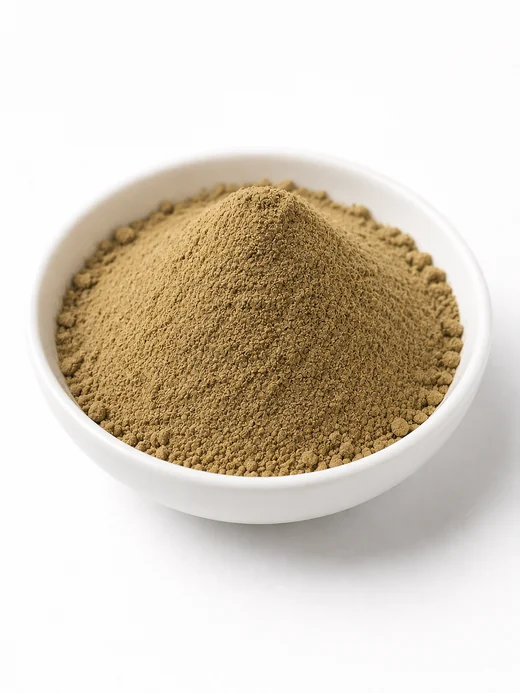
Actual Product
Tribulus terrestris · Saponins Grade · Actual BatchAyurveda's classic herb for strength, vitality and the urinary tract
Gokshura (Tribulus terrestris) is one of the most widely used herbs in the Ayurvedic pharmacopoeia, classified as both a Rasayana (rejuvenative tonic) and a Vajikarana (vitality) herb. The Sanskrit name "Gokshura" refers to the fruit's small, cow's-hoof-shaped spines. For centuries it has been used to support male vitality, physical strength, and healthy urinary function.
The primary bioactive compounds are steroidal saponins of the furostanol and spirostanol classes — chief among them protodioscin, together with dioscin, tribulosin, and diosgenin-type glycosides. Supporting these are flavonoids (quercetin, kaempferol, rutin), trace beta-carboline alkaloids (harman, harmine), and tannins. Protodioscin is the single most-studied active and the marker most worth specifying on a Certificate of Analysis.
SV Botanica sources Tribulus fruit from authenticated cultivation and wild-collection zones across India, then extracts under a validated hydro-alcoholic process that preserves the saponin profile — yielding a clean, greenish-tan to light-brown fine powder that disperses readily in capsules, tablets, and functional beverages.
We supply supplement brands, sports-nutrition companies, Ayurvedic manufacturers, and contract formulators across Europe, the USA, the Middle East, and Southeast Asia. New buyers can start with our Gokshura extract buyer's guide for sourcing and specification benchmarks.
Key phytochemicals driving Gokshura's activity profile
The principal furostanol saponin and the most-studied active. Quantified by HPLC — the meaningful marker for men's-health and sports grades.
The broader saponin fraction (dioscin, tribulosin, diosgenin glycosides) measured gravimetrically/UV at 40%-90% in standardised grades.
Flavonoids providing antioxidant and vascular-toning activity, complementary to the saponin fraction.
A spirostanol saponin studied for cardioprotective and circulatory-support activity in preclinical models.
Harman and harmine occur in trace amounts, chiefly in aerial parts. We monitor and report alkaloid levels on request.
Quantified by UV at 40%-90% in standardised grades. Total saponin content is the primary broad CoA specification.
Evidence from Ayurvedic texts, clinical studies, and ethnopharmacological research
The classical Ayurvedic Vajikarana application. Protodioscin-rich fruit extract is traditionally used to support male reproductive vitality. Human evidence on testosterone in healthy men is mixed; effects are more consistent for subjective vitality and wellbeing.
Ref: Qureshi A et al., 2014; J Diet Suppl (review)The best-supported research area. Several randomised trials report improvements in sexual desire and satisfaction, in both men and women, with standardised Tribulus extract — an effect attributed to protodioscin and nitric-oxide pathways.
Ref: Kamenov Z et al., 2017; Maturitas (RCT)A staple of sports-nutrition and pre-workout formulations, used to support strength, stamina, and recovery. Ergogenic evidence in trained athletes is inconsistent, so we recommend structure/function positioning around vitality and stamina rather than hard performance claims.
Ref: Pokrywka A et al., 2014; Biol Sport (review)One of Gokshura's oldest documented uses — a traditional diuretic and urinary-tract tonic. Ethnopharmacological and preclinical work supports diuretic and litholytic (anti-stone) activity, underpinning its use in urinary-health formulations.
Ref: EMA/HMPC assessment report, Tribulus terrestris herbaSaponins including tribulosin and protodioscin act on nitric-oxide signalling, supporting healthy circulation and endothelial function in preclinical and early clinical studies — relevant to vitality and cardiometabolic wellness blends.
Ref: Strídero et al., 2017; AndrologiaThe flavonoid fraction (quercetin, kaempferol, rutin) provides free-radical scavenging activity that complements the saponins, supporting the herb's traditional restorative, anti-fatigue reputation.
Ref: Chhatre S et al., 2014; Pharmacogn RevFor a formulator-focused read of the active-compound science and the honest state of the evidence, see Tribulus saponins & protodioscin: benefits and the evidence.
Select the right standardisation and form for your formulation requirement
| Grade | Active Content | Form | Best For | Certifications |
|---|---|---|---|---|
| Standard 40% Popular | ≥40% total saponins (UV) | Fine powder, ≥95% through #40 mesh | Men's vitality capsules, Ayurvedic formulations, general supplements | GMP, ISO, Halal, Kosher |
| Standard 60% Popular | ≥60% total saponins (UV) | Fine powder, ≥95% through #40 mesh | Sports-nutrition blends, higher-potency vitality products | GMP, ISO, Halal, Kosher |
| High Potency 90% Premium | ≥90% total saponins (UV) | Fine powder, 100% through #40 mesh | Premium men's-health SKUs, label-forward saponin claims | GMP, ISO, Halal, Kosher |
| Protodioscin Grade HPLC | Standardised protodioscin by HPLC (e.g. ≥20%) | Fine powder, ≥95% through #40 mesh | Clinical-dose & sports formulations needing a defined active | GMP, ISO, Halal, Kosher |
| Organic Grade Organic | ≥40% saponins (UV), organic-certified | Fine powder, ≥95% through #40 mesh | Organic-certified product lines, EU/US natural market | Organic, GMP, ISO |
| Water-Soluble Grade | ≥40% saponins equiv. | Granular / spray-dried | Pre-workouts, shots, effervescents, sachets | GMP, ISO, FSSAI, Food-grade |
Representative batch assays on file: 40% grade — 42.6% saponins (CoA SVB-COA-GK40-0525-01); 60% grade — 61.9% saponins (CoA SVB-COA-GK60-0625-01); 90% grade — 91.2% saponins (CoA SVB-COA-GK90-0425-01); protodioscin grade — 21.8% protodioscin by HPLC (CoA SVB-COA-GKPD-0625-02). Custom protodioscin minimums, saponin levels, and mesh sizes available for orders ≥100 kg. See our standardisation guide to choose between UV saponins and HPLC protodioscin.
Gokshura Extract is bought in five forms. The standardised extract is the stocked item; granulated and dispersible grades are produced on request and raw botanical forms are sourced against a confirmed order.
| Form | What it is | Specification basis | Availability |
|---|---|---|---|
| Standardised extract powder | Tribulus terrestris fruit extract, dried and milled | NLT 40% total saponins (UV) | Stocked |
| Granulated (direct-compression) | Extract granulated for tablet lines | Same marker, declared on the granule | On request |
| Water-dispersible / soluble | Extract in a dispersible matrix for beverages, gummies and sachets | Marker declared on the matrix basis; carrier named | On request |
| Fruit powder (non-extracted) | Dried Tribulus terrestris fruit, milled to mesh | Botanical identity by TLC; heavy metals and microbial panel | On enquiry, subject to lot; phytosanitary certificate usually required |
| Whole dried fruit | Dried fruit, graded and cleaned | Identity, moisture, foreign matter | On enquiry, subject to lot |
A marker percentage without its assay method is not a specification; ask for the method and the plant part on every quotation. Read Gokshura (Tribulus terrestris) Extract Buyer’s Guide: Saponin Grades, Protodioscin & Sourcing, Tribulus Saponins & Protodioscin: The Actives Behind Gokshura and Standardising Gokshura: Saponins by UV vs Protodioscin by HPLC before comparing offers.
Full analytical profile — Standard 40% Saponins grade (representative batch SVB/GK40/0525-01)
| Parameter | Specification | Typical Result |
|---|---|---|
| Botanical Source | Tribulus terrestris L. | Conforms |
| Plant Family | Zygophyllaceae | — |
| Part Used | Fruit (dried) | — |
| Identification (TLC) | Positive vs. reference | Positive |
| Marker Compounds | Total steroidal saponins; protodioscin | — |
| Assay Method | UV-Vis (saponins); HPLC (protodioscin) | — |
| Total Saponins | NLT 40.0% (Standard 40% grade) | 42.6% |
| Protodioscin (HPLC grade) | Standardised on request | Reported per grade |
| Appearance | Greenish-tan to light brown fine powder | Conforms |
| Odour & Taste | Characteristic; slightly bitter | Conforms |
| Particle Size | NLT 95% through #40 mesh | 96.4% |
| Loss on Drying (105°C) | NMT 5.0% w/w | 3.42% |
| Ash Content | NMT 10.0% w/w | 4.1% |
| Bulk Density | NLT 0.30 g/mL | 0.52 g/mL |
| pH (1% aqueous solution) | 4.0-7.0 | 5.6 |
| Heavy Metals (ICP-MS) | Pb ≤1.0 · As ≤1.0 · Cd ≤0.3 · Hg ≤0.1 ppm | Complies |
| Residual Solvents | Comply with USP <467> limits | Complies |
| Pesticide Residues | Compliant with EU MRL (EC 396/2005) | Complies |
| Total Plate Count | NMT 1,000 CFU/g | 310 |
| Yeast & Mould | NMT 100 CFU/g | 34 |
| E. coli / Salmonella / S. aureus | Absent | Absent |
| Shelf Life | 24-36 months (sealed, ≤25°C, <60% RH, dark) | — |
| Packaging | 25 kg HDPE drum with inner PE liner; 500 kg FIBC on request | — |
Total saponins are quantified by UV-Vis spectrophotometry — a broad, industry-standard figure. A specific protodioscin assay by HPLC is available for men's-health and sports-grade specifications and is the recommended way to define real active content. A current Certificate of Analysis, MSDS, and allergen/Non-GMO declarations are issued with every batch. Specifications for 60%, 90%, and protodioscin grades available on request.
From fruit to finished extract — traceable, tested, certified
Raw Material Sourcing: Tribulus fruit is sourced from authenticated cultivation and managed wild-collection under Good Agricultural and Collection Practices (GACP). Botanical authentication — confirming true Tribulus terrestris fruit and screening for aerial-part or species substitution — is performed by our in-house taxonomist using macroscopic, microscopic, and TLC fingerprinting against pharmacopoeial standards (Ayurvedic Pharmacopoeia of India).
Manufacturing: Extraction is carried out in GMP-certified facilities (WHO-GMP and ISO 22000 audited) using validated hydro-alcoholic parameters, with drying under controlled temperatures to preserve saponin and protodioscin integrity. Each batch runs a full QC battery — UV saponin assay, HPLC protodioscin (where specified), TLC fingerprint, heavy-metals ICP-MS, pesticide-residue GC-MS/LC-MS, and a full microbiological panel — before release.
Documentation: Every shipment carries a Certificate of Analysis (CoA), MSDS, Allergen Declaration, BSE/TSE-free statement, Non-GMO affidavit, Country of Origin Certificate, and Phytosanitary Certificate. Halal, Kosher, and Organic certificates are available for the appropriate grades. Procurement teams can reference our Gokshura sourcing guide when qualifying vendors and material.
Full compliance for global B2B supply
Key information for global product registration and labelling
Tribulus terrestris is used in food supplements in several EU member states, but national rules vary and it appears in the EFSA Compendium of botanicals (protodioscin content). No Article 13/14 health claims are authorised. Confirm member-state status before marketing; declare as Tribulus terrestris fruit extract per Regulation (EU) 1169/2011.
Tribulus terrestris is marketed as a dietary ingredient under DSHEA (21 CFR Part 111), with no pre-market approval required for dietary supplements. Facility registration with the FDA is required for importers. Structure-function claims are permissible with 30-day FDA notification and substantiation.
Gokshura is a classical Ayurvedic ingredient under the Drugs and Cosmetics Act and FSSAI-compliant for food-supplement use under the FSS (Health Supplements) Regulations 2022. Widely accepted in the Middle East (Halal grades), Southeast Asia, and Australia (TGA-listed ingredient). See our regulatory & compliance guide.
Deep-dive articles for formulators, buyers, and brand owners
How to specify grade, marker, assay method, and documentation when sourcing.
SourcingCultivation, wild-collection, supply chain, and quality realities.
RegulatoryEU, US, and India rules, and how to keep claims compliant.
ScienceActive-compound science and an honest read of the research.
TechnicalWhy "90% saponins" can mislead, and what to actually specify.
MarketCategory trends driving demand for Tribulus ingredients.
Frequently co-formulated with Gokshura Extract
Technical and commercial questions answered by our ingredients team
Made at GMP-certified facilities, lab-tested, fully documented supply. Saponin-standardised and protodioscin HPLC grades available. Minimum order 25 kg. Samples available for qualified buyers.
Supplied as a bulk ingredient for further manufacture. Buyers are responsible for compliance with the regulations of their destination market. This product is not intended to diagnose, treat, cure or prevent any disease.
We use cookies for analytics and to measure our advertising. Essential cookies are always on. Privacy policy