
Senna alexandrina Mill. (Cassia angustifolia) · Leaf & Pod · Standardized to 20% Sennosides
The world's most established herbal laxative. SV Botanica supplies a Tinnevelly senna leaf-and-pod extract standardized to 20% total sennosides (as sennoside B) by UV, with sennosides A & B confirmed by HPLC — the dianthrone glycosides behind senna's stimulant-laxative action. Water/hydro-alcoholic extracted, non-ETO and non-irradiated, heavy-metal tested and made at GMP-certified facilities, with 40%, 60% and traditional low-sennoside grades available per batch.
Bulk Ingredient
Senna alexandrina · Leaf & Pod · SennosidesThe classic herbal laxative, concentrated to a defined sennoside profile
Senna alexandrina Mill. (syn. Cassia angustifolia) — Tinnevelly or Indian senna — is the most widely used herbal laxative in the world. Its activity is attributed to sennosides, a group of dianthrone glycosides concentrated in the leaf and pod (fruit): chiefly sennosides A & B, with sennosides C & D and free anthraquinones (rhein, aloe-emodin, chrysophanol).
SV Botanica supplies Senna Extract standardized to 20% total sennosides (calculated as sennoside B) by UV, with sennosides A & B confirmed by HPLC. Traditional low-sennoside grades and higher 40% and 60% grades are produced on request — with a batch Certificate of Analysis on the marker figure every time.
A note on the assay: the pharmacopoeial method reports total sennosides calculated as sennoside B by UV spectrophotometry (the basis of the 20% figure), while HPLC resolves the individual sennosides A and B for identity and profiling. The two report on different bases — so always confirm the method. See sennosides standardisation: UV vs HPLC.
A note on identity: cheaper Cassia species and exhausted (spent) senna leaf can dilute the sennoside content, so a bulk number alone can mislead — see senna adulteration. We supply supplement, nutraceutical, tea and OTC-laxative manufacturers across Europe, the USA, the Middle East and Southeast Asia — start with the quote request form or the full Senna extract buyer's guide.
Key compounds driving senna's stimulant-laxative profile
The reference dianthrone glycoside against which total sennosides are calculated in EP/USP UV assays — the benchmark of extract potency.
The principal companion dianthrone glycoside; sennosides A & B are the actives quantified by HPLC for identity.
Minor dianthrone glycosides that add to the total sennoside pool and the native full-spectrum profile.
The active anthraquinone aglycone released from sennosides by colonic microflora — central to the laxative mechanism.
Free hydroxyanthracene anthraquinones present in the native matrix; monitored for EU hydroxyanthracene compliance.
Native flavonoids, mucilage and matrix compounds accompanying the standardised sennoside complex in a full-spectrum grade.
Evidence from clinical and pharmacological research on senna and sennosides
Senna leaf and pod carry an EMA/HMPC monograph for the short-term treatment of occasional constipation — a well-established use.
Ref: EMA/HMPC Monograph, Senna alexandrina; 2018Sennosides are activated by colonic bacteria to rhein anthrone, which stimulates peristalsis and modulates fluid secretion in the colon.
Ref: Franz G, 1993; PharmacologyStandardised senna is used within pre-colonoscopy bowel-cleansing regimens as a documented adjunct to lavage protocols.
Ref: Cochrane review, bowel prep; 2011Senna and sennosides are recognised as a Category I (safe & effective) stimulant laxative under the US OTC laxative monograph.
Ref: US FDA OTC Laxative Monograph, 21 CFR 334Senna leaf has a long tradition of use in herbal laxative teas and cleanse formulas across global markets.
Ref: WHO Monographs on Medicinal Plants, Vol. 1Assay to defined sennoside percentages supports consistent dosing and reproducible finished-product formulation batch to batch.
Ref: European Pharmacopoeia, Sennae folium/fructusThese statements describe traditional use and published research; senna is a stimulant laxative intended for short-term relief of occasional constipation and is not intended for prolonged use. Finished-product claims and dosing must follow the applicable OTC or food-supplement framework in each market. Senna pairs with other digestive botanicals — see our Triphala Extract and Haritaki Extract for gentle-motility blends. For grades and buying criteria, read the senna extract buyer's guide.
Select the right sennoside profile and raw-material part for your formulation
| Grade | Specification | Assay | Best For | Certifications |
|---|---|---|---|---|
| Sennosides 20% Standard | NLT 20% total sennosides (as sennoside B); ID by HPLC | UV | Laxative capsules & tablets | GMP, Halal |
| Sennosides 40% Concentrated | NLT 40% total sennosides (as sennoside B) | UV | High-potency & low-dose formats | GMP, Halal |
| Sennosides 60% High-Potency | NLT 60% total sennosides (as sennoside B) | UV | Pharmaceutical & OTC laxatives | GMP, Kosher |
| Traditional / Tea-Cut On Request | Low-sennoside leaf extract / cut & sifted | UV / Titrimetric | Herbal teas & cleanse blends | Available per batch |
| Sennosides A & B by HPLC | Defined sennosides A + B % by HPLC | HPLC | EP/USP monograph-matched labels | Available per batch |
The documented stock grade is 20% total sennosides (as sennoside B) by UV with HPLC identity (the grade backed by our current Certificate of Analysis, Spec No. SVB-SPEC-SN-01). Because UV total-as-sennoside-B and HPLC A+B report on different bases, we specify the method alongside the percentage — read sennosides standardisation: UV vs HPLC before comparing quotes.
Senna Leaf Extract is bought in five forms. The standardised extract is the stocked item; granulated and dispersible grades are produced on request and raw botanical forms are sourced against a confirmed order.
| Form | What it is | Specification basis | Availability |
|---|---|---|---|
| Standardised extract powder | Senna alexandrina leaf and pod extract, dried and milled | NLT 20% sennosides as sennoside B (UV), identity by HPLC | Stocked |
| Granulated (direct-compression) | Extract granulated for tablet lines | Same marker, declared on the granule | On request |
| Water-dispersible / soluble | Extract in a dispersible matrix for beverages, gummies and sachets | Marker declared on the matrix basis; carrier named | On request |
| Senna leaf (tea-bag cut) | Dried Senna alexandrina leaf, tea-bag cut | Sennosides; moisture; foreign matter | On enquiry, subject to lot; phytosanitary certificate usually required |
| Senna pods | Dried pods, graded | Sennosides; moisture | On enquiry, subject to lot |
A marker percentage without its assay method is not a specification; ask for the method and the plant part on every quotation. Read Sennosides Standardisation: UV vs HPLC, Senna Adulteration: Other Cassia Species & Spent Leaf and Senna Extract Buyer's Guide: Grades, Assay & CoA before comparing offers.
Typical specification — 20% sennosides (UV) leaf & pod grade (mapped from Spec No. SVB-SPEC-SN-01)
| Parameter | Specification | Method |
|---|---|---|
| Botanical Name | Senna alexandrina Mill. (syn. Cassia angustifolia Vahl) | — |
| Part Used | Leaf and pod | — |
| Total Sennosides (as sennoside B) | NLT 20.0% w/w | UV Spectrophotometry |
| Identification (Sennosides A & B) | Complies | HPLC |
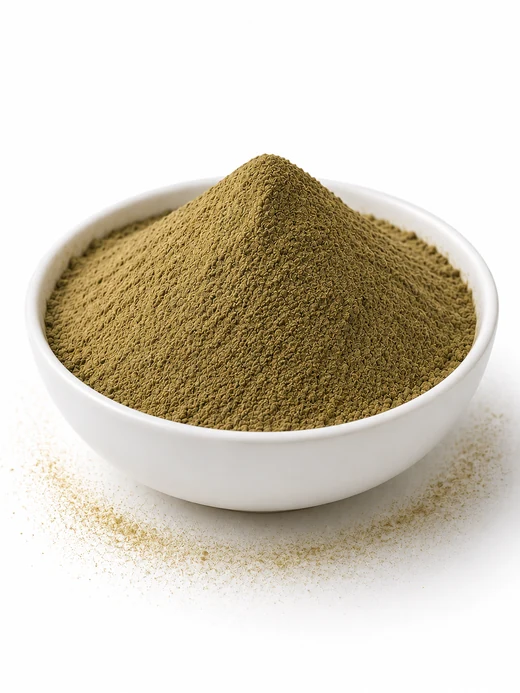
| Appearance | Yellowish-brown to greenish-brown fine powder | Organoleptic |
| Loss on Drying (105°C) | NMT 5.0% | USP <731> |
| Residue on Ignition | NMT 8.0% | USP <561> |
| Bulk Density | NLT 0.35 g/mL | USP <616> |
| Extraction Solvent | Water / hydro-alcoholic (ethanol-water) | — |
| Residual Solvent (Ethanol) | NMT 5,000 ppm | USP <467> |
| Particle Size | NLT 100% through #80 mesh | USP <786> |
| Heavy Metals (Pb/As/Cd/Hg) | ≤3 · ≤1 · ≤1 · ≤0.1 ppm | ICP-MS |
| Total Plate Count | NMT 1,000 CFU/g | USP <2021> |
| Yeast & Mould | NMT 100 CFU/g | USP <2021> |
| E. coli / Salmonella / S. aureus / P. aeruginosa | Absent | USP <2022> / <62> |
| Irradiation / ETO | Non-irradiated / Non-ETO | — |
| Status | GMO-free · BSE/TSE-free · cultivated | — |
| Shelf Life | 36 months (sealed, cool, dry) | — |
| Packaging | 25 kg HDPE drum with inner PE liner; 1 & 5 kg pouches for samples | — |
Figures shown are typical specifications for the 20% sennosides (UV) leaf & pod grade and reflect Spec No. SVB-SPEC-SN-01; a batch-specific CoA is issued with every shipment. MSDS, allergen, non-ETO, Non-GMO and BSE/TSE-free declarations accompany each batch. Specifications for 40%, 60%, traditional low-sennoside, tea-cut and HPLC grades available on request.
From authenticated Tinnevelly senna to a defined sennoside grade — traceable, tested, certified
Raw Material Sourcing: The extract is produced from authenticated, cultivated Senna alexandrina (Cassia angustifolia) leaf and pod — India is the dominant global origin, with Tinnevelly senna from Tamil Nadu and cultivated supply across Gujarat and Rajasthan. Botanical identity is documented at intake and confirmed against the sennoside A & B fingerprint — the safeguard against cheaper-Cassia substitution and spent-leaf adulteration.
Manufacturing & Testing: Leaf and pod are cleaned, extracted with water/ethanol and standardised to sennosides in GMP-certified facilities. Each batch runs a full QC battery — UV assay of total sennosides (as sennoside B) and HPLC identity of sennosides A & B, loss-on-drying, residue-on-ignition, bulk density and sieve checks, residual solvent by USP <467>, heavy metals by ICP-MS, and a complete microbiological panel — before release. Material is non-irradiated and non-ETO.
Documentation: Every shipment comes with a Certificate of Analysis, MSDS, Allergen Declaration, BSE/TSE-free statement, Non-GMO affidavit, non-ETO declaration and Country of Origin Certificate. Hydroxyanthracene and pesticide MRL reports are available on request for EU buyers. Halal and Kosher grades are available; organic certification on request. To qualify our facility or request specifications, reach our team via the certifications page or the quote form.
Full compliance for global B2B supply
Key information for global product registration and labelling
Senna leaf and pod are established herbal laxatives under the EMA/HMPC monograph. Under Regulation (EU) 2021/468, isolated aloe-emodin, emodin and danthron are prohibited, while senna preparations were placed under Union scrutiny rather than banned. Heavy-metal limits (Reg. (EU) 2023/915) and pesticide MRLs (Reg. 396/2005) apply, and Indian botanical extracts fall under Reg. (EU) 2019/1793 increased ETO controls — our extract is non-ETO/non-irradiated with residual-solvent, hydroxyanthracene and MRL reports available. See our regulatory & compliance guide.
Senna and sennosides are recognised as Category I (safe & effective) stimulant laxatives under the FDA OTC laxative monograph (21 CFR 334), and senna is also used as a dietary ingredient under DSHEA (21 CFR Part 111). Importer FDA facility registration is required. Residual-solvent control (USP <467>) and heavy-metal limits (e.g. California Prop 65) make ICP-MS-tested material essential; label warnings for stimulant laxatives apply.
Senna (Swarnapatri) is an official Ayurvedic drug and a major cultivated export crop, relevant under AYUSH and the FSS (Health Supplements) Regulations 2022. Widely accepted across the Middle East (Halal grades), Southeast Asia and other markets, subject to local heavy-metal, residual-solvent and laxative-labelling limits.
Frequently co-formulated with Senna Extract
Deep-dive articles for formulators, buyers, and brand owners
Grades, the UV vs HPLC question, full CoA spec table and what to verify before ordering.
SourcingTinnevelly origin, cultivated supply, sennoside variability and how to de-risk bulk supply.
RegulatoryEU hydroxyanthracene rules (2021/468), US OTC monograph, ETO & MRL controls and documentation.
QualityWhy "total sennosides as sennoside B" and HPLC A+B differ, and how to read the CoA.
IdentityOther Cassia species and exhausted (spent) leaf — how HPLC identity confirms true senna.
SourcingHow leaf and pod differ in sennoside profile, resins and tolerability — and which to specify.
Technical and commercial questions answered by our ingredients team
Made at GMP-certified facilities, authenticated Senna alexandrina leaf and pod, non-ETO, heavy-metal tested and fully documented supply. 20% sennosides (UV) stock grade with HPLC identity; 40%, 60%, traditional low-sennoside, tea-cut and HPLC grades on request. Minimum order 25 kg. Samples available for qualified buyers.
Supplied as a bulk ingredient for further manufacture. Buyers are responsible for compliance with the regulations of their destination market. This product is not intended to diagnose, treat, cure or prevent any disease.
We use cookies for analytics and to measure our advertising. Essential cookies are always on. Privacy policy