
Vaccinium macrocarpon Aiton · Family: Ericaceae · Fruit Extract
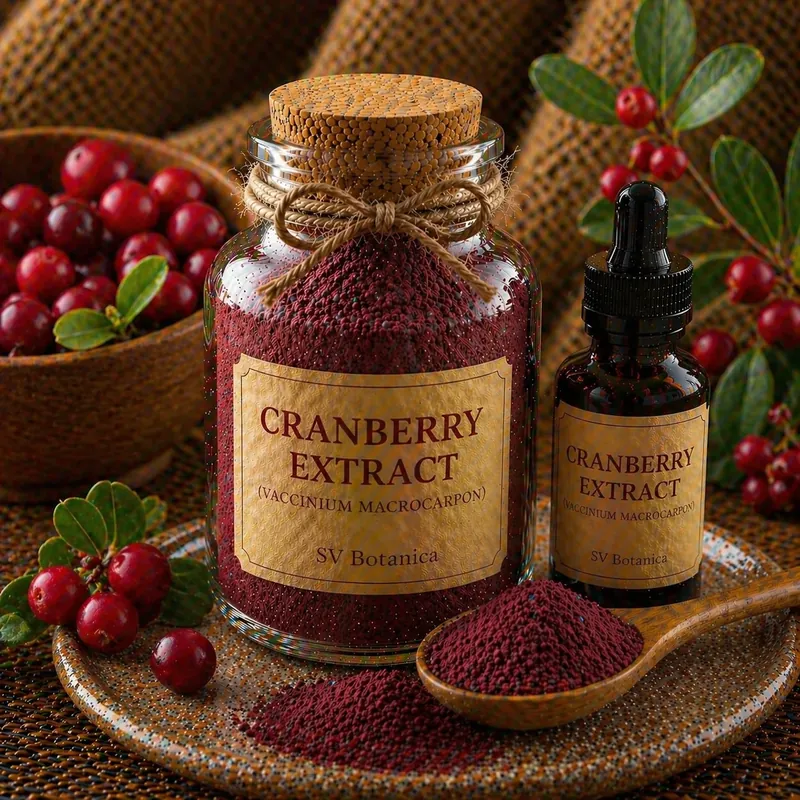
A deep-red cranberry fruit extract standardised for proanthocyanidins (PACs) by the BL-DMAC method — the assay convention behind the market's 36 mg-per-serving benchmark. Prepared from the fruit of Vaccinium macrocarpon for the clinically studied urinary-tract-health category, women's-wellness, antioxidant and functional-beverage formulators. CoA-backed, method-declared supply from India.
Standardised Grade
Vaccinium macrocarpon · PACs by BL-DMACA method-declared PAC active for the most claim-scrutinised category in supplements
Cranberry (Vaccinium macrocarpon Aiton) is the North American large cranberry of the Ericaceae family — a commercial fruit crop harvested from flooded bogs, and one of the most intensively researched botanicals in the supplement industry. The fruit carries a polyphenol profile that is genuinely unusual: its proanthocyanidins (PACs) are dominated by A-type interflavan linkages, a structural feature that most other food PAC sources — grape seed, cocoa, apple — largely lack. The research literature on cranberry centres on those A-type PACs and their bacterial anti-adhesion activity in laboratory models, which is the scientific rationale behind cranberry's position as the anchor botanical of the urinary-tract-health category.
SV Botanica supplies cranberry extract standardised for PAC content by the BL-DMAC method — the industry-consensus colorimetric assay run against a procyanidin A2 reference standard — with the method named on the Certificate of Analysis. That method declaration matters more for cranberry than for almost any other botanical: PAC figures produced by gravimetric methods or by DMAC run against other standards can read several times higher on the identical material, and an extract bought on an unnamed "PAC %" is an extract bought on a number that means nothing. The market's working dose benchmark of 36 mg PACs per serving (BL-DMAC) only functions if everyone is measuring the same way.
The extract is finished as a dark red to maroon, water-soluble fine powder milled to 60–80 mesh, with anthocyanin grades standardised at 10–25% for colour-and-antioxidant positioning, and a certified organic grade available. Cranberry anthocyanins are themselves distinctive — peonidin and cyanidin galactosides dominate, a fingerprint that separates authentic cranberry from cheaper berry blends in a way a bulk assay never can.
We supply supplement brands, women's-wellness and gummy manufacturers, functional-beverage formulators and pet-nutrition producers, with a batch-specific Certificate of Analysis on every shipment.
The polyphenols and acids that define the cranberry fruit
Oligomeric flavan-3-ols carrying at least one A-type interflavan linkage, with procyanidin A2 as the reference marker. The structural signature of cranberry and the basis of the BL-DMAC assay.
Peonidin-3-galactoside and cyanidin-3-galactoside dominate — an unusual galactoside-heavy profile that gives the deep red colour and serves as an authenticity fingerprint. Standardised at 10–25% in colour grades.
Quercetin and myricetin glycosides, present at higher levels in cranberry than in most common fruits, contributing to the antioxidant profile.
Benzoic, chlorogenic and other hydroxycinnamic acids; benzoic acid also underlies the fruit's natural resistance to spoilage.
Quinic, citric and malic acids — the sharply tart facet of the fruit, carried through into juice-derived extract fractions.
Ursolic acid and related triterpenes concentrated in the fruit peel, of interest in cosmetic and pomace-derived fractions.
Why formulators specify a BL-DMAC-standardised cranberry extract — the functional role of the markers
PAC numbers are only comparable when the method is named. A declared BL-DMAC figure against a procyanidin A2 standard lets formulators dose to the 36 mg-per-serving market convention and compare supplier offers on a like-for-like basis — impossible with gravimetric or unspecified assays.
Cranberry's A-type PACs are studied for their ability to interfere with bacterial adhesion in laboratory models — the research rationale that underpins the clinically studied urinary-tract-health category. A verified A-type profile is what separates genuine cranberry from B-type PAC sources such as grape seed.
The 10–25% anthocyanin grades deliver a concentrated galactoside-dominant anthocyanin fraction for antioxidant and polyphenol positioning, with a natural deep-red colour contribution that many berry formats use in place of added colourants.
Cranberry polyphenols are studied across vascular and metabolic wellness endpoints, giving formulators a second, growing positioning route for the same raw material alongside the core urinary category.
The standard grade dissolves in cold water, suiting sachets, drink mixes, wellness shots and RTD formats without the sedimentation issues that force other botanicals into a separate soluble grade.
A free-flowing 60–80 mesh powder with controlled moisture blends and disperses predictably, and the declared PAC and anthocyanin values let you hold a stable active load and colour across batches.
These are functional and physico-chemical properties of the actives; SV Botanica does not make medical or therapeutic claims for this ingredient.
The core specification for the BL-DMAC PAC grade, plus anthocyanin, whole-fruit and organic options
| Grade | Standardisation | Form | Best For | Solubility |
|---|---|---|---|---|
| Cranberry Extract PAC 5% Standard | PACs NLT 5% (BL-DMAC, procyanidin A2 standard) | Dark red to maroon fine powder, 60–80 mesh | Urinary-tract-health category supplements, capsules, tablets & gummies | Water-soluble |
| Cranberry Extract PAC 10% High-potency | PACs NLT 10% (BL-DMAC) | Dark red to maroon fine powder | Low-dose formats, softgels, 36 mg-PAC single-capsule formats | Water-soluble |
| Cranberry Anthocyanin 10–25% Colour & antioxidant | Anthocyanins 10–25% (UV / HPLC) | Deep maroon fine powder | Antioxidant blends, polyphenol formulas, natural colour contribution | Water-soluble |
| Cranberry Fruit Powder 25:1 / 50:1 Whole-fruit ratio | Native concentrate ratio (full-spectrum) | Red to maroon powder | Whole-fruit label claims, food & beverage formats | Water-soluble |
| Organic Cranberry Extract Certified organic | PACs declared per batch (BL-DMAC) | Dark red fine powder | Organic-certified supplement & food lines | Water-soluble |
The BL-DMAC PAC grade is our CoA-backed flagship, assayed against a procyanidin A2 reference standard with the method stated on the certificate. Anthocyanin standardisations, whole-fruit ratio powders, certified organic material, custom mesh and packaging can be quoted against buyer specification and order volume. PAC figures quoted by other laboratories on other methods are not comparable — see the specification note below. Every batch is released against a batch-specific Certificate of Analysis.
Cranberry Extract is bought in five forms. The standardised extract is the stocked item; granulated and dispersible grades are produced on request and raw botanical forms are sourced against a confirmed order.
| Form | What it is | Specification basis | Availability |
|---|---|---|---|
| Standardised extract powder | Vaccinium macrocarpon fruit extract, dried and milled | NLT 5% proanthocyanidins by BL-DMAC | Stocked |
| Granulated (direct-compression) | Extract granulated for tablet lines | Same marker, declared on the granule | On request |
| Water-dispersible / soluble | Extract in a dispersible matrix for beverages, gummies and sachets | Marker declared on the matrix basis; carrier named | On request |
| Fruit powder (non-extracted) | Dried Vaccinium macrocarpon fruit, milled to mesh | Botanical identity by TLC; heavy metals and microbial panel | On enquiry, subject to lot; phytosanitary certificate usually required |
| Whole dried fruit | Dried fruit, graded and cleaned | Identity, moisture, foreign matter | On enquiry, subject to lot |
A marker percentage without its assay method is not a specification; ask for the method and the plant part on every quotation. Read Cranberry Extract: A Complete Buyer's Guide, Cranberry PACs, BL-DMAC and the Assay That Divides the Market and Cranberry Extract Adulteration and How Authenticity Is Proven before comparing offers.
Full product specification for Cranberry Extract PAC (BL-DMAC). Values are specification limits, not batch results; a batch-specific CoA is issued per shipment.
| Parameter | Specification / Limit | Method |
|---|---|---|
| Botanical Source | Vaccinium macrocarpon Aiton | — |
| Plant Family | Ericaceae | — |
| Part Used | Fruit (berry) | — |
| Country of Origin | India (processed from North American fruit solids) | — |
| Appearance | Fine powder | Organoleptic |
| Colour | Dark red to maroon* | Organoleptic |
| Odour | Characteristic, fruity | Organoleptic |
| Taste | Characteristic, tart, astringent | Organoleptic |
| Identification | Corresponds to procyanidin A2 — positive | By HPLC / TLC |
| Solubility | Water-soluble | Visual |
| Loss on Drying (at 105°C, % w/w) | NMT 5.0 | IP-2014 |
| pH (1% w/v solution) | 2.5 – 4.5 | IP-2014 |
| Bulk Density (g/ml) | NLT 0.35 | IP-2014 |
| Particle Size (#60 mesh, % w/w) | NLT 95 | Sieve |
| Total Ash (% w/w) | NMT 5 | IP-2014 |
| Acid Insoluble Ash (% w/w) | NMT 1 | IP-2014 |
| Proanthocyanidins (PACs, % w/w) | NLT 5.0 (grade-dependent) | BL-DMAC (procyanidin A2) |
| Anthocyanins (% w/w) | 10 – 25 (anthocyanin grades) | By UV / HPLC |
| PAC Linkage Profile | A-type — confirmed | By HPLC / MALDI-TOF (on request) |
| Residual Solvent (Ethanol, ppm) | NMT 5,000 | By GC |
| Lead (ppm) | NMT 1.0 | ICP-MS |
| Arsenic (ppm) | NMT 1.0 | ICP-MS |
| Cadmium (ppm) | NMT 0.3 | ICP-MS |
| Mercury (ppm) | NMT 0.1 | ICP-MS |
| Heavy Metals (Total, ppm) | NMT 10 | ICP-MS |
| Pesticide Residues | Complies (EU MRL, on request) | GC-MS / LC-MS/MS |
| Ethylene Oxide (ETO) | Not treated — declaration provided | LC-MS/MS (on request) |
| Total Plate Count (cfu/g) | NMT 1,000 | USP <2021> |
| Yeast & Moulds / Fungi (cfu/g) | NMT 100 | USP <2021> |
| Escherichia coli | Absent | USP <2022> |
| Salmonella sp. | Absent | USP <2022> |
| Staphylococcus aureus | Absent | USP <2022> |
| Cultivation | Cultivated | Declaration |
| Kosher / Halal | Certified (on request) | Certification |
| Shelf Life | 24 months from date of manufacture, in original packed condition | — |
| Storage | Cool, dry place away from light and moisture, in tightly sealed containers | — |
*The product is of fruit origin; colour varies naturally with anthocyanin load and harvest. PACs are assayed by the BL-DMAC method against a procyanidin A2 reference standard — figures generated by gravimetric methods or by DMAC against other standards read substantially higher on identical material and are not comparable. The A-type linkage profile is confirmed on request by HPLC or MALDI-TOF. A current Certificate of Analysis and MSDS are issued with every batch. EU pesticide MRL and ethylene oxide reports are available on request.
From fruit to standardised extract — authenticated, tested, documented
Raw Material & Authentication: The extract is prepared from the fruit of cultivated Vaccinium macrocarpon. Because cranberry PAC extract is one of the most documented adulteration targets in the industry — peanut-skin and grape-seed extracts supply cheap B-type PACs that a bulk DMAC assay cannot distinguish from cranberry — identity is confirmed against procyanidin A2 and the A-type linkage profile is verified by HPLC, with MALDI-TOF confirmation available, before material is accepted.
Manufacturing & Testing: Cranberry Extract is manufactured at certified facilities in India. Each batch runs through a full QC battery — PACs by BL-DMAC, anthocyanins by UV/HPLC where the grade requires it, loss on drying, pH, bulk density, ash and acid-insoluble ash, mesh, residual solvent by GC, heavy metals by ICP-MS, pesticide residue screening, and a complete USP microbiological panel — before release.
Documentation: Every shipment is supplied against a batch-specific Certificate of Analysis with an MSDS, with the PAC assay method named on the certificate. Halal, Kosher and Organic certification are available. Country of Origin and export documentation are provided on request. For EU-bound shipments we supply pesticide screening against EU MRLs and a non-ETO declaration — see our guides on EU pesticide MRL compliance and EU import requirements for botanical extracts.
What backs every batch of Cranberry extract
Key information for global product registration and labelling
Used as a botanical active in supplement, gummy and beverage formats, the extract is supplied to a defined, method-declared PAC specification with full analytical documentation. Cranberry has extensive food-use history, which simplifies its regulatory position, and the 36 mg-PACs-per-day convention is an established market benchmark rather than an authorised claim — in the EU in particular no health claim for cranberry is currently authorised, so on-pack language is the buyer's responsibility and should be drafted against local regulation. Buyers remain responsible for determining suitability and for compliance with the relevant food-supplement regulations in their market. This product is not intended to diagnose, treat, cure or prevent any disease.
Vaccinium macrocarpon (cranberry) fruit extract is an established cosmetic ingredient with a recognised INCI listing, used in antioxidant, astringent and fruit-acid formats. As an active input it should be used within the buyer's finished-product safety assessment; SV Botanica supplies the material specification and CoA to support that dossier.
Supplied from India by SV Botanica — FSSAI Central Licence holder and an APEDA-registered exporter. Cranberry fruit is a North American crop; the extract is processed and finished at certified facilities in India from traceable imported fruit solids, which is standard practice across the global cranberry-ingredient trade and is declared transparently on documentation. The material is Kosher certified and shipped against a batch-specific Certificate of Analysis with export documentation available on request.
Deep-dive articles on cranberry extract for formulators, buyers, and brand owners
How to specify cranberry by PAC content and method, what a CoA must show, and the traps in the most assay-sensitive botanical.
TechnicalWhy the same extract can read 5% or 40% PACs depending on method, and how to write a specification that means something.
QualityPeanut-skin and grape-seed B-type spiking — the documented fraud — and the A-type profiling that catches it.
ApplicationsUrinary-category, women's-wellness, gummy, beverage and pet formats — and which cranberry grade fits each.
ProcurementA scored checklist for qualifying a cranberry extract supplier before you place a bulk order.
MarketWhere cranberry demand is growing across the US, EU and Asia, and which segments drive it.
Frequently co-formulated with Cranberry Extract in polyphenol, women's-wellness & antioxidant blends
Technical and commercial questions answered by our ingredients team
PAC-standardised by BL-DMAC, A-type verified, fully documented supply of Vaccinium macrocarpon fruit extract. Anthocyanin and organic grades available. Samples available for qualified buyers.
Supplied as a bulk ingredient for further manufacture. Buyers are responsible for compliance with the regulations of their destination market. This product is not intended to diagnose, treat, cure or prevent any disease.
We use cookies for analytics and to measure our advertising. Essential cookies are always on. Privacy policy