
Phaseolus vulgaris L. · Family: Fabaceae · Seed Extract
A functional seed extract standardised to alpha-amylase inhibitory activity of NLT 3,000 U/g — the phaseolamin material behind the clinically studied carb-management category. Prepared by aqueous extraction from the seed of Phaseolus vulgaris, with lectin (PHA) activity controlled and verified on every batch. CoA-backed supply from India for weight-management and body-composition formulators.
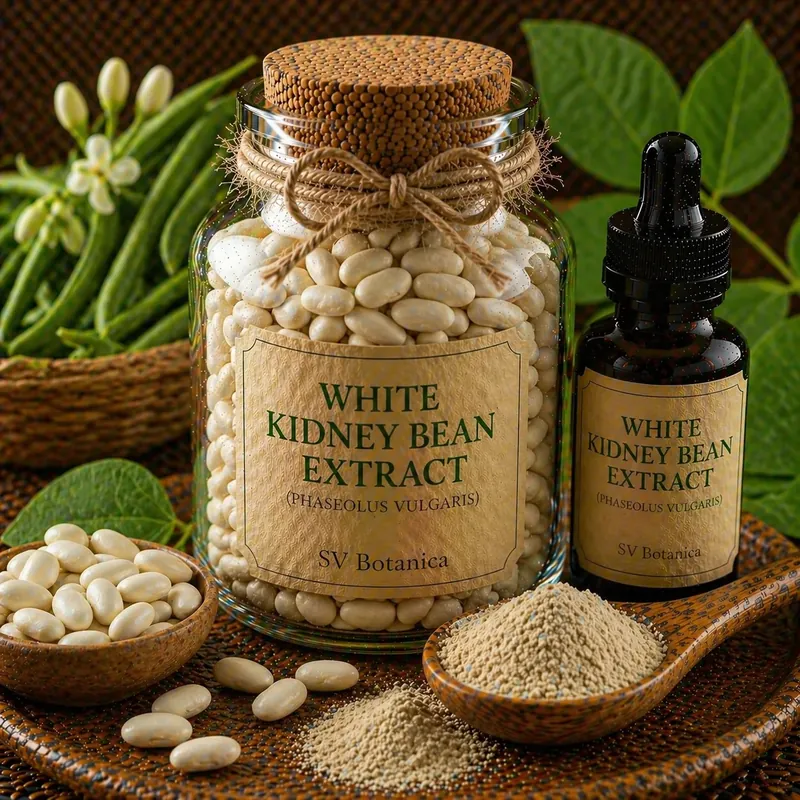
Activity-Standardised Grade
Phaseolus vulgaris · 3,000 U/gA functional protein active where the assay measures what the material does, not what it contains
White kidney bean (Phaseolus vulgaris L.) is an ordinary food legume with an extraordinary seed protein. Alongside its storage proteins, the seed carries a family of defensive glycoproteins that includes alpha-amylase inhibitor 1 (α-AI1) — trivially named phaseolamin since its isolation in 1975. The inhibitor binds pancreatic alpha-amylase, the enzyme that breaks dietary starch into absorbable sugars, and it is the reason white kidney bean extract anchors the clinically studied carb-management category. A concentrated, activity-standardised extract lets a formulator deliver that inhibitor at a defined functional strength rather than relying on variable bean flour.
White kidney bean extract is unusual among commercial botanicals in that it is a functional assay material. There is no marker percentage to chase: the value of the extract is what it does, measured as alpha-amylase inhibitory activity in units per gram. SV Botanica standardises this extract to not less than 3,000 U/g by in-vitro enzymatic assay, with a higher-activity grade and native 4:1 / 10:1 ratio grades available. A ratio number alone — 10:1, 20:1 — tells a buyer nothing about inhibitory strength, which is the central point every serious specification for this material must address.
Because raw kidney bean also contains phytohaemagglutinin (PHA) — the lectin that makes undercooked beans unsafe to eat — controlled processing matters more here than for most botanicals. Our extract is prepared by aqueous extraction with a validated thermal step that deactivates PHA while preserving inhibitor activity, and haemagglutinating activity is tested and reported on every batch CoA. Total protein (NLT 40% by Kjeldahl) serves as the identity and consistency check behind the activity figure.
We supply supplement brands, weight-management and body-composition formulators, functional-food manufacturers and contract manufacturers, with a batch-specific Certificate of Analysis on every shipment.
The seed proteins that define white kidney bean extract
The alpha-amylase inhibitor glycoprotein and the functional identity of the extract. Its inhibitory strength is standardised by in-vitro enzymatic assay and expressed in units per gram.
The inhibitor occurs as isoforms within the seed's lectin–arcelin–α-AI defence protein family; the activity assay integrates their combined effect, which is why activity, not a single-compound assay, is the correct basis.
The kidney bean lectin, present in raw seed and deactivated by our controlled thermal processing. Haemagglutinating activity is verified as not detectable on each batch — a specification line, and a processing-verification tool.
The major seed storage proteins that dominate the total protein figure. Their characteristic electrophoretic profile underpins species identity testing.
Soluble and insoluble bean fibre fractions carried through into ratio grades, relevant to formulators positioning in the fibre and satiety space.
Low-level phenolics, saponins and phytates native to the seed coat and cotyledon; minor in the white-seeded varieties used, which is one reason white kidney bean is preferred over coloured beans.
Why formulators specify an activity-standardised extract — the functional role of the material
The extract is defined by what it does: alpha-amylase inhibitory activity of NLT 3,000 U/g by enzymatic assay. That gives formulators a verifiable functional strength per batch — something no extract ratio or protein percentage can substitute for.
White kidney bean extract anchors the clinically studied carb-management and weight-management category, with a published human-trial literature behind the standardised material. Brands position on that research heritage; responsibility for finished-product claims sits with the brand in its market.
Raw kidney bean lectin must be deactivated by processing, and a haemagglutination line on the CoA proves it batch by batch. A supplier who cannot show that line has not closed the most important safety specification this material has.
A water-soluble, off-white to cream powder with a bland, faintly beany profile, milled to 40–80 mesh. It blends cleanly into capsules, tablets, stick packs and meal-replacement powders without dominating flavour or colour.
The source material is an everyday food legume, extracted with water rather than organic solvent. A non-GMO identity-preserved grade is available, and the ingredient declaration reads simply on a consumer label.
The default partner active in weight-management blends — routinely combined with garcinia, green coffee bean, gymnema and chromium, where its meal-time positioning complements thermogenic and satiety ingredients rather than duplicating them.
These are functional and physico-chemical properties of the actives; SV Botanica does not make medical or therapeutic claims for this ingredient.
The core specification for the flagship 3,000 U/g activity grade, plus high-activity, ratio and non-GMO options
| Grade | Standardisation | Form | Best For | Solubility |
|---|---|---|---|---|
| White Kidney Bean Extract 3,000 U/g Standard activity | α-Amylase inhibitory activity NLT 3,000 U/g (enzymatic assay) | Off-white to cream fine powder, 40–80 mesh | Carb-management & weight-management supplements, capsules & tablets | Water-soluble |
| White Kidney Bean Extract HA High-activity | α-Amylase inhibitory activity NLT 6,000 U/g (enzymatic assay) | Off-white to cream fine powder | Low-dose formats, compact multi-active blends | Water-soluble |
| White Kidney Bean Extract 4:1 Ratio | Native 4:1 concentrate; activity reported per batch | Cream fine powder | Fibre-forward blends, food applications | Water-soluble |
| White Kidney Bean Extract 10:1 Ratio | Native 10:1 concentrate; activity reported per batch | Cream fine powder | Traditional weight-management blends, cost-positioned formats | Water-soluble |
| White Kidney Bean Extract Non-GMO Identity-preserved | Non-GMO IP grade; activity per buyer specification | Off-white to cream fine powder | Clean-label & retail-audited brands, EU-destined formulations | Water-soluble |
The 3,000 U/g activity grade is our CoA-backed flagship, assayed by in-vitro enzymatic method with lectin (PHA) activity verified as not detectable on every batch. Because a ratio says nothing about inhibitory strength, ratio grades are always shipped with the measured activity reported per batch. Alternative activity levels, custom mesh and packaging can be quoted against buyer specification and order volume. Every batch is released against a batch-specific Certificate of Analysis.
White Kidney Bean Extract is bought in five forms. The standardised extract is the stocked item; granulated and dispersible grades are produced on request and raw botanical forms are sourced against a confirmed order.
| Form | What it is | Specification basis | Availability |
|---|---|---|---|
| Standardised extract powder | Phaseolus vulgaris seed extract, dried and milled | Α-amylase inhibitory activity NLT 3,000 U/g (enzymatic) | Stocked |
| Granulated (direct-compression) | Extract granulated for tablet lines | Same marker, declared on the granule | On request |
| Water-dispersible / soluble | Extract in a dispersible matrix for beverages, gummies and sachets | Marker declared on the matrix basis; carrier named | On request |
| Bean powder (non-extracted) | Phaseolus vulgaris beans, milled to mesh | Botanical identity by TLC; heavy metals and microbial panel | On enquiry, subject to lot; phytosanitary certificate usually required |
| Whole beans | Cleaned, graded whole beans | Moisture, foreign matter; pesticide screen | On enquiry, subject to lot |
A marker percentage without its assay method is not a specification; ask for the method and the plant part on every quotation. Read White Kidney Bean Extract: A Complete Buyer's Guide, Phaseolamin and How an Amylase-Inhibitor Extract Is Standardised and White Kidney Bean Extract Adulteration and How Authenticity Is Proven before comparing offers.
Full product specification for White Kidney Bean Extract 3,000 U/g. Values are specification limits, not batch results; a batch-specific CoA is issued per shipment.
| Parameter | Specification / Limit | Method |
|---|---|---|
| Botanical Source | Phaseolus vulgaris L. | — |
| Plant Family | Fabaceae (Leguminosae) | — |
| Part Used | Seed (white kidney bean) | — |
| Country of Origin | India | — |
| Appearance | Fine powder | Organoleptic |
| Colour | Off-white to cream* | Organoleptic |
| Odour | Characteristic, faint | Organoleptic |
| Taste | Bland, slightly beany | Organoleptic |
| Identification | Positive for Phaseolus vulgaris seed-protein profile | SDS-PAGE / HPTLC |
| Loss on Drying (at 105°C, % w/w) | NMT 5.0 | IP-2014 |
| pH (1% w/v solution) | 5 – 7 | IP-2014 |
| Bulk Density (g/ml) | NLT 0.35 | IP-2014 |
| Particle Size (#40 mesh, % w/w) | NLT 95 | Sieve |
| Total Ash (% w/w) | NMT 5 | IP-2014 |
| Acid Insoluble Ash (% w/w) | NMT 1 | IP-2014 |
| α-Amylase Inhibitory Activity (U/g) | NLT 3,000 | Enzymatic assay (in vitro) |
| Total Protein (% w/w, N × 6.25) | NLT 40 | Kjeldahl |
| Lectin Activity (PHA) | Not detectable | Haemagglutination assay |
| Extraction Solvent | Purified water — no organic solvent used | Declaration |
| Lead (ppm) | NMT 1.0 | ICP-MS |
| Arsenic (ppm) | NMT 1.0 | ICP-MS |
| Cadmium (ppm) | NMT 0.3 | ICP-MS |
| Mercury (ppm) | NMT 0.1 | ICP-MS |
| Total Heavy Metals (ppm) | NMT 10 | ICP-MS |
| Pesticide Residues | Complies (EU MRL, on request) | GC-MS / LC-MS/MS |
| Ethylene Oxide (ETO) | Not treated — declaration provided | LC-MS/MS (on request) |
| Aflatoxins B1 / Total (ppb) | NMT 2 / NMT 4 | HPLC-FLD |
| Total Plate Count (cfu/g) | NMT 1,000 | USP <2021> |
| Yeast & Moulds / Fungi (cfu/g) | NMT 100 | USP <2021> |
| Escherichia coli | Absent | USP <2022> |
| Salmonella sp. | Absent | USP <2022> |
| Staphylococcus aureus | Absent | USP <2022> |
| Cultivation | Cultivated | Declaration |
| Kosher / Halal | Certified (on request) | Certification |
| Shelf Life | 24 months from date of manufacture, in original packed condition | — |
| Storage | Cool, dry place below 25°C, away from light and moisture, in tightly sealed containers | — |
*The product is of herbal origin; slight colour variation may occur due to geographical and seasonal variation in the raw material. Alpha-amylase inhibitory activity is a functional (enzymatic) assay: the figure is method-dependent, and our assay conditions are stated on the CoA so results are comparable batch to batch. Because the active is a protein, activity is heat-sensitive — the storage condition is part of the specification. A current Certificate of Analysis and MSDS are issued with every batch. EU pesticide MRL and ethylene oxide reports are available on request.
From food-grade seed to activity-verified extract — processed, tested, documented
Raw Material & Authentication: The extract is prepared from cultivated food-grade white kidney bean (Phaseolus vulgaris L.) seed. Species identity is confirmed against the characteristic Phaseolus seed-protein profile, and total protein by Kjeldahl anchors batch-to-batch consistency. Because bean flour is cheap and visually identical to extract, alpha-amylase inhibitory activity is assayed on every batch before acceptance — a diluted lot simply fails the number.
Manufacturing & Testing: White Kidney Bean Extract is manufactured at certified facilities in India by aqueous extraction, with a validated thermal step that deactivates the native lectin (PHA) while preserving inhibitor activity. Each batch runs through a full QC battery — inhibitory activity by enzymatic assay, haemagglutination test for residual PHA, total protein, loss on drying, pH, bulk density, ash and acid-insoluble ash, mesh, heavy metals by ICP-MS, aflatoxins, pesticide residue screening, and a complete USP microbiological panel — before release.
Documentation: Every shipment is supplied against a batch-specific Certificate of Analysis with an MSDS. Halal, Kosher and Organic certification are available. Country of Origin and export documentation are provided on request. Because dried plant-derived materials are a recognised ethylene-oxide risk category for EU import, we supply a non-ETO declaration and can add LC-MS/MS testing — see our guides on EU pesticide MRL compliance and EU import requirements for botanical extracts.
What backs every batch of White Kidney Bean extract
Key information for global product registration and labelling
Used as a botanical active in weight-management and carb-management supplement formats, the extract is supplied to a defined inhibitory-activity specification with full analytical documentation. Phaseolus vulgaris is a staple food legume with long dietary history, which simplifies its regulatory position in most markets; in the EU, concentrated preparations should be checked against the Novel Food framework for the specific extract and use intended, and no authorised health claims exist for weight-related endpoints — finished-product claims are the buyer's responsibility in the buyer's market. This product is not intended to diagnose, treat, cure or prevent any disease.
As a water-extracted preparation of a familiar food legume, the extract fits meal-replacement, bar and functional-food development where an ingredient declaration must read cleanly. The active is a protein: it survives cold processing intact, but sustained heat denatures it, so process compatibility should be confirmed for heated formats. SV Botanica supplies the material specification, allergen statement (legume-derived; not among the major regulated allergen lists in most markets, but declaration practice varies) and CoA to support the buyer's dossier.
Supplied from India by SV Botanica — FSSAI Central Licence holder and an APEDA-registered exporter. India is one of the world's largest pulse producers, giving direct access to the raw-material base. The material is shipped against a batch-specific Certificate of Analysis, with non-ETO and non-GMO declarations and export documentation available on request.
Deep-dive articles on white kidney bean extract for formulators, buyers, and brand owners
How to specify an amylase-inhibitor extract by activity units, what a CoA must show, and why a ratio number alone is meaningless.
TechnicalWhat alpha-amylase inhibitory units actually measure, why they differ between laboratories, and how to write a comparable specification.
QualityRaw bean flour, undeclared carriers and unit inflation — and the activity, protein and PHA testing that catches them.
ApplicationsCarb-management formats, stacking partners, and the heat-sensitivity rules that come with a protein active.
ProcurementA scored checklist for qualifying a white kidney bean extract supplier before you place a bulk order.
MarketWhere the carb-management category is growing across the US, EU and Asia, and which segments drive it.
Frequently co-formulated with White Kidney Bean Extract in weight-management & body-composition blends
Technical and commercial questions answered by our ingredients team
Activity-standardised, lectin-controlled, fully documented supply of Phaseolus vulgaris seed extract. Alpha-amylase inhibitory activity NLT 3,000 U/g. Samples available for qualified buyers.
Supplied as a bulk ingredient for further manufacture. Buyers are responsible for compliance with the regulations of their destination market. This product is not intended to diagnose, treat, cure or prevent any disease.
We use cookies for analytics and to measure our advertising. Essential cookies are always on. Privacy policy