
Garcinia gummi-gutta (L.) Roxb. · Family: Clusiaceae · Fruit Rind Extract
A hydroxycitric acid extract from Malabar tamarind fruit rind, standardised to total HCA NLT 60% by HPLC with free acid and lactone reported separately. Prepared from the rind of Garcinia gummi-gutta for weight-management, satiety and sports formulators — supplied in defined salt forms rather than as an unspecified "HCA extract". CoA-backed, HPLC-authenticated supply from India.
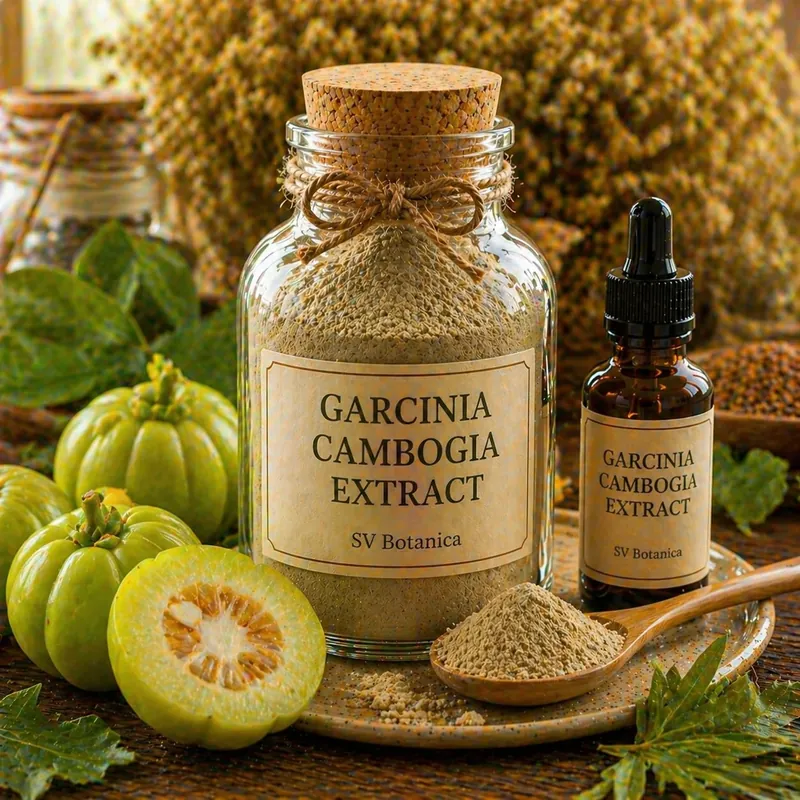
Standardised Grade
Garcinia gummi-gutta · 60% HCAAn acid, a salt and a lactone — the three variables that decide what you actually receive
Garcinia gummi-gutta (L.) Roxb. — still universally traded under its synonym Garcinia cambogia — is a small fruit tree of the Western Ghats, known in Malayalam as kudampuli and in English as Malabar tamarind. The dried rind has been used for centuries in Keralan cooking as a souring agent, particularly in fish curries, and that culinary history is the source of its functional constituent.
The active is (−)-hydroxycitric acid, or HCA — a fruit acid closely related to citric acid, which is what makes the rind sour. Nothing about buying garcinia is difficult once you accept one fact: free HCA is unstable. Left as the free acid it readily cyclises to its lactone, and the lactone is not considered the active form. An extract can therefore assay at a respectable "total HCA" while a substantial share of that total is lactone — which is the single most consequential and least discussed quality variable in this ingredient.
The industry's answer is to stabilise HCA as a salt. Calcium-potassium double salts and potassium-magnesium salts are the two commercial forms, and they behave completely differently: the salt form determines water solubility, bulk density, mineral load and how the material handles on a tabletting line. "HCA 60%" without a stated salt form is an incomplete specification, and buyers who do not ask end up with materials that are not comparable.
SV Botanica standardises to total HCA of not less than 60% by HPLC, with the salt form declared and free acid and lactone reported separately on every certificate. 50% and 70% grades and both salt families are available.
The acid, its salt forms and the degradation product that matters
The active fruit acid of the rind and the basis of the assay. The (−)-isomer is the naturally occurring and functionally relevant form.
The cyclisation product of free HCA, formed on drying and heating. Not considered the active form — which is why we report it separately rather than folding it into a single total.
The most widely used stabilised form. Good stability and handling, with a defined mineral contribution that must be accounted for in your formulation.
A more water-soluble salt family, generally preferred for beverages, sachets and effervescent formats where dissolution matters.
Characteristic polyisoprenylated benzophenones of Garcinia, present in the fruit and useful as species identity markers.
Citric and related fruit acids naturally accompany HCA in the rind and form part of the extract's characteristic chromatographic fingerprint.
Why formulators specify a salt-defined HCA extract — the functional role of the markers
Hydroxycitric acid is the compound the category is built on. HPLC assay gives a defensible number for label arithmetic — and, critically, resolves free acid from lactone rather than reporting a single total that conceals the difference.
Free HCA cyclises to its lactone under heat and time, and the lactone is not the active form. Reporting the split is the only way to know what you actually bought, and it is the quality variable most often left unstated in this ingredient.
Calcium-potassium and potassium-magnesium salts differ in solubility, density, mineral load and tabletting behaviour. We name the salt on every certificate, because "60% HCA" without it is an incomplete specification.
The potassium-magnesium family gives genuinely water-soluble material for beverages, sachets and effervescents, while calcium-potassium salts suit capsules and tablets where dissolution in the pack is not required.
Garcinia remains one of the most recognised botanicals in the weight-management category, giving brands a familiar hero ingredient with a long culinary history behind it.
A free-flowing powder passing ≥95% through a 40-mesh sieve with declared bulk density and mineral contribution, so tablet weight and disintegration behave predictably across batches.
These are functional and physico-chemical properties of the actives; SV Botanica does not make medical or therapeutic claims for this ingredient.
Salt form matters as much as assay percentage — specify both
| Grade | Standardisation | Form | Best For | Solubility |
|---|---|---|---|---|
| Garcinia Extract 50% HCA Entry | Total HCA NLT 50% (HPLC), salt form declared | Off-white to light tan fine powder | Cost-sensitive blends, multi-ingredient formulas | Salt-dependent |
| Garcinia Extract 60% HCA Ca-K Standard | Total HCA NLT 60% (HPLC), calcium-potassium salt | Off-white to light tan fine powder, ≥95% through 40 mesh | Capsules, tablets & weight-management supplements | Partially water-soluble |
| Garcinia Extract 60% HCA K-Mg Water-soluble | Total HCA NLT 60% (HPLC), potassium-magnesium salt | Off-white free-flowing powder | Beverages, sachets, effervescents & drink mixes | Water-soluble |
| Garcinia Extract 70% HCA High-potency | Total HCA NLT 70% (HPLC), salt form declared | Off-white to light tan fine powder | Low-dose formats, softgels, concentrated stacks | Salt-dependent |
| Garcinia Extract Ratio Full-spectrum | Native ratio, HCA reported | Light tan to brown fine powder | Traditional & Ayurvedic formats, culinary applications | Grade-dependent |
The 60% total HCA grade is our CoA-backed flagship, assayed by HPLC with free acid and lactone reported separately and the salt form named. Please state both the required HCA percentage and the salt family on your enquiry — the two salt forms are not interchangeable in a formulation and quoting one against a specification written for the other produces a material that will not behave as expected. Alternative assay strengths, custom mesh and packaging can be quoted against buyer specification and order volume.
Garcinia Cambogia Extract is bought in five forms. The standardised extract is the stocked item; granulated and dispersible grades are produced on request and raw botanical forms are sourced against a confirmed order.
| Form | What it is | Specification basis | Availability |
|---|---|---|---|
| Standardised extract powder | Garcinia gummi-gutta fruit rind extract, dried and milled | NLT 50% hydroxycitric acid (HPLC), salt form declared | Stocked |
| Granulated (direct-compression) | Extract granulated for tablet lines | Same marker, declared on the granule | On request |
| Water-dispersible / soluble | Extract in a dispersible matrix for beverages, gummies and sachets | Marker declared on the matrix basis; carrier named | On request |
| Fruit-rind powder (non-extracted) | Dried Garcinia gummi-gutta rind, milled | Botanical identity by TLC; heavy metals and microbial panel | On enquiry, subject to lot; phytosanitary certificate usually required |
| Dried rind pieces | Sun-dried rind, graded | Identity, moisture, foreign matter | On enquiry, subject to lot |
A marker percentage without its assay method is not a specification; ask for the method and the plant part on every quotation. Read Garcinia Cambogia Extract: A Complete Buyer's Guide, Hydroxycitric Acid, Lactone and How Garcinia Extract Is Standardised and Garcinia Extract Adulteration and How Authenticity Is Proven before comparing offers.
Full product specification for Garcinia Cambogia Extract 60% HCA (calcium-potassium salt). Values are specification limits, not batch results; a batch-specific CoA is issued per shipment.
| Parameter | Specification / Limit | Method |
|---|---|---|
| Botanical Source | Garcinia gummi-gutta (L.) Roxb. (syn. G. cambogia) | — |
| Plant Family | Clusiaceae (Guttiferae) | — |
| Part Used | Fruit rind | — |
| Country of Origin | India | — |
| Appearance | Fine powder | Organoleptic |
| Colour | Off-white to light tan* | Organoleptic |
| Odour | Characteristic | Organoleptic |
| Taste | Characteristic, acidic | Organoleptic |
| Identification | Corresponds to hydroxycitric acid — positive | By TLC / HPLC |
| Salt Form | Calcium-potassium (or potassium-magnesium) — declared per batch | Declaration |
| Total HCA (% w/w, dry basis) | NLT 60.0 | By HPLC |
| Free HCA (% w/w) | Reported per batch | By HPLC |
| HCA Lactone (% w/w) | Reported per batch — NMT 5 preferred | By HPLC |
| Loss on Drying (at 105°C, % w/w) | NMT 5.0 | IP-2014 |
| pH (1% w/v solution) | 3 – 5 | IP-2014 |
| Bulk Density (g/ml) | NLT 0.40 | IP-2014 |
| Particle Size (#40 mesh, % w/w) | NLT 95 | Sieve |
| Total Ash (% w/w) | Reported per batch (salt-form dependent) | IP-2014 |
| Acid Insoluble Ash (% w/w) | NMT 2 | IP-2014 |
| Calcium (% w/w) | Reported per batch | ICP-MS / Titration |
| Potassium (% w/w) | Reported per batch | ICP-MS / Flame |
| Residual Solvent (Ethanol, ppm) | NMT 5,000 | By GC |
| Lead (ppm) | NMT 1.0 | ICP-MS |
| Arsenic (ppm) | NMT 1.0 | ICP-MS |
| Cadmium (ppm) | NMT 0.3 | ICP-MS |
| Mercury (ppm) | NMT 0.1 | ICP-MS |
| Pesticide Residues | Complies (EU MRL, on request) | GC-MS / LC-MS/MS |
| Ethylene Oxide (ETO) | Not treated — declaration provided | LC-MS/MS (on request) |
| Total Plate Count (cfu/g) | NMT 1,000 | USP <2021> |
| Yeast & Moulds / Fungi (cfu/g) | NMT 100 | USP <2021> |
| Escherichia coli | Absent | USP <2022> |
| Salmonella sp. | Absent | USP <2022> |
| Staphylococcus aureus | Absent | USP <2022> |
| Cultivation | Cultivated / wild-collected (declared per batch) | Declaration |
| Kosher / Halal | Certified (on request) | Certification |
| Shelf Life | 36 months from date of manufacture, in original packed condition | — |
| Storage | Cool, dry place away from light and moisture, in tightly sealed containers | — |
*The product is of herbal origin; slight colour variation may occur due to geographical and seasonal variation in the raw material. Total HCA is assayed by HPLC with free acid and lactone reported separately — a total that folds the two together conceals how much of the assay is in the active form. Total ash and mineral content are salt-form dependent and are reported rather than limited, since a calcium-potassium salt legitimately carries a higher mineral load than a potassium-magnesium salt; formulators should account for that contribution in their own mineral declarations. A current Certificate of Analysis and MSDS are issued with every batch.
From fruit rind to salt-stabilised extract — authenticated, tested, documented
Raw Material & Authentication: The extract is prepared from the fruit rind of Garcinia gummi-gutta, largely from the Western Ghats where the species is native. Several Garcinia species contain HCA at differing levels, and some — G. indica (kokum) among them — are traded regionally for other purposes, so a correct-species declaration is part of every batch record. Identity is confirmed against hydroxycitric acid and species declared on the CoA.
Manufacturing & Testing: Garcinia Extract is manufactured at certified facilities in India. Each batch runs through a full QC battery — total HCA by HPLC with free acid and lactone resolved separately, salt form and mineral content confirmed, loss on drying, pH, bulk density, ash, mesh, residual solvent by GC, heavy metals by ICP-MS, pesticide residue screening, and a complete USP microbiological panel — before release. Because HCA cyclises under heat, process temperature control is a release-critical parameter rather than a process detail.
Documentation: Every shipment is supplied against a batch-specific Certificate of Analysis with an MSDS, stating the salt form and the free-acid-to-lactone split. Halal, Kosher and Organic certification are available. Country of Origin and export documentation are provided on request — see our guides on EU pesticide MRL compliance and EU import requirements for botanical extracts.
What backs every batch of Garcinia extract
Key information for global product registration and labelling
Supplied as a botanical active to a defined HCA specification with full analytical documentation. The fruit rind has extensive culinary history in South India, which supports its food-use position in most markets. Garcinia is a well-scrutinised weight-management ingredient and buyers should be aware that regulatory authorities in several jurisdictions have at various points reviewed products in this category — including finished products where garcinia was one component among several. Responsible practice is to formulate to established use levels, avoid disease claims, and hold complete ingredient documentation. Buyers remain responsible for determining suitability and for compliance in their market. This product is not intended to diagnose, treat, cure or prevent any disease.
HCA salts carry a real and non-trivial mineral load — a calcium-potassium salt contributes meaningful calcium and potassium at typical use levels. This must be accounted for in your finished-product nutrition declaration, and it can interact with potassium limits in some supplement frameworks. We report calcium and potassium content per batch so the arithmetic can be done on measured values rather than assumed ones. This is a frequently overlooked labelling detail.
Supplied from India by SV Botanica — FSSAI Central Licence holder and an APEDA-registered exporter. Garcinia gummi-gutta is native to the Western Ghats, giving direct access to the raw material base. The material is Kosher certified and shipped against a batch-specific Certificate of Analysis with export documentation available on request.
Deep-dive articles on garcinia cambogia extract for formulators, buyers, and brand owners
Why 'HCA 60%' is an incomplete specification, and the three variables that decide what you receive.
TechnicalFree acid versus lactone, salt-form chemistry, and why titration and HPLC disagree.
QualityCitric acid spiking, species substitution and salt-form misdeclaration — and the tests that catch them.
ApplicationsWeight-management, beverage and gummy formats — plus the mineral-load arithmetic nobody does.
ProcurementA scored checklist for qualifying a garcinia extract supplier before you place a bulk order.
MarketWhere garcinia demand sits after a decade of scrutiny, and what a credible position looks like now.
Frequently co-formulated with Garcinia Cambogia Extract in weight-management & metabolic blends
Technical and commercial questions answered by our ingredients team
HCA-standardised, lab-tested, fully documented supply of Garcinia gummi-gutta fruit rind extract. Total HCA NLT 60% by HPLC, salt form declared, lactone reported. Samples available for qualified buyers.
Supplied as a bulk ingredient for further manufacture. Buyers are responsible for compliance with the regulations of their destination market. This product is not intended to diagnose, treat, cure or prevent any disease.
We use cookies for analytics and to measure our advertising. Essential cookies are always on. Privacy policy