
Triticum aestivum L. · Family: Poaceae · Young-Grass Extract
A chlorophyll-bearing green powder prepared from the young aerial shoots of Triticum aestivum, harvested before jointing — before any grain forms. Supplied as whole-grass powder, cold-processed juice powder and 10:1 concentrated extract, with total chlorophyll declared by UV-Vis and gluten status verified by ELISA. CoA-backed supply from India for greens blends, wellness shots and superfood formulators.
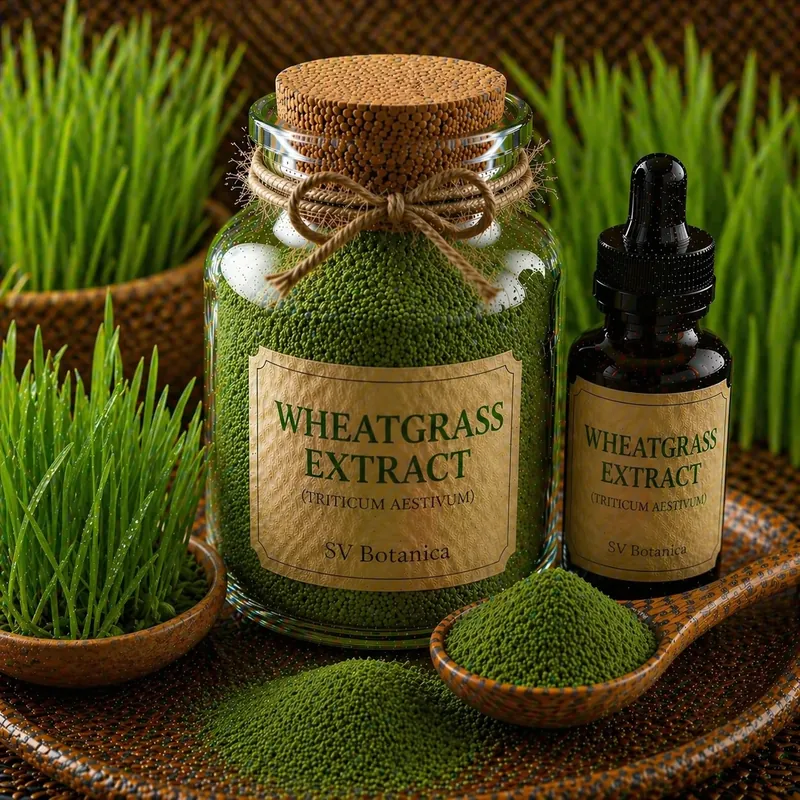
Cold-Processed Grade
Triticum aestivum · Chlorophyll DeclaredThe young grass of the wheat plant, harvested before the grain exists
Wheatgrass (Triticum aestivum L.) is the young grass of the common wheat plant, harvested at the pre-jointing stage — typically 7 to 14 days after germination, before the growing point rises and long before any grain forms. At that stage the plant is metabolically a leafy green vegetable, not a cereal: dense in chlorophyll, carotenoids, vitamins, minerals, amino acids and the flavonoids saponarin and lutonarin. It is that harvest window, not the species name, that defines the material.
"Wheatgrass" on a B2B quotation can mean three genuinely different products. Whole-grass powder is the dried young grass, milled — fibre and all. Juice powder is the cold-pressed juice, dried with the fibre left behind — a more concentrated, more soluble and more expensive material. A 10:1 concentrated extract compresses the profile further for low-dose formats. SV Botanica supplies all three, plus certified organic grades, with the format stated unambiguously on the specification and the CoA.
The unifying quality marker across formats is chlorophyll, declared by UV-Vis spectrophotometry at 0.5–2% depending on grade. Chlorophyll is more than a label number: it degrades to grey-brown pheophytin under heat and acid, so a bright green, high-chlorophyll powder is direct evidence of young harvest and gentle, low-temperature processing. Colour, here, genuinely tells a story.
Because the grass is cut before any grain develops, wheatgrass is inherently gluten-free — but gluten-free status rests on testing, not botany, since cross-contact with wheat kernels can occur at harvest. Every batch is verified below 20 ppm gluten by ELISA. We supply greens-blend and superfood manufacturers, beverage and wellness-shot brands, and supplement formulators worldwide, with a batch-specific Certificate of Analysis on every shipment.
The pigments, micronutrients and flavonoids of the pre-jointing grass
The dominant green pigments and the standardisation basis, declared by UV-Vis. Chlorophyll a leads, with b alongside in the roughly 3:1 ratio characteristic of healthy young grass.
Magnesium-free degradation products of chlorophyll, formed under heat and acid. Their level relative to intact chlorophyll is a direct readout of processing and storage history.
The characteristic flavone glycosides of young cereal grasses, contributing to the antioxidant profile alongside the pigments.
Provitamin A carotenoids, vitamin C, vitamin E and B-complex vitamins including folate — the micronutrient density that anchors wheatgrass's greens positioning.
Iron, calcium, magnesium, potassium and trace minerals, drawn up by a fast-growing young plant; magnesium also sits at the centre of every intact chlorophyll molecule.
A broad amino-acid spectrum — the young grass runs 20–25% protein on a dry basis — together with enzymes such as superoxide dismutase, preserved by low-temperature processing.
Why formulators specify a chlorophyll-declared young-grass material — the functional role of the markers
Chlorophyll at a declared percentage by UV-Vis turns "green powder" into a specification. It fixes the harvest stage and processing quality in a single verifiable number, and lets a greens-blend formulator hold colour and identity constant across batches.
Whole-grass powder, juice powder and 10:1 extract are different materials at different prices. Buying against a CoA that names the format and its chlorophyll figure protects a formulation from the most common wheatgrass sourcing error — paying juice-powder money for milled grass.
Pre-jointing harvest means no grain and hence no gluten in the plant itself — but cross-contact happens at harvest and handling. Batch-wise ELISA testing below 20 ppm gives brands the documentation a gluten-free label actually requires.
Vitamins, minerals, carotenoids, flavonoids and a 20–25% protein fraction in one botanical input — the nutritional density that lets a greens formula carry a broad-spectrum positioning from a short ingredient deck.
Wheatgrass anchors the established detox, alkalising and daily-greens category — a consumer positioning with juice-bar heritage and no education burden, which brands present as market positioning rather than an efficacy promise.
The cold-processed juice powder disperses readily and reconstitutes toward its fresh-juice character, suiting wellness shots, smoothie mixes and RTD greens — formats where a fibrous whole-grass powder would sediment and drink gritty.
These are functional and physico-chemical properties of the actives; SV Botanica does not make medical or therapeutic claims for this ingredient.
Three genuinely different materials — whole-grass powder, juice powder and concentrated extract — plus organic and high-chlorophyll options
| Grade | Standardisation | Form | Best For | Solubility |
|---|---|---|---|---|
| Wheatgrass Powder Whole grass | Total chlorophyll NLT 0.5% (UV-Vis) | Bright to dark green fine powder, 80–100 mesh | Greens powders, tablets & capsules, fibre-inclusive blends | Dispersible in water |
| Wheatgrass Juice Powder Cold-processed | Total chlorophyll NLT 1.0% (UV-Vis) | Bright green fine powder | Wellness shots, smoothie mixes, premium greens blends | Readily dispersible |
| Wheatgrass Extract 10:1 Concentrated | 10:1 concentrated extract (full-spectrum) | Dark green fine powder | Low-dose capsules & tablets, compact multi-green formulas | Dispersible in water |
| Organic Wheatgrass Powder Certified organic | Total chlorophyll NLT 0.5% (UV-Vis) | Bright to dark green fine powder | Certified-organic greens & superfood lines | Dispersible in water |
| Wheatgrass Extract 2% High-chlorophyll | Total chlorophyll NLT 2.0% (UV-Vis) | Dark green fine powder | Chlorophyll-forward formats, natural green colour contribution | Dispersible in water |
The format — whole-grass powder, cold-processed juice powder or 10:1 concentrated extract — is stated explicitly on every specification and CoA, with total chlorophyll declared by UV-Vis on each. Certified organic material (NPOP / EU / NOP), custom chlorophyll minimums, custom mesh and packaging can be quoted against buyer specification and order volume. Every batch is released against a batch-specific Certificate of Analysis.
Wheatgrass Extract is bought in five forms. The standardised extract is the stocked item; granulated and dispersible grades are produced on request and raw botanical forms are sourced against a confirmed order.
| Form | What it is | Specification basis | Availability |
|---|---|---|---|
| Spray-dried powder | Triticum aestivum young aerial parts extract, dried and milled | Whole-grass powder, total chlorophyll NLT 0.5% | Stocked |
| Granulated (direct-compression) | Extract granulated for tablet lines | Same marker, declared on the granule | On request |
| Water-dispersible / soluble | Extract in a dispersible matrix for beverages, gummies and sachets | Marker declared on the matrix basis; carrier named | On request |
| Organic-certified powder | Same product from certified-organic cultivation | Transaction certificate per lot | On request |
| Tablets / compressed forms | Powder compressed without excipient | Weight per tablet; friability | On enquiry via contract fillers, quoted separately |
A marker percentage without its assay method is not a specification; ask for the method and the plant part on every quotation. Read Wheatgrass Extract: A Complete Buyer's Guide, Chlorophyll and How Wheatgrass Is Standardised and Wheatgrass Adulteration and How Authenticity Is Proven before comparing offers.
Full product specification for Wheatgrass Powder (whole grass). Values are specification limits, not batch results; a batch-specific CoA is issued per shipment.
| Parameter | Specification / Limit | Method |
|---|---|---|
| Botanical Source | Triticum aestivum L. | — |
| Plant Family | Poaceae (Gramineae) | — |
| Part Used | Young aerial shoot (leaf), harvested pre-jointing | — |
| Country of Origin | India | — |
| Appearance | Fine powder | Organoleptic |
| Colour | Bright to dark green* | Organoleptic |
| Odour | Characteristic, fresh grassy | Organoleptic |
| Taste | Characteristic, grassy, mildly sweet | Organoleptic |
| Identification | Chlorophyll a & b profile conforms — positive | By UV-Vis / TLC |
| Loss on Drying (at 105°C, % w/w) | NMT 7.0 | IP-2014 |
| pH (1% w/v solution) | 6 – 8 | IP-2014 |
| Bulk Density (g/ml) | NLT 0.35 | IP-2014 |
| Particle Size (#80 mesh, % w/w) | NLT 95 | Sieve |
| Total Ash (% w/w) | NMT 12 | IP-2014 |
| Acid Insoluble Ash (% w/w) | NMT 2 | IP-2014 |
| Total Chlorophyll (% w/w, dry basis) | NLT 0.5 | By UV-Vis |
| Protein (% w/w) | Reported per batch | Kjeldahl |
| Gluten (ppm) | NMT 20 — gluten-free | ELISA (R5) |
| Residual Solvent | None — aqueous / mechanical processing | Declaration |
| Lead (ppm) | NMT 1.0 | ICP-MS |
| Arsenic (ppm) | NMT 1.0 | ICP-MS |
| Cadmium (ppm) | NMT 0.3 | ICP-MS |
| Mercury (ppm) | NMT 0.1 | ICP-MS |
| Heavy Metals, Total (ppm) | NMT 10 | ICP-MS |
| Pesticide Residues | Complies (EU MRL, on request) | GC-MS / LC-MS/MS |
| Ethylene Oxide (ETO) | Not treated — declaration provided | LC-MS/MS (on request) |
| Aflatoxins B1 / Total (ppb) | NMT 2 / NMT 4 | HPLC-FLD |
| Total Plate Count (cfu/g) | NMT 10,000 | USP <2021> |
| Yeast & Moulds / Fungi (cfu/g) | NMT 100 | USP <2021> |
| Escherichia coli | Absent | USP <2022> |
| Salmonella sp. | Absent | USP <2022> |
| Staphylococcus aureus | Absent | USP <2022> |
| Cultivation | Cultivated | Declaration |
| Kosher / Halal | Certified (on request) | Certification |
| Shelf Life | 24–36 months from date of manufacture (grade-dependent), in original packed condition | — |
| Storage | Cool, dry place away from light and moisture, in tightly sealed containers | — |
*The product is of herbal origin; colour varies with harvest stage, season and grade — juice powder and the 2% grade run brighter and carry higher chlorophyll minimums. Chlorophyll degrades to pheophytin under heat, acid and light, so colour and assay together document processing history. Gluten is verified batch-wise by R5 ELISA below 20 ppm. A current Certificate of Analysis and MSDS are issued with every batch; EU pesticide MRL and ethylene oxide reports are available on request.
From pre-jointing harvest to finished powder — authenticated, tested, documented
Raw Material & Authentication: The material is prepared from cultivated Triticum aestivum grass cut at the pre-jointing stage, when chlorophyll and micronutrient density peak. Harvest stage is verified the way it can be — through the chlorophyll assay itself, since mature or over-aged grass cannot reach a young-grass chlorophyll figure. Identity is confirmed against the characteristic chlorophyll a & b profile by UV-Vis, and copper is monitored by ICP-MS because copper-chlorophyllin colour spiking is the known adulteration route for green powders.
Manufacturing & Testing: Wheatgrass grades are manufactured at certified facilities in India under low-temperature, aqueous and mechanical processing — no extraction solvents. Each batch runs through a full QC battery — total chlorophyll by UV-Vis, gluten by R5 ELISA, loss on drying, pH, bulk density, ash and acid-insoluble ash, mesh, heavy metals by ICP-MS, aflatoxins, pesticide residue screening and a complete USP microbiological panel — before release.
Documentation: Every shipment is supplied against a batch-specific Certificate of Analysis with an MSDS. Halal, Kosher and Organic certification are available. Because dried plant materials attract ethylene-oxide scrutiny at EU import, we supply a non-ETO declaration and can add LC-MS/MS testing — see our guides on EU pesticide MRL compliance and EU import requirements for botanical extracts.
What backs every batch of Wheatgrass extract
Key information for global product registration and labelling
Used as a greens-category botanical in supplement, functional-food and beverage formats, wheatgrass is supplied to a declared chlorophyll specification with full analytical documentation. Young cereal grasses have long-standing food use across major markets, which keeps the regulatory position of conventional powders and juice powders straightforward. Gluten-free labelling claims must rest on batch testing — our ELISA documentation supports them — and buyers remain responsible for compliance with the food-supplement regulations of their market. This product is not intended to diagnose, treat, cure or prevent any disease.
Wheatgrass and wheat-derived leaf preparations are established cosmetic ingredients with recognised INCI listings, used in chlorophyll-rich, green-positioned skincare and haircare. As an active input the material should be used within the buyer's finished-product safety assessment; SV Botanica supplies the material specification and CoA to support that dossier. Note that cosmetic-grade gluten documentation is increasingly requested for leave-on formats, and our ELISA reports serve that purpose.
Supplied from India by SV Botanica — FSSAI Central Licence holder and an APEDA-registered exporter. India's wheat belt provides year-round access to controlled young-grass cultivation, and its extract industry provides the low-temperature drying capability that juice powder requires. Material ships against a batch-specific Certificate of Analysis with export documentation available on request.
Deep-dive articles on wheatgrass for formulators, buyers, and brand owners
Whole-grass powder, juice powder and 10:1 extract are different materials at different prices — how to specify the right one.
TechnicalWhat total chlorophyll means, how UV-Vis assay works, and why pheophytin makes colour a processing record.
QualityMature grass, cheaper grasses, undeclared carriers and copper-chlorophyllin dye — and the testing that catches each.
ApplicationsGreens powders, shots, capsules and gummies — which wheatgrass format fits each, and where stability bites.
ProcurementA scored checklist for qualifying a wheatgrass supplier before you place a bulk order.
MarketThe greens-blend and juice-bar demand engine, regional regulatory differences, and what they mean for buyers.
Frequently co-formulated with Wheatgrass in greens, superfood & daily-wellness blends
Technical and commercial questions answered by our ingredients team
Chlorophyll-declared, gluten-tested, fully documented supply of Triticum aestivum young-grass powder, juice powder and 10:1 extract. Samples available for qualified buyers.
Supplied as a bulk ingredient for further manufacture. Buyers are responsible for compliance with the regulations of their destination market. This product is not intended to diagnose, treat, cure or prevent any disease.
We use cookies for analytics and to measure our advertising. Essential cookies are always on. Privacy policy