
Terminalia chebula Retz. · Family: Combretaceae · Fruit (Pericarp) Extract
An astringent, polyphenol-dense haritaki fruit extract standardised to total tannins 30–45% by UV, with the chebulinic and chebulagic acid profile confirmed by HPLC. Prepared from the fruit pericarp of Terminalia chebula — the chebulic myrobalan of the classical Triphala trio — for digestive-wellness, gentle-cleanse, oral-care and Ayurvedic Rasayana formulators. CoA-backed, HPLC-profiled supply from India.
Standardised Grade
Terminalia chebula · 30–45% TanninsThe chebulic myrobalan — Ayurveda's most revered fruit, standardised for its hydrolysable tannins
Haritaki (Terminalia chebula Retz.) is arguably the single most esteemed botanical in Ayurveda — titled the "King of Herbs" in the classical texts and one of the three fruits of Triphala, alongside amla and bibhitaki. The tree is a large deciduous member of the Combretaceae, growing across India and South-East Asia; its dried fruit, traded historically as the chebulic or black myrobalan, was once a global commodity in its own right — shipped west for leather tanning and iron-gall inks, a commercial testament to just how tannin-dense this fruit is.
That tannin load is the analytical identity of the extract. Haritaki's polyphenols are hydrolysable tannins — dominated by chebulinic acid and chebulagic acid, the chebulic-acid ellagitannins that occur in very few botanicals other than T. chebula, together with corilagin, gallic acid and ellagic acid. SV Botanica standardises the extract to total tannins of 30–45% by UV spectrophotometry, and confirms the chebulinic and chebulagic acid profile by HPLC — so every batch is defined both by its polyphenol load and by a species-specific fingerprint, not by a bare extract ratio.
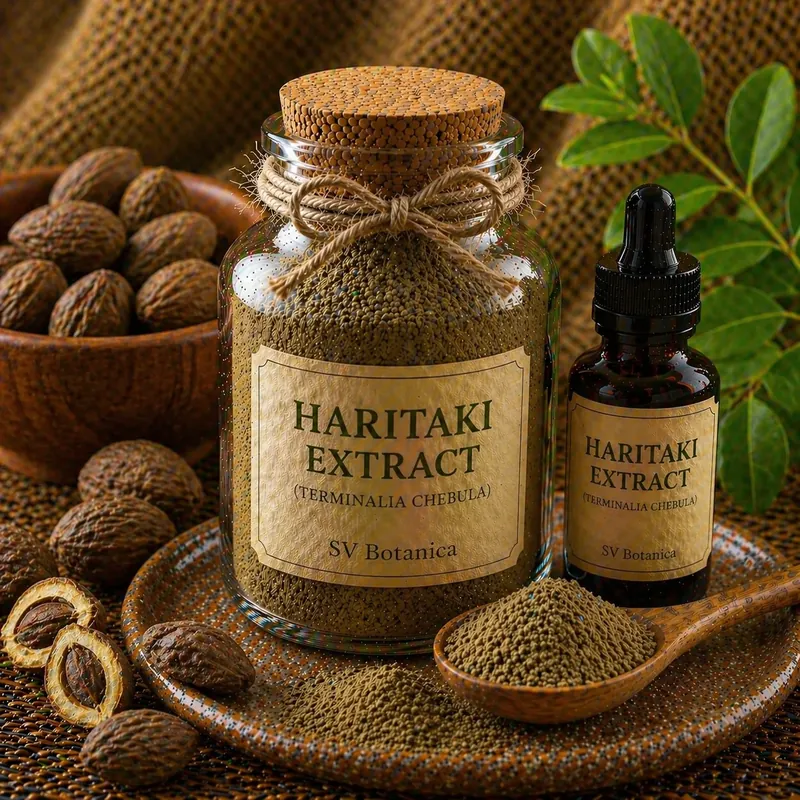
The extract is finished as a free-flowing, brown to dark brown powder in the 40–80 mesh range, genuinely water-soluble, prepared from the fruit pericarp with the stone excluded. Because the tannin content of the fruit varies with maturity, region and season, the assay is specified as a band rather than a single inflated number — buyers who want a fixed minimum can specify 30% or 40% grades, and a certified organic grade and native-ratio full-spectrum grades are available.
We supply supplement brands, Triphala and Ayurvedic manufacturers, oral-care and functional-food formulators, with a batch-specific Certificate of Analysis on every shipment.
The hydrolysable tannins that define the chebulic myrobalan
The signature ellagitannin of Terminalia chebula — an ester of chebulic acid found in very few other botanicals, which makes it the definitive identity marker on an HPLC profile and the compound this extract is profiled for.
The companion chebulic ellagitannin, co-occurring with chebulinic acid in a characteristic proportion. The pair together form the fingerprint that separates genuine haritaki from a generic tannin powder.
Ellagitannins shared with amla and pomegranate that contribute substantially to the total-tannin figure and to the extract's radical-scavenging capacity.
The hydrolysis end-products of the tannin fraction. Modest native levels are normal; elevated levels flag thermal or moisture-driven degradation and are a useful ageing diagnostic on a CoA.
Present at trace levels in the fruit and historically associated with haritaki's gut-motility tradition — orders of magnitude below the sennoside load of a stimulant-laxative botanical.
Chebulosides, arjungenin and a mucilaginous polysaccharide fraction that round out the full-spectrum profile and contribute to the fruit's traditional Rasayana identity.
Why formulators specify a tannin-standardised haritaki extract — the functional role of the markers
A declared 30–45% total-tannin band by UV, anchored by an HPLC chebulinic-acid profile, lets formulators build digestive-wellness and Rasayana products on a verifiable polyphenol load rather than an unqualified ratio claim or a single suspiciously round number.
Haritaki anchors the gentle end of the digestive-regularity category — the heritage botanical positioned against harsher stimulant actives — giving brands a recognised hero ingredient for gut-comfort, regularity and post-meal formats.
One of the three Triphala fruits and titled the "King of Herbs" in the Ayurvedic classics, haritaki carries genuine brand equity into Rasayana, healthy-ageing and traditional-format lines — heritage that markets itself without invented claims.
Hydrolysable-tannin-dense extracts deliver high in-vitro radical-scavenging capacity, useful where a formulation is positioned on polyphenol content or paired with vitamin-C-rich amla in antioxidant and Triphala blends.
A genuinely water-soluble extract suits capsules, tablets, gummies, teas and traditional churna formats alike — with astringency and tannin-protein binding the main sensory variables to design around in liquid formats.
A free-flowing 40–80 mesh powder with moisture controlled to NMT 5% blends and disperses predictably, and the declared tannin band holds colour and astringency within a stable sensory window batch to batch.
These are functional and physico-chemical properties of the actives; SV Botanica does not make medical or therapeutic claims for this ingredient.
The core specification for the tannin-standardised grade, plus profiled, full-spectrum and organic options
| Grade | Standardisation | Form | Best For | Solubility |
|---|---|---|---|---|
| Haritaki Extract 30% Tannins Standard | Total tannins NLT 30% (UV) | Brown to dark brown fine powder, 40–80 mesh | Digestive-wellness supplements, Triphala & Ayurvedic blends, capsules & tablets | Water-soluble |
| Haritaki Extract 40% Tannins High-tannin | Total tannins NLT 40% (UV) | Dark brown fine powder | Low-dose formats, oral-care & astringent applications, concentrated blends | Water-soluble |
| Haritaki Extract Profiled Marker-profiled | Chebulinic & chebulagic acid reported by HPLC | Brown to dark brown fine powder | Brands specifying a marker profile, regulated-market supply | Water-soluble |
| Haritaki Extract Ratio Full-spectrum | Native 4:1 / 10:1 ratio (full-spectrum) | Brown fine powder | Traditional & Ayurvedic formats, Rasayana blends | Water-soluble |
| Organic Haritaki Extract Organic | Certified organic; tannin band per buyer specification | Brown to dark brown fine powder | Organic-certified supplement & food lines | Water-soluble |
The 30–45% total tannins grade is our CoA-backed flagship, assayed by UV with identity confirmed by TLC and the chebulinic and chebulagic acid profile reported by HPLC on request. Fixed-minimum grades, native-ratio (full-spectrum) extracts, certified organic material, custom mesh and packaging can be quoted against buyer specification and order volume. Every batch is released against a batch-specific Certificate of Analysis.
Haritaki Extract is bought in five forms. The standardised extract is the stocked item; granulated and dispersible grades are produced on request and raw botanical forms are sourced against a confirmed order.
| Form | What it is | Specification basis | Availability |
|---|---|---|---|
| Standardised extract powder | Terminalia chebula fruit pericarp extract, dried and milled | NLT 30% tannins (UV) | Stocked |
| Granulated (direct-compression) | Extract granulated for tablet lines | Same marker, declared on the granule | On request |
| Water-dispersible / soluble | Extract in a dispersible matrix for beverages, gummies and sachets | Marker declared on the matrix basis; carrier named | On request |
| Fruit powder (non-extracted) | Dried Terminalia chebula fruit pericarp, milled to mesh | Botanical identity by TLC; heavy metals and microbial panel | On enquiry, subject to lot; phytosanitary certificate usually required |
| Whole dried fruit | Dried fruit, graded and cleaned | Identity, moisture, foreign matter | On enquiry, subject to lot |
A marker percentage without its assay method is not a specification; ask for the method and the plant part on every quotation. Read Haritaki Extract: A Complete Buyer's Guide, Haritaki Tannins, Chebulinic Acid and How the Extract Is Standardised and Haritaki Extract Adulteration and How Authenticity Is Proven before comparing offers.
Full product specification for Haritaki Dry Extract. Values are specification limits, not batch results; a batch-specific CoA is issued per shipment.
| Parameter | Specification / Limit | Method |
|---|---|---|
| Botanical Source | Terminalia chebula Retz. | — |
| Plant Family | Combretaceae | — |
| Part Used | Fruit (pericarp; stone excluded) | — |
| Country of Origin | India | — |
| Appearance | Fine powder | Organoleptic |
| Colour | Brown to dark brown* | Organoleptic |
| Odour | Characteristic, faint | Organoleptic |
| Taste | Astringent, slightly bitter and sour | Organoleptic |
| Identification | Corresponds to chebulinic & gallic acid — positive | By TLC |
| Loss on Drying (at 105°C, % w/w) | NMT 5.0 | IP-2014 |
| pH (1% w/v solution) | 3 – 5 | IP-2014 |
| Bulk Density (g/ml) | NLT 0.40 | IP-2014 |
| Particle Size (#40 mesh, % w/w) | NLT 95; 40–80 mesh grades available | Sieve |
| Solubility | Water-soluble | In-house |
| Total Ash (% w/w) | NMT 8 | IP-2014 |
| Acid Insoluble Ash (% w/w) | NMT 2 | IP-2014 |
| Total Tannins (% w/w, dry basis) | 30 – 45 | By UV |
| Chebulinic Acid (% w/w) | Reported per batch | By HPLC |
| Chebulagic Acid (% w/w) | Reported per batch | By HPLC |
| Residual Solvent (Ethanol, ppm) | NMT 5,000 | By GC |
| Lead (ppm) | NMT 1.0 | ICP-MS |
| Arsenic (ppm) | NMT 1.0 | ICP-MS |
| Cadmium (ppm) | NMT 0.3 | ICP-MS |
| Mercury (ppm) | NMT 0.1 | ICP-MS |
| Pesticide Residues | Complies (EU MRL, on request) | GC-MS / LC-MS/MS |
| Ethylene Oxide (ETO) | Not treated — declaration provided | LC-MS/MS (on request) |
| Aflatoxins B1 / Total (ppb) | NMT 2 / NMT 4 | HPLC-FLD |
| Total Plate Count (cfu/g) | NMT 1,000 | USP <2021> |
| Yeast & Moulds / Fungi (cfu/g) | NMT 100 | USP <2021> |
| Escherichia coli | Absent | USP <2022> |
| Salmonella sp. | Absent | USP <2022> |
| Staphylococcus aureus | Absent | USP <2022> |
| Cultivation | Cultivated & wild-collected — declared per lot | Declaration |
| Kosher / Halal | Certified (on request) | Certification |
| Shelf Life | 36 months from date of manufacture, in original packed condition | — |
| Storage | Cool, dry place away from light and moisture, in tightly sealed containers | — |
*The product is of herbal origin; slight colour variation may occur due to geographical and seasonal variation in the raw material. Total tannins are assayed by UV spectrophotometry and identity is confirmed by TLC; the chebulinic and chebulagic acid profile is reported per batch by HPLC on request. A current Certificate of Analysis and MSDS are issued with every batch. EU pesticide MRL and ethylene oxide reports are available on request.
From myrobalan fruit to standardised extract — authenticated, tested, documented
Raw Material & Authentication: The extract is prepared from the fruit pericarp of Terminalia chebula, sourced from cultivated and traceable wild-collected material, with the stone excluded before extraction. Because "myrobalan" is a trade name that blurs several Terminalia species — T. bellirica (bibhitaki) chief among them — identity is confirmed by TLC against chebulinic and gallic acid, and the chebulinic-acid HPLC profile is checked before any lot is accepted: chebulinic acid occurs in T. chebula and essentially nowhere else in the supply chain.
Manufacturing & Testing: Haritaki Dry Extract is manufactured at certified facilities in India. Each batch runs through a full QC battery — total tannins by UV, chebulinic and chebulagic acid by HPLC, loss on drying, pH, bulk density, ash and acid-insoluble ash, mesh, residual solvent by GC, heavy metals by ICP-MS, aflatoxins by HPLC-FLD, pesticide residue screening, and a complete USP microbiological panel — before release.
Documentation: Every shipment is supplied against a batch-specific Certificate of Analysis with an MSDS. Halal, Kosher and Organic certification are available. Country of Origin and export documentation are provided on request. Because dried fruit-derived botanicals are a recognised ethylene-oxide risk category, we supply a non-ETO declaration and can add LC-MS/MS testing — see our guides on EU pesticide MRL compliance and EU import requirements for botanical extracts.
What backs every batch of Haritaki extract
Key information for global product registration and labelling
Used as a botanical active in supplement, functional-food and traditional formats, the extract is supplied to a defined total-tannin specification with full analytical documentation. Haritaki is a classical Ayurvedic fruit with a long history of traditional use and is listed in the Ayurvedic Pharmacopoeia of India; conventional extracts trade on that established position, though buyers formulating unusually concentrated preparations for the EU should confirm the Novel Food position before committing. Buyers remain responsible for determining suitability and for compliance with the relevant food-supplement regulations in their market. This product is not intended to diagnose, treat, cure or prevent any disease.
Terminalia chebula fruit extract is an established cosmetic ingredient with a recognised INCI listing, used in astringent, toning and antioxidant formats and in Ayurvedic hair-care traditions. As an active input it should be used within the buyer's finished-product safety assessment; SV Botanica supplies the material specification and CoA to support that dossier.
Supplied from India by SV Botanica — FSSAI Central Licence holder and an APEDA-registered exporter. India is the natural home of the chebulic myrobalan and the centre of the world's Triphala manufacturing, giving direct access to the raw material base. The material is shipped against a batch-specific Certificate of Analysis with Kosher and Halal certification and export documentation available on request.
Deep-dive articles on haritaki extract for formulators, buyers, and brand owners
How to specify haritaki by tannin band and HPLC profile, what a CoA must show, and the myrobalan traps.
TechnicalWhat total tannins by UV really measures, why the number invites inflation, and how the HPLC profile anchors it.
QualityTannic-acid spiking, myrobalan species confusion and milled-in stone — and the testing that catches them.
ApplicationsDigestive-regularity, Triphala, Rasayana and oral-care formats — and which haritaki grade fits each.
ProcurementA scored checklist for qualifying a haritaki extract supplier before you place a bulk order.
MarketWhere haritaki demand is growing across gut health, Triphala and oral care, and what drives supply.
Frequently co-formulated with Haritaki Extract in digestive, Triphala & Rasayana blends
Technical and commercial questions answered by our ingredients team
Tannin-standardised, lab-tested, fully documented supply of Terminalia chebula fruit extract. Total tannins 30–45% by UV, chebulinic acid profiled by HPLC. Samples available for qualified buyers.
Supplied as a bulk ingredient for further manufacture. Buyers are responsible for compliance with the regulations of their destination market. This product is not intended to diagnose, treat, cure or prevent any disease.
We use cookies for analytics and to measure our advertising. Essential cookies are always on. Privacy policy