
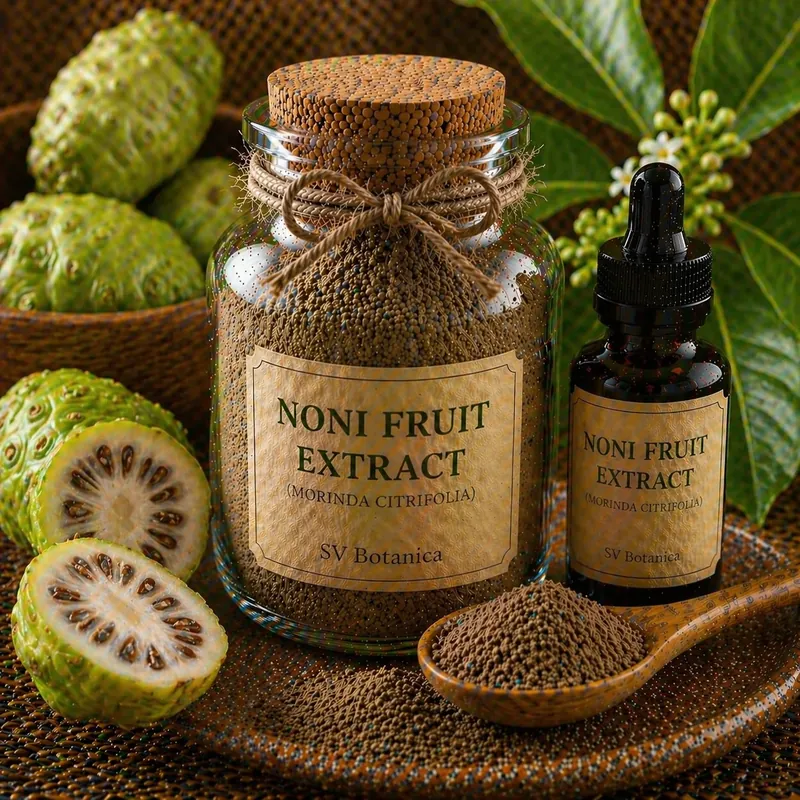
Morinda citrifolia L. · Family: Rubiaceae · Fruit Extract & Juice Powder
Noni is unusual among botanicals in having a genuine EU novel food authorisation — and that authorisation attaches to defined preparations, not to "noni" in general. So the first question on this ingredient is which preparation you are buying, and we declare it. Iridoid markers reported by HPLC, potassium content available, and the regulatory position set out rather than glossed. CoA-backed supply from India.
Preparation Declared
Iridoid-ProfiledAn ingredient where the preparation is a regulatory fact
Noni (Morinda citrifolia) is a small tropical tree of the Rubiaceae, native across the Pacific and Southeast Asia and cultivated widely in India, whose pale knobbly fruit has long traditional use in Polynesian and Asian practice. It became a globally traded wellness ingredient largely on the back of noni juice, and it remains a substantial category.
What makes noni unusual among the botanicals we supply is its regulatory history in the EU. Where most concentrated botanical extracts sit in an unresolved novel food grey area that a buyer has to investigate, noni has been through the process: noni juice was authorised as a novel food in the EU, and noni preparations appear in the Union list of authorised novel foods with conditions attached.
That is genuinely good news, with a specific catch. The authorisation attaches to defined preparations — particular forms, produced particular ways, for particular uses — rather than to the plant in general. So "is noni allowed in the EU?" is not quite the right question. The right question is whether your specific preparation, at your specification, for your intended use falls within an authorisation. A fruit powder, a juice powder and a concentrated extract are not automatically the same thing for this purpose.
We therefore declare the preparation type on every batch, report iridoid markers by HPLC — principally deacetylasperulosidic acid, the meaningful modern marker for noni — and make potassium content available, which matters for reasons set out in the regulatory section. We also tell buyers plainly where the EU position needs their regulatory reviewer's attention rather than implying it is settled.
What is in noni fruit
The principal iridoid of noni fruit and the most useful modern marker for standardisation and batch consistency. Reported by HPLC on every batch.
A related iridoid occurring alongside DAA; the relationship between the two forms part of the characterisation.
A coumarin frequently quoted on noni certificates. Worth knowing that scopoletin is widely distributed across plants and is therefore a weak identity marker on its own — useful as supporting information, not as proof of what you have.
Octanoic and hexanoic acids give ripe noni its notorious odour. A formulation reality rather than a specification line, and the reason format choice matters so much here.
Noni fruit and juice are notably potassium-rich, which is a genuine consideration for certain consumer groups — see the regulatory section.
The wider fruit matrix, retained to different degrees depending on whether the material is a juice powder, fruit powder or concentrated extract.
Why formulators specify a preparation-declared noni
Juice powder, whole fruit powder and concentrated extract are different products — and on noni that difference has regulatory weight in the EU, not just technical weight.
Deacetylasperulosidic acid and related iridoids reported per batch — the meaningful modern markers, rather than resting on scopoletin, which many plants make.
Noni has a real authorisation history in the EU. We tell you what that does and does not cover rather than implying your product is automatically inside it.
Noni is potassium-rich. For products aimed at consumers with renal considerations this is a number your safety reviewer will want.
Ripe noni's smell is famous and real. Grade and format selection is the practical answer, and we will tell you which grades suit which formats.
Noni is cultivated across southern and coastal India, including on marginal land, giving a steady supply base with declared cultivation status.
These are functional and physico-chemical properties of the actives; SV Botanica does not make medical or therapeutic claims for this ingredient.
Juice powder, fruit powder and extract — three preparations
| Grade | Standardisation | Form | Best For | Solubility |
|---|---|---|---|---|
| Noni Juice Powder Juice-derived | Spray-dried fruit juice; iridoids reported, carrier declared | Brown free-flowing powder | Beverage and supplement formats closest to traditional juice use | Water-soluble |
| Noni Fruit Powder Whole fruit | Dried milled whole fruit — not concentrated | Light brown to brown powder | Whole-food formats, capsules, blends | Dispersible |
| Noni Extract 4:1 / 10:1 Concentrated | Native ratio; iridoids reported | Dark brown fine powder | Capsules, tablets, concentrated blends | Partially water-soluble |
| Noni Extract Iridoid-Standardised Marker-standardised | DAA to specification by HPLC | Dark brown fine powder | Low-dose formats, marker-led positioning | Partially water-soluble |
| Noni Fruit Powder Organic Certified organic | Organic certified; iridoids reported | Light brown to brown powder | Organic-certified finished products | Dispersible |
On noni the preparation type is not merely a technical description — in the EU it is bound up with which authorisation, if any, your product falls under. Noni juice was authorised as a novel food in the EU and noni preparations appear in the Union list with conditions, but authorisations attach to defined preparations and uses rather than to the plant generally. A juice powder, a dried whole-fruit powder and a concentrated iridoid-standardised extract are therefore not interchangeable from a regulatory standpoint, whatever their technical similarities. We declare the preparation on every certificate so your regulatory reviewer has the fact they need. Where a spray-dried grade uses a carrier, it is named with its inclusion level. Organic certification is available on confirmed order.
Noni Fruit Extract is bought in five forms. The standardised extract is the stocked item; granulated and dispersible grades are produced on request and raw botanical forms are sourced against a confirmed order.
| Form | What it is | Specification basis | Availability |
|---|---|---|---|
| Spray-dried powder | Morinda citrifolia fruit extract, dried and milled | Spray-dried juice powder, iridoids reported, carrier declared | Stocked |
| Granulated (direct-compression) | Extract granulated for tablet lines | Same marker, declared on the granule | On request |
| Water-dispersible / soluble | Extract in a dispersible matrix for beverages, gummies and sachets | Marker declared on the matrix basis; carrier named | On request |
| Fruit powder (non-extracted) | Dried Morinda citrifolia fruit, milled | Botanical identity by TLC; heavy metals and microbial panel | On enquiry, subject to lot |
| Freeze-dried juice powder | Freeze-dried rather than spray-dried juice | Marker and carrier declared | On request, subject to minimum quantity |
A marker percentage without its assay method is not a specification; ask for the method and the plant part on every quotation. Read Noni Fruit: A Complete Buyer's Guide, Noni and EU Novel Food: Authorised, But Read the Conditions and Noni Standardisation: Why Iridoids and Not Scopoletin before comparing offers.
Full product specification for Noni Fruit Juice Powder. Values are specification limits, not batch results; a batch-specific CoA is issued per shipment.
| Parameter | Specification / Limit | Method |
|---|---|---|
| Botanical Source | Morinda citrifolia L. | — |
| Plant Family | Rubiaceae | — |
| Part Used | Fruit | — |
| Country of Origin | India | — |
| Preparation Type | Juice powder / fruit powder / extract — declared per batch | Declaration |
| Appearance | Free-flowing powder | Organoleptic |
| Colour | Brown to dark brown* | Organoleptic |
| Odour | Characteristic, pungent | Organoleptic |
| Taste | Characteristic, sour-bitter | Organoleptic |
| Identification | Corresponds to M. citrifolia reference — positive | By TLC |
| Deacetylasperulosidic Acid (DAA) | Reported per batch | By HPLC |
| Asperulosidic Acid / Iridoid Profile | Corresponds to reference — reported on request | By HPLC |
| Scopoletin | Reported on request — supporting information only | By HPLC |
| Potassium | Reported on request | ICP-MS / AAS |
| Carrier | Declared with inclusion level (where used) | Declaration |
| Loss on Drying (at 105°C, % w/w) | NMT 5.0 | IP-2014 |
| pH (1% w/v solution) | 3.5 – 5.5 | IP-2014 |
| Bulk Density (g/ml) | NLT 0.40 | IP-2014 |
| Particle Size (#40 mesh, % w/w) | NLT 95 | Sieve |
| Total Ash (% w/w) | NMT 12 | IP-2014 |
| Acid Insoluble Ash (% w/w) | NMT 2 | IP-2014 |
| Lead (ppm) | NMT 1.0 | ICP-MS |
| Arsenic (ppm) | NMT 1.0 | ICP-MS |
| Cadmium (ppm) | NMT 0.3 | ICP-MS |
| Mercury (ppm) | NMT 0.1 | ICP-MS |
| Pesticide Residues | Complies (EU MRL, on request) | GC-MS / LC-MS/MS |
| Ethylene Oxide (ETO) | Not treated — declaration provided | LC-MS/MS (on request) |
| Aflatoxins B1 / Total (ppb) | NMT 2 / NMT 4 | HPLC-FLD |
| Total Plate Count (cfu/g) | NMT 10,000 | USP <2021> |
| Yeast & Moulds / Fungi (cfu/g) | NMT 100 | USP <2021> |
| Escherichia coli | Absent | USP <2022> |
| Salmonella sp. | Absent | USP <2022> |
| Staphylococcus aureus | Absent | USP <2022> |
| Cultivation | Cultivated (declared per batch) | Declaration |
| Kosher / Halal | Certified (on request) | Certification |
| Shelf Life | 24 months from date of manufacture, in original packed condition | — |
| Storage | Cool, dry place away from light, heat and moisture, in tightly sealed containers | — |
*The product is of fruit origin; colour varies with ripeness, preparation and processing. The preparation-type line at the top of this specification is doing regulatory work, not just descriptive work. Noni juice was authorised as a novel food in the EU and noni preparations appear in the Union list with conditions of use attached — but those authorisations cover defined preparations rather than the plant in general, so a juice powder, a dried whole-fruit powder and a concentrated iridoid-standardised extract cannot be assumed to sit in the same regulatory position. Establishing which authorisation your product falls under, if any, is a determination for your regulatory reviewer against your exact specification and intended use; what we can do is state precisely what the material is. Note also that iridoids — principally deacetylasperulosidic acid — are the meaningful modern markers, while scopoletin, widely quoted on noni documentation, is distributed across many plant species and is weak evidence of identity on its own. Potassium content is available on request and is relevant for products aimed at consumers with renal considerations. A current Certificate of Analysis and MSDS are issued with every batch.
From fruit to declared preparation — iridoid-profiled, documented
Raw Material & Preparation Control: The material is prepared from cultivated Morinda citrifolia fruit, harvested at controlled ripeness. Species identification is straightforward on this botanical — noni fruit is distinctive and the species is cultivated rather than wild-gathered from mixed stands. The control that matters here is preparation: juice powder, whole fruit powder and concentrated extract are produced by different routes from the same fruit, and because the EU authorisation position turns on preparation, we record and declare it rather than describing everything as "noni extract".
Processing & Testing: Noni is processed at certified facilities in India. Ripeness at harvest is controlled, since noni develops its characteristic odour and composition sharply as it ripens and over-ripe fruit is both harder to handle and microbiologically riskier. Each batch runs identity by TLC, iridoid markers including DAA by HPLC, loss on drying, pH, bulk density, ash, mesh, heavy metals by ICP-MS, aflatoxins by HPLC-FLD, pesticide residue screening and a complete USP microbiological panel before release. Potassium is available on request.
Documentation: Every shipment is supplied against a batch-specific Certificate of Analysis stating the species, the preparation type, the iridoid results, carrier and inclusion level where used, and cultivation status, together with an MSDS. Organic, Halal and Kosher certification are available — see also our guides on EU pesticide MRL compliance and EU import requirements for botanical extracts.
What backs every batch of Noni extract
Key information for global product registration and labelling
Noni is one of the few botanicals in our range where the EU novel food question has a documented answer rather than an open one, and we would rather set out its shape accurately than let a buyer over- or under-read it. Noni juice was authorised as a novel food in the EU, and noni preparations appear in the Union list of authorised novel foods with conditions of use attached. The important qualification is that novel food authorisations attach to defined preparations, produced in defined ways, for defined uses — not to a plant in general. A dried whole-fruit powder, a spray-dried juice powder and a concentrated iridoid-standardised extract are technically different materials, and it cannot be assumed that all three sit inside the same authorisation, or that any given intended use falls within the conditions attached to it. Determining where your specific product sits is a matter for your regulatory reviewer working from the current Union list entry and your full specification. What we contribute is an accurate, declared statement of what the material actually is.
Two matters we would rather raise than leave for a buyer's reviewer to encounter cold. First, reports of liver effects associated with noni juice consumption have been examined by European food safety authorities on more than one occasion in the course of the ingredient's regulatory history; the current authorisation framework and its conditions are the operative position, and the topic belongs in your safety review rather than being treated as closed or as disqualifying. Second, and more concretely for formulation, noni fruit and juice are notably potassium-rich. For products intended for consumers with renal impairment — for whom potassium intake is a genuine clinical consideration — this is a number a safety reviewer will want, and we report it on request. Neither point makes noni problematic; both make it an ingredient that rewards a buyer who has done the reading.
Supplied from India by SV Botanica — FSSAI Central Licence holder and an APEDA-registered exporter — from cultivated noni, with cultivation status declared per batch. Shipped against a batch-specific Certificate of Analysis carrying the preparation type and iridoid results, with export documentation available on request. Organic-certified material is available on confirmed order. This product is not intended to diagnose, treat, cure or prevent any disease.
Deep-dive articles on noni for formulators, buyers, and brand owners
Three preparations, one name, and a regulatory position that depends on which you have.
RegulatoryAuthorised — but authorisations attach to preparations, not to plants.
TechnicalWhy DAA is the marker that means something and scopoletin mostly isn't.
ApplicationsThe smell is real. Format selection is the answer, and it starts before you buy.
QualityPreparation type, iridoids, potassium and the microbiology of a fermenting fruit.
SourcingRipeness, marginal-land cultivation and why the processing window is short.
Other fruit and antioxidant actives from our range
Technical and commercial questions answered by our ingredients team
Morinda citrifolia juice powder, fruit powder and extract — each declared as what it is, with iridoid markers by HPLC and the EU position set out. Samples for qualified buyers.
Supplied as a bulk ingredient for further manufacture. Buyers are responsible for compliance with the regulations of their destination market. This product is not intended to diagnose, treat, cure or prevent any disease.
We use cookies for analytics and to measure our advertising. Essential cookies are always on. Privacy policy