
Oenothera biennis L. · Family: Onagraceae · Seed Extract
A seed-derived, lipid-bearing evening primrose extract standardised to 8–10% gamma-linolenic acid (GLA) by GC. Prepared from the seed of Oenothera biennis for women's-wellness, skin-nutrition and beauty-from-within formulators, in softgel-grade oil and emulsified powder formats. CoA-backed, GC-authenticated supply from India.
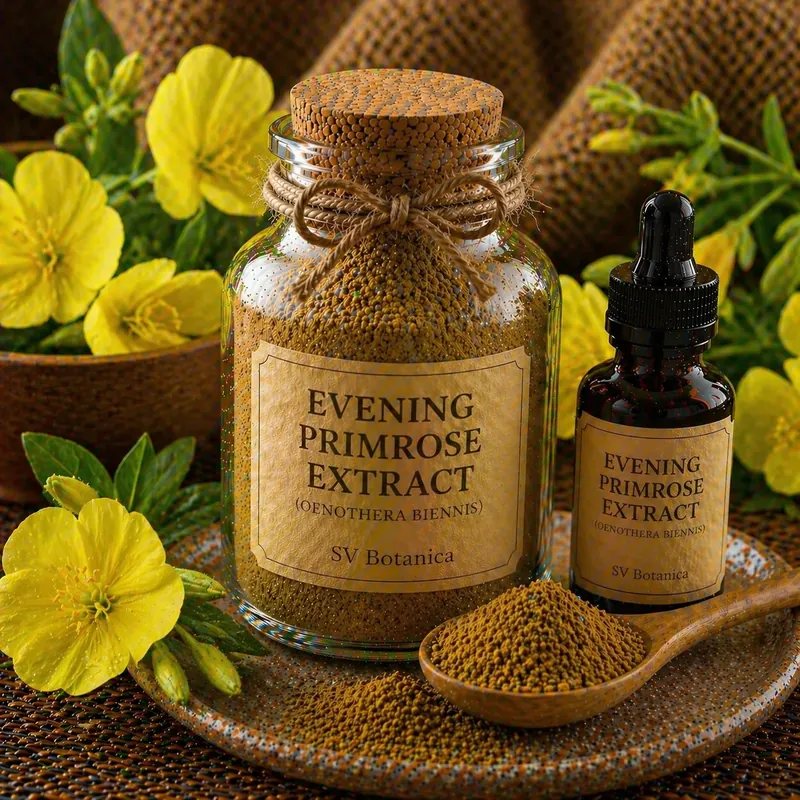
Standardised Grade
Oenothera biennis · 8–10% GLAA GLA-defined seed lipid for the women's-wellness and skin-nutrition categories
Evening primrose (Oenothera biennis L.) is a biennial of the Onagraceae family whose small brown seeds carry one of the few commercially practical plant sources of gamma-linolenic acid (GLA) — an omega-6 fatty acid the body otherwise makes from dietary linoleic acid. That biochemical position is what built the category: GLA sits upstream of the prostaglandin pathways that attract sustained research interest in skin-barrier and women's-wellness areas, and evening primrose is the source consumers actually recognise on a label.
The defining specification is the fatty-acid profile by GC: gamma-linolenic acid at 8–10% of fatty acids alongside linoleic acid at 65–75%. Unlike a phenolic-marker botanical, there is no extract-ratio arithmetic here — the material is the seed lipid, and the GC fatty-acid methyl ester assay is both the potency claim and the identity fingerprint. SV Botanica supplies a refined softgel-grade oil, a cold-pressed grade, an emulsified (spray-dried) powder for capsules and tablets, and a certified organic grade.
Because this is a polyunsaturated lipid, oxidation control is part of the specification, not an afterthought. Peroxide value and acid value are held to defined limits, packing is nitrogen-flushed, and storage conditions genuinely determine whether the material a formulator receives performs like the material that left the plant. Buyers who have only handled dry phenolic extracts should read the specification with fresh eyes — the failure modes are different.
We supply supplement brands, softgel contract manufacturers, beauty-from-within and dermo-nutrition formulators and cosmetic houses, with a batch-specific Certificate of Analysis on every shipment.
The seed-lipid profile that defines evening primrose
The signature omega-6 fatty acid, present at 8–10% of total fatty acids and the basis of standardisation. Quantified by GC as its methyl ester against reference standards.
The dominant fatty acid at 65–75% — the dietary precursor of GLA and, together with the GLA figure, the core of the authenticity fingerprint.
The minor fatty acids that complete the GC profile. Their proportions are characteristic of genuine evening primrose seed and shift visibly when cheaper oils are blended in.
Native vitamin-E-family antioxidants that give the cold-pressed oil part of its intrinsic oxidative stability and are retained by gentle processing.
Beta-sitosterol and campesterol dominate the sterol fraction — a secondary authenticity marker, since adulterant oils carry their own distinct sterol signatures.
Minor catechin- and gallic-acid-derived phenolics from the seed coat that accompany the lipid in less refined grades.
Why formulators specify a GLA-standardised evening primrose extract — the functional role of the profile
GLA is the whole commercial point of evening primrose, and a declared 8–10% figure by GC lets formulators dose in milligrams of GLA per serving rather than milligrams of oil. The same chromatogram doubles as an identity fingerprint, so potency and authenticity are verified in one assay.
Evening primrose is one of the most recognised botanicals in the cycle-comfort and menopause-support category, carrying decades of research literature and near-universal consumer awareness. That gives brands a hero ingredient in women's-wellness formats that needs no label education.
As a source of skin-barrier-relevant omega-6 lipids, evening primrose anchors beauty-from-within softgels and dermo-nutrition blends, and appears as an INCI-listed emollient oil in topical cosmetic formulations — one material serving both sides of the beauty category.
Defined peroxide-value and acid-value limits, native tocopherols and nitrogen-flushed packing protect the polyunsaturated profile through shelf life. For a lipid-bearing material this is the quality parameter that separates serious supply from commodity trading.
The refined oil fills softgels directly, while the emulsified spray-dried powder brings GLA into two-piece capsules, tablets and sachet blends that plain oil cannot enter. Both formats carry the same GC-verified fatty-acid profile.
A free-flowing 40–80 mesh powder with a declared carrier and oil load blends predictably, and the batch CoA states the profile the formulator is actually dosing — so a change of batch never silently changes the delivered GLA.
These are functional and physico-chemical properties of the actives; SV Botanica does not make medical or therapeutic claims for this ingredient.
The core specification for the GLA-standardised grades — oil, powder and organic options
| Grade | Standardisation | Form | Best For | Solubility |
|---|---|---|---|---|
| Evening Primrose Extract Powder Standard | GLA 8–10% of fatty acids (GC) | Light yellow to cream fine powder, 40–80 mesh | Capsules, tablets, women's-wellness & beauty-from-within blends | Emulsified — water-dispersible |
| Evening Primrose Oil — Softgel Grade Refined oil | GLA NLT 9% of fatty acids (GC) | Clear, light yellow oil | Softgel encapsulation, oil blends with fish oil & vitamin E | Oil-soluble |
| Evening Primrose Oil — Cold-Pressed Virgin oil | GLA 8–10% (GC), native tocopherols retained | Golden yellow oil, characteristic mild odour | Premium softgels, cosmetic & personal-care formulations | Oil-soluble |
| Organic Evening Primrose Organic | GLA 8–10% (GC), certified organic chain | Oil or emulsified powder | Organic & clean-label supplement lines | Grade-dependent |
| Custom Carrier / Oil-Load Grade Custom | Oil load and carrier per buyer specification | Powder on buyer-specified carrier | Contract manufacturing & private label | Dispersibility per specification |
The 8–10% GLA specification is our CoA-backed standard across oil and powder formats, assayed by GC with the full fatty-acid profile reported. For powder grades the carrier and oil load are declared on the specification, so the delivered GLA per gram is always calculable. Organic certification, custom carriers, buyer-specified mesh and packaging can be quoted against specification and order volume. Every batch is released against a batch-specific Certificate of Analysis.
Evening Primrose Extract is bought in five forms. The standardised extract is the stocked item; granulated and dispersible grades are produced on request and raw botanical forms are sourced against a confirmed order.
| Form | What it is | Specification basis | Availability |
|---|---|---|---|
| Standardised extract powder | Oenothera biennis seed extract, dried and milled | GLA 8–10% of fatty acids (GC), powder form | Stocked |
| Granulated (direct-compression) | Extract granulated for tablet lines | Same marker, declared on the granule | On request |
| Water-dispersible / soluble | Extract in a dispersible matrix for beverages, gummies and sachets | Marker declared on the matrix basis; carrier named | On request |
| Seed powder (non-extracted) | Cleaned Oenothera biennis seed, milled to mesh | Botanical identity by TLC; heavy metals and microbial panel | On enquiry, subject to lot; phytosanitary certificate usually required |
| Whole seed | Cleaned, graded whole seed | Purity, moisture, foreign matter; pesticide screen | On enquiry, subject to lot; spice-trade item |
A marker percentage without its assay method is not a specification; ask for the method and the plant part on every quotation. Read Evening Primrose Extract: A Complete Buyer's Guide, GLA and How Evening Primrose Extract Is Standardised and Evening Primrose Adulteration and How Authenticity Is Proven before comparing offers.
Full product specification for Evening Primrose Extract (emulsified powder grade; oil-basis parameters stated where they apply). Values are specification limits, not batch results; a batch-specific CoA is issued per shipment.
| Parameter | Specification / Limit | Method |
|---|---|---|
| Botanical Source | Oenothera biennis L. | — |
| Plant Family | Onagraceae | — |
| Part Used | Seed | — |
| Country of Origin | India | — |
| Appearance | Fine powder (oil grades: clear to golden yellow liquid) | Organoleptic |
| Colour | Light yellow to cream* | Organoleptic |
| Odour | Characteristic, mild | Organoleptic |
| Taste | Characteristic, bland | Organoleptic |
| Identification | Fatty-acid profile corresponds to reference — positive | By GC |
| Loss on Drying (at 105°C, % w/w) | NMT 5.0 | IP-2014 |
| Bulk Density (g/ml) | NLT 0.30 | IP-2014 |
| Particle Size (mesh) | 40 – 80 | Sieve |
| Total Ash (% w/w) | NMT 5 | IP-2014 |
| Acid Insoluble Ash (% w/w) | NMT 1 | IP-2014 |
| Gamma-Linolenic Acid (GLA, % of fatty acids) | 8 – 10 | By GC |
| Linoleic Acid (% of fatty acids) | 65 – 75 | By GC |
| Peroxide Value (meq O₂/kg, oil basis) | NMT 10 | IP-2014 |
| Acid Value (mg KOH/g, oil basis) | NMT 2.0 | IP-2014 |
| Carrier / Oil Load (powder grade) | Declared on specification | Documentation |
| Residual Solvent (Hexane, ppm) | NMT 10 (cold-pressed grade: not solvent-extracted) | By GC |
| Lead (ppm) | NMT 1.0 | ICP-MS |
| Arsenic (ppm) | NMT 1.0 | ICP-MS |
| Cadmium (ppm) | NMT 0.3 | ICP-MS |
| Mercury (ppm) | NMT 0.1 | ICP-MS |
| Pesticide Residues | Complies (EU MRL, on request) | GC-MS / LC-MS/MS |
| Ethylene Oxide (ETO) | Not treated — declaration provided | LC-MS/MS (on request) |
| Aflatoxins B1 / Total (ppb) | NMT 2 / NMT 4 | HPLC-FLD |
| Total Plate Count (cfu/g) | NMT 1,000 | USP <2021> |
| Yeast & Moulds / Fungi (cfu/g) | NMT 100 | USP <2021> |
| Escherichia coli | Absent | USP <2022> |
| Salmonella sp. | Absent | USP <2022> |
| Staphylococcus aureus | Absent | USP <2022> |
| Cultivation | Cultivated | Declaration |
| Kosher / Halal | Certified (on request) | Certification |
| Shelf Life | 24–36 months from date of manufacture (grade-dependent), in original packed condition | — |
| Storage | Cool, dry place below 25°C, away from light and oxygen; keep nitrogen-flushed containers tightly sealed | — |
*The product is of herbal origin; slight colour variation may occur due to geographical and seasonal variation in the raw material. The fatty-acid profile is standardised and identity-confirmed in a single GC assay; peroxide and acid values are tested on the oil phase at release. For powder grades the carrier and oil load are declared, so delivered GLA per gram is stated, not implied. A current Certificate of Analysis and MSDS are issued with every batch. EU pesticide MRL and ethylene oxide reports are available on request.
From seed to standardised lipid — authenticated, oxidation-controlled, documented
Raw Material & Authentication: The extract is prepared from cultivated Oenothera biennis seed. Because GLA-bearing oils are a recognised blending target — cheap high-linoleic oils are chemically similar enough to hide in a partial assay — every batch is authenticated by its full GC fatty-acid profile, not a single-number GLA figure, before it is accepted.
Manufacturing & Testing: Evening Primrose Extract is manufactured at certified facilities in India. Each batch runs through a full QC battery — fatty-acid profile and GLA by GC, peroxide and acid value on the oil phase, loss on drying, bulk density, ash and acid-insoluble ash, mesh, residual solvent by GC, heavy metals by ICP-MS, aflatoxins, pesticide residue screening, and a complete USP microbiological panel — before release. Oil is stored and packed under nitrogen.
Documentation: Every shipment is supplied against a batch-specific Certificate of Analysis with an MSDS. Halal, Kosher and Organic certification are available. Country of Origin and export documentation are provided on request. For EU-bound shipments we supply a non-ETO declaration and can add LC-MS/MS testing — see our guides on EU pesticide MRL compliance and EU import requirements for botanical extracts.
What backs every batch of Evening Primrose extract
Key information for global product registration and labelling
Used as a botanical lipid active in supplement and functional-food formats, the extract is supplied to a defined GLA specification with full analytical documentation. Evening primrose oil has a long history of food-supplement use in the US, EU and Asia, which simplifies its regulatory position relative to novel botanicals; unusually concentrated GLA preparations may warrant a market-specific check. Buyers remain responsible for determining suitability and for compliance with the relevant food-supplement regulations in their market. This product is not intended to diagnose, treat, cure or prevent any disease.
Oenothera biennis (evening primrose) oil is an established cosmetic ingredient with a recognised INCI listing, used as an emollient and barrier-support lipid in facial oils, creams and hair care. As an active input it should be used within the buyer's finished-product safety assessment; SV Botanica supplies the material specification and CoA to support that dossier.
Supplied from India by SV Botanica — FSSAI Central Licence holder and an APEDA-registered exporter. The material is shipped in nitrogen-flushed, food-grade packaging against a batch-specific Certificate of Analysis, with Halal, Kosher and Organic certification and export documentation available on request.
Deep-dive articles on evening primrose extract for formulators, buyers, and brand owners
How to specify by GLA content, choose between oil and powder, and read a lipid CoA properly.
TechnicalWhat 8–10% GLA means, how GC assay works, and how evening primrose compares with borage and blackcurrant.
QualityCheap-oil blending, over-carried powders and refreshed old stock — and the GC fingerprint that catches them.
ApplicationsSoftgel, capsule, beauty-from-within and combination formats — and which grade fits each.
ProcurementA scored checklist for qualifying an evening primrose supplier before you place a bulk order.
MarketWhere GLA demand is growing across women's wellness and beauty-from-within, and which segments drive it.
Frequently co-formulated with Evening Primrose Extract in women's-wellness, skin & balance blends
Technical and commercial questions answered by our ingredients team
GLA-standardised, oxidation-controlled, fully documented supply of Oenothera biennis seed extract. GLA 8-10% by GC in oil and powder grades. Samples available for qualified buyers.
Supplied as a bulk ingredient for further manufacture. Buyers are responsible for compliance with the regulations of their destination market. This product is not intended to diagnose, treat, cure or prevent any disease.
We use cookies for analytics and to measure our advertising. Essential cookies are always on. Privacy policy