
Cuminum cyminum L. · Family: Apiaceae · Seed Extract
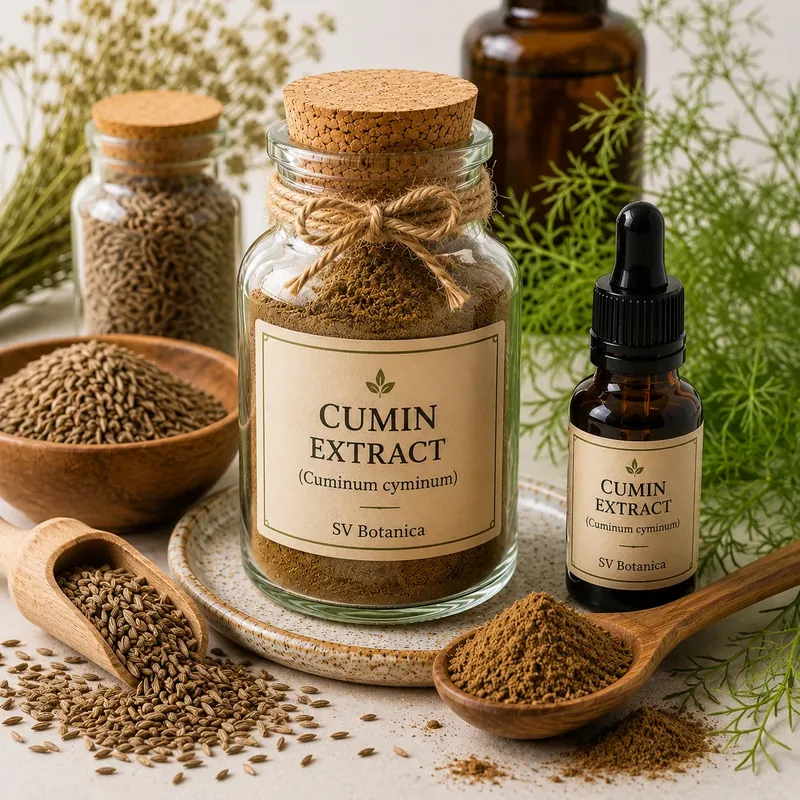
A warm, aromatic cumin seed extract standardised to cuminaldehyde 25–35% by GC. Prepared from the seed of Cuminum cyminum — true cumin, not black cumin — for digestive-comfort, metabolic-wellness, sports-nutrition and Ayurvedic formulators. CoA-backed, GC-authenticated supply from India, the world's dominant cumin producer.
Standardised Grade
Cuminum cyminum · Cuminaldehyde 25–35%A standardised aroma-active from the world's second-most-traded spice seed
Cumin (Cuminum cyminum L.) is one of the oldest cultivated spices on earth — traded across the ancient Mediterranean, prescribed in Ayurveda as jeeraka, and today second only to black pepper among globally traded spice seeds. The dried ripe fruit, traded universally as "cumin seed", carries a volatile-oil fraction whose defining constituent is cuminaldehyde, the compound responsible for cumin's unmistakable warm aroma and the marker on which a serious commercial extract is standardised.
One point of nomenclature matters commercially before anything else: cumin is not black cumin. Nigella sativa — black cumin, black seed, kalonji — is an entirely unrelated plant from a different botanical family, standardised on a different marker (thymoquinone) and serving a different market. The two are confused constantly in trade enquiries, and the confusion is expensive. Every SV Botanica cumin document states Cuminum cyminum L., family Apiaceae, so there is never ambiguity about which material is being quoted.
SV Botanica standardises this extract to cuminaldehyde 25–35% by GC — the appropriate method for a volatile marker — so every batch is defined by its actual aroma-active load rather than by extract ratio or colour. A high-potency 35–45% grade, a native 10:1 full-spectrum ratio grade and a certified organic grade are also available. The extract is finished as a free-flowing, light tan to brownish-yellow powder with the characteristic warm cumin aroma, prepared from seed sourced in Gujarat and Rajasthan — the cultivation belt that makes India the world's dominant cumin producer.
We supply supplement brands, functional-food and beverage manufacturers, sports-nutrition formulators and Ayurvedic houses, with a batch-specific Certificate of Analysis on every shipment.
The volatile aldehyde and its companions that define the cumin seed
The signature aromatic aldehyde of cumin and the standardisation marker. Aroma-active at low concentrations, quantified here by GC on every batch.
The monoterpene precursors of cuminaldehyde in the seed's biosynthetic pathway, and consistent companions in any genuine cumin volatile profile.
The remaining monoterpene hydrocarbons that round out cumin's fresh, resinous top note and appear as characteristic peaks on the GC trace.
p-Mentha-1,3-dien-7-al and 1,4-dien-7-al — aldehydes closely related to cuminaldehyde whose presence in natural proportion distinguishes genuine seed extract from spiked material.
The flavonoid fraction of the seed, carried through in full-spectrum and ratio grades and part of cumin's antioxidant research profile.
The Apiaceae-typical fatty fraction of the seed, largely removed in the standardised powder but defining for the oleoresin and pressed-oil trades.
Why formulators specify a cuminaldehyde-standardised extract — the functional role of the markers
Cuminaldehyde is the aroma-active aldehyde that defines cumin's functional and sensory identity. A declared percentage by GC lets formulators build digestive-comfort and metabolic-wellness products on a consistent, verifiable active load rather than a vague extract ratio.
Cumin is a foundation herb of the traditional digestive repertoire — jeera water is a daily ritual across South Asia — giving brands a carminative-heritage hero ingredient in the digestive and gut-wellness category that needs little consumer education.
Because "cumin" in trade covers true cumin, black cumin (Nigella sativa) and regional look-alikes such as caraway and shahi jeera, a TLC identity corresponding to cuminaldehyde plus a correct-species declaration protects a formulation from the industry's most common labelling mix-up.
Cumin appears in the researched metabolic-wellness and weight-management category and in thermogenic sports formats, where its warming sensory character reinforces the positioning. A standardised marker load keeps dosing consistent across a category that formulates aggressively.
The partially water-soluble powder suits capsules, tablets and blends, while the warm aroma carries into functional beverages and jeera-water-style formats. Where a pure flavour contribution is wanted, the companion cumin oleoresin serves seasoning and savoury systems.
A free-flowing 40–80 mesh powder with controlled moisture (NMT 5%) disperses and blends predictably, and the declared cuminaldehyde load lets you hold a stable sensory and active profile batch to batch.
These are functional and physico-chemical properties of the actives; SV Botanica does not make medical or therapeutic claims for this ingredient.
The core specification for the flagship cuminaldehyde 25–35% grade, plus high-potency, ratio and organic options
| Grade | Standardisation | Form | Best For | Solubility |
|---|---|---|---|---|
| Cumin Extract 25–35% Standard | Cuminaldehyde 25–35% (GC) | Light tan to brownish-yellow fine powder, 40–80 mesh | Digestive-comfort & metabolic-wellness supplements, capsules & tablets | Partially water-soluble |
| Cumin Extract 35–45% High-potency | Cuminaldehyde 35–45% (GC) | Tan to brownish-yellow fine powder | Low-dose formats, softgels, concentrated blends | Partially water-soluble |
| Cumin Extract 10:1 Full-spectrum | Native 10:1 ratio (full-spectrum) | Light tan to brownish-yellow fine powder | Traditional & Ayurvedic formats, herbal blends | Partially water-soluble |
| Organic Cumin Extract Organic | Certified organic; cuminaldehyde declared per batch | Light tan to brownish-yellow fine powder | Organic-certified supplement & food lines | Partially water-soluble |
| Cumin Oleoresin Oleoresin | Volatile-oil content declared per batch | Viscous amber to brown liquid | Seasoning systems, savoury flavours, food processing | Oil-dispersible |
The cuminaldehyde 25–35% grade is our CoA-backed flagship, assayed by GC with identity confirmed by TLC. The high-potency, native-ratio and certified organic grades, the companion cumin oleoresin, custom mesh and packaging can be quoted against buyer specification and order volume. Every batch is released against a batch-specific Certificate of Analysis.
Cumin Extract is bought in five forms. The standardised extract is the stocked item; granulated and dispersible grades are produced on request and raw botanical forms are sourced against a confirmed order.
| Form | What it is | Specification basis | Availability |
|---|---|---|---|
| Standardised extract powder | Cuminum cyminum seed extract, dried and milled | Cuminaldehyde 25–35% (GC) | Stocked |
| Granulated (direct-compression) | Extract granulated for tablet lines | Same marker, declared on the granule | On request |
| Water-dispersible / soluble | Extract in a dispersible matrix for beverages, gummies and sachets | Marker declared on the matrix basis; carrier named | On request |
| Seed powder (non-extracted) | Cleaned Cuminum cyminum seed, milled to mesh | Botanical identity by TLC; heavy metals and microbial panel | On enquiry, subject to lot; phytosanitary certificate usually required |
| Whole seed | Cleaned, graded whole seed | Purity, moisture, foreign matter; pesticide screen | On enquiry, subject to lot; spice-trade item |
A marker percentage without its assay method is not a specification; ask for the method and the plant part on every quotation. Read Cumin Extract: A Complete Buyer's Guide, Cuminaldehyde and How Cumin Extract Is Standardised and Cumin Extract Adulteration and How Authenticity Is Proven before comparing offers.
Full product specification for Cumin Seed Extract 25–35%. Values are specification limits, not batch results; a batch-specific CoA is issued per shipment.
| Parameter | Specification / Limit | Method |
|---|---|---|
| Botanical Source | Cuminum cyminum L. | — |
| Plant Family | Apiaceae (Umbelliferae) | — |
| Part Used | Seed (dried ripe fruit) | — |
| Country of Origin | India (Gujarat & Rajasthan) | — |
| Appearance | Fine powder | Organoleptic |
| Colour | Light tan to brownish-yellow* | Organoleptic |
| Odour | Characteristic, warm aromatic | Organoleptic |
| Taste | Characteristic, warm, slightly bitter | Organoleptic |
| Identification | Corresponds to cuminaldehyde — positive | By TLC |
| Loss on Drying (at 105°C, % w/w) | NMT 5.0 | IP-2014 |
| pH (1% w/v solution) | 4 – 7 | IP-2014 |
| Bulk Density (g/ml) | NLT 0.35 | IP-2014 |
| Particle Size (40–80 mesh, % w/w) | NLT 95 through #40 | Sieve |
| Total Ash (% w/w) | NMT 8 | IP-2014 |
| Acid Insoluble Ash (% w/w) | NMT 2 | IP-2014 |
| Cuminaldehyde (% w/w) | 25 – 35 | By GC |
| Volatile Profile (p-cymene, terpinenes) | Reported per batch | By GC |
| Residual Solvent (Ethanol, ppm) | NMT 5,000 | By GC |
| Lead (ppm) | NMT 1.0 | ICP-MS |
| Arsenic (ppm) | NMT 1.0 | ICP-MS |
| Cadmium (ppm) | NMT 0.3 | ICP-MS |
| Mercury (ppm) | NMT 0.1 | ICP-MS |
| Total Heavy Metals (ppm) | NMT 10 | ICP-MS |
| Pesticide Residues | Complies (EU MRL, on request) | GC-MS / LC-MS/MS |
| Ethylene Oxide (ETO) | Not treated — declaration provided | LC-MS/MS (on request) |
| Aflatoxins B1 / Total (ppb) | NMT 2 / NMT 4 | HPLC-FLD |
| Total Plate Count (cfu/g) | NMT 1,000 | USP <2021> |
| Yeast & Moulds / Fungi (cfu/g) | NMT 100 | USP <2021> |
| Escherichia coli | Absent | USP <2022> |
| Salmonella sp. | Absent | USP <2022> |
| Staphylococcus aureus | Absent | USP <2022> |
| Cultivation | Cultivated | Declaration |
| Kosher / Halal | Certified (on request) | Certification |
| Shelf Life | 24–36 months (grade-dependent) from date of manufacture, in original packed condition | — |
| Storage | Cool, dry place away from light and moisture, in tightly sealed containers | — |
*The product is of herbal origin; slight colour variation may occur due to geographical and seasonal variation in the raw material. Cuminaldehyde is standardised by GC and identity is confirmed by TLC; the wider volatile profile is reported per batch on request. Because cuminaldehyde is a volatile marker, containers must be kept tightly sealed — see storage. A current Certificate of Analysis and MSDS are issued with every batch. EU pesticide MRL and ethylene oxide reports are available on request.
From seed to standardised extract — authenticated, tested, documented
Raw Material & Authentication: The extract is prepared from cultivated Cuminum cyminum seed from Gujarat and Rajasthan. Because "cumin" in trade spans several unrelated botanicals — black cumin (Nigella sativa), caraway and shahi jeera among them — and because seed extracts are routinely diluted with spent meal or undeclared carriers, cuminaldehyde identity is confirmed by TLC and the marker is assayed by GC on every batch before it is accepted.
Manufacturing & Testing: Cumin Seed Extract is manufactured at certified facilities in India. Each batch runs through a full QC battery — cuminaldehyde by GC, loss on drying, pH, bulk density, ash and acid-insoluble ash, mesh, residual solvent by GC, heavy metals by ICP-MS, aflatoxins by HPLC-FLD, pesticide residue screening, and a complete USP microbiological panel — before release.
Documentation: Every shipment is supplied against a batch-specific Certificate of Analysis with an MSDS. Halal, Kosher and Organic certification are available. Country of Origin and export documentation are provided on request. Because dried spice-derived materials are a recognised ethylene-oxide risk category — and cumin specifically has featured in EU ETO enforcement — we supply a non-ETO declaration and can add LC-MS/MS testing; see our guides on EU pesticide MRL compliance and EU import requirements for botanical extracts.
What backs every batch of Cumin extract
Key information for global product registration and labelling
Used as a botanical active in supplement, functional-food and beverage formats, the extract is supplied to a defined cuminaldehyde specification with full analytical documentation. Cumin has millennia of food use in essentially every market, which simplifies its regulatory position relative to novel botanicals. Buyers remain responsible for determining suitability and for compliance with the relevant food-supplement regulations in their market. This product is not intended to diagnose, treat, cure or prevent any disease.
Cumin is an established food ingredient worldwide, and the extract and companion oleoresin are used to standardise flavour and aroma in seasoning and savoury systems. As a spice-derived input for EU-destined food it sits in a recognised ethylene-oxide and pesticide-residue control category; SV Botanica supplies non-ETO declarations and EU MRL screening to support the buyer's import file.
Supplied from India by SV Botanica — FSSAI Central Licence holder and an APEDA-registered exporter. India is the world's dominant cumin producer, with the Gujarat–Rajasthan belt supplying the large majority of global trade, giving direct access to the raw material base. The material is Kosher certified and shipped against a batch-specific Certificate of Analysis with export documentation available on request.
Deep-dive articles on cumin extract for formulators, buyers, and brand owners
How to specify cumin extract by cuminaldehyde content, what a CoA must show, and the black-cumin trap.
TechnicalWhat the cuminaldehyde percentage means, why a volatile marker is assayed by GC, and how it is kept.
QualitySpent seed meal, undeclared carriers, synthetic cuminaldehyde and species swaps — and the tests that catch them.
ApplicationsDigestive, metabolic, sports and beverage formats — and which cumin grade fits each.
ProcurementA scored checklist for qualifying a cumin extract supplier before you place a bulk order.
MarketHow the world's largest spice-seed trade shapes cumin extract supply, and which segments drive demand.
Frequently co-formulated with Cumin Extract in digestive, metabolic & Ayurvedic blends
Technical and commercial questions answered by our ingredients team
Cuminaldehyde-standardised, lab-tested, fully documented supply of Cuminum cyminum seed extract. Cuminaldehyde 25–35% by GC. Samples available for qualified buyers.
Supplied as a bulk ingredient for further manufacture. Buyers are responsible for compliance with the regulations of their destination market. This product is not intended to diagnose, treat, cure or prevent any disease.
We use cookies for analytics and to measure our advertising. Essential cookies are always on. Privacy policy