
Saraca asoca (Roxb.) Willd. · Family: Fabaceae · Stem Bark Extract
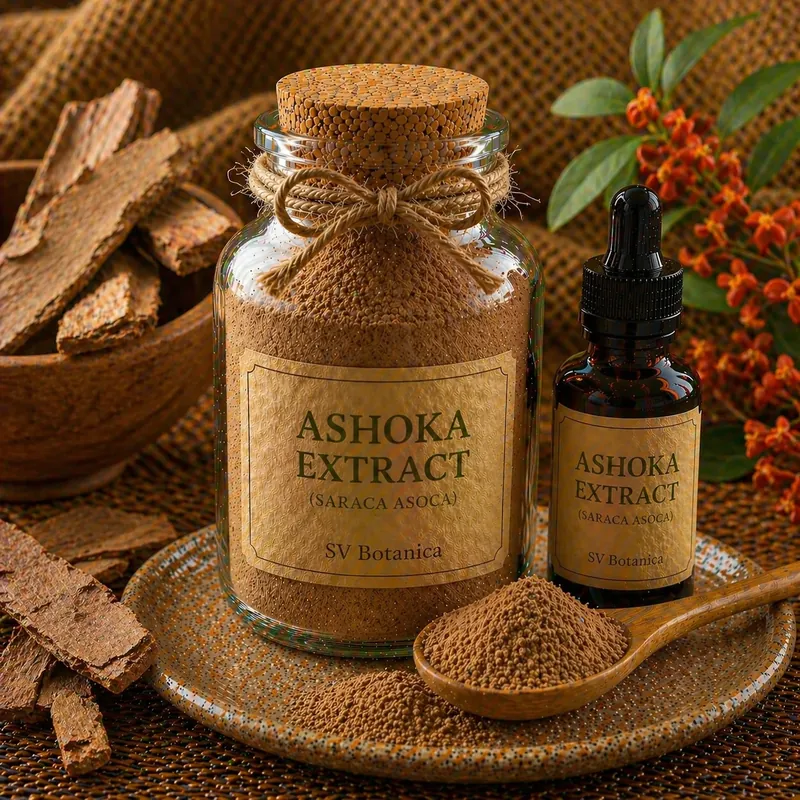
Ashoka is the classical Ayurvedic women's-health bark — and the name is attached, all over India, to a completely unrelated ornamental tree whose bark reaches the trade as ashoka. We supply Saraca asoca, the correct binomial, with Polyalthia longifolia excluded by HPLC and catechin markers reported. On a species assessed as threatened, we also prefer cultivated and plantation bark and declare the source. CoA-backed supply from India.
Species Confirmed
P. longifolia ExcludedA famous name attached to the wrong tree
Ashoka (Saraca asoca) is a small evergreen tree of the Fabaceae, native to the Indian subcontinent, whose stem bark is the classical Ayurvedic botanical for women's health — named in the traditional literature for gynaecological use and still the backbone of a large category of Indian formulations. It is also a tree of considerable cultural significance, associated with sacred groves and temple planting.
There are two problems with buying it, and both are about names.
The first: an unrelated ornamental tree is called "ashoka" across much of India. Polyalthia longifolia — the mast tree or false ashoka, family Annonaceae, not even distantly related — is planted in enormous numbers along roads, in gardens and around institutions, and is commonly known by the same name. Its bark is abundant, cheap and freely available where genuine Saraca asoca is neither. It is the best-documented bark adulterant in the Ayurvedic trade, and its presence in commercial ashoka is not occasional.
The second: most certificates name the wrong species. "Saraca indica" appears on a great deal of ashoka documentation, but the correct name for the Ayurvedic ashoka is Saraca asoca (Roxb.) Willd.; Saraca indica L. properly refers to a different species. The distinction is not pedantry on a document that is supposed to identify a plant. We use the correct binomial, confirm species by HPLC with P. longifolia excluded, and report catechin markers — and because S. asoca is assessed as threatened and bark harvest is destructive, we prefer cultivated and plantation material and declare the source on every batch.
What is in Saraca asoca stem bark
A principal flavan-3-ol of S. asoca bark and the most useful single marker for confirming the species is what it claims to be.
Present alongside epicatechin; the catechin/epicatechin relationship forms part of the pattern used for species confirmation.
Condensed tannin oligomers of the bark, contributing to the astringency and to the tannin assay figure.
The broader tannin fraction on which the trade conventionally standardises — abundant, measurable, and common to a great many barks.
Further phenolic constituents of the bark reported in the literature on this species.
β-sitosterol and related constituents present in the stem bark.
Why formulators specify a species-confirmed ashoka
Polyalthia longifolia shares the common name, is planted everywhere in India, and its bark is cheap. It is excluded analytically rather than by assurance.
Saraca asoca (Roxb.) Willd. — not "Saraca indica", which properly names a different species and appears on a great deal of trade documentation in error.
(−)-Epicatechin and the catechin profile by HPLC, because a tannin percentage on a bark extract does not establish which bark you have.
Documented gynaecological use in the Ayurvedic classical literature — genuinely old and specific traditional provenance.
S. asoca is assessed as threatened and bark harvest is destructive. We prefer cultivated and plantation material and declare source per batch.
Wood, leaf and other parts differ in composition and are excluded by declaration, with acid-insoluble ash controlling carry-over.
These are functional and physico-chemical properties of the actives; SV Botanica does not make medical or therapeutic claims for this ingredient.
Tannin-standardised, marker-profiled and native ratio
| Grade | Standardisation | Form | Best For | Solubility |
|---|---|---|---|---|
| Ashoka Extract 5% Standard | Tannins NLT 5% (method declared); markers profiled | Brown to reddish brown fine powder, ≥95% through 40 mesh | Women's-health formulations, capsules & tablets | Partially water-soluble |
| Ashoka Extract 10% High-assay | Tannins NLT 10% (method declared); markers profiled | Reddish brown fine powder | Low-dose formats, concentrated blends | Partially water-soluble |
| Ashoka Extract Ratio Full-spectrum | Native 10:1 / 20:1 ratio; markers profiled | Brown fine powder | Classical ashoka formulations, herbal blends | Grade-dependent |
| Ashoka Extract WS Water-soluble | Cold-water-soluble spray-dried; markers profiled | Brown free-flowing powder | Syrups, tonics and liquid formats | Cold-water-soluble |
| Ashoka Bark Powder Raw milled | Milled stem bark — not an extract | Brown coarse to fine powder | Churna and classical preparations | Dispersible |
Every grade is supplied as Saraca asoca (Roxb.) Willd. with Polyalthia longifolia explicitly excluded by HPLC and the catechin marker profile reported. We treat the species control as standard rather than optional, because false ashoka is the most commonly documented bark adulterant in this trade and a tannin assay does not detect it. Syrups and liquid tonics are a major traditional format for this botanical, which is why the water-soluble grade exists rather than being an export-convenience specification. Milled bark powder is a separate product from extract and is quoted separately. Source — cultivated, plantation or wild-collected — is declared per batch; see our conservation guide for why that line matters more on this species than on most.
Ashoka Extract is bought in five forms. The standardised extract is the stocked item; granulated and dispersible grades are produced on request and raw botanical forms are sourced against a confirmed order.
| Form | What it is | Specification basis | Availability |
|---|---|---|---|
| Standardised extract powder | Saraca asoca stem bark extract, dried and milled | NLT 5% tannins with markers profiled, stem bark only | Stocked |
| Granulated (direct-compression) | Extract granulated for tablet lines | Same marker, declared on the granule | On request |
| Water-dispersible / soluble | Extract in a dispersible matrix for beverages, gummies and sachets | Marker declared on the matrix basis; carrier named | On request |
| Bark powder (non-extracted) | Dried Saraca asoca stem bark, milled to mesh | Botanical identity by TLC; heavy metals and microbial panel | On enquiry, subject to lot; phytosanitary certificate usually required |
| Cut bark | Dried bark pieces, sifted to size | Identity, moisture, foreign matter | On enquiry; for decoction and in-house extraction |
A marker percentage without its assay method is not a specification; ask for the method and the plant part on every quotation. Read Ashoka Extract: A Complete Buyer's Guide, The False Ashoka Problem: When an Ornamental Tree Shares the Name and Saraca asoca, Not Saraca indica: Naming and Marker Standardisation before comparing offers.
Full product specification for Ashoka Stem Bark Dry Extract 5%. Values are specification limits, not batch results; a batch-specific CoA is issued per shipment.
| Parameter | Specification / Limit | Method |
|---|---|---|
| Botanical Source | Saraca asoca (Roxb.) Willd. | — |
| Plant Family | Fabaceae | — |
| Part Used | Stem bark | — |
| Country of Origin | India | — |
| Appearance | Fine powder | Organoleptic |
| Colour | Brown to reddish brown* | Organoleptic |
| Odour | Characteristic | Organoleptic |
| Taste | Characteristic, astringent-bitter | Organoleptic |
| Identification | Corresponds to S. asoca reference — positive | By TLC |
| Species Confirmation | Corresponds to S. asoca; Polyalthia longifolia not detected | By HPLC |
| (−)-Epicatechin / Catechin Profile | Corresponds to reference — reported per batch | By HPLC |
| Tannins (% w/w, dry basis) | NLT 5 — method declared | UV / Titrimetric |
| Wood / Leaf Material | Absent — stem-bark declaration provided | Declaration |
| Source | Cultivated / plantation / wild-collected — declared per batch | Declaration |
| Loss on Drying (at 105°C, % w/w) | NMT 5.0 | IP-2014 |
| pH (1% w/v solution) | 4 – 6 | IP-2014 |
| Bulk Density (g/ml) | NLT 0.35 | IP-2014 |
| Particle Size (#40 mesh, % w/w) | NLT 95 | Sieve |
| Total Ash (% w/w) | NMT 10 | IP-2014 |
| Acid Insoluble Ash (% w/w) | NMT 2 | IP-2014 |
| Residual Solvent (Ethanol, ppm) | NMT 5,000 | By GC |
| Lead (ppm) | NMT 1.0 | ICP-MS |
| Arsenic (ppm) | NMT 1.0 | ICP-MS |
| Cadmium (ppm) | NMT 0.3 | ICP-MS |
| Mercury (ppm) | NMT 0.1 | ICP-MS |
| Pesticide Residues | Complies (EU MRL, on request) | GC-MS / LC-MS/MS |
| Ethylene Oxide (ETO) | Not treated — declaration provided | LC-MS/MS (on request) |
| Aflatoxins B1 / Total (ppb) | NMT 2 / NMT 4 | HPLC-FLD |
| Total Plate Count (cfu/g) | NMT 1,000 | USP <2021> |
| Yeast & Moulds / Fungi (cfu/g) | NMT 100 | USP <2021> |
| Escherichia coli | Absent | USP <2022> |
| Salmonella sp. | Absent | USP <2022> |
| Staphylococcus aureus | Absent | USP <2022> |
| Kosher / Halal | Certified (on request) | Certification |
| Shelf Life | 36 months from date of manufacture, in original packed condition | — |
| Storage | Cool, dry place away from light and moisture, in tightly sealed containers | — |
*The product is of herbal origin; slight colour variation may occur due to geographical and seasonal variation in the raw material. Two lines on this specification exist because of one tree. Polyalthia longifolia — the mast tree, family Annonaceae — is planted across India in enormous numbers as an ornamental and is commonly called "ashoka". Its bark is abundant and inexpensive where genuine Saraca asoca is scarce and protected, and it is the most frequently documented bark adulterant in this trade. A tannin assay will not detect it, because both are tannin-bearing barks; the catechin marker profile and species confirmation will. Note also that we name the species Saraca asoca (Roxb.) Willd. rather than the widely used "Saraca indica", which properly refers to a different species — a distinction that matters on a document whose purpose is to identify a plant, and one that a supplier's paperwork ought to get right. Finally, because bark harvest from a threatened species raises real sourcing questions, source is declared per batch. A current Certificate of Analysis and MSDS are issued with every batch.
From bark to confirmed extract — species-checked, marker-profiled, source-declared
Raw Material & Authentication: The extract is prepared from Saraca asoca stem bark, with species confirmed analytically rather than accepted on a name. This is not a theoretical precaution on this botanical: Polyalthia longifolia is called ashoka throughout India, planted ornamentally in vast numbers, and its bark is readily available and cheap. We confirm incoming material and finished extract by HPLC against authentic S. asoca reference, looking at the catechin and epicatechin profile rather than at tannins, which both barks carry. Wood and leaf are excluded by declaration.
Manufacturing & Testing: Ashoka Bark Extract is manufactured at certified facilities in India. Each batch runs identity by TLC, species confirmation and catechin marker profile by HPLC with P. longifolia excluded, tannins by a named method, loss on drying, pH, bulk density, total and acid-insoluble ash, mesh, residual solvent by GC, heavy metals by ICP-MS, aflatoxins by HPLC-FLD, pesticide residue screening and a complete USP microbiological panel before release.
Documentation: Every shipment is supplied against a batch-specific Certificate of Analysis stating the species as Saraca asoca (Roxb.) Willd. with Polyalthia longifolia named as excluded, the catechin marker result, the stem-bark declaration, the tannin assay with its method, and the source — cultivated, plantation or wild-collected — together with an MSDS. See also our guides on EU pesticide MRL compliance and EU import requirements for botanical extracts.
What backs every batch of Ashoka extract
Key information for global product registration and labelling
Saraca asoca has been assessed as a threatened species, and the pressure on it comes directly from the trade this product belongs to: the harvested part is bark, taken from a slow-growing tree, and demand from the Ayurvedic sector has grown substantially. Unlike arjuna, where partial rotational debarking allows a tree to survive and regenerate, ashoka bark harvest as commonly practised is considerably more damaging, and wild trees have been lost to it. We would rather state this than let a buyer assume a botanical with a temple-grove reputation carries no sourcing question. Our position: cultivated and plantation material is preferred and specified where available, source is declared on every batch, and buyers who care about this should ask for the declaration rather than assume it. Cultivation is expanding, and paying for cultivated bark is the mechanism by which it continues to.
Ashoka's classical indication is gynaecological, and that shapes what can be said about it. Claims relating to menstrual disorders or gynaecological conditions are disease claims in most regulated markets, which places them outside food-supplement positioning and into medicinal territory. In the EU, health claims for botanicals in this area are effectively unavailable. Traditional-use framing is the route that travels, in markets whose frameworks recognise it — and ashoka's documented classical use is genuine and specific. Formulators should also consider whether advisory labelling is appropriate for pregnancy and for consumers on related medication, determined by their own regulatory and safety review. This product is not intended to diagnose, treat, cure or prevent any disease.
Supplied from India by SV Botanica — FSSAI Central Licence holder and an APEDA-registered exporter — from the species' native range, with source declared per batch and cultivated material preferred. Shipped against a batch-specific Certificate of Analysis carrying the correct binomial, the species confirmation with P. longifolia excluded, and the catechin marker profile, with export documentation available on request.
Deep-dive articles on ashoka extract for formulators, buyers, and brand owners
Two name problems, one tannin assay that catches neither, and what to require instead.
QualityPolyalthia longifolia — the ornamental tree that shares the name and reaches the trade.
TechnicalWhy 'Saraca indica' is on the wrong certificates, and what catechin profiling adds.
ApplicationsSyrups, ashokarishta, combinations — and where the claim line sits.
QualityThe species line, the source line, and the assay that proves less than it appears to.
SourcingA threatened tree harvested for its bark — cultivation, plantation supply and honest declarations.
Other women's health and traditional actives from our range
Technical and commercial questions answered by our ingredients team
Saraca asoca stem bark extract with Polyalthia longifolia excluded by HPLC, catechin markers reported, and source declared on every batch. Samples for qualified buyers.
Supplied as a bulk ingredient for further manufacture. Buyers are responsible for compliance with the regulations of their destination market. This product is not intended to diagnose, treat, cure or prevent any disease.
We use cookies for analytics and to measure our advertising. Essential cookies are always on. Privacy policy