
Terminalia arjuna (Roxb. ex DC.) Wight & Arn. · Family: Combretaceae · Stem Bark Extract
Ayurveda's principal hridya — the cardiac botanical — supplied as stem bark only, with species confirmed and the arjunolic acid marker profile reported by HPLC. Tannin content is the trade's standardisation habit, but tannins are the one thing almost every bark has. We report the markers that are actually characteristic of Terminalia arjuna. CoA-backed supply from India.
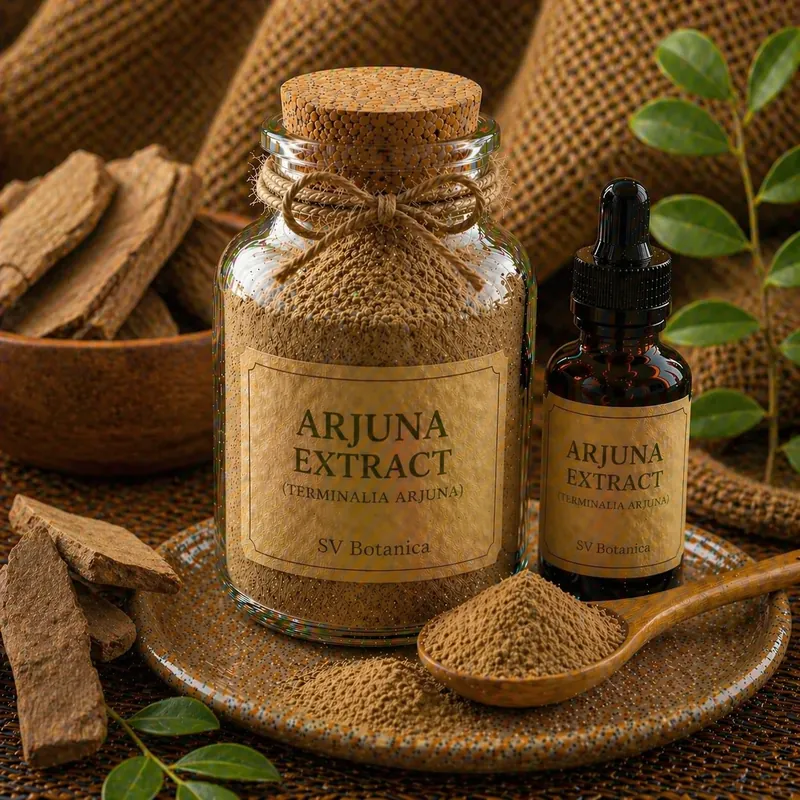
Bark Only
Wood Excluded · Species ConfirmedWhy a tannin percentage is the least informative line on an arjuna specification
Arjuna (Terminalia arjuna) is a large deciduous tree of the Combretaceae family, native to the river valleys of the Indian subcontinent, whose smooth grey-pink stem bark has been the principal cardiac botanical of Ayurveda for well over a thousand years. It is named directly in the classical literature as hridya — heart-supporting — and unlike much of the traditional-use framing in this industry, that documentation is genuine, specific and old.
The commercial problem with arjuna is not obscurity. It is that the ingredient is almost universally quoted on tannin content, and tannins are the least discriminating thing you can measure on a tree bark. A 40% tannin specification is satisfied by arjuna bark, by the bark of several related Terminalia species growing in the same forests, and by a range of unrelated tannin-rich barks that cost considerably less. The assay is real; it simply is not answering the question buyers think they are asking.
What is characteristic of T. arjuna is its triterpenoid fraction — arjunolic acid, arjunic acid, arjungenin and the glycoside arjunetin. These are the constituents the pharmacological literature is built on, and they are what separates arjuna bark from bark that merely resembles it on a tannin figure. We report the arjunolic acid marker profile by HPLC on every batch alongside the tannin assay, and we confirm species against authentic reference material.
The second control is the part. Arjuna is harvested by stripping bark from a standing tree, and the wood beneath it is worth a fraction of the bark by weight while looking similar once milled. We declare stem bark only, with wood and heartwood excluded, and pair that declaration with an acid-insoluble ash limit that catches the woody and mineral carry-over stripping tends to bring with it.
The triterpenoid and tannin fractions of arjuna stem bark
The best-known characteristic triterpenoid of T. arjuna bark and the marker most useful for confirming that the material is what it claims to be. Reported by HPLC on every batch.
Structurally related pentacyclic triterpenoids of the bark, part of the profile that distinguishes arjuna from other tannin-rich Terminalia barks.
A triterpenoid glycoside of the bark, contributing to the characteristic chromatographic fingerprint.
Casuarinin, punicalagin-type and related tannins forming the fraction on which the trade conventionally standardises — abundant, measurable, and not species-specific.
Arjunone, arjunolone, luteolin and baicalein-type flavonoids reported in the bark, part of the wider polyphenol complex.
The bark is notably rich in calcium and magnesium, which is why total ash on arjuna runs higher than on leaf and fruit extracts and why the ash limit is set accordingly.
Why formulators specify a bark-only, marker-profiled arjuna extract
Arjuna is named in the Ayurvedic classical literature as hridya and has been used for cardiovascular support for more than a millennium — documented traditional use rather than heritage constructed for a label.
The triterpenoid markers are what actually characterise T. arjuna. We report the profile on every batch rather than resting on a tannin figure that any bark can satisfy.
Bark is stripped from standing trees and the wood beneath is cheap and visually similar once milled. The part declaration is explicit, and acid-insoluble ash is limited to catch what stripping carries over.
Tannin figures move substantially with method. We name ours, so a quotation can be compared like with like instead of on a number without provenance.
T. tomentosa and T. crenulata share the same forests and yield visually similar bark at lower cost. We confirm against authentic T. arjuna reference material.
Arjuna bark regenerates on a living tree when stripped correctly. We source from suppliers practising partial, rotational debarking rather than girdling, and declare collection status per batch.
These are functional and physico-chemical properties of the actives; SV Botanica does not make medical or therapeutic claims for this ingredient.
Tannin strength, marker-profiled and native ratio grades
| Grade | Standardisation | Form | Best For | Solubility |
|---|---|---|---|---|
| Arjuna Extract 40% Standard | Tannins NLT 40% (method declared); markers profiled | Light brown to reddish brown fine powder, ≥95% through 40 mesh | Cardiovascular supplements, Ayurvedic formats, capsules & tablets | Partially water-soluble |
| Arjuna Extract 50% High-assay | Tannins NLT 50% (method declared); markers profiled | Reddish brown fine powder | Low-dose formats, concentrated blends | Partially water-soluble |
| Arjuna Extract Ratio Full-spectrum | Native 10:1 / 20:1 ratio; markers profiled | Brown fine powder | Classical arjuna formulations, herbal blends | Grade-dependent |
| Arjuna Extract WS Water-soluble | Cold-water-soluble spray-dried; markers profiled | Brown free-flowing powder | Beverages, shots, sachets & effervescents | Cold-water-soluble |
| Arjuna Bark Powder Raw milled | Milled stem bark — not an extract | Pale brown coarse to fine powder | Churna and classical preparations only | Dispersible |
Milled arjuna bark powder is not an extract and should never be quoted against an extract specification — it is the whole bark milled, not concentrated, and it carries a fraction of the marker content at a fraction of the price. Every extract grade is supplied against a stem-bark-only declaration with wood and heartwood excluded, with species confirmed against authentic T. arjuna reference material and the arjunolic acid marker profile reported by HPLC alongside the tannin assay. Because tannin figures are strongly method-dependent, the method is named on every certificate. Alternative assay strengths, water-soluble and native-ratio grades can be quoted against buyer specification and order volume.
Arjuna Extract is bought in five forms. The standardised extract is the stocked item; granulated and dispersible grades are produced on request and raw botanical forms are sourced against a confirmed order.
| Form | What it is | Specification basis | Availability |
|---|---|---|---|
| Standardised extract powder | Terminalia arjuna stem bark extract, dried and milled | NLT 40% tannins with markers profiled, stem bark only | Stocked |
| Granulated (direct-compression) | Extract granulated for tablet lines | Same marker, declared on the granule | On request |
| Water-dispersible / soluble | Extract in a dispersible matrix for beverages, gummies and sachets | Marker declared on the matrix basis; carrier named | On request |
| Bark powder (non-extracted) | Dried Terminalia arjuna stem bark, milled to mesh | Botanical identity by TLC; heavy metals and microbial panel | On enquiry, subject to lot; phytosanitary certificate usually required |
| Cut bark | Dried bark pieces, sifted to size | Identity, moisture, foreign matter | On enquiry; for decoction and in-house extraction |
A marker percentage without its assay method is not a specification; ask for the method and the plant part on every quotation. Read Arjuna Extract: A Complete Buyer's Guide, Arjuna Standardisation: Tannins, Arjunolic Acid, and What Each One Measures and Arjuna Adulteration: Related Species, Wood in the Bark, and Powder Sold as Extract before comparing offers.
Full product specification for Arjuna Stem Bark Dry Extract 40%. Values are specification limits, not batch results; a batch-specific CoA is issued per shipment.
| Parameter | Specification / Limit | Method |
|---|---|---|
| Botanical Source | Terminalia arjuna (Roxb. ex DC.) Wight & Arn. | — |
| Plant Family | Combretaceae | — |
| Part Used | Stem bark | — |
| Country of Origin | India | — |
| Appearance | Fine powder | Organoleptic |
| Colour | Light brown to reddish brown* | Organoleptic |
| Odour | Characteristic | Organoleptic |
| Taste | Characteristic, astringent | Organoleptic |
| Identification | Corresponds to T. arjuna reference — positive | By TLC |
| Species Confirmation | Corresponds to T. arjuna reference; T. tomentosa / T. crenulata excluded | By HPLC |
| Tannins (% w/w, dry basis) | NLT 40 — method declared | UV / Titrimetric |
| Arjunolic Acid Marker Profile | Corresponds to reference — reported per batch | By HPLC |
| Wood / Heartwood Material | Absent — stem-bark declaration provided | Declaration |
| Loss on Drying (at 105°C, % w/w) | NMT 5.0 | IP-2014 |
| pH (1% w/v solution) | 4 – 6 | IP-2014 |
| Bulk Density (g/ml) | NLT 0.35 | IP-2014 |
| Particle Size (#40 mesh, % w/w) | NLT 95 | Sieve |
| Total Ash (% w/w) | NMT 12 | IP-2014 |
| Acid Insoluble Ash (% w/w) | NMT 2 | IP-2014 |
| Residual Solvent (Ethanol, ppm) | NMT 5,000 | By GC |
| Lead (ppm) | NMT 1.0 | ICP-MS |
| Arsenic (ppm) | NMT 1.0 | ICP-MS |
| Cadmium (ppm) | NMT 0.3 | ICP-MS |
| Mercury (ppm) | NMT 0.1 | ICP-MS |
| Pesticide Residues | Complies (EU MRL, on request) | GC-MS / LC-MS/MS |
| Ethylene Oxide (ETO) | Not treated — declaration provided | LC-MS/MS (on request) |
| Aflatoxins B1 / Total (ppb) | NMT 2 / NMT 4 | HPLC-FLD |
| Total Plate Count (cfu/g) | NMT 1,000 | USP <2021> |
| Yeast & Moulds / Fungi (cfu/g) | NMT 100 | USP <2021> |
| Escherichia coli | Absent | USP <2022> |
| Salmonella sp. | Absent | USP <2022> |
| Staphylococcus aureus | Absent | USP <2022> |
| Collection Status | Cultivated / wild-collected (declared per batch) | Declaration |
| Kosher / Halal | Certified (on request) | Certification |
| Shelf Life | 36 months from date of manufacture, in original packed condition | — |
| Storage | Cool, dry place away from light and moisture, in tightly sealed containers | — |
*The product is of herbal origin; slight colour variation may occur due to geographical and seasonal variation in the raw material. Two lines on this specification do more work than the tannin assay. The first is the arjunolic acid marker profile, which is characteristic of Terminalia arjuna where tannins are common to almost every bark in the trade. The second is the stem-bark declaration: arjuna is harvested by stripping bark from a living tree, and wood carry-over is the most ordinary form of dilution on this material — which is why the acid-insoluble ash limit is set tightly alongside it. Note also that tannin figures are method-dependent; a 40% by one method is not a 40% by another, so the method is named on every certificate and should be matched when comparing quotations. Total ash runs higher on arjuna than on most extracts because the bark is genuinely mineral-rich, and the limit reflects that rather than indicating contamination. A current Certificate of Analysis and MSDS are issued with every batch.
From stripped bark to profiled extract — species-confirmed, tested, documented
Raw Material & Authentication: The extract is prepared from Terminalia arjuna stem bark, with species confirmed analytically rather than assumed. T. tomentosa and T. crenulata grow in the same forests and yield bark that is difficult to distinguish once dried and milled, and they cost less — so we confirm incoming material and finished extract against authentic T. arjuna reference by HPLC, and we look at the triterpenoid profile rather than the tannin figure to do it. Wood and heartwood are excluded by declaration and controlled by an acid-insoluble ash limit.
Manufacturing & Testing: Arjuna Bark Extract is manufactured at certified facilities in India. Each batch runs a full QC battery — identity by TLC, species confirmation and arjunolic acid marker profile by HPLC, tannins by a named method, loss on drying, pH, bulk density, total and acid-insoluble ash, mesh, residual solvent by GC, heavy metals by ICP-MS, aflatoxins by HPLC-FLD, pesticide residue screening and a complete USP microbiological panel — before release.
Documentation: Every shipment is supplied against a batch-specific Certificate of Analysis stating the species by binomial, the marker profile result, the stem-bark declaration, and the tannin assay with its method named, together with an MSDS. Halal, Kosher and Organic certification are available — see our guides on EU pesticide MRL compliance and EU import requirements for botanical extracts.
What backs every batch of Arjuna extract
Key information for global product registration and labelling
Arjuna's classical indication is cardiac, and that is precisely what makes its regulatory handling delicate in export markets. In the EU, cardiovascular claims for botanicals are effectively unavailable under the health-claims framework, and a product marketed for heart conditions risks being assessed as a medicinal product by function or by presentation rather than as a food supplement. The same logic applies in most regulated markets, with the detail differing by jurisdiction. Our position is that this should shape the marketing rather than the ingredient: arjuna is a legitimate, well-documented botanical supplied with full analytical documentation, and the finished-product claim strategy belongs in the brand owner's regulatory review. We supply the material and the data; we do not supply claims.
Supplied as a botanical active with full analytical documentation. Arjuna has extensive documented use in the Ayurvedic classical literature, which supports traditional-use framing in markets that recognise it — and traditional-use framing generally travels considerably better than physiological claims on this ingredient. Because the botanical is associated with cardiovascular use, formulators should also consider whether advisory labelling is appropriate for consumers taking cardiac or antihypertensive medication, with the specific requirement determined by your regulatory review. This product is not intended to diagnose, treat, cure or prevent any disease.
Supplied from India by SV Botanica — FSSAI Central Licence holder and an APEDA-registered exporter — from the species' native range. Collection status is declared per batch, and we source from suppliers practising rotational, partial debarking that allows the bark to regenerate on a living tree rather than harvesting methods that kill it. The material is shipped against a batch-specific Certificate of Analysis carrying the species confirmation and marker profile, with export documentation available on request.
Deep-dive articles on arjuna extract for formulators, buyers, and brand owners
Why the tannin percentage on your specification is the least useful line on it.
TechnicalTannins versus arjunolic acid — what each measures, and which one identifies the bark.
QualityRelated Terminalia species, wood in the bark, and milled powder sold as extract.
ApplicationsFormats that work, and the regulatory line cardiac positioning runs into.
QualityWhat to require on an arjuna certificate, and what a 40% figure alone leaves open.
SourcingBark from a living tree — how arjuna is harvested, and why method matters.
Other cardiovascular and Ayurvedic actives from our range
Technical and commercial questions answered by our ingredients team
Terminalia arjuna stem bark extract with species confirmed, wood excluded, and the arjunolic acid marker profile reported by HPLC on every batch. Tannins standardised, method stated. Samples for qualified buyers.
Supplied as a bulk ingredient for further manufacture. Buyers are responsible for compliance with the regulations of their destination market. This product is not intended to diagnose, treat, cure or prevent any disease.
We use cookies for analytics and to measure our advertising. Essential cookies are always on. Privacy policy