
Sophora japonica L. · Family: Fabaceae · Flower Bud Derived
A high-purity botanical flavonol assayed to quercetin NLT 95% by HPLC, derived from the flower buds of Sophora japonica via rutin conversion. Supplied to immune-support, seasonal-wellness, cardiovascular and healthy-ageing formulators as anhydrous, dihydrate and bioavailability-enhanced grades. CoA-backed, HPLC-authenticated supply from India.
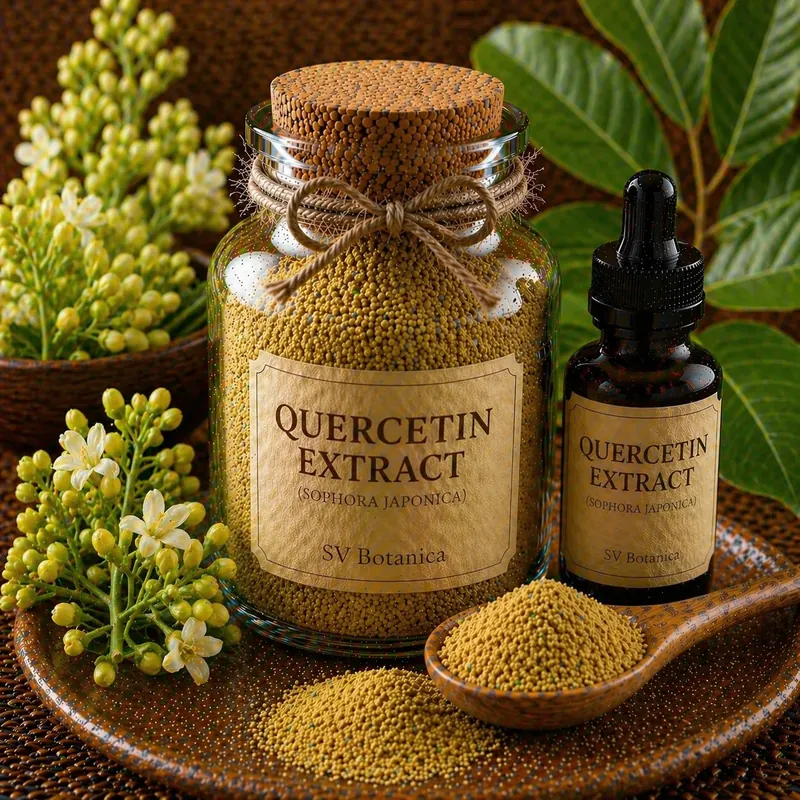
High-Purity Grade
Sophora japonica · 95% QuercetinA purified flavonol active — closer to a defined phytochemical than to a crude botanical extract
Quercetin is the most abundant flavonol in the human diet, present in onions, apples, capers, tea and dozens of other plants — but commercial quercetin is not made by concentrating any of them. It is produced from the flower buds of Sophora japonica L. (the Japanese pagoda tree, family Fabaceae), which accumulate the glycoside rutin at levels no other practical raw material approaches. Controlled hydrolysis cleaves rutin's sugar, and the liberated aglycone is crystallised and purified to a defined chemical entity.
That production route places quercetin in a different category from most botanicals on this site: it is a purified botanical active, specified like a phytochemical rather than a crude extract. SV Botanica supplies quercetin at NLT 95% by HPLC on the anhydrous basis, with a 98% high-purity grade, a defined dihydrate grade carrying two waters of crystallisation, and bioavailability-enhanced formats. Because the same powder can be assayed on an as-is or anhydrous basis with materially different results, the basis is stated explicitly on every specification and CoA — the single most important line on a quercetin document.
The material is a fine yellow to greenish-yellow powder with a faint characteristic odour. It is only sparingly water-soluble and has a low bulk density with poor wettability — genuine formulation variables that we address through mesh selection, granulated options and the enhanced-solubility grades. Residual rutin is monitored by HPLC on every batch as a direct readout of conversion completeness.
We supply supplement brands, functional-food manufacturers, sports-nutrition formulators and contract manufacturers worldwide, with a batch-specific Certificate of Analysis on every shipment.
The flavonol chemistry behind a rutin-derived purified active
3,3′,4′,5,7-pentahydroxyflavone — the free flavonol that constitutes 95–98% of the material and is quantified directly by HPLC against a reference standard.
The crystalline form carrying two molecules of water of crystallisation (~10.7% theoretical). The same molecule, but the water changes the as-is assay arithmetic — which is why the basis must be declared.
The source glycoside from Sophora flower buds — quercetin bound to rutinose. A small residual is normal; its level on the CoA is a direct measure of how completely the hydrolysis ran.
The mono-glucoside intermediate between rutin and free quercetin. Trace levels can appear in the chromatogram of a genuine rutin-derived material.
Structurally adjacent flavonols that co-occur at trace levels; their pattern in the impurity profile is part of what distinguishes authentic material.
Enhanced-solubility formats — glycosylated quercetin and lecithin co-processed (phytosome-style) grades — supplied where the free aglycone's low water solubility limits the application.
Why formulators specify a purified, HPLC-assayed quercetin — the functional role of the material
At 95–98% quercetin by HPLC, the material behaves like a defined phytochemical: dose arithmetic is simple, batch variation is minimal, and the label claim maps almost one-to-one onto powder weight. Formulators get the predictability of a purified compound with a botanical origin story.
Quercetin anchors the immune-support and seasonal-wellness category, routinely paired with vitamin C and zinc. Strong consumer recognition since 2020 gives brands a hero ingredient in this positioning that needs little education.
Anhydrous and dihydrate material can both legitimately read "95%" — on different bases. We state the basis (anhydrous) and the form on every CoA, with water by Karl Fischer on the dihydrate grade, so buyers compare quotations on identical arithmetic.
Quercetin's low bulk density, dustiness and poor wettability are real production issues in capsule filling and blending. Mesh selection, density reporting per batch and granulated options let the buyer match the powder to the process.
The free aglycone is sparingly water-soluble, and formulators increasingly specify formats developed around that constraint — glycosylated quercetin and lecithin co-processed phytosome-style grades — which we supply against buyer specification.
Quercetin's flavonol chemistry makes it a staple of the cardiovascular-wellness and healthy-ageing categories, where a purified, HPLC-verified active supports clean, quantified label declarations.
These are functional and physico-chemical properties of the actives; SV Botanica does not make medical or therapeutic claims for this ingredient.
The core specification for the flagship 95% grade, plus 98%, dihydrate and enhanced-bioavailability options
| Grade | Standardisation | Form | Best For | Solubility |
|---|---|---|---|---|
| Quercetin 95% Standard | Quercetin NLT 95% (HPLC, anhydrous basis) | Yellow to greenish-yellow fine powder, 40–80 mesh | Immune-support & antioxidant supplements, capsules & tablets | Sparingly water-soluble |
| Quercetin 98% High-purity | Quercetin NLT 98% (HPLC, anhydrous basis) | Yellow fine crystalline powder | Premium formulations, low-excipient formats, softgels | Sparingly water-soluble |
| Quercetin Dihydrate Dihydrate | Quercetin NLT 95% on anhydrous basis; water 8–12% by KF | Yellow fine powder | Standard supplement formats where the dihydrate form is specified | Sparingly water-soluble |
| Quercetin Enhanced-Bioavailability Formulated | Quercetin content declared per grade | Yellow to tan powder (carrier-dependent) | Beverages, gummies & formats requiring improved dispersion or absorption | Dispersible / grade-dependent |
The 95% grade (anhydrous basis) is our CoA-backed flagship, assayed by HPLC with identity confirmed against a quercetin reference standard. The 98% grade, defined dihydrate, glycosylated and lecithin co-processed formats, custom mesh and packaging can be quoted against buyer specification and order volume. Every batch is released against a batch-specific Certificate of Analysis stating form and assay basis.
Quercetin Extract is bought in three forms. The standardised extract is the stocked item; granulated and dispersible grades are produced on request and raw botanical forms are sourced against a confirmed order.
| Form | What it is | Specification basis | Availability |
|---|---|---|---|
| Standardised extract powder | Sophora japonica flower bud extract, dried and milled | NLT 95% quercetin (HPLC, anhydrous basis) | Stocked |
| Granulated (direct-compression) | Extract granulated for tablet lines | Same marker, declared on the granule | On request |
| Water-dispersible / soluble | Extract in a dispersible matrix for beverages, gummies and sachets | Marker declared on the matrix basis; carrier named | On request |
A marker percentage without its assay method is not a specification; ask for the method and the plant part on every quotation. Read Quercetin Extract: A Complete Buyer's Guide, Quercetin Purity: Rutin Conversion, HPLC Assay and the Anhydrous Basis and Quercetin Adulteration and How Authenticity Is Proven before comparing offers.
Full product specification for Quercetin 95%. Values are specification limits, not batch results; a batch-specific CoA is issued per shipment.
| Parameter | Specification / Limit | Method |
|---|---|---|
| Botanical Source | Sophora japonica L. | — |
| Plant Family | Fabaceae | — |
| Part Used | Flower bud | — |
| Country of Origin | India | — |
| Appearance | Fine powder | Organoleptic |
| Colour | Yellow to greenish-yellow* | Organoleptic |
| Odour | Characteristic, faint | Organoleptic |
| Taste | Characteristic, slightly bitter | Organoleptic |
| Identification | Retention time corresponds to quercetin reference standard | By HPLC / UV |
| Loss on Drying (at 105°C, % w/w) | NMT 5.0 (anhydrous grade) | IP-2014 |
| Water (dihydrate grade, % w/w) | 8.0 – 12.0 | Karl Fischer |
| Bulk Density (g/ml) | 0.15 – 0.40 (reported per batch) | IP-2014 |
| Particle Size (#40 mesh, % w/w) | NLT 95 (80 mesh available) | Sieve |
| Total Ash (% w/w) | NMT 1.0 | IP-2014 |
| Acid Insoluble Ash (% w/w) | NMT 0.5 | IP-2014 |
| Quercetin (% w/w, anhydrous basis) | NLT 95.0 | By HPLC |
| Residual Rutin (% w/w) | NMT 2.0 | By HPLC |
| Residual Solvent (Ethanol, ppm) | NMT 5,000 | By GC |
| Lead (ppm) | NMT 1.0 | ICP-MS |
| Arsenic (ppm) | NMT 1.0 | ICP-MS |
| Cadmium (ppm) | NMT 0.3 | ICP-MS |
| Mercury (ppm) | NMT 0.1 | ICP-MS |
| Pesticide Residues | Complies (EU MRL, on request) | GC-MS / LC-MS/MS |
| Ethylene Oxide (ETO) | Not treated — declaration provided | LC-MS/MS (on request) |
| Total Plate Count (cfu/g) | NMT 1,000 | USP <2021> |
| Yeast & Moulds / Fungi (cfu/g) | NMT 100 | USP <2021> |
| Escherichia coli | Absent | USP <2022> |
| Salmonella sp. | Absent | USP <2022> |
| Staphylococcus aureus | Absent | USP <2022> |
| Cultivation | Cultivated | Declaration |
| Kosher / Halal | Certified (on request) | Certification |
| Shelf Life | 36 months from date of manufacture, in original packed condition | — |
| Storage | Cool, dry place away from light and moisture, in tightly sealed containers | — |
*The product is of botanical origin; slight colour variation may occur between batches. Quercetin is assayed by HPLC on the anhydrous basis with identity confirmed against a reference standard; the form (anhydrous or dihydrate) and water content are stated on every CoA. A current Certificate of Analysis and MSDS are issued with every batch. EU pesticide MRL and ethylene oxide reports are available on request.
From Sophora flower bud to purified flavonol — authenticated, tested, documented
Raw Material & Authentication: The material is produced from cultivated Sophora japonica flower buds, the world's standard rutin source, via controlled hydrolysis and crystallisation. Identity is confirmed by HPLC retention time against a quercetin reference standard, and the impurity profile — residual rutin, isoquercitrin and related flavonols — is reviewed on every batch, because that profile is what distinguishes genuine rutin-derived quercetin from spiked or substituted material.
Manufacturing & Testing: Quercetin is manufactured at certified facilities in India. Each batch runs through a full QC battery — quercetin assay by HPLC on the anhydrous basis, residual rutin, loss on drying or water by Karl Fischer as the form requires, bulk density, ash and acid-insoluble ash, mesh, residual solvent by GC, heavy metals by ICP-MS, pesticide screening, and a complete USP microbiological panel — before release.
Documentation: Every shipment is supplied against a batch-specific Certificate of Analysis stating the form and assay basis, with an MSDS. Halal, Kosher and Organic certification are available. Country of Origin and export documentation are provided on request. A non-ETO declaration is standard, with LC-MS/MS testing available for EU-bound consignments — see our guides on EU pesticide MRL compliance and EU import requirements for botanical extracts.
What backs every batch of Quercetin extract
Key information for global product registration and labelling
Quercetin is an established dietary-supplement ingredient with a long history of use in the US and most Asian markets, supplied here to a defined purity specification with full analytical documentation. In the EU, conventional quercetin is widely used in food supplements, though buyers specifying unusually concentrated or novel delivery formats should confirm the position under the Novel Food framework for their specific preparation. Buyers remain responsible for determining suitability and for compliance with the relevant food-supplement regulations in their market. This product is not intended to diagnose, treat, cure or prevent any disease.
Quercetin carries a recognised INCI listing and is used as an antioxidant active in serums, creams and anti-pollution formats. As a concentrated active it should be used within the buyer's finished-product safety assessment; SV Botanica supplies the material specification and CoA to support that dossier.
Supplied from India by SV Botanica — FSSAI Central Licence holder and an APEDA-registered exporter. The material is processed and released at certified facilities with NABL-accredited laboratory testing, and shipped against a batch-specific Certificate of Analysis with export documentation available on request.
Deep-dive articles on quercetin for formulators, buyers, and brand owners
How to specify quercetin by grade and assay basis, what a CoA must show, and the dihydrate trap that skews price comparisons.
TechnicalRutin-conversion chemistry, what 95% on the anhydrous basis actually means, and how the HPLC assay works.
QualityWater weight, under-converted rutin, spiked assays — and the identity testing that catches them.
ApplicationsImmune, cardiovascular, sports and combination formats — and which quercetin grade fits each.
ProcurementA scored checklist for qualifying a quercetin supplier before you place a bulk order.
MarketWhere quercetin demand is growing across the US, EU and Asia, and which segments drive it.
Frequently co-formulated with Quercetin in antioxidant, immune-support & healthy-ageing blends
Technical and commercial questions answered by our ingredients team
High-purity, lab-tested, fully documented supply of Sophora-derived quercetin. NLT 95% by HPLC on a declared basis. Samples available for qualified buyers.
Supplied as a bulk ingredient for further manufacture. Buyers are responsible for compliance with the regulations of their destination market. This product is not intended to diagnose, treat, cure or prevent any disease.
We use cookies for analytics and to measure our advertising. Essential cookies are always on. Privacy policy