
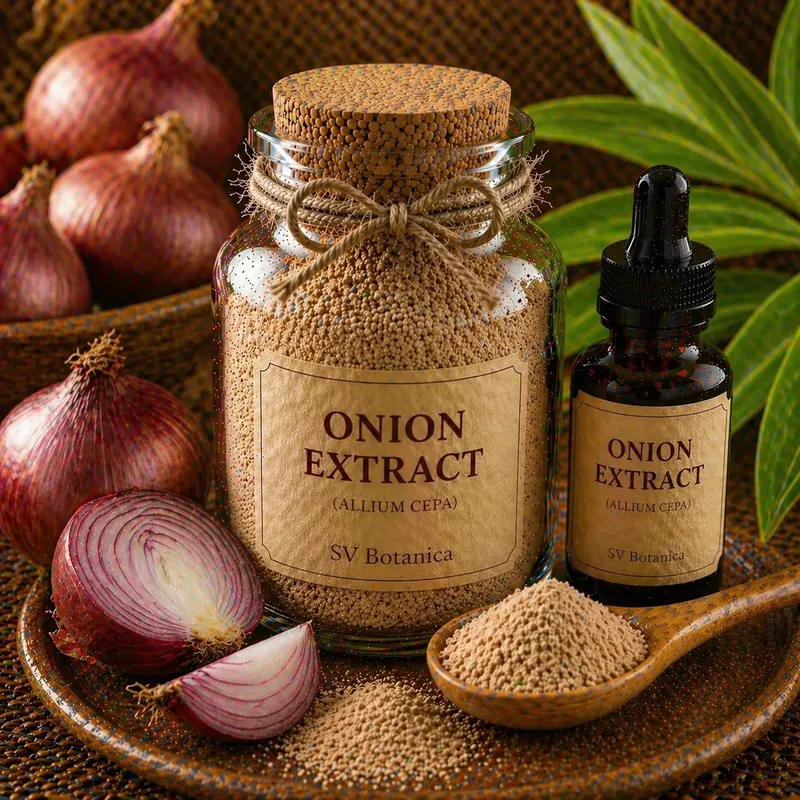
Allium cepa L. · Family: Amaryllidaceae · Bulb Extract
A food-origin source of quercetin, supplied at 10–30% by HPLC or as total flavonoids at 20–40%, with the basis stated on the certificate. That matters more here than on most materials: in onion the quercetin sits largely as glycosides, so expressing it as aglycone or as glycosides gives two different numbers on the same batch. Water-soluble, with a deodorised grade for formats where onion would carry through.
Basis Declared
Aglycone or Glycosides · StatedOne ingredient, two assay bases, and two products it is constantly confused with
Onion extract (Allium cepa) is a food-origin source of quercetin. That is its whole commercial argument: the active arrives inside a food matrix, with the accompanying flavonoids and the organosulfur fraction of the bulb, from a plant nobody has to be persuaded is edible.
The first thing to settle is the assay basis, and there are two layers to it. You can buy the extract assayed on quercetin at 10–30% by HPLC, or on total flavonoids at 20–40% — different measurements of different things. And within the first, there is a subtlety specific to this plant: in onion, quercetin is present mostly as glycosides, principally quercetin-4′-glucoside and quercetin-3,4′-diglucoside, rather than as the free aglycone. The same batch therefore reports one figure expressed as aglycone, usually after hydrolysis, and a different one expressed as glycosides. Neither is wrong. Not saying which is.
The second is sensory, and it is entirely practical. Onion carries its smell and taste into any chewable, liquid or sachet format. A deodorised grade holds the marker level and reduces that carry-through. For a hard capsule it is unnecessary; for a gummy or a beverage it usually decides whether the product is viable.
Two things this is not. It is not isolated quercetin, which is a purified compound, usually from another botanical source, bought on concentration and cost per milligram of active. And it is not onion peel extract: the dry outer skin is far richer in quercetin than the bulb, but it is a by-product that is not habitually eaten, so its regulatory position is a separate question. We keep the three apart and do not substitute one for another.
A word on origin, said plainly: Spain, Mexico and Peru are all significant onion producers, so the bulb as a raw material is close to many buyers. What is bought from India here is the extract — the assay on a declared basis, the deodorised grade, the water solubility — which is process rather than farming.
What the extract contains, and how it is measured
The marker flavonol, assayed by HPLC at 10–30% depending on grade, with the basis of expression declared on the certificate.
The form in which quercetin actually occurs in onion — chiefly quercetin-4′-glucoside and quercetin-3,4′-diglucoside. They are also markedly more water-soluble than the free aglycone, which is why this extract dissolves as well as it does.
The alternative assay basis at 20–40%, which measures the group rather than a single compound and is not interchangeable with a quercetin figure.
The sulfur fraction characteristic of the genus Allium, responsible for the odour and reduced in the deodorised grade.
The carbohydrate fraction of the bulb, part of what makes this a food-matrix extract rather than an isolate.
The dry outer skin is far richer in quercetin than the bulb and is offered as a separate product, with a separate regulatory question attached.
Two assay bases said plainly, and a grade that can actually be formulated
Quercetin or total flavonoids, and within quercetin, aglycone or glycosides. The certificate says which, so two quotations can be compared on the same footing.
The active arrives in a food matrix from a plant with unquestioned dietary history, which is the argument an isolate cannot make.
10–30% depending on grade, quantified by the method that suits a flavonol rather than a group assay.
The glycosides are far more soluble than free quercetin, so beverages, sachets and liquid formats work without a special grade.
Marker level held, sensory carry-through reduced — the difference between a viable gummy or beverage and an unusable one.
We will tell you when isolated quercetin or the peel extract is the better buy, rather than selling this one into the wrong brief.
These are functional and physico-chemical properties of the actives; SV Botanica does not make medical or therapeutic claims for this ingredient.
Four grades, chosen by assay basis and by format
| Grade | Standardisation | Form | Best For | Solubility |
|---|---|---|---|---|
| Quercetin Grade Standard | Quercetin 10–30% by HPLC, basis declared | Light yellowish brown fine powder, 40–80 mesh | Antioxidant supplements, flavonoid formulations, capsules & tablets | Water-soluble |
| Flavonoid Grade Alternative basis | Total flavonoids 20–40% | Light yellowish brown fine powder | Formulations written to a group assay rather than a single marker | Water-soluble |
| Deodorised Grade Sensory | Quercetin or flavonoids to specification, reduced sensory carry-through | Light fine powder | Gummies, beverages, sachets and chewables | Water-soluble |
| Organic Grade On request | To buyer specification, certified chain of custody | Per specification | Certified organic product lines | Per specification |
Fix two things in writing before comparing prices. The basis — quercetin or total flavonoids. And, if quercetin, how it is expressed — as aglycone, normally after hydrolysis of the glycosides, or as glycosides. Because onion quercetin is largely glycosylated, those two readings give different numbers on the same material and neither is incorrect. What is incorrect is a certificate that does not say which was used.
Onion extract is bought in four forms. The standardised extract is the reference item; granulated and deodorised grades are produced to order and the dehydrated bulb powder is sourced against a confirmed order.
| Form | What it is | Specification basis | Availability |
|---|---|---|---|
| Standardised extract powder | Allium cepa bulb extract, dried and milled | Quercetin 10–30% by HPLC with basis declared, or total flavonoids 20–40% | Stocked |
| Granulated (direct-compression) | Extract granulated for tablet lines | Same marker and same basis, declared on the granule | On request |
| Deodorised grade | Extract with the organosulfur fraction reduced | Marker to specification; sensory carry-through reduced | On request |
| Dehydrated bulb powder (non-extracted) | Dehydrated, milled Allium cepa bulb | Botanical identity; heavy metals and microbial panel | On enquiry, subject to lot |
A marker percentage without its method is not a specification, and on this material it is not one without its basis either. Ask for the method and for how the quercetin is expressed.
Full specification for the standard grade. Values are specification limits, not a particular batch result; every shipment carries its own certificate of analysis
| Parameter | Specification / Limit | Method |
|---|---|---|
| Botanical Source | Allium cepa L. | — |
| Plant Family | Amaryllidaceae | — |
| Part Used | Bulb — not the outer peel | — |
| Country of Origin | India | — |
| Appearance | Fine powder | Organoleptic |
| Colour | Light yellowish brown* | Organoleptic |
| Odour | Characteristic; reduced in the deodorised grade | Organoleptic |
| Identification | Botanical identity confirmed per batch | TLC |
| Quercetin (% w/w) | 10 – 30 by grade; basis declared on the certificate | HPLC |
| Assay basis | Aglycone (after hydrolysis) or glycosides — stated per batch | Declaration |
| Total Flavonoids (% w/w) | 20 – 40 (flavonoid grade) | HPLC / UV |
| Solubility | Soluble in water | — |
| Loss on Drying (105°C, % w/w) | NMT 5.0 | IP-2014 |
| pH (1% w/v solution) | 4 – 7 | IP-2014 |
| Bulk Density (g/ml) | NLT 0.35 | IP-2014 |
| Particle Size | 40 – 80 mesh | Sieve |
| Total Ash (% w/w) | NMT 10 | IP-2014 |
| Acid-Insoluble Ash (% w/w) | NMT 2 | IP-2014 |
| Residual Solvent (ethanol, ppm) | NMT 5,000 | GC |
| Lead (ppm) | NMT 1.0 | ICP-MS |
| Arsenic (ppm) | NMT 1.0 | ICP-MS |
| Cadmium (ppm) | NMT 0.3 | ICP-MS |
| Mercury (ppm) | NMT 0.1 | ICP-MS |
| Total Heavy Metals (ppm) | NMT 10 | ICP-MS |
| Pesticide Residues | Complies (EU MRL, on request) | GC-MS / LC-MS/MS |
| Ethylene Oxide (ETO) | Not treated with ETO — declaration provided | LC-MS/MS (on request) |
| Aflatoxins B1 / total (ppb) | NMT 2 / NMT 4 | HPLC-FLD |
| Total Plate Count (cfu/g) | NMT 10,000 | USP <2021> |
| Yeast & Mould (cfu/g) | NMT 100 | USP <2021> |
| Escherichia coli | Absent | USP <2022> |
| Salmonella sp. | Absent | USP <2022> |
| Staphylococcus aureus | Absent | USP <2022> |
| Irradiation | Not irradiated — declaration provided | Declaration |
| GMO Status | GMO-free — declaration provided | Declaration |
| Kosher / Halal | Certified (on request) | Certification |
| Shelf Life | 24–36 months from manufacture, in unopened original packing | — |
*Plant-derived product; colour may vary slightly by region and season. The assay-basis line is what makes the figure comparable. In onion, quercetin occurs mostly as glycosides — chiefly quercetin-4′-glucoside and quercetin-3,4′-diglucoside — rather than as the free aglycone. The same batch therefore reports one number expressed as aglycone, normally after hydrolysis, and a different number expressed as glycosides; neither reading is incorrect, but they are not interchangeable. On top of that sits the choice between assaying quercetin and assaying total flavonoids, which measure different things. The certificate always states which was used. Note also the part used: this is the bulb, not the outer peel, which is a separate product with a much higher quercetin content and a separate regulatory question. Current CoA and MSDS accompany every batch.
From bulb to documented extract, with the basis of the number in plain view
Raw material and identity: the extract is prepared from the bulb of Allium cepa, with botanical identity confirmed per batch. The dry outer peel is offered as a separate product and is never blended into this one.
Assay with the basis in view: quercetin is quantified by HPLC and the certificate states whether the result is expressed as aglycone, normally after hydrolysis of the glycosides, or as glycosides, and whether the assay is of quercetin or of total flavonoids. Onion quercetin is largely glycosylated, so those readings differ on the same material.
Sensory control: the deodorised grade reduces the organosulfur fraction that carries onion odour and taste into unencapsulated formats, while holding the specified marker level.
Manufacturing, control and documentation: the extract is manufactured at GMP- and ISO-certified facilities in India. Every batch runs a full panel — quercetin or flavonoids by HPLC, moisture, pH, bulk density, sieve, ash, residual solvent, heavy metals by ICP-MS, aflatoxins and the USP microbial panel — with not-irradiated and GMO-free declarations, EU MRL pesticide screening and a not-treated-with-ETO declaration on request. Each shipment carries its certificate of analysis and MSDS; certifications and export documentation are provided on request via our certifications page.
What backs every batch of Onion extract
Key information for global product registration and labelling
Onion is a food of established consumption in the European Union and is not a novel food, which makes this one of the simpler ingredients in the range to notify. Confirm nonetheless the status of the specific preparation where the extract is highly concentrated. The line worth watching is the part of the plant: the bulb is the habitually eaten part, whereas the dry outer peel is a by-product that is not habitually consumed, so the bulb's status does not carry across to it. That is why we keep the peel extract as a separate product with its own page and its own caution rather than folding it in here.
There are no authorised health claims in the EU for quercetin, so antioxidant and cardiovascular references cannot be carried onto a label in those terms, however rich the material is in flavonols. This is a limitation of the whole flavonoid category in Europe rather than of this product. Measured antioxidant capacity is a characterisation datum for the material, not a product claim. The buyer is responsible for assessing suitability and compliance in their market. This product is not intended to diagnose, treat, cure or prevent any disease.
Spain, Mexico and Peru are all significant onion producers, so for many buyers the bulb as a raw material is available close to home and often at a better landed cost than anything shipped from India. What is bought from India here is the extract: the assay on a declared basis, the deodorised grade and the water-soluble behaviour, which are process rather than farming. If your project can obtain an extract locally with the same documentation, that is a legitimate option and we will say so.
Ingredients commonly formulated alongside onion extract
Technical and commercial questions answered by our ingredients team
Quercetin at 10–30% by HPLC or total flavonoids at 20–40%, with the assay basis declared, plus water-soluble and deodorised grades. Samples for qualified buyers.
Supplied as a bulk ingredient for further manufacture. Buyers are responsible for compliance with the regulations of their destination market. This product is not intended to diagnose, treat, cure or prevent any disease.
We use cookies for analytics and to measure our advertising. Essential cookies are always on. Privacy policy