
Plectranthus barbatus Andrews (syn. Coleus forskohlii) · Family: Lamiaceae · Root Extract
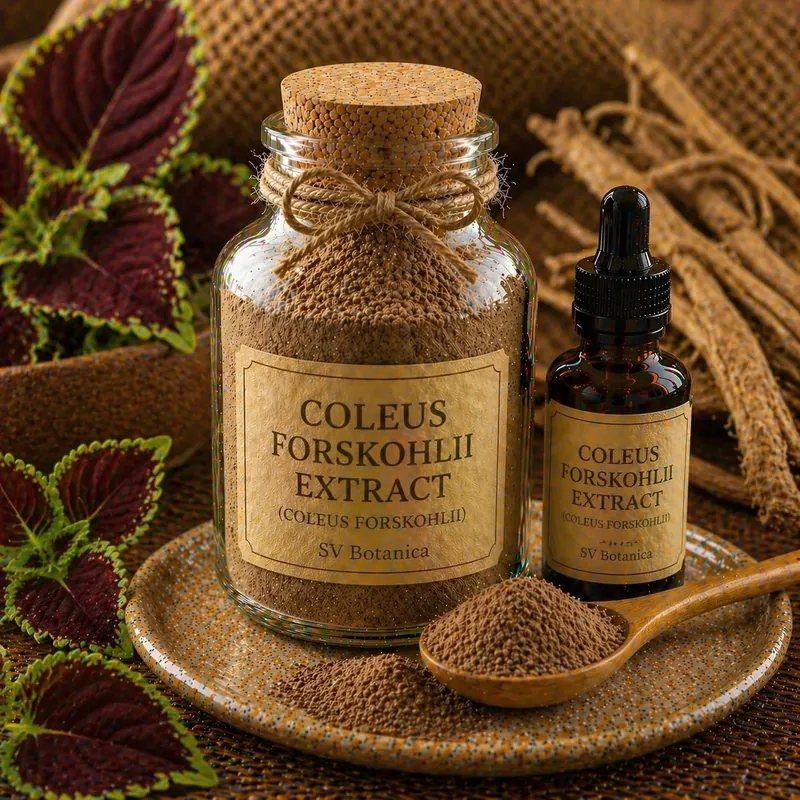
A forskolin-standardised coleus root extract, assayed at 10%, 20% or 40% by HPLC — root only, with species declared, because forskolin sits in the tuberous root and nowhere else in the plant. Prepared from Plectranthus barbatus for weight-management, sports-nutrition and cosmetic formulators. CoA-backed, HPLC-authenticated supply from India.
Standardised Grade
Forskolin 10% · 20% · 40%A single defined compound, a single plant part, and a supply base under real pressure
Coleus forskohlii — correctly Plectranthus barbatus Andrews under current taxonomy, though the trade universally retains the older name — is a member of the mint family native to the Indian subcontinent, where its tuberous root has long been used in Ayurveda and, in some regions, pickled as a food. It is a genuinely Indian ingredient: essentially all commercial supply originates here.
Its commercial identity rests on a single defined compound: forskolin, a labdane diterpene also called coleonol. That makes coleus refreshingly straightforward to specify compared with the saponin and polyphenol classes elsewhere in this category — forskolin is one molecule, it has a reference standard, and it is assayed by HPLC with real specificity. There is no method ambiguity to navigate.
Two things do require care. First, forskolin is confined to the tuberous root. Leaf, stem and aerial parts contain essentially none, which makes a root-only declaration a genuine quality control rather than a formality — aerial material is cheap, abundant at harvest, and dilutes the extract while looking plausible. Second, the higher grades deserve honest framing: a 40% forskolin material is closer to a purified compound than to a botanical extract, and that distinction matters for labelling, for regulatory position and for how you present it.
The supply picture also warrants attention. Coleus is a root crop harvested destructively — the plant is lifted to obtain the tuber — and sustained demand has put real pressure on the cultivation base. Availability and price are more volatile than for a leaf or bark botanical, and contracting ahead is worth more here than in most of this category.
One marker compound, and what accompanies it
The labdane diterpene that defines the ingredient. A single defined compound with an available reference standard, assayed by HPLC to 10%, 20% or 40%.
Structurally related labdane diterpenes co-occurring in the root; part of the extract's characteristic chromatographic fingerprint.
A related diterpene present in the root and useful as a supporting authenticity marker alongside the primary assay peak.
The aromatic fraction of the root, characteristic of the Lamiaceae family and contributing to the material's odour profile.
The bulk matrix of the tuberous root, largely removed in higher-assay grades — which is why a 40% grade behaves differently from a 10%.
Minor phenolic constituents typical of the mint family, present in full-spectrum and lower-assay grades.
Why formulators specify a root-only, HPLC-assayed forskolin extract
Forskolin is one defined molecule with a reference standard, not a compound class. That gives coleus a specificity most botanicals in this category cannot offer — the number means one thing, measured one way.
Forskolin occurs in the tuberous root and essentially nowhere else in the plant. Aerial material is cheap and abundant at harvest, so a root-only declaration is a real quality control rather than boilerplate.
Coleus is an established component of the weight-management and body-composition ingredient set, with forskolin as a named, quantifiable active for formulators building on a defined load.
The 20% and 40% grades suit crowded sports stacks where fill volume is contested and a low-inclusion, high-assay active earns its space.
Forskolin-standardised material is used in cosmetic actives and self-tanning adjacent formulations, where a defined assay and a clean specification matter as much as in supplements.
10%, 20% and 40% grades let formulators match fill volume and cost — though the 40% is best understood as a near-purified compound rather than a conventional extract.
These are functional and physico-chemical properties of the actives; SV Botanica does not make medical or therapeutic claims for this ingredient.
Three assay strengths — and one of them is not really an extract
| Grade | Standardisation | Form | Best For | Solubility |
|---|---|---|---|---|
| Coleus Extract 10% Standard | Forskolin NLT 10% (HPLC); root only | Light brown to tan fine powder, ≥95% through 40 mesh | Weight-management supplements, multi-ingredient blends | Partially water-soluble |
| Coleus Extract 20% High-assay | Forskolin NLT 20% (HPLC); root only | Tan to light brown fine powder | Sports stacks, fill-volume-constrained formats | Partially water-soluble |
| Coleus Extract 40% Near-purified | Forskolin NLT 40% (HPLC); root only | Off-white to pale tan fine powder | Low-dose formats, cosmetic actives — see note | Poorly water-soluble |
| Coleus Extract WD Water-dispersible | Forskolin to specification, dispersible grade | Tan free-flowing powder | Beverages, sachets & drink mixes | Water-dispersible |
| Coleus Extract Ratio Full-spectrum | Native ratio; forskolin reported | Brown fine powder | Traditional & Ayurvedic formats | Grade-dependent |
A candid note on the 40% grade: at that concentration the material is closer to a purified compound than to a botanical extract, since most of the root matrix has been removed. That distinction matters for how you describe it on a label, for its regulatory position in some markets, and for its handling — forskolin itself is poorly water-soluble, so higher-assay grades disperse less readily than lower ones. All grades are root-only with the species declared and forskolin assayed by HPLC. Every batch is released against a batch-specific Certificate of Analysis.
Coleus Forskohlii Extract is bought in five forms. The standardised extract is the stocked item; granulated and dispersible grades are produced on request and raw botanical forms are sourced against a confirmed order.
| Form | What it is | Specification basis | Availability |
|---|---|---|---|
| Standardised extract powder | Plectranthus barbatus root extract, dried and milled | NLT 10% forskolin (HPLC), root only | Stocked |
| Granulated (direct-compression) | Extract granulated for tablet lines | Same marker, declared on the granule | On request |
| Water-dispersible / soluble | Extract in a dispersible matrix for beverages, gummies and sachets | Marker declared on the matrix basis; carrier named | On request |
| Root powder (non-extracted) | Cleaned, dried Plectranthus barbatus root, milled to mesh | Botanical identity by TLC; heavy metals and microbial panel | On enquiry, subject to lot; phytosanitary certificate usually required |
| Cut & sifted root | Dried root pieces, sifted to size | Identity, moisture, foreign matter | On enquiry; for tea, decoction and in-house extraction |
A marker percentage without its assay method is not a specification; ask for the method and the plant part on every quotation. Read Coleus Forskohlii Extract: A Complete Buyer's Guide, Forskolin: How Coleus Forskohlii Extract Is Standardised and Coleus Forskohlii Adulteration and How Authenticity Is Proven before comparing offers.
Full product specification for Coleus Forskohlii Root Extract 10% forskolin. Values are specification limits, not batch results; a batch-specific CoA is issued per shipment.
| Parameter | Specification / Limit | Method |
|---|---|---|
| Botanical Source | Plectranthus barbatus Andrews (syn. Coleus forskohlii) | — |
| Plant Family | Lamiaceae | — |
| Part Used | Root only (tuberous root) | — |
| Country of Origin | India | — |
| Appearance | Fine powder | Organoleptic |
| Colour | Light brown to tan* | Organoleptic |
| Odour | Characteristic, aromatic | Organoleptic |
| Taste | Characteristic | Organoleptic |
| Identification | Corresponds to forskolin — positive | By TLC / HPLC |
| Forskolin (% w/w, dry basis) | NLT 10.0 (20 / 40 in high-assay grades) | By HPLC |
| Related Diterpene Profile | Corresponds to reference — reported on request | By HPLC |
| Aerial Part Material | Absent — root-only declaration provided | Declaration / TLC |
| Loss on Drying (at 105°C, % w/w) | NMT 5.0 | IP-2014 |
| pH (1% w/v solution) | 4 – 7 | IP-2014 |
| Bulk Density (g/ml) | NLT 0.35 | IP-2014 |
| Particle Size (#40 mesh, % w/w) | NLT 95 | Sieve |
| Total Ash (% w/w) | NMT 8 | IP-2014 |
| Acid Insoluble Ash (% w/w) | NMT 2 | IP-2014 |
| Residual Solvent (Ethanol / Hexane, ppm) | NMT 5,000 / NMT 290 | By GC |
| Lead (ppm) | NMT 1.0 | ICP-MS |
| Arsenic (ppm) | NMT 1.0 | ICP-MS |
| Cadmium (ppm) | NMT 0.3 | ICP-MS |
| Mercury (ppm) | NMT 0.1 | ICP-MS |
| Pesticide Residues | Complies (EU MRL, on request) | GC-MS / LC-MS/MS |
| Ethylene Oxide (ETO) | Not treated — declaration provided | LC-MS/MS (on request) |
| Total Plate Count (cfu/g) | NMT 1,000 | USP <2021> |
| Yeast & Moulds / Fungi (cfu/g) | NMT 100 | USP <2021> |
| Escherichia coli | Absent | USP <2022> |
| Salmonella sp. | Absent | USP <2022> |
| Staphylococcus aureus | Absent | USP <2022> |
| Cultivation | Cultivated | Declaration |
| Kosher / Halal | Certified (on request) | Certification |
| Shelf Life | 36 months from date of manufacture, in original packed condition | — |
| Storage | Cool, dry place away from light and moisture, in tightly sealed containers | — |
*The product is of herbal origin; slight colour variation may occur due to geographical and seasonal variation in the raw material. The root-only declaration is a substantive control on this ingredient — forskolin is confined to the tuberous root, and aerial material is abundant and cheap at harvest, so leaf and stem inclusion dilutes the extract while remaining visually plausible. Residual solvent deserves particular attention here: higher-assay forskolin grades commonly involve non-polar solvent steps, so we report hexane separately against a tighter limit rather than folding all solvents into one figure. A current Certificate of Analysis and MSDS are issued with every batch.
From tuberous root to standardised extract — root-verified, HPLC-assayed, documented
Raw Material & Authentication: The extract is prepared from cultivated Plectranthus barbatus tuberous root. Because forskolin is confined to the root and the aerial parts of the plant contain essentially none, verifying that the incoming material is root — not root plus the leaf and stem that arrive with it at harvest — is the primary raw-material control on this ingredient. Species and part are declared on every batch.
Manufacturing & Testing: Coleus Root Extract is manufactured at certified facilities in India. Each batch runs through a full QC battery — forskolin by HPLC against a reference standard, related diterpene profile, loss on drying, pH, bulk density, ash and acid-insoluble ash, mesh, residual solvent by GC with hexane reported separately, heavy metals by ICP-MS, pesticide residue screening, and a complete USP microbiological panel — before release.
Documentation: Every shipment is supplied against a batch-specific Certificate of Analysis stating species, part used and the HPLC forskolin figure, with an MSDS. Halal, Kosher and Organic certification are available. Country of Origin and export documentation are provided on request — see our guides on EU pesticide MRL compliance and EU import requirements for botanical extracts.
What backs every batch of Coleus extract
Key information for global product registration and labelling
Supplied as a botanical active to a defined forskolin specification with full analytical documentation. One point deserves explicit attention: at 40% forskolin the material is closer to a purified compound than to a conventional botanical extract, since most of the root matrix has been removed. That distinction can matter for how a product is described on a label and for its regulatory classification in some markets, where highly purified plant constituents are treated differently from traditional extracts. Buyers should confirm the position for their market and grade. This product is not intended to diagnose, treat, cure or prevent any disease.
Coleus is used predominantly in weight-management and body-composition formats — a category that attracts sustained regulatory attention, particularly around claims and around multi-ingredient formulations. Responsible practice is to formulate to established use levels, avoid disease or dramatic outcome claims, and hold complete documentation for every component of a blend. Buyers remain responsible for compliance with the food-supplement regulations applying in their market.
Supplied from India by SV Botanica — FSSAI Central Licence holder and an APEDA-registered exporter. Essentially all commercial coleus forskohlii originates in India, giving direct access to the cultivation base rather than a re-export chain. The material is Kosher certified and shipped against a batch-specific Certificate of Analysis with export documentation available on request.
Deep-dive articles on coleus forskohlii extract for formulators, buyers, and brand owners
Root-only, species-declared, HPLC-assayed — and why the 40% grade needs different thinking.
TechnicalA single compound with a real reference standard — and where the specification still needs care.
QualityAerial material, synthetic spiking and species confusion — and how HPLC settles each.
ApplicationsWeight-management, sports and cosmetic formats — plus forskolin's real solubility problem.
ProcurementA scored checklist for qualifying a coleus supplier, weighted around root verification.
MarketA single-origin root crop under cultivation pressure — what that means for price and availability.
Frequently co-formulated with Coleus Forskohlii Extract in weight-management & sports blends
Technical and commercial questions answered by our ingredients team
Forskolin-standardised by HPLC at 10%, 20% or 40%, root-only with species declared. Direct from the world's origin for this crop. Samples available for qualified buyers.
Supplied as a bulk ingredient for further manufacture. Buyers are responsible for compliance with the regulations of their destination market. This product is not intended to diagnose, treat, cure or prevent any disease.
We use cookies for analytics and to measure our advertising. Essential cookies are always on. Privacy policy