
Syzygium aromaticum (L.) Merr. & L.M.Perry · Family: Myrtaceae · Flower Bud Extract
A polyphenol-dense clove flower-bud extract standardised to eugenol 60–70% by GC, with a 70–80% dental-pharma grade for oral-care ingredient supply. Prepared from the dried flower bud of Syzygium aromaticum for antioxidant, oral-care, digestive-comfort and preservation-system formulators. CoA-backed, GC-verified supply from India.
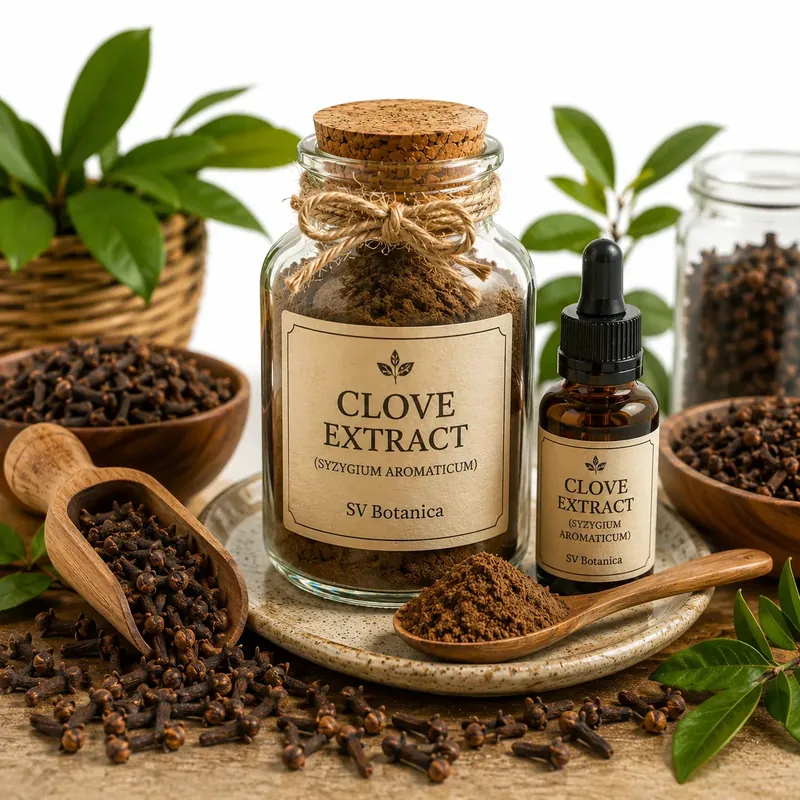
Standardised Grade
Syzygium aromaticum · 60–70% EugenolA eugenol-standardised active from one of the most polyphenol-dense botanicals in commerce
Clove (Syzygium aromaticum) is the dried, unopened flower bud of a Myrtaceae tree native to the Maluku Islands and now cultivated across Indonesia, Madagascar, Zanzibar, Sri Lanka and southern India. It has moved through two thousand years of trade history — Han-dynasty court etiquette, the spice routes, Ayurvedic practice as lavanga — on the strength of a single remarkable property: no common spice packs more phenolic material into less weight. A standardised extract concentrates that chemistry into a defined, assayable powder a formulator can dose with confidence.
The defining constituent is eugenol, a volatile phenylpropene that typically makes up the great majority of clove's essential-oil fraction and is the reason clove smells and tastes like clove. SV Botanica standardises this extract to eugenol 60–70% by GC for nutraceutical use, with a 70–80% dental-pharma grade for oral-care and dental-material ingredient supply. Because eugenol is volatile, the industry-correct assay is gas chromatography — a point that matters more than it appears, and one we cover in depth in our standardisation guide.
Alongside eugenol sit eugenyl acetate — the ester that distinguishes genuine bud material from cheaper stem- and leaf-derived eugenol — and β-caryophyllene, plus a substantial non-volatile polyphenol fraction of gallotannins, eugeniin and flavonoids. That polyphenol density is what puts whole clove at the top of published ORAC tables among common spices; we state it as a compositional fact of the material, not as a claim about what the finished product will do.
The extract is finished as a free-flowing brown to dark brown powder, milled to 40–80 mesh, partially water-soluble with a cold-water-soluble grade available. We supply supplement brands, oral-care and dental-material manufacturers, functional-food and beverage processors and traditional-formulation houses, with a batch-specific Certificate of Analysis on every shipment.
The volatile phenylpropenes and polyphenols that define the clove bud
A volatile phenylpropene (4-allyl-2-methoxyphenol) and the dominant active of the clove bud. Standardised here at 60–70% by GC, with a 70–80% dental-pharma grade.
The acetate ester of eugenol, present in meaningful quantity only in bud-derived material — which makes it the single most useful authenticity marker on a clove CoA.
A bicyclic sesquiterpene that rounds out the volatile fraction and contributes the dry, woody facet of clove's aroma profile.
The non-volatile tannin fraction — including the ellagitannin eugeniin — that carries much of clove's exceptional polyphenol density and radical-quenching capacity in vitro.
Kaempferol, quercetin and rhamnetin glycosides that co-occur with the tannins and contribute to the total phenolic figure of the bud.
Oleanolic acid and related triterpenoids of the bud matrix, part of the full-spectrum profile carried through into the finished extract.
Why formulators specify a eugenol-standardised clove extract — the functional role of the markers
Eugenol defines clove's functional identity, and because it is volatile the correct assay is gas chromatography. A declared eugenol percentage by GC lets formulators build oral-care, antioxidant and digestive-comfort products on a verifiable active load rather than a vague extract ratio.
Clove sits at the top of published ORAC rankings among common spices — a compositional consequence of its tannin and phenolic load. For antioxidant-positioned formulas, that density means a meaningful polyphenol contribution from a small inclusion weight.
Eugenol has a long-established place in dental materials — zinc oxide–eugenol cements and dressings are standard of trade — and in oral-care formats from toothpaste to mouthwash. The 70–80% grade is supplied specifically as an ingredient input for these regulated applications.
Cheap eugenol from clove stem and leaf oil, or from synthesis, can hit the same headline assay as genuine bud extract. The eugenyl acetate and caryophyllene profile is the fingerprint that proves bud origin — and we report it, because the number alone proves nothing.
A water-soluble grade suits mouthwashes, functional beverages and clear-format applications, while the standard grade suits capsules, tablets, toothpaste bases and dry blends. An organic-certified grade is available for certified product lines.
A free-flowing powder milled to 40–80 mesh with controlled moisture (NMT 5%) disperses and blends predictably, and the declared eugenol load lets you hold a stable sensory and active profile batch to batch.
These are functional and physico-chemical properties of the actives; SV Botanica does not make medical or therapeutic claims for this ingredient.
The core specification for the flagship 60–70% eugenol grade, plus dental-pharma, water-soluble and organic options
| Grade | Standardisation | Form | Best For | Solubility |
|---|---|---|---|---|
| Clove Extract 60–70% Standard | Eugenol 60–70% (GC) | Brown to dark brown fine powder, 40–80 mesh | Antioxidant & digestive supplements, oral-care formats, capsules & tablets | Partially water-soluble |
| Clove Extract 70–80% Dental-pharma | Eugenol 70–80% (GC) | Brown to dark brown fine powder | Dental-material inputs, toothpaste & mouthwash actives, topical oral-care preparations | Partially water-soluble |
| Clove Extract WS Water-soluble | Water-soluble grade, eugenol declared per batch | Brown free-flowing powder | Mouthwashes, functional beverages, clear formats & drink mixes | Cold-water-soluble |
| Clove Extract Organic Certified organic | Eugenol declared per batch (GC) | Brown to dark brown fine powder | Certified-organic supplement & food lines | Partially water-soluble |
The 60–70% eugenol grade is our CoA-backed flagship, assayed by GC with identity confirmed by TLC; the 70–80% grade is supplied for dental and oral-care ingredient applications. Water-soluble and certified-organic grades, custom mesh and packaging can be quoted against buyer specification and order volume. Every batch is released against a batch-specific Certificate of Analysis.
Clove Extract is bought in five forms. The standardised extract is the stocked item; granulated and dispersible grades are produced on request and raw botanical forms are sourced against a confirmed order.
| Form | What it is | Specification basis | Availability |
|---|---|---|---|
| Standardised extract powder | Syzygium aromaticum flower bud extract, dried and milled | Eugenol 60–70% (GC) | Stocked |
| Granulated (direct-compression) | Extract granulated for tablet lines | Same marker, declared on the granule | On request |
| Water-dispersible / soluble | Extract in a dispersible matrix for beverages, gummies and sachets | Marker declared on the matrix basis; carrier named | On request |
| Clove powder (ground buds) | Dried Syzygium aromaticum flower buds, ground | Volatile oil, eugenol; moisture | On enquiry; spice-trade item |
| Whole cloves | Cleaned, graded whole buds | Volatile oil, headless count, moisture | On enquiry; see the whole-spice range |
A marker percentage without its assay method is not a specification; ask for the method and the plant part on every quotation. Read Clove Extract: A Complete Buyer's Guide, Eugenol and How Clove Extract Is Standardised and Clove Extract Adulteration and How Bud Origin Is Proven before comparing offers.
Full product specification for Clove Bud Extract 60–70%. Values are specification limits, not batch results; a batch-specific CoA is issued per shipment.
| Parameter | Specification / Limit | Method |
|---|---|---|
| Botanical Source | Syzygium aromaticum (L.) Merr. & L.M.Perry | — |
| Plant Family | Myrtaceae | — |
| Part Used | Flower bud | — |
| Country of Origin | India | — |
| Appearance | Fine powder | Organoleptic |
| Colour | Brown to dark brown* | Organoleptic |
| Odour | Characteristic, strongly aromatic of clove | Organoleptic |
| Taste | Characteristic, pungent, slightly astringent | Organoleptic |
| Identification | Corresponds to eugenol — positive | By TLC |
| Loss on Drying (at 105°C, % w/w) | NMT 5.0 | IP-2014 |
| pH (1% w/v solution) | 4 – 7 | IP-2014 |
| Bulk Density (g/ml) | NLT 0.35 | IP-2014 |
| Particle Size (#40 mesh, % w/w) | NLT 95 | Sieve |
| Total Ash (% w/w) | NMT 8 | IP-2014 |
| Acid Insoluble Ash (% w/w) | NMT 2 | IP-2014 |
| Eugenol (% w/w, dry basis) | 60 – 70 | By GC |
| Eugenyl Acetate (% w/w) | Reported per batch | By GC |
| β-Caryophyllene (% w/w) | Reported per batch | By GC |
| Residual Solvent (Ethanol, ppm) | NMT 5,000 | By GC |
| Heavy Metals (total, ppm) | NMT 10 | ICP-MS |
| Lead (ppm) | NMT 1.0 | ICP-MS |
| Arsenic (ppm) | NMT 1.0 | ICP-MS |
| Cadmium (ppm) | NMT 0.3 | ICP-MS |
| Mercury (ppm) | NMT 0.1 | ICP-MS |
| Pesticide Residues | Complies (EU MRL, on request) | GC-MS / LC-MS/MS |
| Ethylene Oxide (ETO) | Not treated — declaration provided | LC-MS/MS (on request) |
| Aflatoxins B1 / Total (ppb) | NMT 2 / NMT 4 | HPLC-FLD |
| Total Plate Count (cfu/g) | NMT 1,000 | USP <2021> |
| Yeast & Moulds / Fungi (cfu/g) | NMT 100 | USP <2021> |
| Escherichia coli | Absent | USP <2022> |
| Salmonella sp. | Absent | USP <2022> |
| Staphylococcus aureus | Absent | USP <2022> |
| Cultivation | Cultivated | Declaration |
| Kosher / Halal | Certified (on request) | Certification |
| Shelf Life | 24–36 months from date of manufacture (grade-dependent), in original packed condition | — |
| Storage | Cool, dry place away from light and moisture, in tightly sealed containers | — |
*The product is of herbal origin; slight colour variation may occur due to geographical and seasonal variation in the raw material. Eugenol is standardised by GC and identity is confirmed by TLC; eugenyl acetate and β-caryophyllene are reported per batch on request as bud-origin markers. A current Certificate of Analysis and MSDS are issued with every batch. EU pesticide MRL and ethylene oxide reports are available on request.
From flower bud to standardised extract — authenticated, tested, documented
Raw Material & Authentication: The extract is prepared from cultivated Syzygium aromaticum flower bud. Because eugenol is cheaply available from clove stem and leaf oil — and from synthesis — clove extract is a recognised target for origin fraud. Identity is confirmed by TLC against reference eugenol, the assay is run by GC, and the eugenyl acetate and β-caryophyllene profile is checked as a bud-origin fingerprint before a lot is accepted.
Manufacturing & Testing: Clove Bud Extract is manufactured at certified facilities in India. Each batch runs through a full QC battery — eugenol by GC, loss on drying, pH, bulk density, ash and acid-insoluble ash, mesh, residual solvent by GC, heavy metals by ICP-MS, aflatoxins by HPLC-FLD, pesticide residue screening, and a complete USP microbiological panel — before release.
Documentation: Every shipment is supplied against a batch-specific Certificate of Analysis with an MSDS. Halal, Kosher and Organic certification are available. Country of Origin and export documentation are provided on request. Because dried spice-derived materials are a recognised ethylene-oxide risk category, we supply a non-ETO declaration and can add LC-MS/MS testing — see our guides on EU pesticide MRL compliance and EU import requirements for botanical extracts.
What backs every batch of Clove extract
Key information for global product registration and labelling
Used as a botanical active in supplement, functional-food and beverage formats, the extract is supplied to a defined eugenol specification with full analytical documentation. Clove has centuries of food and spice use in essentially every market, which simplifies its regulatory position relative to novel botanicals; unusually concentrated preparations for the EU should still be checked against the Novel Food framework before formulation. Buyers remain responsible for determining suitability and for compliance with the relevant food-supplement regulations in their market. This product is not intended to diagnose, treat, cure or prevent any disease.
Eugenol has a long-established place in dental materials — zinc oxide–eugenol cements, temporary dressings and related systems — and clove extract is an established input for toothpaste, mouthwash and gum-care formats. SV Botanica supplies the ingredient specification and CoA to support the buyer's own product dossier. Formulators for the EU should note that eugenol is a listed fragrance allergen under the EU Cosmetics Regulation and must be declared on-label above the threshold concentrations; the eugenol content stated on our CoA supports that calculation.
Supplied from India by SV Botanica — FSSAI Central Licence holder and an APEDA-registered exporter. Clove is cultivated in the hill tracts of Kerala and Tamil Nadu, and India's extraction and analytical infrastructure — GC assay, NABL-accredited testing — is built for regulated export markets. The material is shipped against a batch-specific Certificate of Analysis with export documentation available on request.
Deep-dive articles on clove extract for formulators, buyers, and brand owners
How to specify clove extract by eugenol content, what a CoA must show, and the bud-versus-stem trap most buyers never check.
TechnicalWhat the eugenol percentage means, why the assay is GC rather than HPLC, and the acetate ratio that proves bud origin.
QualityStem- and leaf-derived eugenol, synthetic spiking and spent bud marc — and the fingerprint testing that catches them.
ApplicationsAntioxidant, oral-care, digestive and food-preservation formats — and which clove grade fits each.
ProcurementA scored checklist for qualifying a clove extract supplier before you place a bulk order.
MarketOne crop, five bidders — where clove demand comes from, why prices swing, and what it means for buyers.
Frequently co-formulated with Clove Extract in antioxidant, oral-care & spice-active blends
Technical and commercial questions answered by our ingredients team
Eugenol-standardised, lab-tested, fully documented supply of Syzygium aromaticum flower-bud extract. Eugenol 60–70% by GC, with a 70–80% dental-pharma grade. Samples available for qualified buyers.
Supplied as a bulk ingredient for further manufacture. Buyers are responsible for compliance with the regulations of their destination market. This product is not intended to diagnose, treat, cure or prevent any disease.
We use cookies for analytics and to measure our advertising. Essential cookies are always on. Privacy policy