
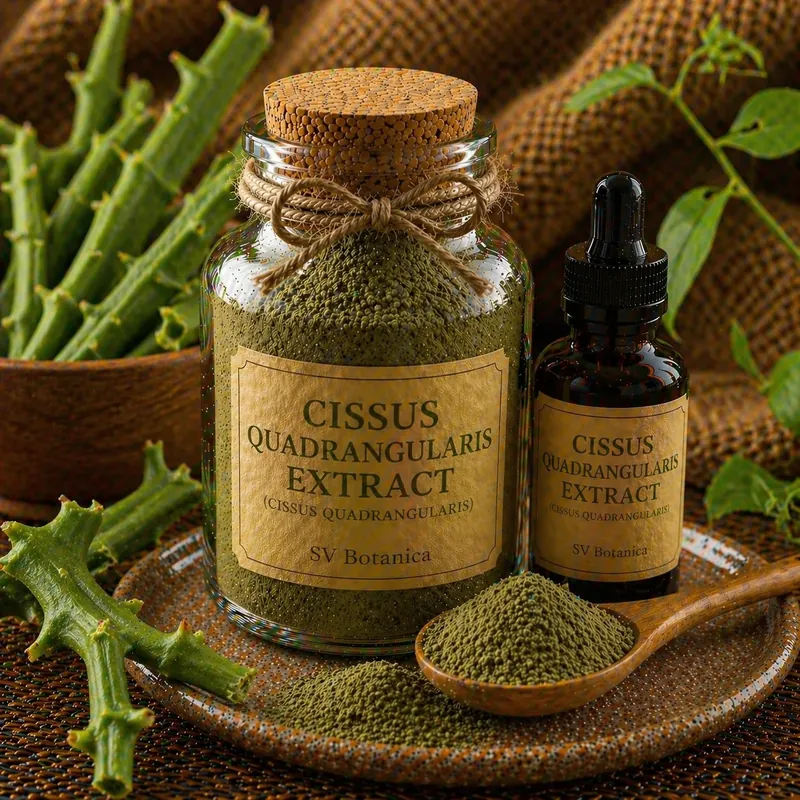
Cissus quadrangularis L. · Family: Vitaceae · Aerial Stem Extract
Ayurveda's asthisamhari — the bone-setter — supplied with the ketosterone assay method declared on every certificate and a flavonoid and phytosterol profile reported alongside it. The trade quotes cissus on a ketosterone percentage that is rarely defined and almost never comparable between suppliers. We state what was measured and how. CoA-backed supply from India.
Method Declared
Ketosterone Assay StatedWhy a ketosterone percentage means less than the market assumes
Cissus quadrangularis — hadjod in Hindi, asthisamhari in Sanskrit, both names meaning roughly "bone joiner" — is a succulent climbing vine of the Vitaceae family, the same family as the grape, native to India, Sri Lanka and parts of Africa and Southeast Asia. Its distinctive quadrangular aerial stem has been used in Ayurveda for bone and joint support for centuries, and it has since become one of the most widely used botanicals in sports and bone-health nutrition.
Commercially, cissus is quoted almost universally on "ketosterones" — 2.5%, 5%, sometimes 10%. It is worth being direct about what that specification is and is not. "Ketosterone" is not a single defined compound with a universally agreed reference standard the way curcumin or piperine is. It denotes a class of ketone-bearing steroidal constituents, and the figures reported against it depend heavily on which analytical method a laboratory runs and what it calibrates against.
The practical consequence is that two suppliers quoting 5% ketosterones may not be quoting the same thing, and a buyer comparing them on that number alone is comparing two numbers rather than two materials. This is not an accusation aimed at the trade; it is a straightforward analytical fact that the trade has been slow to state plainly.
Our approach is to keep the specification the market uses while making it interpretable: we declare the assay method on every certificate, and we report a flavonoid and phytosterol profile by HPLC as a supporting characterisation of the material. We also supply from the aerial stem only, with root and leaf excluded, and offer banned-substance screening for buyers formulating into sports nutrition — a category where the risk profile of an under-specified assay is materially higher.
What is actually in the aerial stem
The ketone-bearing steroidal fraction on which the trade standardises. A class rather than a single defined compound, which is why the assay method has to be stated for the figure to be interpretable.
Quercetin and related flavonoids are well characterised in the aerial stem and are analytically tractable by HPLC, which makes them useful supporting markers where the primary assay is not species-specific.
The plant sterol fraction of the stem, part of the profile reported alongside the primary assay.
Onocer-type triterpenoids reported in the stem, contributing to the characteristic profile.
The stem is genuinely calcium-rich, which is consistent with its classical bone-support positioning and is why total ash runs higher on cissus than on many extracts.
Present in the fresh stem and variably retained through processing depending on the extraction route.
Why formulators specify a method-declared cissus extract
The single most useful thing a cissus certificate can carry. Ketosterone figures move with method; naming ours makes the number interpretable and your quotations comparable.
Asthisamhari — the bone-setter — is among the most specifically documented traditional indications in the Ayurvedic range, and the basis of the ingredient's modern bone and joint use.
Quercetin, flavonoid and phytosterol profiling by HPLC gives a second, analytically tractable handle on the material where the primary assay is class-based.
Cissus sells heavily into sports nutrition, where a steroidal-fraction assay and adulteration incentives meet. Screening is available on request and we recommend it for that channel.
The quadrangular aerial stem is the classical part. Root and leaf differ in composition and are excluded by declaration.
Cissus grows readily and is cultivated across India, so the supply base is genuinely renewable rather than dependent on wild collection of a slow-growing species.
These are functional and physico-chemical properties of the actives; SV Botanica does not make medical or therapeutic claims for this ingredient.
Ketosterone grades, native ratio and water-soluble
| Grade | Standardisation | Form | Best For | Solubility |
|---|---|---|---|---|
| Cissus Extract 2.5% Standard | Ketosterones NLT 2.5% — method declared | Green-brown to brown fine powder, ≥95% through 40 mesh | Bone & joint supplements, capsules & tablets | Partially water-soluble |
| Cissus Extract 5% High-assay | Ketosterones NLT 5% — method declared | Brown fine powder | Sports nutrition, concentrated blends | Partially water-soluble |
| Cissus Extract 10% Concentrated | Ketosterones NLT 10% — method declared | Dark brown fine powder | Low-dose formats, premium positioning | Partially water-soluble |
| Cissus Extract Ratio Full-spectrum | Native 10:1 / 20:1 ratio; profile reported | Green-brown fine powder | Classical hadjod formulations, herbal blends | Grade-dependent |
| Cissus Stem Powder Raw milled | Milled aerial stem — not an extract | Pale green-brown powder | Churna and classical preparations only | Dispersible |
Every grade states the ketosterone assay method on the certificate, because a percentage without a method is not a comparable specification on this ingredient. Where a buyer's existing supplier has quoted a figure without naming a method, we are happy to run a comparison against the method they were using rather than simply asserting that ours is better — that is a more useful conversation than a number-for-number argument. Each grade also carries a flavonoid and phytosterol profile by HPLC as a supporting characterisation and an aerial-stem-only declaration. Milled stem powder is not an extract and is quoted separately. Banned-substance screening is available on request and is recommended for sports-nutrition applications. Native-ratio and water-soluble grades can be quoted against buyer specification and order volume.
Cissus Extract is bought in five forms. The standardised extract is the stocked item; granulated and dispersible grades are produced on request and raw botanical forms are sourced against a confirmed order.
| Form | What it is | Specification basis | Availability |
|---|---|---|---|
| Standardised extract powder | Cissus quadrangularis aerial stem extract, dried and milled | NLT 2.5% ketosterones, method declared | Stocked |
| Granulated (direct-compression) | Extract granulated for tablet lines | Same marker, declared on the granule | On request |
| Water-dispersible / soluble | Extract in a dispersible matrix for beverages, gummies and sachets | Marker declared on the matrix basis; carrier named | On request |
| Whole-herb powder (non-extracted) | Dried Cissus quadrangularis aerial stem, milled to mesh | Botanical identity by TLC; heavy metals and microbial panel | On enquiry, subject to lot; phytosanitary certificate usually required |
| Cut herb (tea-bag cut) | Dried herb, tea-bag cut or cut & sifted | Identity, moisture, foreign matter | On enquiry; for teas and in-house extraction |
A marker percentage without its assay method is not a specification; ask for the method and the plant part on every quotation. Read Cissus Quadrangularis Extract: A Complete Buyer's Guide, The Cissus Ketosterone Assay: What the Number Measures and Why It Moves and Cissus Adulteration: Sterol Spiking, Part Substitution and the Sports-Channel Risk before comparing offers.
Full product specification for Cissus Quadrangularis Aerial Stem Dry Extract 2.5%. Values are specification limits, not batch results; a batch-specific CoA is issued per shipment.
| Parameter | Specification / Limit | Method |
|---|---|---|
| Botanical Source | Cissus quadrangularis L. | — |
| Plant Family | Vitaceae | — |
| Part Used | Aerial stem | — |
| Country of Origin | India | — |
| Appearance | Fine powder | Organoleptic |
| Colour | Green-brown to brown* | Organoleptic |
| Odour | Characteristic | Organoleptic |
| Taste | Characteristic, slightly bitter | Organoleptic |
| Identification | Corresponds to C. quadrangularis reference — positive | By TLC |
| Ketosterones (% w/w, dry basis) | NLT 2.5 — assay method declared on certificate | Method stated |
| Flavonoid / Phytosterol Profile | Corresponds to reference — reported per batch | By HPLC |
| Quercetin | Reported per batch | By HPLC |
| Root / Leaf Material | Absent — aerial-stem declaration provided | Declaration |
| Banned Substances (sports nutrition) | Screening available on request | LC-MS/MS |
| Loss on Drying (at 105°C, % w/w) | NMT 5.0 | IP-2014 |
| pH (1% w/v solution) | 4 – 7 | IP-2014 |
| Bulk Density (g/ml) | NLT 0.35 | IP-2014 |
| Particle Size (#40 mesh, % w/w) | NLT 95 | Sieve |
| Total Ash (% w/w) | NMT 12 | IP-2014 |
| Acid Insoluble Ash (% w/w) | NMT 2 | IP-2014 |
| Residual Solvent (Ethanol, ppm) | NMT 5,000 | By GC |
| Lead (ppm) | NMT 1.0 | ICP-MS |
| Arsenic (ppm) | NMT 1.0 | ICP-MS |
| Cadmium (ppm) | NMT 0.3 | ICP-MS |
| Mercury (ppm) | NMT 0.1 | ICP-MS |
| Pesticide Residues | Complies (EU MRL, on request) | GC-MS / LC-MS/MS |
| Ethylene Oxide (ETO) | Not treated — declaration provided | LC-MS/MS (on request) |
| Aflatoxins B1 / Total (ppb) | NMT 2 / NMT 4 | HPLC-FLD |
| Total Plate Count (cfu/g) | NMT 1,000 | USP <2021> |
| Yeast & Moulds / Fungi (cfu/g) | NMT 100 | USP <2021> |
| Escherichia coli | Absent | USP <2022> |
| Salmonella sp. | Absent | USP <2022> |
| Staphylococcus aureus | Absent | USP <2022> |
| Cultivation | Cultivated (declared per batch) | Declaration |
| Kosher / Halal | Certified (on request) | Certification |
| Shelf Life | 36 months from date of manufacture, in original packed condition | — |
| Storage | Cool, dry place away from light and moisture, in tightly sealed containers | — |
*The product is of herbal origin; slight colour variation may occur due to geographical and seasonal variation in the raw material. The ketosterone line on this specification is only meaningful with its method attached, which is why we state the method rather than the number alone. "Ketosterone" describes a class of ketone-bearing steroidal constituents rather than a single compound with a universally agreed reference standard, so figures generated by different laboratory methods are not interchangeable — a 5% by one method is not necessarily a 5% by another. We therefore report the assay with its method and add a flavonoid and phytosterol profile by HPLC as a second, analytically tractable characterisation of the material. For sports-nutrition buyers we recommend adding banned-substance screening to the specification; the combination of a steroidal-fraction assay and a category where spiking has a commercial incentive is exactly where that control earns its cost. A current Certificate of Analysis and MSDS are issued with every batch.
From cultivated stem to characterised extract — method-declared, profiled, documented
Raw Material & Authentication: The extract is prepared from the aerial stem of cultivated Cissus quadrangularis, identity-confirmed by TLC against reference material and supported by HPLC profiling of the flavonoid and phytosterol fraction. Root and leaf are excluded by declaration. Because the species is cultivated rather than wild-collected across most of our supply base, the identification risk that dominates wild-harvested botanicals is materially lower here — the analytical question on cissus is about what the assay means, not usually about which plant arrived.
Manufacturing & Testing: Cissus Quadrangularis Extract is manufactured at certified facilities in India. Each batch runs a full QC battery — identity by TLC, ketosterone assay by a declared method, flavonoid and phytosterol profile and quercetin by HPLC, loss on drying, pH, bulk density, total and acid-insoluble ash, mesh, residual solvent by GC, heavy metals by ICP-MS, aflatoxins by HPLC-FLD, pesticide residue screening and a complete USP microbiological panel — before release. Banned-substance screening by LC-MS/MS is available on request and is recommended for sports-nutrition supply.
Documentation: Every shipment is supplied against a batch-specific Certificate of Analysis stating the species by binomial, the ketosterone assay with its method named, the supporting HPLC profile and the aerial-stem declaration, together with an MSDS. Halal, Kosher and Organic certification are available — see our guides on EU pesticide MRL compliance and EU import requirements for botanical extracts.
What backs every batch of Cissus extract
Key information for global product registration and labelling
This is the control we would most encourage sports-nutrition buyers to add, and we would rather explain why than simply offer it. Cissus is standardised on a steroidal fraction and sells heavily into a category where products have historically been adulterated with synthetic anabolic agents. Those two facts sit uncomfortably close together: an assay that responds to a class of steroidal compounds, in a market with an incentive to inflate it, is a structure worth controlling explicitly rather than assuming away. We offer banned-substance screening by LC-MS/MS on request, and for any buyer supplying tested athletes or a certified sports channel we recommend it as standard rather than as an option.
Buyers planning EU launch should confirm the novel food position for their specific product before committing. Cissus quadrangularis appears in the EU Novel Food Catalogue, and as with many concentrated botanical extracts the status can differ between a traditional preparation and a modern standardised extract at a given concentration. This is a determination for your regulatory review against your exact specification and intended use rather than something a supplier can settle on your behalf — but it should be settled before formulation rather than after. Our guide to EU import requirements covers the wider framework.
Supplied from India by SV Botanica — FSSAI Central Licence holder and an APEDA-registered exporter. The material is predominantly cultivated, with collection status declared per batch, and is shipped against a batch-specific Certificate of Analysis carrying the assay method declaration and supporting HPLC profile. Export documentation is available on request. This product is not intended to diagnose, treat, cure or prevent any disease.
Deep-dive articles on cissus quadrangularis extract for formulators, buyers, and brand owners
Why two suppliers quoting 5% ketosterones may not be quoting the same thing.
TechnicalWhat the number measures, why the method changes it, and what to ask for instead.
QualitySterol spiking, part substitution, and the sports-nutrition risk profile.
ApplicationsFormats, dosing conventions, and why banned-substance screening belongs in the spec.
QualityReading a cissus certificate when the headline assay is class-based.
SourcingCultivated supply, seasonality, and the EU novel food question.
Other bone, joint and sports actives from our range
Technical and commercial questions answered by our ingredients team
Aerial stem extract with the ketosterone assay method stated on every certificate, a flavonoid and phytosterol profile by HPLC, and banned-substance screening available for sports nutrition. Samples for qualified buyers.
Supplied as a bulk ingredient for further manufacture. Buyers are responsible for compliance with the regulations of their destination market. This product is not intended to diagnose, treat, cure or prevent any disease.
We use cookies for analytics and to measure our advertising. Essential cookies are always on. Privacy policy