
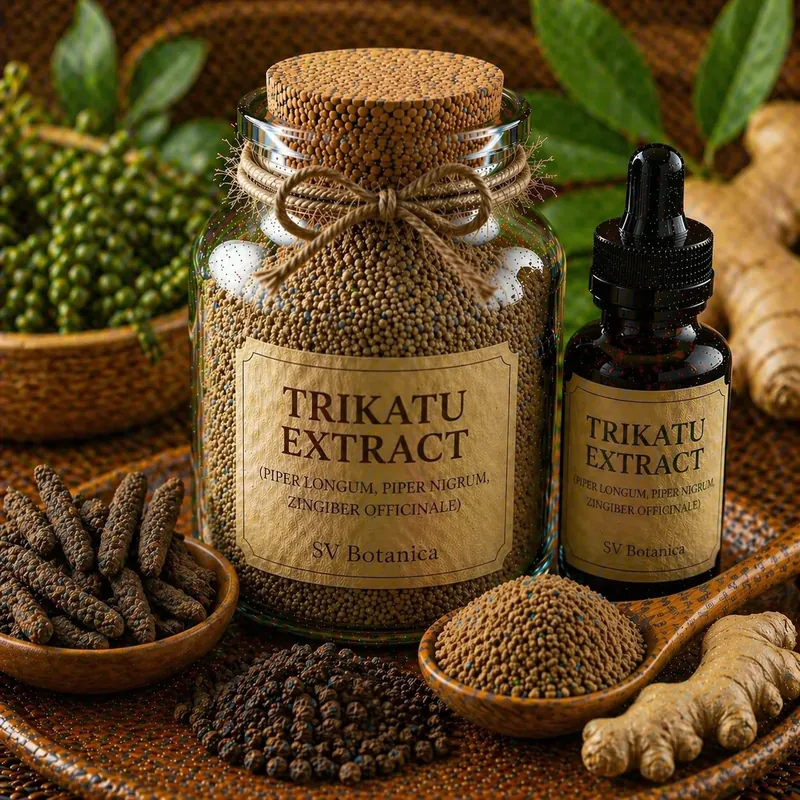
Piper nigrum L. · Zingiber officinale Roscoe · Piper longum L. · 1:1:1 Blend Extract
The classical Ayurvedic three-pungent formulation — black pepper, ginger and long pepper in authentic 1:1:1 proportion — standardised to piperine 5–10% by HPLC. Supplied for digestive-wellness, bioavailability-enhancement, thermogenic and traditional Ayurvedic formulators. CoA-backed, ratio-verified supply from India.
Classical Blend
Piper nigrum · Zingiber · Piper longumAyurveda's principal digestive and bioavailability formulation, standardised as a single documented ingredient
Trikatu — Sanskrit for "three pungents" — is one of the oldest and most cited formulations in classical Ayurvedic literature: equal parts black pepper (Piper nigrum), ginger (Zingiber officinale) and long pepper (Piper longum, pippali). In the traditional system it is the archetypal deepana-pachana combination — the formulation used to kindle agni, the digestive fire — and the classical vehicle for improving the uptake of other herbs. That heritage is precisely why it remains commercially relevant: trikatu is the traditional, whole-formulation ancestor of the modern isolated-piperine bioavailability enhancer.
SV Botanica supplies trikatu as a concentrated extract blend maintaining the authentic 1:1:1 proportion of the three botanicals, standardised to piperine 5–10% by HPLC. Piperine — the pungent alkaloid contributed by both pepper species — is the assay marker; the blend ratio itself is a declared specification, because in trikatu the ratio is the formulation. An extract heavy on cheap black pepper and light on costly long pepper can still pass a piperine assay while being, in classical terms, not trikatu at all.
The extract is finished as a dark brown to brownish-grey fine powder, 40–80 mesh, with the sharp, warming pungency the three botanicals share. Because piperine occurs in both Piper species, we verify each component before blending — species identity, piperine load of each pepper, gingerol content of the ginger — so the finished CoA can stand behind both the assay and the proportion.
We supply Ayurvedic and herbal manufacturers, supplement brands building digestive and thermogenic formats, and formulators using trikatu as a label-friendly traditional bioavailability enhancer, with a batch-specific Certificate of Analysis on every shipment.
The pungent alkaloids and phenolics contributed by the three botanicals
The principal pungent alkaloid, contributed by both Piper nigrum and Piper longum, and the HPLC assay marker for the blend. Widely studied as an inhibitor of first-pass metabolism — the mechanistic basis of trikatu's traditional pairing role.
Piperlongumine (piplartine) and related amides occur in Piper longum but not meaningfully in black pepper — which makes them the analytical fingerprint that proves long pepper is genuinely present in the blend.
6-, 8- and 10-gingerol from the ginger rhizome. Reported per batch on request; a trikatu with no gingerol signal is a trikatu with no ginger in it.
The dehydration product of 6-gingerol, formed on drying and heating. Its level relative to the gingerols is a readout of how gently the ginger fraction was processed.
The longer-chain amides of black pepper that accompany piperine in genuine fruit extract; their natural proportion helps distinguish real pepper extract from piperine-spiked material.
β-caryophyllene and terpenes from the peppers and zingiberene from ginger carry the blend's characteristic sharp aroma and round out the full-spectrum profile.
Why formulators specify a ratio-verified, piperine-standardised trikatu — the functional role of the blend
Piperine is the marker that makes trikatu a defined ingredient rather than a spice mix. A declared piperine percentage by HPLC lets formulators dose the blend on verified active load, batch after batch, instead of trusting an unquantified traditional powder.
In trikatu, the proportion is the product. Long pepper is the expensive component, so cheapened blends drift towards black pepper while still passing a piperine assay. We declare the 1:1:1 ratio on the CoA and verify each botanical before blending.
Piperine's role in supporting the absorption of co-administered actives is one of the most-cited mechanisms in nutraceutical formulation. Trikatu lets a brand occupy that positioning with a recognised traditional formulation rather than an isolated compound.
Trikatu is Ayurveda's archetypal digestive formulation, documented across the classical texts as the combination that kindles agni. That centuries-deep heritage gives digestive-wellness products an authentic traditional story that isolated actives cannot claim.
The three pungents give trikatu a natural home in the thermogenic and metabolic-wellness category, where pungency-driven botanicals anchor pre-workout and weight-management positioning and the piperine assay provides the quantifiable active.
Sourcing trikatu as a single standardised blend replaces three raw-material qualifications with one — one CoA, one identity package, one supplier audit — while the per-component verification behind it is done on our side before blending.
These are functional and physico-chemical properties of the actives; SV Botanica does not make medical or therapeutic claims for this ingredient.
The core specification for the flagship piperine-standardised 1:1:1 blend, plus high-potency, full-spectrum and organic options
| Grade | Standardisation | Form | Best For | Solubility |
|---|---|---|---|---|
| Trikatu Extract 5% Standard | Piperine NLT 5% (HPLC) · 1:1:1 blend | Dark brown to brownish-grey fine powder, 40–80 mesh | Digestive-wellness & Ayurvedic supplements, bioavailability co-formulation, capsules & tablets | Partially water-soluble |
| Trikatu Extract 10% High-potency | Piperine NLT 10% (HPLC) · 1:1:1 blend | Dark brown fine powder | Low-dose formats, softgels, thermogenic & metabolic stacks | Partially water-soluble |
| Trikatu Extract Ratio Full-spectrum | Native full-spectrum 1:1:1 blend, extract ratio declared per batch | Dark brown to brownish-grey fine powder | Classical Ayurvedic formats, churna-style concentrates, traditional blends | Grade-dependent |
| Trikatu Extract Organic Certified organic | Piperine declared per batch · certified organic supply chain | Dark brown to brownish-grey fine powder | Organic-certified supplement & functional-food lines | Partially water-soluble |
The piperine 5% grade is our CoA-backed flagship — an authentic 1:1:1 blend of the three botanicals with piperine standardised by HPLC and identity confirmed by TLC. Higher piperine strengths within the 5–10% range, native full-spectrum grades, certified organic supply, custom mesh and packaging can be quoted against buyer specification and order volume. Every batch is released against a batch-specific Certificate of Analysis stating the blend ratio.
Trikatu Extract is bought in four forms. The standardised extract is the stocked item; granulated and dispersible grades are produced on request and raw botanical forms are sourced against a confirmed order.
| Form | What it is | Specification basis | Availability |
|---|---|---|---|
| Standardised extract powder | The three botanicals extracted and blended 1:1:1 | NLT 5% piperine (HPLC), 1:1:1 black pepper, long pepper and ginger | Stocked |
| Granulated (direct-compression) | Extract granulated for tablet lines | Same marker, declared on the granule | On request |
| Water-dispersible / soluble | Extract in a dispersible matrix for beverages, gummies and sachets | Marker declared on the matrix basis; carrier named | On request |
| Classical churna (powdered blend, non-extracted) | The three botanicals milled and blended 1:1:1, not extracted | Ratio verified by marker HPLC; identity; heavy metals | On enquiry, subject to lot |
A marker percentage without its assay method is not a specification; ask for the method and the plant part on every quotation. Read Trikatu Extract: A Complete Buyer's Guide, Piperine, Gingerols and Ratio Markers: How Trikatu Extract Is Standardised and Trikatu Adulteration: Ratio Fraud and How Authenticity Is Proven before comparing offers.
Full product specification for Trikatu Extract 5%. Values are specification limits, not batch results; a batch-specific CoA is issued per shipment.
| Parameter | Specification / Limit | Method |
|---|---|---|
| Botanical Source | Piper nigrum L. · Zingiber officinale Roscoe · Piper longum L. | — |
| Plant Family | Piperaceae (both peppers) · Zingiberaceae (ginger) | — |
| Parts Used | Fruit (P. nigrum, P. longum) · Rhizome (Z. officinale) | — |
| Blend Ratio | 1:1:1 (equal proportions), declared per batch | Formulation record |
| Country of Origin | India | — |
| Appearance | Fine powder | Organoleptic |
| Colour | Dark brown to brownish-grey* | Organoleptic |
| Odour | Characteristic, sharp pungent aromatic | Organoleptic |
| Taste | Characteristic, pungent | Organoleptic |
| Identification | Corresponds to piperine — positive | By TLC |
| Loss on Drying (at 105°C, % w/w) | NMT 5.0 | IP-2014 |
| pH (1% w/v solution) | 4 – 7 | IP-2014 |
| Bulk Density (g/ml) | NLT 0.35 | IP-2014 |
| Particle Size | 40 – 80 mesh | Sieve |
| Total Ash (% w/w) | NMT 8 | IP-2014 |
| Acid Insoluble Ash (% w/w) | NMT 2 | IP-2014 |
| Piperine (% w/w, dry basis) | NLT 5.0 | By HPLC |
| Total Gingerols (% w/w) | Reported per batch | By HPLC |
| Piperlongumine (long-pepper marker) | Detected — reported on request | By HPLC |
| Residual Solvent (Ethanol, ppm) | NMT 5,000 | By GC |
| Lead (ppm) | NMT 1.0 | ICP-MS |
| Arsenic (ppm) | NMT 1.0 | ICP-MS |
| Cadmium (ppm) | NMT 0.3 | ICP-MS |
| Mercury (ppm) | NMT 0.1 | ICP-MS |
| Pesticide Residues | Complies (EU MRL, on request) | GC-MS / LC-MS/MS |
| Ethylene Oxide (ETO) | Not treated — declaration provided | LC-MS/MS (on request) |
| Aflatoxins B1 / Total (ppb) | NMT 2 / NMT 4 | HPLC-FLD |
| Total Plate Count (cfu/g) | NMT 1,000 | USP <2021> |
| Yeast & Moulds / Fungi (cfu/g) | NMT 100 | USP <2021> |
| Escherichia coli | Absent | USP <2022> |
| Salmonella sp. | Absent | USP <2022> |
| Staphylococcus aureus | Absent | USP <2022> |
| Cultivation | Cultivated | Declaration |
| Kosher / Halal | Certified (on request) | Certification |
| Shelf Life | 24 months from date of manufacture, in original packed condition | — |
| Storage | Cool, dry place away from light and moisture, in tightly sealed containers | — |
*The product is of herbal origin; slight colour variation may occur due to geographical and seasonal variation in the raw materials. Piperine is standardised by HPLC and identity is confirmed by TLC; total gingerols and the piperlongumine long-pepper marker are reported per batch on request as ratio verification. Each botanical is identity-tested before blending. A current Certificate of Analysis and MSDS are issued with every batch. EU pesticide MRL and ethylene oxide reports are available on request.
Three botanicals, one specification — verified before blending, tested after
Raw Material & Authentication: Trikatu's defining risk is the blend itself — long pepper costs a multiple of black pepper, and because both contribute piperine, a skewed blend can pass a piperine assay while betraying the formulation. Each botanical is therefore authenticated separately before blending: species identity by TLC, piperine load of each pepper fraction, and gingerol content of the ginger rhizome. Only verified components are blended, in equal proportion, under a batch formulation record.
Manufacturing & Testing: Trikatu Extract is manufactured at certified facilities in India. Each finished batch runs through a full QC battery — piperine by HPLC, total gingerols reported per batch, loss on drying, pH, bulk density, ash and acid-insoluble ash, mesh, residual solvent by GC, heavy metals by ICP-MS, aflatoxins by HPLC-FLD, pesticide residue screening, and a complete USP microbiological panel — before release.
Documentation: Every shipment is supplied against a batch-specific Certificate of Analysis stating the 1:1:1 blend ratio, with an MSDS. Halal, Kosher and Organic certification are available. Country of Origin and export documentation are provided on request. Because dried spice-derived materials are a recognised ethylene-oxide risk category, we supply a non-ETO declaration and can add LC-MS/MS testing — see our guides on EU pesticide MRL compliance and EU import requirements for botanical extracts.
What backs every batch of Trikatu extract
Key information for global product registration and labelling
Used as a botanical active in supplement and functional-food formats, the blend is supplied to a defined piperine specification with the ratio declared and full analytical documentation. Black pepper and ginger have essentially universal food histories; long pepper's position varies by market, and buyers formulating concentrated preparations for the EU should confirm the Novel Food status of their finished format. Buyers remain responsible for determining suitability and for compliance with the relevant food-supplement regulations in their market. This product is not intended to diagnose, treat, cure or prevent any disease.
Trikatu is a named classical formulation documented in the Ayurvedic pharmacopoeial literature, which gives manufacturers of traditional-medicine products a recognised formulation identity to work from. We supply the extract blend as a bulk ingredient to the declared ratio and piperine specification; classification of the finished product — supplement, traditional medicine or food — remains the manufacturer's determination in their jurisdiction.
Supplied from India by SV Botanica — FSSAI Central Licence holder and an APEDA-registered exporter. India is the historic home of all three botanicals and the principal global source of long pepper, giving direct access to the raw-material base for the authentic blend. The material is shipped against a batch-specific Certificate of Analysis with export documentation available on request.
Deep-dive articles on trikatu extract for formulators, buyers, and brand owners
How to specify a genuine 1:1:1 blend, what a CoA must show, and why the ratio — not the assay — is the real specification.
TechnicalWhy piperine alone cannot verify trikatu, and the marker set — gingerols, piperlongumine — that proves the blend.
QualityRatio fraud is trikatu's defining adulteration: how cheapened blends are made, and the testing that exposes them.
ApplicationsDigestive, bioavailability-enhancer and thermogenic formats — and how to dose a blend on its piperine load.
ProcurementA scored checklist for qualifying a trikatu supplier — weighted for the blend-integrity risks unique to this material.
MarketWhere trikatu demand is growing as Ayurvedic formulation globalises, and which segments drive it.
Frequently co-formulated with Trikatu Extract in digestive, bioavailability & traditional blends
Technical and commercial questions answered by our ingredients team
Ratio-verified 1:1:1 blend of black pepper, ginger and long pepper, standardised to piperine 5–10% by HPLC. Lab-tested, fully documented. Samples available for qualified buyers.
Supplied as a bulk ingredient for further manufacture. Buyers are responsible for compliance with the regulations of their destination market. This product is not intended to diagnose, treat, cure or prevent any disease.
We use cookies for analytics and to measure our advertising. Essential cookies are always on. Privacy policy