
Picrorhiza kurroa Royle ex Benth. · Family: Plantaginaceae · Rhizome Extract
Ayurveda's principal hepatic bitter, supplied with picroside I + II at 5–10% by HPLC and the assay basis stated on the certificate. Before the price, one thing has to be settled: Picrorhiza kurrooa is on CITES Appendix II, and since the 2007 annotation change the listing covers all parts and derivatives except seeds, pollen and finished retail packs. A bulk extract is not exempt.
CITES Appendix II
Permit Per Shipment · Basis DeclaredA permit question before a price question, and an assay basis before a percentage
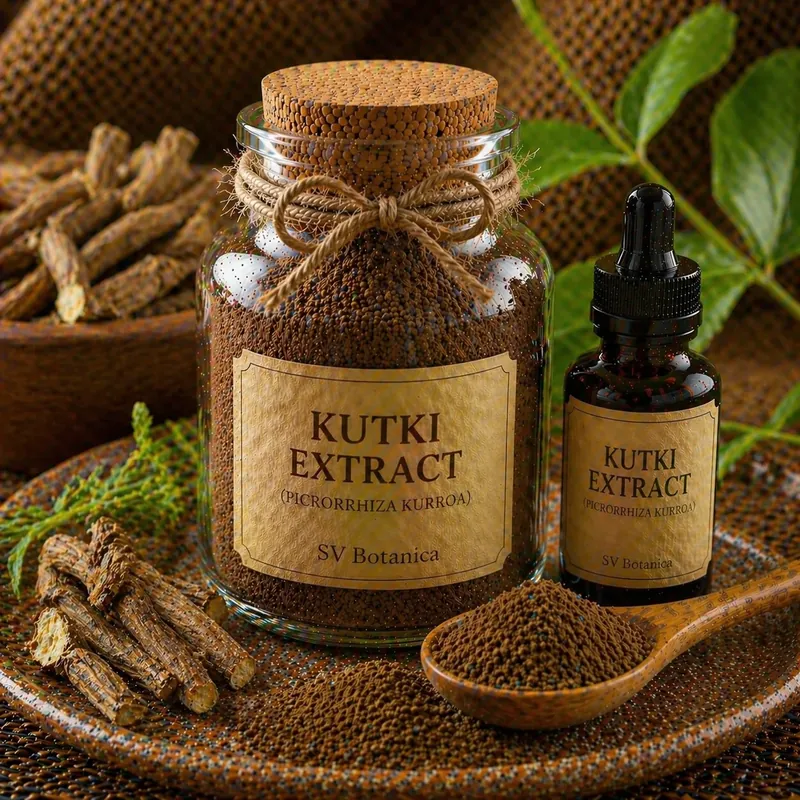
Kutki, also called katuki, is the classical hepatic bitter of Ayurveda: a slow-growing alpine herb of the Himalaya whose rhizome concentrates iridoid glycosides, principally picroside I and picroside II.
The first thing a buyer needs from this material is not a specification — it is a permit. Picrorhiza kurrooa was listed on CITES Appendix II in 1997, at CoP10 in Harare, at the request of the Government of India itself, because wild collection was stripping the species. The original annotation covered only whole and sliced roots and expressly excluded “manufactured parts or derivatives such as powders, pills, extracts, tonics, teas and confectionery”. Under that wording an extract travelled without CITES paperwork, and a great many trade datasheets still quote it.
That annotation was replaced at CoP14 in 2007. The current one designates all parts and derivatives except a) seeds and pollen and b) finished products packaged and ready for retail trade. A bulk extract is a derivative and is not a finished retail pack, so it is covered: a CITES export permit is required per consignment from India, and an import permit in the European Union, where Appendix II species sit in Annex B of Regulation (EC) 338/97.
The second thing is the assay basis. This material trades on two different ones: the sum of picroside I + picroside II, two compounds quantified by HPLC, and kutkin, a term that names a mixture rather than a molecule. They are not the same number on the same material and the conversion is not direct. We state which basis a batch was assayed on.
Grades run from the commercial 5–10% picroside specification through a kutkin-standardised grade, a full-spectrum grade, and water-soluble and organic grades to buyer specification. Tell us your destination country when you ask for a quotation, because on this product the destination drives the lead time.
What is measured in this extract, and on which basis
An iridoid glycoside and the primary marker of P. kurroa rhizome, quantified by HPLC and reported as part of the declared sum.
The second reference iridoid. Picroside I and II together form the assay basis of our commercial grade, and both are reported individually on the certificate.
A term that designates a mixture of iridoids rather than a single molecule. It is a legitimate alternative assay basis and it is not interchangeable with the picroside I+II sum — the certificate says which was used.
The complete iridoid fraction of the rhizome, which is what the full-spectrum grade preserves rather than standardising to a marker.
Minor phenolic constituents described in the rhizome, part of the full-spectrum profile.
A bitter triterpenoid fraction characteristic of the genus and part of the material's organoleptic signature.
A listed species and a two-basis assay make documentation the deciding factor
Picrorhiza kurrooa is an Appendix II species and the 2007 annotation covers derivatives. The export permit is applied for per consignment and the requirement is stated up front, not discovered at the border.
Picroside I + II, or kutkin. Two bases, two different numbers on the same material. Ours says which, so a comparison between suppliers is a real comparison.
The method that suits these glycosides, with picroside I and picroside II reported separately as well as summed.
Kutki is the reference hepatic botanical of the Ayurvedic materia medica, with a long documented record of traditional use behind its positioning.
Cultivated or collected, stated per batch. On a slow-growing alpine species that entered CITES because of collection pressure, that line belongs on the certificate.
Both are produced against a confirmed order rather than held as stock, with the availability and lead time confirmed before quotation.
These are functional and physico-chemical properties of the actives; SV Botanica does not make medical or therapeutic claims for this ingredient.
Five grades, and on every one the basis of the figure is declared
| Grade | Standardisation | Form | Best For | Solubility |
|---|---|---|---|---|
| Picroside I + II 5–10% Commercial specification | Picroside I + II 5–10% by HPLC; basis declared | Light brown to pale yellow fine powder, 40–80 mesh | Liver-support supplements, Ayurvedic formats, capsules & tablets | Partially water-soluble |
| Kutkin Standardised Alternative basis | Standardised on the kutkin fraction; basis declared | Light brown fine powder | Formulations written to the traditional specification | Partially water-soluble |
| Full-Spectrum Extract Whole-rhizome profile | Complete rhizome profile, not standardised to a marker | Light brown fine powder | Traditional preparations and full-spectrum formats | Partially water-soluble |
| Water-Soluble Grade To buyer specification | Per the buyer's specification; produced to order | Free-flowing powder | Beverages, sachets and liquid formats | Water-soluble |
| Organic Grade To buyer specification | Certified organic supply chain, subject to availability | Light brown fine powder | Certified organic product lines | Per specification |
Two things save time on this product. Fix the assay basis in writing before comparing prices — a kutkin figure and a picroside I+II sum describe the same rhizome with different numbers, and neither supplier is wrong. And remember that the lead time depends on the destination, because every shipment needs a CITES export permit from India and an import permit in the buyer's country. Tell us the destination and we will quote a schedule that includes both.
Kutki is bought in four forms. The standardised extract is the reference item; granulated and dispersible grades are produced to order and the unextracted rhizome is sourced against a confirmed order. CITES requirements apply to every one of them.
| Form | What it is | Specification basis | Availability |
|---|---|---|---|
| Standardised extract powder | Picrorhiza kurroa rhizome extract, dried and milled | Picroside I + II 5–10% by HPLC, basis declared | To order; subject to CITES permit per shipment |
| Granulated (direct-compression) | Extract granulated for tablet lines | Same marker and same basis, declared on the granule | On request; subject to CITES |
| Water-dispersible / soluble | Extract in a dispersible matrix for beverages and sachets | Marker declared on the matrix basis; carrier named | On request; subject to CITES |
| Rhizome powder (non-extracted) | Dried Picrorhiza kurroa rhizome, milled to mesh | Botanical identity by TLC; heavy metals and microbial panel | On enquiry, subject to lot; CITES permit and phytosanitary certificate |
A marker percentage without its method is not a specification, and without its basis it is not one either. On kutki there is a second condition: without the CITES permit the consignment neither leaves nor lands.
Full specification for the commercial grade. Values are specification limits, not a particular batch result; every shipment carries its own certificate of analysis
| Parameter | Specification / Limit | Method |
|---|---|---|
| Botanical Source | Picrorhiza kurroa Royle ex Benth. | — |
| Plant Family | Plantaginaceae | — |
| Part Used | Rhizome | — |
| Country of Origin | India | — |
| Appearance | Fine powder | Organoleptic |
| Colour | Light brown to pale yellow* | Organoleptic |
| Odour | Characteristic | Organoleptic |
| Taste | Characteristic, strongly bitter | Organoleptic |
| Identification | Conforms to P. kurroa reference — positive | TLC |
| Picroside I + II (% w/w) | 5 – 10; basis declared on the certificate | HPLC |
| Picroside I (% w/w) | Reported per batch | HPLC |
| Picroside II (% w/w) | Reported per batch | HPLC |
| Assay basis | Picroside I + II sum, or kutkin — stated per batch | Declaration |
| CITES status | Appendix II; export permit per shipment, EU import permit required | Documentary |
| Mode of obtention | Cultivated or collected — declared per batch | Declaration |
| Loss on Drying (105°C, % w/w) | NMT 5.0 | IP-2014 |
| pH (1% w/v solution) | 4 – 7 | IP-2014 |
| Bulk Density (g/ml) | NLT 0.35 | IP-2014 |
| Particle Size | 40 – 80 mesh | Sieve |
| Total Ash (% w/w) | NMT 10 | IP-2014 |
| Acid-Insoluble Ash (% w/w) | NMT 2 | IP-2014 |
| Residual Solvent (ethanol, ppm) | NMT 5,000 | GC |
| Lead (ppm) | NMT 1.0 | ICP-MS |
| Arsenic (ppm) | NMT 1.0 | ICP-MS |
| Cadmium (ppm) | NMT 0.3 | ICP-MS |
| Mercury (ppm) | NMT 0.1 | ICP-MS |
| Pesticide Residues | Complies (EU MRL, on request) | GC-MS / LC-MS/MS |
| Ethylene Oxide (ETO) | Not treated with ETO — declaration provided | LC-MS/MS (on request) |
| Aflatoxins B1 / total (ppb) | NMT 2 / NMT 4 | HPLC-FLD |
| Total Plate Count (cfu/g) | NMT 10,000 | USP <2021> |
| Yeast & Mould (cfu/g) | NMT 100 | USP <2021> |
| Escherichia coli | Absent | USP <2022> |
| Salmonella sp. | Absent | USP <2022> |
| Staphylococcus aureus | Absent | USP <2022> |
| Kosher / Halal | Certified (on request) | Certification |
| Shelf Life | 24–36 months from manufacture, in unopened original packing | — |
*Plant-derived product; colour may vary slightly by region and season. Three lines decide a kutki purchase. The assay basis: a kutkin figure names a mixture and a picroside I + II figure is the sum of two HPLC-quantified compounds, so the two are not interchangeable and the certificate says which was used. The CITES status: Picrorhiza kurrooa has been on Appendix II since 1997 and the annotation adopted at CoP14 in 2007 covers all parts and derivatives except seeds, pollen and finished retail packs, so a bulk extract requires an export permit per consignment and, in the EU, an import permit under Annex B of Regulation (EC) 338/97. And the mode of obtention, declared per batch, which matters on a slow-growing alpine species that entered CITES because of collection pressure. Current CoA and MSDS accompany every batch.
From an alpine rhizome to a documented extract, with the permit settled before shipment
Raw material and identity: the extract is prepared from the rhizome of Picrorhiza kurroa, with botanical identity confirmed per batch and the mode of obtention declared — cultivated or collected — on a species that entered CITES precisely because of pressure from wild collection.
Assay with the basis in view: picroside I and picroside II are quantified by HPLC, reported individually and as the declared sum, and the certificate states whether the figure is that sum or the kutkin fraction, which names a mixture rather than a molecule.
CITES documentation: because the species is on Appendix II and the annotation in force covers derivatives, every shipment is prepared with the corresponding export permit, applied for per consignment; the buyer must obtain the import permit in the destination country, which in the European Union follows Annex B of Regulation (EC) 338/97. This affects the schedule and we say so when quoting rather than afterwards.
Manufacturing, control and documentation: the extract is manufactured at GMP- and ISO-certified facilities in India. Every batch runs a full panel — picrosides by HPLC, moisture, pH, bulk density, sieve, ash, residual solvent by GC, heavy metals by ICP-MS, aflatoxins and the USP microbial panel — with EU MRL pesticide screening and a not-treated-with-ETO declaration on request. Each shipment carries its certificate of analysis and MSDS; certifications and export documentation are provided on request via our certifications page.
What backs every batch of Kutki extract
Key information for global product registration and labelling
This is the point to settle before price, and the one most often reported incorrectly. Picrorhiza kurrooa was included in CITES Appendix II in 1997 at CoP10 in Harare, at the request of the Government of India, because of overexploitation of the wild species. The original annotation designated “whole and sliced roots and parts of roots, excluding manufactured parts or derivatives such as powders, pills, extracts, tonics, teas and confectionery” — and under that wording an extract fell outside the listing. A great many trade datasheets still quote that version. It was replaced at CoP14 in 2007 by an annotation designating all parts and derivatives except a) seeds and pollen and b) finished products packaged and ready for retail trade. The practical consequence is unambiguous: a bulk extract is a derivative and is covered. It needs a CITES export permit from India, applied for per consignment, and in the European Union an import permit in the importer's name, because Appendix II species are listed in Annex B of Council Regulation (EC) 338/97. The only thing genuinely exempt is retail-packed finished product, which is not what a B2B buyer is purchasing.
Three concrete things. First, the lead time depends on the destination: beyond production and transit you must allow for the issue of the export permit and for the import permit in your own country, which you obtain and we do not. Second, start the import permit in parallel with order confirmation, not on receipt of the shipping advice. Third, a supplier offering bulk kutki without mentioning CITES is either working from the pre-2007 annotation or not applying it, and the risk of detention at the border sits with the importer under every Incoterm. Tell us the destination country when you ask for a quotation and the schedule we give you will include both permit windows.
Confirm the status of the specific Picrorhiza kurroa preparation for your market before notifying, including the novel food assessment in the European Union, since its food use in the EU is not established. There are no authorised health claims in the EU for this ingredient, and claims relating to liver function are among the most closely policed because of their proximity to medicinal territory, so kutki's traditional hepatic positioning cannot be carried onto a label in those terms. The buyer is responsible for assessing suitability and compliance in their market. This product is not intended to diagnose, treat, cure or prevent any disease.
Ingredients commonly formulated alongside kutki extract
Technical and commercial questions answered by our ingredients team
Picroside I + II at 5–10% by HPLC with the assay basis declared, and the CITES paperwork handled per shipment. Tell us the destination country and we will quote a realistic schedule.
Supplied as a bulk ingredient for further manufacture. Buyers are responsible for compliance with the regulations of their destination market. This product is not intended to diagnose, treat, cure or prevent any disease.
We use cookies for analytics and to measure our advertising. Essential cookies are always on. Privacy policy