
Curcuma longa · Family: Zingiberaceae · Rhizome Essential Oil
A golden turmeric essential oil standardised to total turmerones NLT 50% by GC — the sesquiterpene ketones that define the volatile fraction of Curcuma longa rhizome. A yellow mobile liquid with the warm, earthy-woody character of fresh turmeric, released against a full heavy-metal, residual-solvent and microbiological panel. CoA-backed supply from India for cosmetic, nutraceutical, aromatherapy and flavour formulators.
Standardised Grade
Curcuma longa · ≥50% TurmeronesThe golden rhizome's volatile fraction, standardised on the compounds that define it
Turmeric (Curcuma longa) is best known for curcumin — the golden pigment of the world's most studied spice. But the rhizome carries a second, entirely distinct chemistry: a volatile essential-oil fraction dominated by the turmerones, sesquiterpene ketones found in commercial quantity nowhere else in the plant kingdom. Where curcumin is a colour and a polyphenol, the turmerones are the aroma and the oil — warm, earthy, softly woody-spicy.
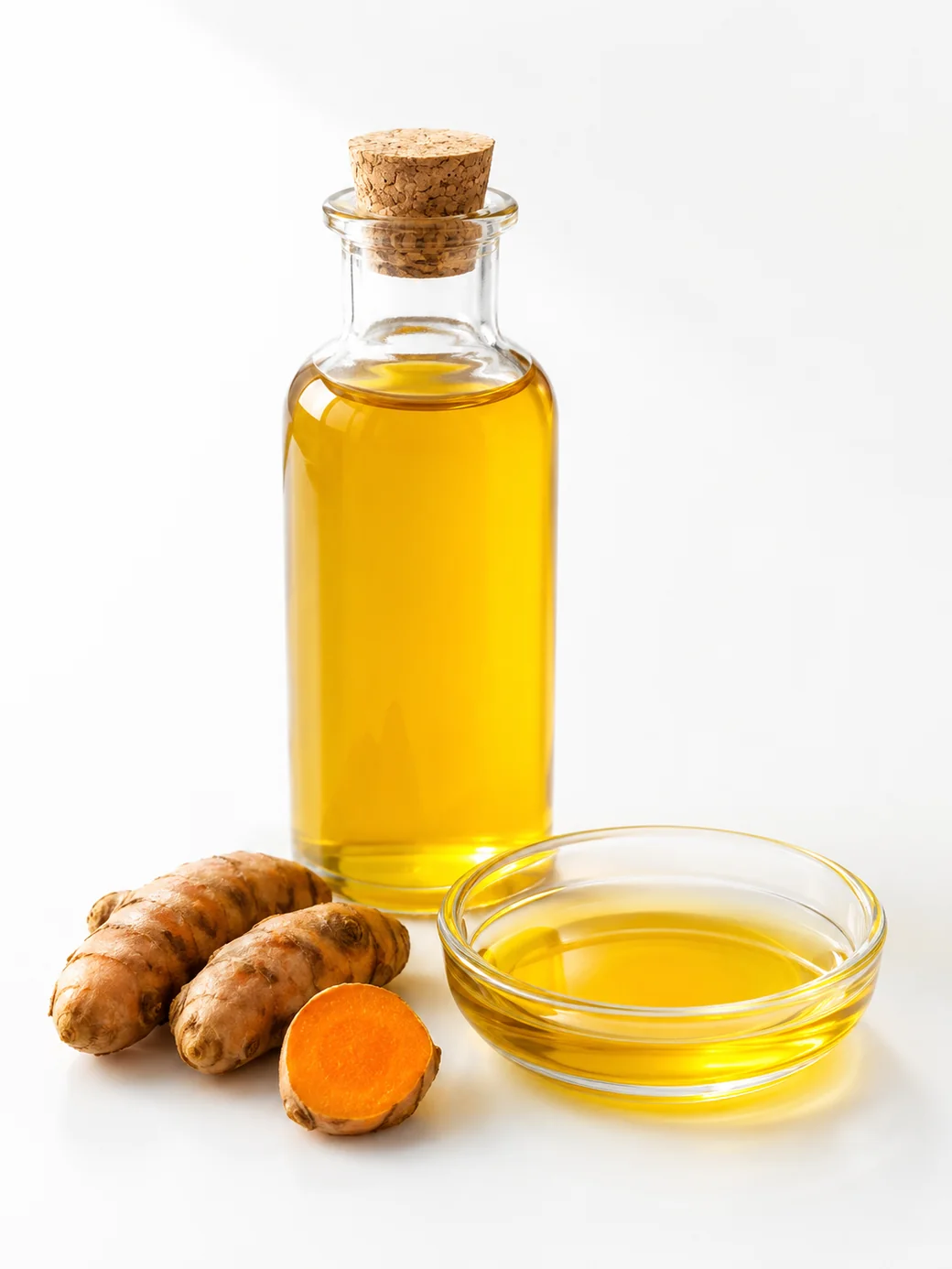
Turmeric Oil is that fraction isolated: a yellow mobile liquid distilled from the rhizome, which SV Botanica supplies standardised to total turmerones of not less than 50% by GC — the sum of ar-turmerone, α-turmerone and β-turmerone. Standardising on the turmerones does for this oil what a curcumin percentage does for the extract: it turns "turmeric oil" from a description into a measurable specification, verified on every batch chromatogram.
Quality control goes well beyond the assay. Each batch is released against Karl Fischer moisture (NMT 1.0%), refractive index and specific gravity windows, a full ICP-MS heavy-metal panel (lead, arsenic, cadmium, mercury), residual solvents per USP <467>, and a complete USP microbiological panel. The oil is non-irradiated, not treated with ethylene oxide, non-GMO, BSE/TSE-free and allergen-free per EU Regulation 1169/2011 — documentation that matters in exactly the regulated markets where turmeric ingredients are under the most scrutiny.
We supply cosmetic and personal-care manufacturers, nutraceutical formulators — including those pairing the oil with curcumin in bioavailability-oriented formats — aromatherapy brands and flavour houses, with a batch-specific Certificate of Analysis on every shipment.
The sesquiterpene ketones and companions that define turmeric's volatile fraction
The signature aromatic turmerone and typically the dominant single constituent — the compound most associated with turmeric oil's identity and its research profile.
One of the two major alicyclic turmerones summed into the total turmerones assay alongside ar-turmerone.
The third member of the turmerone trio; its proportion relative to the α- and ar- forms is a useful fingerprint of genuine C. longa rhizome oil.
Zingiberaceae-family sesquiterpenes shared with ginger that round out the oil's warm, rooty body.
Minor oxygenated sesquiterpenes whose consistent presence in natural proportion distinguishes distilled rhizome oil from reconstructed blends.
The lighter, fresher top of the profile — present in modest amounts that lift the opening of the aroma.
Why formulators specify a turmerone-standardised oil — the functional role of the markers
A declared minimum of 50% total turmerones by GC turns the oil into a defined active input — formulators dose a verified sesquiterpene-ketone load, not a golden-coloured unknown that varies lot to lot.
Curcuma longa oil is an established cosmetic ingredient for skin- and scalp-care positioning. Unlike curcumin-rich extracts, the oil delivers turmeric identity with far less of the staining that complicates golden formulations.
Turmeric essential oil is the classic co-formulation partner in bioavailability-oriented curcumin formats, where curcuminoids are recombined with the rhizome's native volatile fraction — one supplier, both halves of the rhizome.
The turmerones give a soft, warm, woody-earthy profile used in aromatherapy blends, spa formats and contemporary fragrance accords seeking a rooted, golden character.
ICP-MS heavy metals, USP <467> residual solvents, full microbiological panel, non-ETO and non-irradiation declarations, allergen-free per EU 1169/2011 — the dossier regulated buyers actually get audited on.
A low-viscosity yellow liquid that blends directly into oil phases, fragrance concentrates, softgel fills and carrier dilutions — no melting or pre-dispersion step.
These are functional and physico-chemical properties of the actives; SV Botanica does not make medical or therapeutic claims for this ingredient.
The turmerone-standardised oil and its sister formats from the same rhizome
| Grade | Standardisation | Form | Best For | Solubility |
|---|---|---|---|---|
| Turmeric Oil ≥50% Essential Oil | Total turmerones NLT 50% (GC) | Yellow mobile liquid, characteristic odour | Cosmetics, curcumin co-formulation, aromatherapy, premium flavour | Oil-soluble / insoluble in water |
| Turmeric Extract 95% Curcuminoids | Total curcuminoids NLT 95% (HPLC) | Orange-yellow crystalline powder | Nutraceutical curcumin formats, tablets, capsules | Practically insoluble in water |
| Turmeric Oleoresin Oleoresin | Curcumin content and volatile oil declared per batch | Deep orange-red viscous liquid | Food colour & flavour, seasoning and processing systems | Oil-dispersible |
This page specifies the turmerone-standardised essential oil. The 95% curcuminoids extract and the oleoresin are separate SV Botanica products with their own specifications — see Related Products below. Custom pack sizes and buyer-specific documentation can be quoted against order volume; every batch is released against a batch-specific Certificate of Analysis.
Full product specification for Turmeric Oil (Total Turmerones 50%). Values are specification limits, not batch results; a batch-specific CoA is issued per shipment.
| Parameter | Specification / Limit | Method |
|---|---|---|
| Botanical Source | Curcuma longa | — |
| Plant Family | Zingiberaceae | — |
| Part Used | Rhizome | — |
| Preparation | Essential oil | — |
| Country of Origin | India | — |
| Appearance | Yellow liquid with characteristic odour* | Organoleptic |
| Identification | To conform with reference standard | By GC |
| Total Turmerones (% w/w) | NLT 50.0 | By GC |
| Moisture Content (Karl Fischer, % w/w) | NMT 1.0 | USP <921> |
| Refractive Index | 1.40 – 1.70 | In-house |
| Specific Gravity | 0.92 – 0.97 | In-house |
| Total Heavy Metals (ppm) | NMT 10.0 | USP <233> / ICP-MS |
| Lead (ppm) | NMT 3.0 | USP <233> / ICP-MS |
| Arsenic (ppm) | NMT 1.0 | USP <233> / ICP-MS |
| Cadmium (ppm) | NMT 1.0 | USP <233> / ICP-MS |
| Mercury (ppm) | NMT 0.1 | USP <233> / ICP-MS |
| Residual Solvents | Complies as per USP | USP <467> |
| Total Viable Aerobic Count (cfu/g) | NMT 1,000 | USP <61> |
| Yeast & Mould (cfu/g) | NMT 100 | USP <61> |
| Escherichia coli | Negative / g | USP <62> |
| Salmonella sp. | Negative / 10 g | USP <62> |
| Coliforms | Negative / g | USP <62> |
| Pseudomonas aeruginosa | Negative / g | USP <62> |
| Staphylococcus aureus | Negative / g | USP <62> |
| Irradiation Status | Non-irradiated | Declaration |
| Ethylene Oxide (ETO) | Not treated with ETO | Declaration |
| GMO Status | Non-GMO | Declaration |
| BSE/TSE Status | BSE/TSE-free | Declaration |
| Allergen Status | Free from allergens (Reg. EU No. 1169/2011) | Declaration |
| Shelf Life | 24 months from date of manufacture, in original packed condition | — |
| Storage | Store at room temperature in an air-tight container, protected from moisture and direct sunlight | — |
*The product is of natural origin; slight variation in colour may occur due to geographical and seasonal variation in the raw material. Total turmerones are standardised by GC against reference standard. A current Certificate of Analysis and MSDS are issued with every batch; non-ETO, non-irradiation, GMO-free and allergen declarations are provided as standard.
From golden rhizome to standardised oil — assayed, screened, documented
Raw Material & Distillation: The oil is distilled from the rhizome of Curcuma longa grown in India — the world's dominant turmeric producer. The volatile fraction crosses over; the non-volatile curcuminoids stay behind, which is why a genuine turmeric essential oil is golden-yellow rather than the deep orange of curcumin, and why it carries turmeric's aroma with far less staining intensity.
Testing & Release: Every batch is assayed for total turmerones by GC against reference standard (NLT 50%), with identification by GC, Karl Fischer moisture (NMT 1.0%), refractive index (1.40–1.70) and specific gravity (0.92–0.97). Safety screening covers the four heavy metals by ICP-MS per USP <233>, residual solvents per USP <467>, and a seven-organism USP microbiological panel including Salmonella, E. coli and Pseudomonas aeruginosa.
Documentation: Every shipment is supplied against a batch-specific Certificate of Analysis with an MSDS, plus non-irradiation, non-ETO, non-GMO, BSE/TSE-free and allergen-free (EU 1169/2011) declarations as standard. Because turmeric-derived ingredients face elevated EU scrutiny on ETO and contaminants, this dossier is built for regulated-market entry — see our guides on buying turmeric oil and turmeric oil authenticity.
What backs every batch of Turmeric essential oil
Key information for global product registration and labelling
Curcuma longa (turmeric) root oil is an established cosmetic ingredient with a recognised INCI listing, used in skin-care, hair-care and fragrance formats. As an essential oil it should be used diluted and within the buyer's finished-product safety assessment; SV Botanica supplies the specification, CoA and MSDS to support that dossier.
Turmeric has deep, long-standing food use across essentially every market, and the essential oil is used both as a flavouring and as a co-formulation partner in curcumin-based supplement formats. Buyers remain responsible for the regulatory basis of their finished format in their own market — including flavouring, supplement and novel-food frameworks where applicable. This product is not intended to diagnose, treat, cure or prevent any disease.
Supplied from India by SV Botanica — FSSAI Central Licence holder and an APEDA-registered exporter. India grows the large majority of the world's turmeric, giving direct access to rhizome at origin. Every batch ships with a Certificate of Analysis, MSDS and the full declaration set (non-ETO, non-irradiated, non-GMO, allergen-free), with further export documentation available on request.
Deep-dive articles on turmeric oil for formulators, buyers, and brand owners
How to specify turmerone-standardised oil, what the CoA must show, and the traps in the golden-rhizome trade.
Technicalar-, α- and β-turmerone, what "total turmerones by GC" actually sums, and why the assay matters.
QualityDilution, reconstruction and off-species Curcuma — and the GC and physical tests that expose them.
ApplicationsSkin and scalp formats, curcumin co-formulation, aromatherapy and flavour — and how to dose each.
ProcurementA scored checklist for qualifying a turmeric oil supplier before you place a bulk order.
Format GuideTurmerones, curcuminoids or both — which turmeric format fits your product, and how to buy each.
Frequently co-formulated with Turmeric Oil across cosmetic & nutraceutical programmes
Technical and commercial questions answered by our ingredients team
Turmerone-standardised, ICP-MS screened, fully documented supply of Curcuma longa rhizome essential oil. Total turmerones NLT 50% by GC. Samples available for qualified buyers.
Supplied as a bulk ingredient for further manufacture. Buyers are responsible for compliance with the regulations of their destination market. This product is not intended to diagnose, treat, cure or prevent any disease.
We use cookies for analytics and to measure our advertising. Essential cookies are always on. Privacy policy